
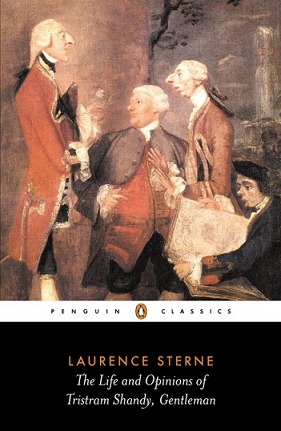
 If you type ‘Tristram Shandy’ into the search field on WordPress’s “Reader” pages, you will be presented with a large number of results. Look more closely, and it turns out that for every review of Sterne’s ridiculous, extravagant, often nonsensical novel, there is another post lamenting its unreadability. I sympathise. ‘Tristram Shandy’ was published over the course of eight years (1759-1767), so reading it now over the course of a week is a very different experience. It is a pointedly experimental novel: if ‘Tristram Shandy’ was a radio programme, it would be The Goons; if it was a television show it would be The Mighty Boosh; if it was a painting it would be something by Dali or Magritte (whether these comparisons are compliments or criticisms is of course a matter of personal taste). Continue reading
Category Archives: 18th century literature
Tom Jones, by Henry Fielding, 1749
The novel was still very much in its infancy as a form when Henry Fielding wrote ‘Tom Jones‘. In this long and elaborate narrative, you can see Fielding working out some of the conventions and traditions that were still to be established. Fielding is a dominant and forceful presence throughout the novel, in contrast to Richardson’s ‘Clarissa‘, published a year earlier, where the narrator tries very hard (but ultimately unsuccessfully), to disappear into the background. Each of the eighteen books which make up the novel are introduced by a chapter where Field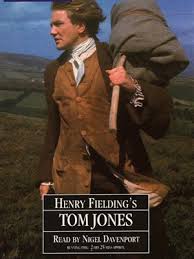 ing discourses on anything that happens to take his interest, invariably little to do with the novel itself. During the substantive chapters the narrator constantly intrudes, usually tongue in cheek, commenting on the reader’s expectations, anticipating objections, warning of salacious or shocking content coming up, and generally commenting on the novel as it develops:
“We would bestow some pains here in minutely describing all the mad pranks which Jones played on this occasion could we be well assured that the reader would take the same pains in perusing them, but as we are apprehensive that after all the labour which we should employ in painting this scene the said reader would be very apt to skip it entirely over, we have saved ourself that trouble. To say the truth, we have from this reason alone often done great violence to the luxuriance of our genius, and have left many excellent descriptions out of our work which would otherwise have been in it.”
The narrative style is discursive – Fielding is telling a relaxed tale over a few drinks, and fully intends to take his time:
“Reader, I think proper, before we proceed any further together, to acquaint thee that I intend to digress, through this whole history, as often as I see occasion, of which I am myself a better judge than any pitiful critic whatever.”
The pretence is maintained that this is a ‘history’ – indeed, the novel’s full title is ‘The History of Tom Jones, a foundling’ – but the reader is at no point under any apprehension but that all will end up well for Tom and his amour, Sophia.
The novel’s plot is said to be complex, but rambling would be a fairer description. Fielding is a fan of that standby coincidence to help resolve the plot complications he leads himself into. The novel opens with Squire Allworthy finding an abandoned baby sleeping in his bed. The baby’s presence in his bed – as opposed to in a cardboard box on the doorstep – sends a clear message that the mother is a member of his household, with easy access to his room, but Squire Allworthy is true to his name, and doesn’t pursue the issue with any interest, and accepts the presented fiction that the child is the son of a local village woman. Allworthy promises his sister Dorothy, who we (spoilers) eventually find out to be the boy’s mother, to raise the boy, and names him Tom. Dorothy goes on to marry and have a legitimate son, Master Blifil, who is brought up with Tom.
Years pass, and Tom grows into a promiscuous young man. He impregnates the local gamekeeper’s daughter, or thinks he does, although it later turns out the child is not his – fatherhood is an uncertain business in this novel. Tom then falls for the neighbouring squire’s daughter, Sophia, but being a bastard, and thus unlikely to inherit much from the squire, the match is never going to be sanctioned by their parents.
Sophia’s father, Squire Western, is intent on making Sophia marry Allworthy’s heir, Master Blifil, but she refuses. Where this exact situation in ‘Clarissa’ is the cause of great distress for the heroine, here it is treated as a source of comedy – Squire Western is a preposterous lunatic, and easily controlled by the women in his life. Sophia runs away, as does Clarissa, ostensibly to escape from her father’s influence, but principally to allow her to join Tom in his adventures. Tom has earlier been thrown out by Allworthy as a result of a plot by Blifil to paint him in a bad light, something Tom makes very easy for him by his sexual escapades. Thus the central part of the narrative, whereby Tom travels around central England in a largely pointless round of adventures centring on numberless inns and pubs, is established. At one point Tom joins the army briefly, thus introducing the novel’s backdrop of the 1745 Jacobite rebellion, but no sooner is this introduced than like several other threads it is quietly dropped. The legitimacy of the Hanoverian succession is freely damned by Squire Western, but the subject is mainly used for humour rather than as anything of legitimate political or dramatic interest. Later, Tom sleeps with two older women and nearly kills a man in a duel, incidents which are the source for the novel’s reputation as a bawdy “romp”. Certainly the narrator does not pass judgment on Tom for his sexual indiscretions – there is much more an attitude of encouraging the sowing of wild oats.
Eventually, the novel is wound up quite hurriedly – the happy ever afters are arranged by the discovery of Tom’s parenthood, allowing him to become Squire Allworthy’s heir and thus a suitable partner for Sophia. Tom’s previous sexual misconduct is quietly overlooked.
Tom is a likeable well-meaning hero, always falling on his feet. There’s never really a moment’s doubt about the ending that is in store for him. The supporting cast is reasonably strong – some characters such as Allworthy are two-dimensional, but there are enough well realised people such as Squire Western, Tom’s sidekick Partridge, and Sophia herself, to maintain interest when Tom’s storyline is put on hold to allow others to catch up. But the relaxed method of story telling extends matters to a pointlessly long degree – at one point even Fielding seems to recognise that yet another inn, with an identikit landlady and set of customers, is beginning to be a bit repetitive. The bawdiness of the novel is said to have been shocking to eighteenth century readers – I wonder how true this actually is? Frank discussion of “country matters” thinly disguised behind euphemism – at one point Fielding describes Tom having long “conversations” with one of his conquests, where the wink, wink,nudge, nudge is audible – surely didn’t really shock an audience used to Congreve and Shakespeare? Perhaps that is the point – Fielding is finding a new audience for the novel here, one more used to the bawdiness of the theatre.
Supplementary: Last words on ‘Clarissa’, by Samuel Richardson, 1748
A final post about ‘Clarissa’, I promise. Please be aware of multiple spoilers in the unlikely event you were planning to read this novel.
I left Clarissa at the end of volume 4 of 9 in the hands of the sinister Robert Lovelace. In his citation of this novel in the ‘100 best novels written in the English language’ series, the Guardian’s Robert McCrum describes Lovelace as “dashing and witty” and “perhaps the most charming villain in English literature”, and characterises Clarissa and Lovelace as “lovers”, comparing them to Romeo and Juliet.
I must have missed the bit in Romeo and Juliet where Romeo imprisons Juliet in a brothel, drugs and rapes her, and distresses her so much that she eventually dies. In my reading of the novel, yes, admittedly Clarissa is initially attracted by the glamour of Lovelace’s reputation, but this attraction quickly fades following her kidnap. As it would. Sexual assault, an extraordinarily elaborate subterfuge to re-enslave her, and the drugged rape does nothing to re-kindle the flames of attraction. Clarissa finally escapes from her elaborate confinement, but her health and appetite for life has been  damaged beyond repair.
Lovelace is a sinister psychopath – we are told at one point he enjoyed torturing animals as a child, a perceptive insight into his mentality. He is able to convince himself that the blame for the rape rests with Clarissa, his accomplices, her family, Miss Howe, in fact everyone but him. In volume five his psychological torture of Clarissa, culminating in the drugged rape, is highly distressing. Belford, his friend, emerges as a saner version of Lovelace, and comes to be Clarissa’s friend and protector, although not before the damage is done. Lovelace is used from childhood to getting his own way, and challenging with violence anyone who resists him. He is a serial rapist, and it is difficult to imagine how he has escaped prosecution thus far – obviously being heir to an earldom might have something to do with this. Far from being dashing and witty, he is a convincing portrait of a dangerous and psychotic narcissist.
Clarissa’s death is a long drawn out affair. What she dies from is never specified. The most likely cause is self-starvation – the symptoms of gradual weakening, loss of mobility and finally sight, suggest this is the case. Her acceptance of death is presented as a heroic process from which we can all learn. Lovelace’s fate (and that of his various accomplices) is equally presented as a morality tale, with a suggestion that Lovelace prefers “death by duel” as a way of avoiding responsibility for his actions.
In a world in which many women have no (or very little) say in who their husband is to be, ‘Clarissa’ remains hugely relevant. Clarissa is treated as property by her family (at one point she is even described as such). Lovelace’s offence is seen by Clarissa’s family and friends as a form of robbery, removing her of her commercial value on the marriage market. Richardson lays heavy emphasis on Clarissa’s inheritance from her grandfather as being the origins of her siblings’s resentment towards her, but this bequest also complicates the question of her marriage – as the younger sister she is intrinsically of less value than Arabella, but she now has an element of personal wealth that the Harlowe’s are desperately keen to keep control over. As an act of theft, Lovelace can remedy his offence my marrying Clarissa – something Miss Howe consistently urges her to do, because it will effectively legitimise his crime – you can’t steal something that is yours.
Clarissa, and by implication Richardson, reject this notion of women as property. Clarissa is a strong minded independent character, who is unwilling to allow herself to be traded as a commodity, sold to the highest bidder irrespective of her personal preferences. It would be stretching the point to paint ‘Clarissa’ as a feminist novel; Richardson creates a fully rounded character who knows her own mind, but pays a heavy price for that independence.
‘Clarissa’ is a compelling, if ridiculously long tragedy, and was clearly hugely influential – echoes of this story can be found in ‘Pride and Prejudice’ for example. But I think we can all be grateful that the novel has evolved as a form since the eighteenth century, and is not such an all-consuming affair.

