
Birnam Wood by Eleanor Catton, 2023
I really enjoyed reading Birnam Wood, until the end, when I didn’t, which retrospectively spoiled the whole novel for me. Don’t you hate it when that happens?
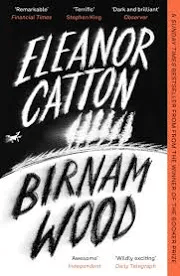
First. just to get one thing out of the way, this novel has nothing to do with Macbeth. You could work hard at trying to find some parallels, but they won’t work. Which is just one of those minor disappointments that could have easily have been overlooked if the novel’s ending worked, which it didn’t, as I may have mentioned.
The author invites us to believe that a New Zealand community gardening project, with the mildly amusing name of Birnam Wood, is covertly a much more subversive, radical project threatening the status quo – or so some of its members believe (others just like gardening). For wildly complex and improbably reasons, this group gets involved with Robert Lemoine, an American billionaire, who decides to sponsor and support the group. He’s a psychopath, so the reasons he gives for sponsoring BW are nonsensical, but we are invited to accept them anyway because billionaires spend their money on whimsical projects as the fancy takes them. don’t they.
“I know how easy it was,’ said Lemoine. Mira didn’t follow. How easy what was?’ All of it,’ he said, shrugging. Getting rich. Staying rich. Winning. It was all so easy. I just took what I wanted, and it was mine. I said what I wanted, and people got it for me. I did what I wanted, and nobody stopped me. So simple. And if it was easy for me, then it could be easy for anybody, and that’s a very frightening thought. Apart from anything else, it would be untenable, Everyone can’t be on top, or it wouldn’t be the top any more, would it? That’s just a fact. And I’ve been in the citadels of power,’ he added. I’ve eaten at the high tables; I’ve seen behind the doors that never open. Everyone’s the same. You reach a certain level and it’s all exactly the same: it’s all just luck and loopholes and being in the right place at the right time, and compound growth taking care of the rest. That’s why we’re all building barricades. It’s in case the rest of you ever figure out how incredibly easy it was for us to get to where we are.
Lemoine invites the group to start gardening in the grounds of an estate he is considering buying and of course they accept, the whole deal sweetened by the promise of much more money to come once the garden is established and he gets to know them better. No, that doesn’t make any sense, does it? Obviously I have summarised the ‘logic’ behind his investment unfairly, because I am irritated by the fact that a central plot point in the novel makes no sense, but it gets worse. Because secretly this one-dimensional evil genius is drilling for rare earth minerals in the national park around the home he is about to buy and having a group of hippies on site is just what any illegal covert mining operation needs.
Despite all of the above, I enjoyed at least three quarters of the novel. It was well-paced, the non-billionaire characters were well-sketched, and I was interested to find out what happened to everyone. As the remaining pages dwindled and the multitude of plot lines remained stubbornly unresolved, I wondered how the author was going to bring everything together. At one point I genuinely thought we were going to be set up for a sequel, there was so much left incomplete. Instead, Catton totally blows the ending. She uses a crude device to bring to a sudden halt some of the plot lines, and leaves a few dangling uncertainly. One central character, Shelley, seems to be forgotten entirely. The climax is rushed, unconvincing, and the reader is left to sketch in most of what happens themselves, with little to go on. Most of the dramatic events happen off-screen (as it were) with the reader left to join the dots from scattered clues. Imagine Hamlet from Fortinbras’s perspective and you get a rough idea of how the potential drama of the climax is thrown away.
Birnam Wood aspires to being a thoughtful novel of ideas, and there are prolonged sections in which characters discuss the decline of late stage capitalism, mostly in a millennial argot in which the word ‘like’ is sprinkled through the speeches every other sentence, in a redundant attempt at authenticity.
“Shelley said “I was just thinking about it. Like, no one ever actually knows that the right thing to do is. I mean, you can think that you know what’s right, and you can tell yourself that you know, but at the point that you make your choice, like, in the moment, you’re never really certain. Yu just hope. You just act and you hope for the best…But, like, the wrong thing to do, that’s often much clearer. Wrong is, like, easier to se than right, a lot of the time. It’s more definite – like, this is the line I know I will not cross. “
I get it that some people do speak like that and I understand that it is just the twenty-first century equivalent of um’s and er’s, but on the page it is wearisome. The ideas being discussed never really come into focus and are quickly forgotten when the action sequences in the novel kick in.
In a promotional interview the author said that she aspired to write a twenty-first century equivalent of Jane Austen’s Emma. I don’t think I have ever read a more absurd comparison in a very long time. It’s like Dan Brown comparing the Da Vinci Code to Middlemarch. Austen is the most precise, careful writer – Birnam Wood is ultimately a soggy mess. Which proves one thing – that thrillers are not as easy to write as you might think.

