Book review

Clown Town by Mick Herron, 2025

Clown Town is the ninth novel in Mick Herron’s Slow Horses series, which you may be more familiar with as the television series featuring Gary Oldman. In addition to the nine sequential novels there are also seven other novels set in the Slow Horses ‘universe’ giving the background stories of and additional detail about the characters. I appreciate it is a strange decision to start a series on book nine, but in my defence I have watched the television series up season 6 (which is mid-run) which combines the sixth and seventh novels in the main series. This does mean I have inadvertently skipped book 8, but I think the damage done is limited.
The Slow Horses series follows a group of outcast spies, people who have broken the rules or otherwise offended the powers that be, but who have not sinned seriously enough to be sacked. Instead they are cast away to the outpost known as Slough House, into a team of rejects and mavericks, run by the uber-maverick himself, Jackson Lamb (the character played by Gary Oldman in the television series). While the Slow Horses are meant to be desk-bound, analysing data, the strong suggestion is that they are being tortured with mundane tasks to try to force them into resigning. Instead, mainly out of boredom, they seek opportunities for field work, which often proves dangerous.

Clown Town opens with River Cartwright still on medical leave from the events in book 8. He is managing the closure of his grandfather’s estate – his grandfather being a former senior spy. River is ostensibly the ‘hero’ of the series, the alpha male action man, but Herron debunks this whole idea by making River consistently mess things up. (In the television series River is almost constantly running after the bad guys, barging bemused commuters out of the way). Clown Town is no different in that respect. River nurtures the faint hope that one day he might be allowed back into ‘The Park’ the main headquarters of the security services. Everyone else seems to know this is never going to happen.

Part of the probate process involves moving River’s grandfather’s library to his old college and for reasons I didn’t understand/weren’t properly explained the books have to be re-shelved in exactly the same order as in their original location. In this process River notices a book is missing – or rather the archivist he is working with notices this. To complicate matters further this is a book that does not exist – no book of that name and author was ever published. This leads River to suspect that this was not really a book at all, but a way of hiding a cache of documents.

This is of course all complete nonsense. Why would River’s grandfather have hidden top secret documents on a bookcase instead of, say, in a safe? And if you are going to do that why hide it in a fake book that doesn’t exist, instead of a boring Victorian novel that would not draw attention to itself. This was not a case of his grandfather leaving clues for River to follow after his death, it is just implausible plotting. Later in the novel there is another example of the reader being asked to suspend their critical judgment. Lamb is planning something that requires his presence at a location in London to be untraceable, so he asks Roddy Ho, Slough House’s resident technical wizard, to disconnect all the CCTV within a certain radius. Roddy is unsurprisingly inept at this task, which will cause Lamb some serious problems in book 10. But this invites us to ignore the fact that many houses have smart doorbells that can track the movement of cars passing by, and lots of cars, delivery vans, and others have mobile recording that make any secret journey across London impossible. So even had Roddy been able to disable all the CCTV cameras in the area, Lamb journey would be easy trace. Perhaps I am being pedantic here, because this detail was not overly important in the scale of things, but it did stand out as being a problem that someone like Lamb would normally easily avoid.

Back to the plot. River tracks down Charles Stamoran, a former friend of his grandfather who gained access to the archive and stole the missing ‘book’. He tells River he destroyed the contents, claiming they were some embarrassing porn, but River is dubious. In fact the hidden evidence links back to “Operation Pitchfork,” a brutal, Troubles-era black ops mission involving an MI5 enforcer and the IRA, an operation that everyone is now keen to forget. A group of retired operatives, led by Stamoran, use a recording of a meeting where the black op is discussed, to blackmail ‘First Desk’ Diana Taverner. Taverner is untroubled by the attempted blackmail but recruits the aging spooks to take out one of her enemies. The novel builds to a bloody climax that by the end of the narrative is not quite fully resolved, leaving the reader eagerly waiting for novel ten.

Herron roots his stories very firmly in a real political context. A thinly disguised Keir Starmer, for example, makes an appearance (Herron is not a fan) and the deeply unpleasant former Home Secretary Peter Judd could easily be mistaken for Boris Johnson – Herron keeps just the right side of the libel laws. Contemporary historical and political references are woven into the narrative but I don’t think you need to be a politics student to follow the plot. Whether Clown Town can be read as a standalone novel without some prior knowledge of the series – either through the novels or the faithful to the books television series – is another question. I am sure it could be read and appreciated on its own, but knowledge of the characters’ backgrounds lends another level to the narrative. So if darkly humorous spy novels appeal to you, either don’t start here – or watch the television shows first (they are highly binge-able).

Herron’s cast of characters is well established at this point in the series, and there is always a risk when this happens they start to become predictable. We know Lamb will be rude to, well, everyone, and his questionable personal hygiene will feature, as will his tradecraft that might help his team of ‘joes’ survive. We know Lady Di (First Desk, the boss of MI5) will plot her own advancement with no regard for who gets in her way (the final showdown between her and Lamb can’t be far off), that the Slow Horses will be inept, and that Roddy Ho, the narcissistic computer hacker will continue to make everyone cringe. Within these constraints, Herron moves his pieces around the board adeptly, avoiding any hint of self-parody. We come, with Lamb, to care about his joes, even if they are a bit rubbish.

Several of the reviews quoted on the inside cover of the paperback edition of Clown Town emphasise the humour of the novel – the word ‘hilarious’ is used. Certainly there is humour here, sometimes childish (for example the insults the characters throw at one another) and there are plenty of fart jokes. But the real tone of the novel is very dark, even angry – Herron thinks of Parliament and our other institutions of state as a national version of Slough House, full of rejects and incompetents.

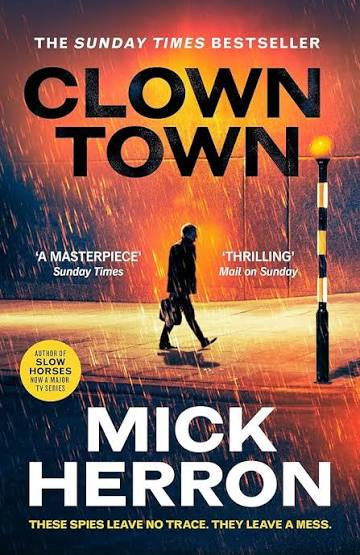
Clown Town is an excellent antidote for viewers impatient for the next episode of the series to be released, but it does inevitably include spoilers which cannot be avoided. So pick a lane – either watch the television series and enjoy the twists and turns as they are revealed, or read the books and know, broadly, what is going to happen but enjoy the episodes anyway. I did have one final moan and that is with the paperback cover, shown above. It is horribly generic and any number of other spy novels use this template. The strap line used under the author’s name – “These spies leave no trace. They leave a mess” is a clumsy attempt at humour that might mislead an unwary browser into thinking they are buying a comedy spy novel, which is a long way from the whole picture. The novel deserves a better presentation than this by Herron’s publisher Baskerville the literary crime and thriller imprint of John Murray Press.
Clown Town by Mick Herron, 2025

Aside
Book review

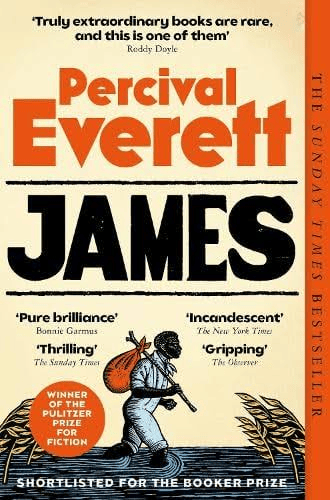
James by Percival Everett, 2024

It is a simple coincidence that I followed a reimagining of Hamlet (in Tom Stoppard’s Rosencrantz and Guildenstern are Dead) with Percival Everett’s 2024 novel, James, which reimagines Mark Twain’s Adventures of Huckleberry Finn from the perspective of the enslaved Jim.

Before reading James I reread my review of Huck Finn to remind myself of my reactions to that novel. One of the observations I made in that review (back in 2016) was that “All the black people in the novel are portrayed as caricatures – they speak an exaggerated form of English, rendered phonetically thus: “But it’s awluz jis’ so; people dat’s sot, stays sot; dey won’t look into noth’n’en fine it out f’r deyselves, en when you fine it out en tell um ’bout it, dey doan’ b’lieve you.” They are all also hugely superstitious, frightened of ghosts and witches, and are extremely easy to tease or fool, with a child-like innocence or naivety. Huck and Tom have no hesitation in exploiting this gullibility for their own amusement.”

This is explained in James which shifts radically from Twain’s original text to reveal that Jim is intelligent and literate. He and the other enslaved characters use the “dumbed-down” slave dialect quoted above as a survival mechanism to keep white people feeling comfortable and superior about their status. Stupid, childlike slaves do not represent a threat to the slave owners. The same applies to the superstition about witches and ghosts – the enslaved encourage white people to believe they are slow-witted and superstitious in order to make them feel superior and therefore less likely to resort to violence. So Jim has two voices – the intelligent measured voice he uses when with other enslaved people he trusts and his slavery dialect, deliberately full of grammatical mistakes and clumsy constructions. This dichotomy is also reflected in his two names – Jim the enslaved man, and James, his true personality.

The novel begins in Hannibal, Missouri, in 1861, the year the American Civil War broke out. When Jim’s wife, Sadie, overhears that their enslaver plans to sell Jim to a new owner in New Orleans, Jim flees to hide out on the nearby Jackson’s Island. There, he meets Huckleberry Finn, who has faked his own death to escape his abusive father. The pair team up and begin a treacherous raft journey down the Mississippi. As they navigate the river, Jim deals with the challenges of the river journey, including a near-fatal rattlesnake bite. While feverish, he hallucinates intellectual, fierce debates with Enlightenment philosophers like Voltaire, Jean-Jacques Rousseau, and John Locke. Eventually Jim is separated from Huck and sold into a blackface minstrel troupe. Here, Everett opens a discussion of the social construction of race through a discussion of the concept of “passing” and racial performance. Within the troupe, Jim meets Norman, a light-skinned Black man who is successfully passing as white in his daily life to secure his safety and freedom. However, to perform in the minstrel show, the white-passing Norman must apply burnt cork to his face to “play Black” for white audiences. Jim is forced to do the same. Everett dissects how white supremacy relies on an artificial concept of race. While passing allows Norman access to physical safety, it forces an ongoing alienation from his true identity. At the same time James never fully trusts Norman, recognising that his ability to ‘pass’ as white gives him an advantage Jim will never have.

In Twain’s original Huckleberry Finn, Jim’s story ends with his ‘owner’, Miss Watson, freeing him in her will because she feels guilty about her previous plans to sell him. Tom Sawyer knows Jim is already legally free but callously conceals the truth so he can orchestrate a convoluted, theatrical escape plot. Huck thinks he is breaking the law to help a runaway slave, only to discover his elaborate efforts were unnecessary because Jim was already a free man. In James, the novel’s ending is very different. James knows that a black man is never fully free in the Southern slaving owning states, where a piece of paper is worthwhile against slavers’ guns, dogs and whips. So he takes the question of his liberty, and that of his family, into his own hands.

Novels about the enslavement of black people in America have to walk a fine line in terms of being honest about the abuse of the enslaved without descending into gratuitous descriptions of the visceral horror that was daily life. The brutality of life for the enslaved is not something writers can sugar-coat (unlike Twain of course) but simply portraying horror, abuse and degradation for the sake of it would make difficult reading. Octavia Butler’s Kindred manages this difficult balancing act by viewing slavery through a twentieth century time traveller’s lens. James ennobles the enslaved with an intelligence to outwit their masters and a bravery to face the daily horrors of their lives. Everett does not turn away from the darkness of slavery, but neither does he allow it to overwhelm the narrative. Although James uses Huck Finn as its starting point, it shows us a very different version of the American South on the brink of civil war. I’ve read that Huck Finn is taught to all American schoolchildren – it would be great if they could all be encouraged to read James as well as a corrective to the warped views of the American nineteenth century.


James, by Percival Everett, 2024

Aside
Book review

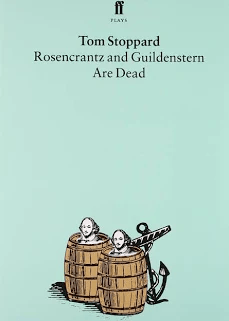
Rosencrantz and Guildenstern are Dead was the answer to a question on University Challenge last month – and that was enough of a reminder that I absolutely loved this play and that I ought to revisit it, especially as I had promised myself that I would read more plays this year. I warmed up by first watching the 1990 Stoppard written and directed version of the play on YouTube. This production took some liberties with the script, but no harm done and I returned to the text looking forward to Stoppard’s wordplay, wit, and intelligence. And I am pleased to say I was not disappointed.

What is that I love about this play so much? First and foremost it’s the simple brilliance of the whole conceit. Telling the story of two minor characters who feature in Hamlet with not much more than walk-on parts, trying to understand their motivation, to explain how they come to betray their childhood friend, as well as providing a drama in its own right throws new light on Hamlet itself. We see key sections of the play in a totally fresh way. Take for example the scene where R&G are trying to work out why Hamlet is so out of sorts. In asking for their help Claudius says

“Something have you heard
Of Hamlet’s transformation, so call it,
Sith nor th’exterior nor inward man
Resembles that it was. What it should be,
More than his father’s death, that thus hath put him,
So much from th’understanding of himself,
I cannot dream of.”

R&G chew this over and come to the following conclusion:

ROS: “To sum up: your father, whom you love, dies, you are his heir, you come back to find that hardly was the corpse cold before his young brother popped on to his throne and into his sheets, thereby offending both legal and natural practice. Now, why exactly you behaving in this extraordinary manner?”

Hamlet is such an extraordinarily strong play that it can survive being carved apart like this and still emerge the stronger. You don’t need an intimate knowledge of Hamlet to appreciate R&G though. Some of the humour and in particular the clowning in the play is brilliantly, effortlessly, done.

“What’s the first thing you remember?”

“No, it’s no good, it’s gone.”

I haven’t indicated in the quote above who says what line because the confusion between the characters’ identities – which is Rosencrantz and which Guildenstern – is one of the many running gaps through the play, picking up on hints in the original text that this was Shakespeare’s intention. Of course the characters are differentiated – Rosencrantz is consistently the more stupid and innocent of the two – but their often muddled identities underlines the point that their lives are of such little value to Hamlet, to Claudius, and to Shakespeare.

The play obviously owes a debt to Waiting for Godot – two characters on an almost bare stage passing time waiting for something to happen. Beckett breaks the tension with the arrival of Pozzo and Lucky; Stoppard achieves the same effect with the larger scale arrival of the players. These are another set of characters with small (but critical) parts in Hamlet given expanded roles here. Stoppard speculates on the lives of itinerant players struggling through hard times and hints at their having to resort to prostitution. It’s never said explicitly but these scenes always make me think that Stoppard was commenting on Shakespeare’s life as a player prior to his writing taking off, especially during the plague years when the company would need to go on the road to stay in business. Stoppard sees this as a hard life, which no doubt it was. Despite these hardships the players retain a dignity and pride in their performances.

Between their brief appearances in the main play, off-stage as it were, Rosencrantz and Guildenstern find ways to pass the time. When the play opens they are playing heads or tail. Guildenstern tosses a coin; Rosencrantz wins if it is heads, which it is every time:

GUIL spins. ROS studies coin.
ROS: Heads.
(He picks it up and puts it in his money bag. The process is repeated.)
Heads.
(Again.)
ROS: Heads.
(Again.)
Heads.
(Again.)
Heads.
GUIL (flipping a coin): There is an art to the building up of suspense.

(This is one of many artful breaches of the fourth wall that greatly add to the humour of the play).

As the run of heads continues improbably into three figures, Rosencrantz is simply delighted with his run of good luck, but Guildenstern becomes increasingly troubled by the implications of what is happening. It becomes an existential threat to his existence and sense of self:

GUIL: It must be indicative of something, besides the redistribution of wealth. (He muses.) List of possible explanations. One: I’m willing it. Inside where nothing shows, I’m the essence of a man spinning double-headed coins, and betting against himself in private atonement for an unremembered past. (He spins a coin at ROS.)
ROS: Heads.
GUIL: Two: time has stopped dead, and a single experience of one coin being spun once has been repeated ninety times… (He flips a coin, looks at it, tosses it to ROS.) On the whole, doubtful. Three: divine intervention, that is to say, a good turn from above concerning him, cf. children of Israel, or retribution from above concerning me, cf. Lot’s wife. Four: a spectacular vindication of the principle that each individual coin spun individually (he spins one) is as likely to come down heads as tails and therefore should cause no surprise that each individual time it does. (It does. He tosses it to ROS.)

This scene is a tour de force of writing, a spectacular piece of craftsmanship which it must be a delight to perform. Stoppard is playing lightly with ideas of determinism and fate. This combination of light comedic touches with the discussion of philosophical ideas – why are we here, is there some force determining our fate or is the world just random? – is an incredibly difficult tightrope to walk, but Stoppard pulls it off with apparent ease.

“A weaker man might be moved to re-examine his faith, if in nothing else at least in the law of probability”

I recognise this has become more of an appreciation than a review, but this is a great play that remains fresh and vibrant. It doesn’t really need a ‘what happens’ review because the clue is in the title! Stoppard went on to write plays that were more successful and more critically lauded, but I don’t think he wrote anything better.

Rosencrantz and Guildenstern are Dead by Tom Stoppard, 1966

Aside
Book review

“The school at which I was science-master was desirably situated, right in the centre of the town, By walking only a few yards the masters and boys could find themselves in a café or a public-house. I used to frequent a café in the market-place. It was on the first floor, and underneath was a shop where coffee was roasted. A delicious aroma drifted through the maze of market stalls, mingling with the smell of celery, apples and chrysanthemums: you could pick up in the middle of the place and follow it to the source, where, in the shop-window, a magnificent roasting-machine turned with a flash of red enamel and chromium plate.”

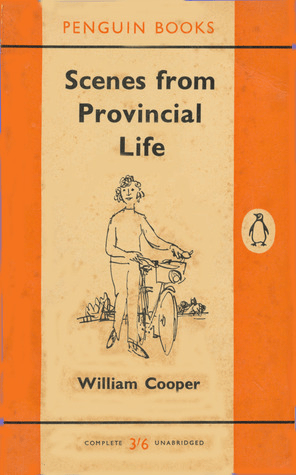
Remarkably it seems that Scenes from Provincial Life, a novel once described as ‘a post-war literary landmark’ by Anthony Burgess and as ‘seminal’ by John Braine, is now out of print. It has received only seven reviews on Goodreads. I first came across the novel in the mid-1980’s in the classic Penguin edition shown here. I remember finding it charming and amusing, but recalled little else about it. You will not be surprised such is the fallibility of memory that returning to the novel I found it much changed!

Scenes from Provincial Life, with a title knowingly looking back to earlier nineteenth century ‘small town’ literature, features as its protagonist a new type of central character, one who came to dominate fiction of the 1950’s: male, (inevitably), but also young, sexually active, educated and (crucially) not financially independent. Unlike so many of the people in (for example) the average Bloomsbury novel, these characters have to work for a living. And their jobs are not things that happen ‘off-screen’ as diversions from the central events of the novel, the love affairs and melodramas, but are actually places they go and things they spend time doing. Kingsley Amis’ Lucky Jim is probably the best known example of this genre, but Scenes, published in 1950, came before it and showed the way. Joe Lunn is a physics teacher in a not very good secondary school in a provincial town (widely acknowledged as being Leicester). He is not a very good teacher, under threat of dismissal for his flagrant disregard for the petty headmaster’s rules and not at all worried about the prospect. He has other things to worry about, not least the fact that this is the spring of 1939 and war seems unavoidable. (Joe thinks the alternative to war, capitulation to Germany, would be even worse). He finds his work boring and pointless. He is not much older than his sixth form students and finds it easier to relate to them than his peers.

Joe’s social circle involves his girlfriend, Myrtle, Tom, an accountant, and Stephen, Tom’s much younger boyfriend. The portrait of an openly gay relationship (open within his social circle, but not out in the modern sense) was highly unusual, not least because it is presented as unexceptional and unproblematic. Stephen and Tom’s relationship is portrayed as slightly hysterical with lots of ups and downs, ultimatums and so on, but Joe never passes judgment on them as a gay couple.

But the central relationship of the novel is that between Joe and Myrtle, which is based on a mutual and enthusiastic sexual attraction. They spend weekends at Joe’s cottage (which it seems he either hires for weekends only or that can afford to rent both this cottage and his room in a boarding house, where overnight guests are forbidden by moralistic landladies). Either way, the cottage is the place where they can enjoy one another’s company without the intrusion of prying eyes. Joe, a few years older than Myrtle, is very keen on having as much sex as possible with her, but is very clear that he is not interested in marriage. In the 1930’s, when the novel is set, and even into the 1950’s when it was published, pre-marital sex obviously happened, but the implied understanding was that it would, sooner or later, lead to marriage, rather than being a fun occupation in its own right. There is even, in chapter two, a very clear but not quite explicit description of oral sex that I think could have been shocking to Cooper’s 1950’s readers, even those who had managed to get their hands on a still-banned copy of Lady Chatterley’s Lover. Sex is fun and uncomplicated in a very 1960’s post pill way. Myrtle does have a pregnancy scare at one point, which she successfully treats with copious amounts of gin.

As the year passes, the international situation deteriorates and it becomes clear that war is coming ever closer. Joe and his friends develop a plan to emigrate to America – Tom in particular is keen to leave, being Jewish. These plans never really get off the ground and I had the feeling that such talk was common in some quarters in 1939, the alternative being too grim to contemplate. J0oe tries to involve Myrtle in this plan, but as he never mentions the ‘m’ word (marriage) she is not interested. Joe and Myrtle’s relationship begins to struggle as he stubbornly refuses to accept her hints about getting engaged and in response she starts to spend time going to parties with other men. If this is intended to make him jealous it succeeds, but not sufficiently to change his mind on the matrimony front. To complicate matters Tom tells Joe that he is planning to ask Myrtle to marry him – other than to make Stephen jealous it is not clear why he is going to do this, and neither Joe nor Myrtle take the offer seriously.

A comedic sports day chapter is entertaining, but as soon as the narrative returns to the love affairs of the cast the novel slows back down. Joe really wants to end his relationship with Myrtle, but she continues to sleep with him, which acts as a serious disincentive to him ending it, but he also does not want to appear caddish, and would rather it be Myrtle herself who ends things. This she finally does. Cooper closes the novel with a quick summary of how the characters fared during and after the war. I was surprised while preparing this post to find out that Cooper published several sequels to this novel, charting the later lives of Joe, Myrtle and friends. I am in two minds as to whether to read these – I am not sure that the characters are sufficiently compelling to justify several follow up novels – but I might! I doubt they are in print however.

I wonder who comes closer to the truth – the novelists and critics of the 1950’s who saw in Scenes from Provincial Life something important and significant, or the modern judgment which is to have largely forgotten the novel? It is possible that both views are right – Scenes was important when first published because it marked a break with the dominant Modernist novel of the interwar years, but that in itself is not enough to preserve its value as a novel in its own right once stripped of its historical and cultural context. I am not entirely convinced it had the cultural impact that some have claimed – after all George Orwell and others were writing novels about young, educated but not very well-off young men looking for new types of relationships that did not involve marriage back in the 1930s. But at the same time this template has proven remarkably resilient and you will find many writers of today writing to this pattern, using these themes. Scenes deserves to be remembered and read, and recognised as an important cultural landmark, even if hindsight now tells us that the turning point it seemed to represent didn’t last that long.

Scenes from Provincial Life by William Cooper, 1950

Aside
Book review

House of Meetings by Martin Amis, 2006

I can’t remember the last time I did not finish a book. Over the course of this blog I have probably left unfinished fewer than four or five books – the only one that springs to mind is Lies Inc by Philip K Dick, which was unreadable. So I think it says something that I came very close to abandoning House of Meetings some forty pages from the end. Only sheer stubbornness kept me going. It’s not that it is a bad book, it was just not very interesting. Which is fairly extraordinary – how could any writer make Stalin’s gulags dull?

House of Meetings is also at times harrowing. It is a historical novel framed as a prolonged confession by an unnamed, eighty-four-year-old Russian narrator. Addressed to his American stepdaughter, Venus, the text is an attempt to explain and come to terms with the narrator’s turbulent life – his violent past and the destructive relationships that defined his youth. If you impose a chronological order on the novel, the narrative begins in late 1940s Moscow, where the narrator and his younger half-brother, Lev, both fall in love with Zoya, a striking nineteen-year-old Jewish woman. Of course that is not what happens on the page, where the narrative is fragmented, told in snatches of memory, interspersed with commentary on contemporary events such as the Beslan school shootings.

The narrator is a handsome, (he says) and physically strong World War II veteran who has been deeply hardened emotionally by the conflict, including having participated in the brutal mass rapes and other atrocities committed by the Red Army during its advance through Germany. These crimes are described as just something that happened – the narrator takes no moral responsibility for his behaviour and even seems to think it was justified in some way. (“In the last months of the war, when I raped in uniform – we were, by then, so full of death (and the destruction of everything we had and knew) that the act of love, even in travesty, felt like a spell against the riot of murder.”) Lev, by contrast, is a frail, stuttering poet, a pacifist, and an idealist. Zoya chooses the gentler brother, marrying Lev just before the Soviet state begins a fresh reign of terror which sees the brothers thrown into a gulag.

The narrator adapts quickly to the lawless, violent hierarchy of the camp, but Lev suffers immensely despite the narrator’s attempts to shield him. In 1956, during a period of relaxed rules following Stalin’s death, Lev is granted a highly prized conjugal visit. Zoya travels thousands of miles to meet him in a designated wooden cabin known as the “House of Meetings.” The narrator, consumed by envy, is tormented by not knowing what happens in the House, even though this surely requires very little imagination.

Following their eventual release, the brothers’ lives diverge. The narrator defects to the West, eventually settling in America. Here he improbably becomes a wealthy arms dealer. Lev returns to Zoya, but he is broken by his time in the gulag, and their marriage does not survive. The novel ends in 2004, as the elderly narrator travels back to Siberia and the camp, this time as a tourist. During this final voyage he opens a long ignored letter from Lev telling him what happened in the House of Meetings, something that has haunted the narrator for some reason. Far from being a climax this is simply an ending, with nothing of interest being revealed.

This novel was ill-conceived and ill-advised. There is an extensive literature of the gulag written by survivors to which this adds nothing. His commentary on contemporary Russian politics is dated and dull, and the narrator’s portrait of the gulags is strangely banal. The references to the atrocities being committed by Chechen terrorists are thrown in casually and do not serve any function – if we are supposed to infer that little changes in Russia and it remains as barbaric as ever, then the point is moot and badly put. I did not care about the characters in the novel, and apart from the brothers none of them were drawn with any care or interest. Zoya in particular was very one-dimensional with no real existence outside her role as the third element of the love triangle. No doubt that is because that is how the narrator saw here – just as a woman rather than as a real person, and why he obsessed with what she did or didn’t do in the House of Meetings with his brother. Just what he thought they did, and why he could not get over that brief visit, I could not understand nor care about.

I’d like to find something positive to say about this novel to conclude this review, but I have racked my brains and I can’t. I’ve looked back at some of my reviews of earlier novels by Amis (who died in 2023) and find that I loathed Lionel Asbo and Yellow Dog, so I suppose the fact that I found House of Meetings merely banal represents something of an improvement!

House of Meetings by Martin Amis, 2006

Aside
Book review

How Far Can You Go? by David Lodge, 1980

“It is just after eight o’clock in the morning of a dark February day, in this year of grace nineteen hundred and fifty-two. An atmospheric depression has combined with the coal smoke from a million chimneys to cast a pall over London. A cold drizzle is falling on he narrow nondescript streets north of Soho, south of the Euston Road. Inside the church of Our Lady and St Judge, a greystone, neo-gothic edifice squeezed between a bank and a furniture warehouse, it might still be night.“

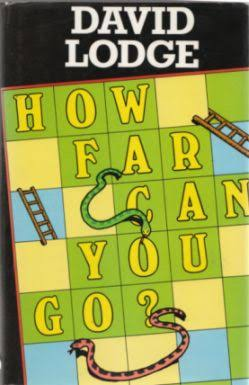
How Far Can You Go? charts the lives of a group of English Catholic students from the early 1950’s to the late 1970’s, a period of dramatic change in the UK and within the church. The novel is organised chronologically into themed chapters that track the group’s lives within the context of the social and theological changes of the period with a particular focus on the evolution of Catholic teaching. The novel opens by introducing the group of students as they gather at a cold and dark Catholic church for an early-morning mass prior to lectures at University College London. All the students have been taught and believe the church’s teachings on sin, guilt, and sexual abstinence. Compliance with the teachings of the church is compared to a twisted board game (hence the illustration on the novel’s front cover):

The name of the game was Salvation, the object to get to heaven and avoid Hell. It was like Snakes and Ladders: sin sent you plummeting down towards the Pit; the sacraments, good deeds, acts of self-mortification, enabled you to climb back towards the light.” The author is the unnamed eleventh character in the novel, regularly intruding into the narrative by breaking the fourth wall.

‘How They Lost Their Virginities’ is the (self-explanatory) next section of the novel which details how the awkward, guilt-ridden students transition from youthful chastity into their early sexual experiences and marriages. Or most of them do – one character becomes a nun, with the inevitable vow of chastity that involves, and another is a closeted gay man who is scared of sex, worrying that it will damn his soul. Most of the other students wait until marriage before having sex, largely due to the same fear of damnation. In some cases they wait for several years, with the stress and anxieties this inevitably brings.

‘How Things Began To Change’ takes the novel into the 1960s. The characters marry, have children, and begin a long struggle with the strict Church ban on ‘artificial’ contraception. Hopes for a relaxation of the church’s teachings on this issue are dashed in ‘How They Lost The Fear Of Hell’ with the publication of the papal encyclical Humanae vitae (HV) in 1968, which reaffirmed the ban. The young people, now not so young, have increasingly large families, and the burden of near constant pregnancy or abstinence puts pressure on their compliance with the church’s teachings. Around them society grows more permissive and some of them abandon ‘natural’ contraception for methods that actually work, feeling liberated when doing so.

From here, the fairly linear story begins to fragment as the characters’ lives go their different ways, each of them finding their place in the world and ways to reconcile their faith with their day-to-day lives. Some get divorced, have affairs, suffer mental breakdowns, or experiment with charismatic, personalised versions of faith. One couple, Dennis and Angela, have a child with Down’s Syndrome. The references to the child being a ‘Mongol’ are a shocking remind of how, until quite recently, people with Down’s were commonly referred to. The birth of a child with Down’s Syndrome is presented as a curse from God and this is followed shortly by the death of their daughter, Anne, when she is run down in the road by a car. Here the author once again breaks the fourth wall:

“I have avoided a direct presentation of this incident because frankly I find it too painful to contemplate. Of course, Dennis and Angela and Anne are fictional characters, they cannot bleed or weep, but they stand here for all the real people to whom such disasters happen with no apparent reason or justice. One does not kill off characters lightly, I assure you, even ones like Anne, evoked solely for that purpose”.

This intrusion of the author into the narrative might have seemed very modern or even post-Modern in 1980, but it has not aged well. It is largely redundant (we know Dennis and Angela and Anne are fictional characters, but have chosen to temporarily engage with them as ‘real’ characters as part of the experience of reading the novel) and intrusive, reminding the reader that this is just a novel and that we have no real reason to care about the characters – other than as avatars for anyone we know who has ever suffered. Lodge anticipates this response: “People who find religious belief absurd are often upset if a novelist breaks the illusion of reality he has created”. No, I was not upset, just mildly irritated at the unnecessary intrusion of another, no less illusory character, the author.

The novel ends with a transcript of the documentary filmed at a progressive Catholic retreat organised by some of the characters. The film causes a minor scandal, showing as it does people pushing at the boundaries of the church’s teaching on how religious observance is to be conducted (that is, seriously, without celebration, music or fun).

Underpinning the narrative is a liberal assumption that the course of the church’s teaching is fixed and inevitable, and in particular that sooner or later the rules about contraception will be relaxed. This is presented as something that is simply unavoidable, a matter of time, and I am sure that is how it must have felt in the 1960’s and ’70’s. Lodge’s characters would I think have been shocked to find out that in 2026 the Catholic Church still maintains that artificial contraception is an ‘intrinsic evil’ – it is “always morally wrong and can never be justified by any good intention or difficult situation”. There was nothing inevitable about the liberalisation of Catholic teaching, however it must have seemed half a century ago. Which, unless you are a dogmatic, committed Catholic, makes How Far Can You Go? rather sad. “Thus far and no further” is the answer none of Lodge’s characters, nor I suspect Lodge himself, would have expected.

Why am I (still) reading David Lodge? He was an important figure in the British literary scene in the 1980’s and was nominated and shortlisted twice for the Booker Prize in that decade. I think his standing has diminished significantly since then and his work is commonly perceived as outdated. Which I think is right, but I find it hard to resist a first edition hardback in a second-hand bookshop for just a couple of pounds, so here we are.

How Far Can You Go? by David Lodge, 1980

Aside
Book review

The End of Everything by M John Harrison, 2026

For years Phillip Tennent lived at the end of the sea, where artefacts were washed up every day. Scavengers, professional and otherwise, came and went. Turnover was higher than you’d expect given the relaxed lifestyle, the constant good weather, the ease with which some sort of existence could be pursued.

The End of Everything defies categorisation. The term ‘dystopian fiction’ helps a little – the novel is set in an indeterminate future where society as we know it has largely broken down, although there is still some form of social order. It could also be categorised as science fiction, as the world is now occupied by an alien race known as the iGhetti who seem to have come to an accommodation with humanity, and co-exist alongside them – or, it is unclear, they might be destroying the world very slowly. There are also ‘bad patches’ – areas in the countryside where the normal rules of time and space have ceased to exist, and weird things happen. It’s best not to get caught in a bad patch – you might not be able to get out. ‘Speculative fiction’ is just too broad a genre to be of any help here. In the end the label that helped me come to terms with this novel the most was new weird fiction, a term that Harrison himself coined.

The search for a genre label might appear to be an attempt to put Harrison’s text into a framework that limits it, ties it down, but The End of Everything easily sidesteps any such attempt. It is unlike anything I have read before, and was consciously unsettling and disturbing. The narrative, such as it is, follows a beachcomber named Phillip who finds an ‘artefact’, something other-worldly left behind or created by the aliens. This artefact is never directly described, but it is alive, or has features that mimic life – it grows and adapts and can even be eaten, but is hard if not impossible to kill. It appears to be able to adapt to its environment and develop in ways that mimic the things around it – in this case Philip. Philip takes the artefact to his 70-year-old aunt Marnie, an artist suffering from early-stage Alzheimer’s disease. defends her townhouse and starts her own journey from gallery to gallery. Phillip decides to dispose of the artefact, and heads away from the coast. Following a ‘dispute’ with her neighbours, Marnie embarks on her own nomadic journey up the coast.

The disturbing scene which describes this dispute appears early on in the novel and firmly establishes the tone. I would not read this if you are in any way squeamish. Marnie lives in a ramshackle house. One day a fourteen year old boy climbs into the extension of her house and, finding her sleeping in the room below, urinates on her.

“He turned to run away and put his foot through the extension roof. Totten plaster pattered down inside. His left leg dangled into the room beneath, scrabbling for purchase. He began to call out in a high voice. “I have you now, you little bastard” Marnie told him. She wiped herself off and went inside, where she rummaged about in the kitchen until she found a metre or two of old electrical flex. This she fastened round the boy’s ankle, anchoring the other end to the heaviest object she could find, which happened to be the bed, to limit the movement of the leg. Once she was satisfied, she went outside again and pulled herself up on the edge of the extension roof until she could look at him.

“How do you feel about this now?” she said. The boy was in half-sitting half-kneeling position, his visible leg quivering with the strain of supporting him…. Marty went back inside. After some consideration, she grasped the tethered leg in both hands and hung from it. “No one in the street likes you”, she shouted. “Do you hear?” Then she found a knife in a cupboard, cut into the boys femoral artery and stepped quickly away from the spray of blood. She stood there for a moment watching the leg flail and spurt…. She watched for a minute or two as the boy lost energy, then turned away and leaned on the balcony rail, looking up and down the row at the overgrown gardens…. She went to talk to the boy’s father, who lived a couple of doors down. They sorted things out between them, and the father sent someone to lever his dead son out of her extension roof…..

After breakfast the boy’s father called, with delegation comprised of half a dozen other people who lived along the street. “Some of us feel you went too far”, he said, implying perhaps that he didn’t. ….The general feeling, the father said, the feeling of everyone there, was that Marnie should leave. “I can see I can see why you might say that” she said, although she couldn’t. ” I’ve lived here longer than any of you, but I can see why you might say that.”

I’ve quoted this awful, upsetting scene at considerable length (even though I have edited it down substantially, shown by the ellipses) because it is such a striking, unsettling episode. Killing a young boy (turns out he was actually 12, not 14 as Marnie believes) is done so casually, and with so few consequences, as if she has committed some minor social faux pas, rather than murder. Marnie is asked, politely, with typical British understatement, to move on, but other than that she is free to go. We are not in a typical dystopian world where life is cheap because of the breakdown of social order – instead this is a world where killing people casually, almost disinterestedly, is accepted, not normal, but not distressing either. This is not the only casual killing in the novel – Marnie has a gun, and uses it when she feels the need – but it is the one that stands out the most, coming early in the novel and setting the tone for what is to come. The reader has no frame of reference to respond to this incident – this is unlike any other dystopia, any end of the world written about before. Obviously the author’s intention is to unsettled the reader, to remove any solid ground from under them. Mission accomplished.

The rest of the novel follows this template. You never quite know what is happening. There is a narrative structure, of sorts, but it is not that important. Neither are the principal characters. People are introduced, things happen, nothing really makes much sense.

I turned to the internet for help in framing my reactions to the novel, and come across this review by sci-fi blogger At Boundary’s Edge. The blogger observes in one very telling sentence that “Harrison isn’t telling us a story. He’s selling us an experience.” This makes a lot of sense. Don’t read the novel to find out ‘what happens’ or to enjoy the story, because there really isn’t much of one. Instead, immerse yourself in the experience of reading a M John Harrison novel, like taking a drug that you aren’t sure how you are going to react, whether the experience is going to be a good one or not, but it is definitely going to be an experience. Another reviewer over on Goodreads wrote: “There’s using confusion and warped perception as a literary tool, and then there’s this. As soon as it started approaching interesting concepts, it swiftly turned away to then prattle on about nothing of substance… It shouldn’t be this much of a slog to get through a 200 page book.” And there we have it. Because I did find it hard to make my way to the end of The End of Everything. There was no-one to care about, no plot to resolve or end, even the mildly interesting puzzle of what the artefact might be or become is left unclear – and I was left feeling a little embarrassed at my need for clarity or resolution. Alongside the weirdness there is plenty of lyrical descriptive writing suggesting Harrison is a skilled and capable writer, but this is definitely a case where for me the strangeness went that little bit too far. The Booker Prize panel obviously disagreed, long-listing this novel for the 2026 award, but I would be shocked if it makes it any further in the process.

The End of Everything by M John Harrison, 2026

Aside
Book review

Orbital by Samantha Harvey 2023

Rotating about the Earth in their spacecraft, they are so together, and so alone, that even their thoughts, their internal mythologies, at times convene. Sometimes they dream the same, dreams of fractals and blue spheres and familiar faces engulfed in dark, and of the bright energetic black of space that slams their senses. Raw space is a panther, feral and primal; they dream it stalking through their quarters.

Orbital, which won the 2024 Booker Prize, follows a day in the lives of six astronauts in low-earth orbit on the International Space Station. Italian, Russian, British, American and Japanese astronauts spend their day in a mixture of the mundane – monitoring routine experiments on the behaviour of microbes and mice in space, documenting their bodily functions, eating, drinking, sleeping – and the extraordinary, watching the vastness of space and the earth pinwheeling round. We learn the backstory of each astronaut and how they came to be on the ISS. Simultaneously another mission takes off from earth, this time going back to the moon.

The novel is a poem to the beauty of the earth and its fragile improbability. The prose is extraordinarily lyrical – I could fill this review with examples of the author’s wonderful descriptions of earth as it passes by the space station’ s windows:

There’s the first dumbfounding view of Earth, a hunk of tourmaline, No, a cantaloupe, an eye, lilac, orange, almond, mauve, white, magenta, bruised, textured, shellacked splendour.

and

As they traverse south, the colours change, the browns lighter, the palette less sombre, a range of greens, from the dark of the mountainsides to the emerald of river plains to the teal of the sea. The rich purplish green of the vast Nile Delta. Brown becomes peach, becomes plum: Africa beneath them in its abstract batik. The Nile is a spillage of royal blue ink.

and

Down over the arrowing peninsula of Dakar, crossing the equator, and in the closing minutes of day, the lights of Brazzaville and Kinshasa on either side of the Congo River, tepid in the dusk. Blue becomes mauve becomes indigo becomes black, and night-time down southern Africa in one. Gone is the paint-splattered, ink-leached, crumpled-satin, crumbled-pastel overflowing-fruit-bowl continent of chaotic perfection, the continent of salt pans and red sedimented floodplain and the nerve networks of splaying rivers and mountains that bubble up from the plains, green and velvety like mould growth. Gone is a continent, and here is another sheer widow’s veil of starstruck night.

This is some of the finest descriptive writing I have read in a very long time and I make no apology for quoting it at such length.

Orbital is not just a prose poem on the beauty of the earth. No novel, however slight (the text is less than 140 pages long) could sustain that as its sole theme. It touches on a number of other topics. One of the astronauts is asked to provide a response to the question “With this new era of space travel, how are we writing the future of humanity?” (this is with reference to the new journey to the moon, not the low-orbit space station which is very much showing its age), and the response offered by one of his fellow astronauts is “With the gilded pens of billionaires”, which is at once beautifully lyrical and at the same time recognises the role of the mega-rich in plotting the future course of space exploration. Climate change is addressed as the astronauts watch a tornado as it cuts a devastating route across islands in the Pacific. Chie, the Japanese astronaut, finds out that her mother has died and reflects on the improbability of her birth (her mother survived the atom bombs on Japan at the end of the second world war) and her journey into space.

There are many small stories here – but I would have to accept that the absence of a larger, over-arching storyline was one I missed. Orbital has no real narrative structure, no story in the conventional sense. There is incident – when the mice being experimented on suddenly discover that the absence of gravity means they can effectively fly is a wonderful moment – but the book felt more like an extended short story rather than a novella. While the distinction between these two categories might seem slight |I do think it is significant. It meant that there were points in the book where, however wonderful the prose descriptions of the earth were, I felt that there are only so many of these that I needed.

I will definitely be looking out for more works by this author. Her description of the ‘cosmic calendar‘ concept, used to to visualise the chronology of the universe, scaling its currently understood age of nearly fourteen billion years into a single year in order to help us comprehend the vastness of its scale, was extraordinary, and worth the price of admission on its own. Although this is a familiar concept I don’t think I have ever read it described more lyrically or in fact beautifully as Harvey in this book. She is a great writer, even if here she is not such a great story-teller.

Orbital by Samantha Harvey 2023

Aside
Book review

How Not to be a Political Wife by Sarah Vine, 2025

This book’s clumsy title sets the tone for what is, one can be pretty confident, going to be quite a bumpy ride. The book is categorised as a memoir, but more accurately it is a confessional of staggeringly indiscrete proportions, quite calculatedly burning lots of Ms Vine’s bridges with the Cameron vintage Conservative hierarchy. The book serves as an interesting and I suspect deliberate contrast to Sasha Swire’s much more reflective and considered Diary of an MP’s Wife which covers much of the same time period and territory.

Sarah Vine describes herself as a journalist, but more accurately she is a columnist, writing observational pieces about the world as she sees it. She is one of the genre of columnists who specialise in what is now called ‘rage-bait’ – constructing controversial ‘opinions’ and comments to order that she may or may not mean to be taken seriously, but which are going to drive traffic to her newspaper’s website, which nowadays is all that matters.

The author had a front-row seat at some of the most turbulent years of recent British politics. She worked for mainly right-wing newspapers throughout the period covered by the memoir. Her husband Michael Gove was Education Secretary, Chief Whip, and Lord Chancellor in David Cameron’s and Theresa May’s governments, and then held prominent roles in the Conservative administrations after the 2019 general election. He is now editor of the Spectator and, it goes without saying, a member of the House of Lords. In mentioning Mr Gove I am not succumbing to the sexist idea that a woman is only as important as her husband’s job. The fact is his story is an integral part of this memoir – his choices and decisions had a profound impact on the course of her life over this period and he features significantly throughout. In fact she defines herself in this narrative by contrasting what she did with what she believes was expected of her – hence the book’s title. While the introductory chapters on the author’s early life are interesting, the substance of the book is her role as Gove’s wife and partner, inside observer of the recent Conservative governments. This period can be summed up briefly – for the author it was (despite all the privilege and benefits being part of the Government involved) unremittingly awful. Everyone felt entitled to be nasty to you:

Doctors can shed what’s left of their bedside manner with you. Ordinary people no longer need have any consideration for you. Friends no longer trust you. Children are taught to despise you, not respect you. Journalists and policemen no longer need to be impartial or accurate. You have lost those human rights and protections because you are no longer human, you are a politician and you are now the legitimate prey of the only big game hunting still allowed in this country.

It wasn’t just unkind words of course – death threats followed, their children were bullied and they were ostracised from various friendship groups. None of this stopped Vine having her manufactured views on her political opponents of course. She wrote of Ed Miliband’s kitchen, for example, that there was “not much prospect of a decent meal emanating from that mean, sterile, little box.” Minor television celebrity Carol Vorderman is paid back for having the temerity to criticise the later Tory administrations: “One year we had Carol Vorderman, when she was in her pro Tory phase (as opposed to her sucking up to Labour phase): rarely have I encountered such a heavily cantilevered bosom.” Is the state of Carol Vorderman’s bosom really relevant here?

It wasn’t all bad. Vine has happy memories of weekends at Chequers with the Camerons and the rest of the Notting Hill set:

“Sam really came into her own when she threw a party, and the party she threw at Chequers for her delayed 40th, in 2014, was probably my last truly happy memory of those gilded days, and almost certainly one of the best parties I’ve ever been to. Sam had transformed the Great Hall into a rave, with glitter balls, lasers and disco lights playing over about 150 people dancing wildly to the music of DJ Sarah HB, short for Hard Bitch. Dave and Sam ruled over the dance floor, always the best dancers, doing their Ceroc double act with enviable grace. Everyone was beautiful and clever and powerful; but for once I didn’t feel like Cinders at the ball. Sam had already complimented me on my Diane von Furstenberg black wrap dress, even though it was a touch too tight around the middle – “those bosoms, Sarah!” – and I was having the time of my life, sipping mojitos and chatting to Sarah Montague in the Rose Garden.“

Vine’s main issue is a crippling instance of imposter syndrome. Her dysfunctional relationship with her bullying father (who in the book’s acknowledgements she thanks for “fucking me up so brilliantly” and who lived to see this book published) has left her with the inability to believe she deserves her place in ranks of the country’s privileged few. Money is an obsession – she objects to Gove’s sacking by Cameron as Education Secretary because of the impact it will have on their family income. Her address is not quite in the right postcode. Gove even pays to have an 0207 number (instead of 0208) – an incredibly niche but telling piece of status insecurity that today has not real equivalent.

The heart of the book is her account of the Brexit debacle. Gove promised not to campaign for Brexit, then led the campaign, expressing disbelief that the Cameron’s would see that as a betrayal, even though it destroyed his political career. (In his memoir For the Record, David Cameron directly accuses Michael Gove of disloyalty, stating, “As for Michael, one quality shone through: disloyalty. Disloyalty to me — and, later, disloyalty to Boris”). Vine is able to see that “everyone hated us” without ever really understanding why. If everyone hates you, doesn’t that suggest that you have done something to provoke that response, rather than that everyone was wrong, misjudging you, or being hateful? Gove’s decision to support the Vote Leave campaign and to go on and lead the Brexit campaign, was a turning point in the whole debate – it is arguable that without that decision Boris Johnson would not have supported leave, and potentially that the outcome of the vote would have been different. Certainly Vine’s description of the days and weeks following the Brexit vote does not read like a celebration by the winning side. The suggestion that Cameron should have stayed on as Prime Minister and worked to implement the outcome of the Brexit vote, that his refusal to take responsibility for something he had found hard against was in some way the cause of the utter shitshow that followed, is laughable. Talk about not owning your own mistakes!

Vine has a stunning lack of insight into why people hated her, why they blamed her husband for the disaster that was Brexit, why people stopped being their friends after he stabbed them in the back. She just can’t understand why anyone had a problem with her and Gove’s behaviour. It is all a mystery – which is funny because even the most obtuse reader can easily understand these things. Vine is like a flawed narrator of her own memoir, accidentally revealing insights into her personality and behaviour without having them herself. There are more accurate and more interesting histories of this period, but How Not to be a Political Wife nevertheless gives an original insight into many of the mistakes made by those involved.

How Not to be a Political Wife by Sarah Vine, 2025

Aside
Book review

Every Man for Himself by Beryl Bainbridge, 2002

Half past four on the afternoon of 8th April 1912 – the weather was mild and hyacinths bloomed in window boxes – a stranger chose to die in my arms. “Please,” I said, as he pitched forward and clutched me round the waist. We both fell to our knees. Over the road a crocodile of Girl Guides sashayed sing-song through the ornamental gates of the public gardens.

I wrote some time back about my policy of avoiding reading much, if anything, about a novel before reading the novel itself. Apart from the obvious risk of spoilers, pre-reading can influence your reaction to a book, shaping it in a certain direction. For example, if you are told a novel is ‘a work of genius’ it might encourage you to overlook any flaws you identify in it. A similar problem occurred after I read Beryl Bainbridge’s book about the Titanic disaster, Every Man for Himself, when I came across this article she wrote in the Guardian in 2009. In it she describes the process of negotiating a new contract with her publisher:

“I’d been about to seek another publisher, one who would offer me money, and told Baird-Smith that I was willing to stay with him if he granted me a three-book contract, something miraculous I’d heard of in regard to other authors. When he asked me what themes I was considering, from the top of my head I blurted out Scott going to the pole, the sinking of the Titanic and the Crimean war. Baird-Smith then offered me a substantial advance, which shook me; I wasn’t used to payments.”

Bainbridge was true to her word, writing Master Georgie about the Crimean War, The Birthday Boys about the Scott Polar expedition, and Every Man for Himself. Does it matter that Bainbridge was writing to order rather than being genuinely inspired by her subject matter? A bit, yes. Because I think it shows in the novel itself. The writing is rather ‘by the numbers’ and only sporadically shows a real interest in the subject matter. Most of the novel sees the characters in a holding pattern, running up the word count and down the clock until the iceberg strikes.

As a thought exercise, imagine you were the author in this situation, committed to writing a novel about the Titanic. How would you go about addressing the central challenge of this scenario, which is obviously the lack of any suspense about the overall ending? The first thing you would do, I would suggest, is try to make your central character or characters people the reader cares about, wanting to know whether they survive – in other words you reframe the question ‘What happens?’ to ‘What happens to X?’ This would involve giving the character a backstory and the reader a reason to care about them. The other element I think the hypothetical novel would need would be some depth – for example consideration of social issues or class. The differential in survival rates on the Titanic – 62% of first-class passengers survived, against only 24% of third class passengers (41% for second class if you were interested) – has always struck me as something worth detailed analysis. Was it because the first-class passengers were prioritised in the evacuation and in life-boat spaces, or was it more to do with where they were in the ship when the collision occurred? (To be clear, I am 100% sure that this differential has been analysed very fully by historians – I just don’t think the issues have ever been explored by novelists). And then there’s the crew, who had to supervise the evacuation and enforce the ‘women and children first’ protocol, many of whom stayed behind to carry out their duties to the last minute. The Titanic sinking has so many dramatic stories, conflicts, moments of tension and so on that it would be almost impossible to write a novel that didn’t engage the reader in the drama of the situation.

And yet….

Every Man for Himself tells the story of the sinking of the Titanic through the eyes of one of the first-class passengers, 22 year-old Morgan, part of a very wealthy banking family. Morgan is an orphan who was brought up relatives. Before boarding the ship he sees a man who has fallen onto some railings, dying in a rather clumsy piece of foreshadowing. Once onboard he spends his time socialising with the other first class passengers. He shows some interest in the construction of the ship (having worked on some aspects of its design – presumably the author providing us with a reason to care a little more about the outcome?) and finds out that it set sail with a fire in one of the coal holds not completely under control. There are also occasional mentions of warnings from other ships about icebergs ahead. But the Titanic was unsinkable, so there is nothing to worry about…. He is attracted to socialite Wallis Ellery, who flirts with him while all the time having a fling with one of the other passengers, but he recovers fairly quickly when he finds this out.

The Titanic’s evacuation order (which, from what I can tell, was a long-established protocol) was the very opposite of the novel’s title – not ‘every man for himself’ but ‘women and children first’ – an order that was largely voluntarily complied with. I think the author chose this title as a commentary on the behaviour of the first-class passengers prior to the collision, where their personal interests, well-being and finances are prioritised over everyone else. Every man for himself was the spirit of the age.

Bainbridge does her best to differentiate the large cast of characters, but at times they blurred into one another. Everyone seems to know everyone else (Morgan even knows the captain). This privileged social circle is intimate and hostile to outsiders. Morgan describes his first dinner on board thus:

Dinner that evening was a boisterous affair. Ours was a small world and between the soup and the fish we were all constantly bobbing up and down to acknowledge people we knew; but for the intermittent and minute flickerings of the electric lights we might have been dining at the Ritz in Paris. The Thayers stopped at our table, the Daniels, Mrs Snyder, the Speddens of Tuxedo
Park, Colonel Gracie, jolly Mrs Hogeboom with the excessively ritual eccentric Mrs James Brown, her bridge crony from Denver, in tow. As usual, the latter was dressed inappropriately and wore a gigantic hat across whose brim languished an entire stuffed bird. Colonel Astor and his young bride passed by without a nod, leaving Ginsberg on his feet with his hand held foolishly out. He said he knew Vincent, the colonel’s older son, and had often fenced with him.

Most of these characters are not mentioned again and are just passing across the stage, mildly comically, to make the point as to how close this circle is. But it makes it hard to care about the characters who do eventually emerge from the throng. Morgan fails to make any real new associations with other passengers and neither does the reader. Second and third class passengers, and the crew, are restricted to walk on parts. So I am not sure we really care who lives and who dies when the novel reaches its inevitable climax. In other words this was a disappointing effort, going through the motions by a novelist who at her best was very much better than this.

Every Man for Himself, by Beryl Bainbridge, 2002

Aside