For years Phillip Tennent lived at the end of the sea, where artefacts were washed up every day. Scavengers, professional and otherwise, came and went. Turnover was higher than you’d expect given the relaxed lifestyle, the constant good weather, the ease with which some sort of existence could be pursued.
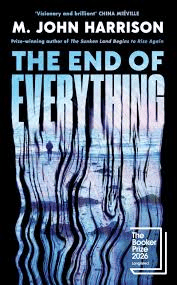
The End of Everything defies categorisation. The term ‘dystopian fiction’ helps a little – the novel is set in an indeterminate future where society as we know it has largely broken down, although there is still some form of social order. It could also be categorised as science fiction, as the world is now occupied by an alien race known as the iGhetti who seem to have come to an accommodation with humanity, and co-exist alongside them – or, it is unclear, they might be destroying the world very slowly. There are also ‘bad patches’ – areas in the countryside where the normal rules of time and space have ceased to exist, and weird things happen. It’s best not to get caught in a bad patch – you might not be able to get out. ‘Speculative fiction’ is just too broad a genre to be of any help here. In the end the label that helped me come to terms with this novel the most was new weird fiction, a term that Harrison himself coined.
The search for a genre label might appear to be an attempt to put Harrison’s text into a framework that limits it, ties it down, but The End of Everything easily sidesteps any such attempt. It is unlike anything I have read before, and was consciously unsettling and disturbing. The narrative, such as it is, follows a beachcomber named Phillip who finds an ‘artefact’, something other-worldly left behind or created by the aliens. This artefact is never directly described, but it is alive, or has features that mimic life – it grows and adapts and can even be eaten, but is hard if not impossible to kill. It appears to be able to adapt to its environment and develop in ways that mimic the things around it – in this case Philip. Philip takes the artefact to his 70-year-old aunt Marnie, an artist suffering from early-stage Alzheimer’s disease. defends her townhouse and starts her own journey from gallery to gallery. Phillip decides to dispose of the artefact, and heads away from the coast. Following a ‘dispute’ with her neighbours, Marnie embarks on her own nomadic journey up the coast.
The disturbing scene which describes this dispute appears early on in the novel and firmly establishes the tone. I would not read this if you are in any way squeamish. Marnie lives in a ramshackle house. One day a fourteen year old boy climbs into the extension of her house and, finding her sleeping in the room below, urinates on her.
“He turned to run away and put his foot through the extension roof. Totten plaster pattered down inside. His left leg dangled into the room beneath, scrabbling for purchase. He began to call out in a high voice. “I have you now, you little bastard” Marnie told him. She wiped herself off and went inside, where she rummaged about in the kitchen until she found a metre or two of old electrical flex. This she fastened round the boy’s ankle, anchoring the other end to the heaviest object she could find, which happened to be the bed, to limit the movement of the leg. Once she was satisfied, she went outside again and pulled herself up on the edge of the extension roof until she could look at him.
“How do you feel about this now?” she said. The boy was in half-sitting half-kneeling position, his visible leg quivering with the strain of supporting him…. Marty went back inside. After some consideration, she grasped the tethered leg in both hands and hung from it. “No one in the street likes you”, she shouted. “Do you hear?” Then she found a knife in a cupboard, cut into the boys femoral artery and stepped quickly away from the spray of blood. She stood there for a moment watching the leg flail and spurt…. She watched for a minute or two as the boy lost energy, then turned away and leaned on the balcony rail, looking up and down the row at the overgrown gardens…. She went to talk to the boy’s father, who lived a couple of doors down. They sorted things out between them, and the father sent someone to lever his dead son out of her extension roof…..
After breakfast the boy’s father called, with delegation comprised of half a dozen other people who lived along the street. “Some of us feel you went too far”, he said, implying perhaps that he didn’t. ….The general feeling, the father said, the feeling of everyone there, was that Marnie should leave. “I can see I can see why you might say that” she said, although she couldn’t. ” I’ve lived here longer than any of you, but I can see why you might say that.”
I’ve quoted this awful, upsetting scene at considerable length (even though I have edited it down substantially, shown by the ellipses) because it is such a striking, unsettling episode. Killing a young boy (turns out he was actually 12, not 14 as Marnie believes) is done so casually, and with so few consequences, as if she has committed some minor social faux pas, rather than murder. Marnie is asked, politely, with typical British understatement, to move on, but other than that she is free to go. We are not in a typical dystopian world where life is cheap because of the breakdown of social order – instead this is a world where killing people casually, almost disinterestedly, is accepted, not normal, but not distressing either. This is not the only casual killing in the novel – Marnie has a gun, and uses it when she feels the need – but it is the one that stands out the most, coming early in the novel and setting the tone for what is to come. The reader has no frame of reference to respond to this incident – this is unlike any other dystopia, any end of the world written about before. Obviously the author’s intention is to unsettled the reader, to remove any solid ground from under them. Mission accomplished.
The rest of the novel follows this template. You never quite know what is happening. There is a narrative structure, of sorts, but it is not that important. Neither are the principal characters. People are introduced, things happen, nothing really makes much sense.
I turned to the internet for help in framing my reactions to the novel, and come across this review by sci-fi blogger At Boundary’s Edge. The blogger observes in one very telling sentence that “Harrison isn’t telling us a story. He’s selling us an experience.” This makes a lot of sense. Don’t read the novel to find out ‘what happens’ or to enjoy the story, because there really isn’t much of one. Instead, immerse yourself in the experience of reading a M John Harrison novel, like taking a drug that you aren’t sure how you are going to react, whether the experience is going to be a good one or not, but it is definitely going to be an experience. Another reviewer over on Goodreads wrote: “There’s using confusion and warped perception as a literary tool, and then there’s this. As soon as it started approaching interesting concepts, it swiftly turned away to then prattle on about nothing of substance… It shouldn’t be this much of a slog to get through a 200 page book.” And there we have it. Because I did find it hard to make my way to the end of The End of Everything. There was no-one to care about, no plot to resolve or end, even the mildly interesting puzzle of what the artefact might be or become is left unclear – and I was left feeling a little embarrassed at my need for clarity or resolution. Alongside the weirdness there is plenty of lyrical descriptive writing suggesting Harrison is a skilled and capable writer, but this is definitely a case where for me the strangeness went that little bit too far. The Booker Prize panel obviously disagreed, long-listing this novel for the 2026 award, but I would be shocked if it makes it any further in the process.
3 thoughts on “The End of Everything by M John Harrison, 2026”
I discovered M John Harrison in the 1970’s when he was a regular contributor to the UK monthly “New Worlds”, and I came to love his eerie, disturbing stories and novels. Recently I have been catching up with his more recent work. I would agree that the “experience” is more striking than details of plot or character, although episodes like the one you quote are unforgettable. If you are looking for a slightly more conventional novel, I would strongly recommend his 2020 work “The Sunken Land Begins To Rise Again”.
I just found this story weird. If there was some development of the characters and some maybe development of the artefact, it might have been different, but I was just left thinking, what is going on? Which may well be the point..
Also I found that early scene with the boy who falls through the roof to be so overly vindictive without context. Sure, I would not want to be pissed on.. but…



I discovered M John Harrison in the 1970’s when he was a regular contributor to the UK monthly “New Worlds”, and I came to love his eerie, disturbing stories and novels. Recently I have been catching up with his more recent work. I would agree that the “experience” is more striking than details of plot or character, although episodes like the one you quote are unforgettable. If you are looking for a slightly more conventional novel, I would strongly recommend his 2020 work “The Sunken Land Begins To Rise Again”.
LikeLiked by 1 person
I just found this story weird. If there was some development of the characters and some maybe development of the artefact, it might have been different, but I was just left thinking, what is going on? Which may well be the point..
Also I found that early scene with the boy who falls through the roof to be so overly vindictive without context. Sure, I would not want to be pissed on.. but…
LikeLiked by 1 person
Pingback: Booker Short List – 2026 – Yarra Book Club