For years Phillip Tennent lived at the end of the sea, where artefacts were washed up every day. Scavengers, professional and otherwise, came and went. Turnover was higher than you’d expect given the relaxed lifestyle, the constant good weather, the ease with which some sort of existence could be pursued.
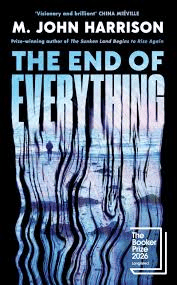
The End of Everything defies categorisation. The term ‘dystopian fiction’ helps a little – the novel is set in an indeterminate future where society as we know it has largely broken down, although there is still some form of social order. It could also be categorised as science fiction, as the world is now occupied by an alien race known as the iGhetti who seem to have come to an accommodation with humanity, and co-exist alongside them – or, it is unclear, they might be destroying the world very slowly. There are also ‘bad patches’ – areas in the countryside where the normal rules of time and space have ceased to exist, and weird things happen. It’s best not to get caught in a bad patch – you might not be able to get out. ‘Speculative fiction’ is just too broad a genre to be of any help here. In the end the label that helped me come to terms with this novel the most was new weird fiction, a term that Harrison himself coined.
The search for a genre label might appear to be an attempt to put Harrison’s text into a framework that limits it, ties it down, but The End of Everything easily sidesteps any such attempt. It is unlike anything I have read before, and was consciously unsettling and disturbing. The narrative, such as it is, follows a beachcomber named Phillip who finds an ‘artefact’, something other-worldly left behind or created by the aliens. This artefact is never directly described, but it is alive, or has features that mimic life – it grows and adapts and can even be eaten, but is hard if not impossible to kill. It appears to be able to adapt to its environment and develop in ways that mimic the things around it – in this case Philip. Philip takes the artefact to his 70-year-old aunt Marnie, an artist suffering from early-stage Alzheimer’s disease. defends her townhouse and starts her own journey from gallery to gallery. Phillip decides to dispose of the artefact, and heads away from the coast. Following a ‘dispute’ with her neighbours, Marnie embarks on her own nomadic journey up the coast.
The disturbing scene which describes this dispute appears early on in the novel and firmly establishes the tone. I would not read this if you are in any way squeamish. Marnie lives in a ramshackle house. One day a fourteen year old boy climbs into the extension of her house and, finding her sleeping in the room below, urinates on her.
“He turned to run away and put his foot through the extension roof. Totten plaster pattered down inside. His left leg dangled into the room beneath, scrabbling for purchase. He began to call out in a high voice. “I have you now, you little bastard” Marnie told him. She wiped herself off and went inside, where she rummaged about in the kitchen until she found a metre or two of old electrical flex. This she fastened round the boy’s ankle, anchoring the other end to the heaviest object she could find, which happened to be the bed, to limit the movement of the leg. Once she was satisfied, she went outside again and pulled herself up on the edge of the extension roof until she could look at him.
“How do you feel about this now?” she said. The boy was in half-sitting half-kneeling position, his visible leg quivering with the strain of supporting him…. Marty went back inside. After some consideration, she grasped the tethered leg in both hands and hung from it. “No one in the street likes you”, she shouted. “Do you hear?” Then she found a knife in a cupboard, cut into the boys femoral artery and stepped quickly away from the spray of blood. She stood there for a moment watching the leg flail and spurt…. She watched for a minute or two as the boy lost energy, then turned away and leaned on the balcony rail, looking up and down the row at the overgrown gardens…. She went to talk to the boy’s father, who lived a couple of doors down. They sorted things out between them, and the father sent someone to lever his dead son out of her extension roof…..
After breakfast the boy’s father called, with delegation comprised of half a dozen other people who lived along the street. “Some of us feel you went too far”, he said, implying perhaps that he didn’t. ….The general feeling, the father said, the feeling of everyone there, was that Marnie should leave. “I can see I can see why you might say that” she said, although she couldn’t. ” I’ve lived here longer than any of you, but I can see why you might say that.”
I’ve quoted this awful, upsetting scene at considerable length (even though I have edited it down substantially, shown by the ellipses) because it is such a striking, unsettling episode. Killing a young boy (turns out he was actually 12, not 14 as Marnie believes) is done so casually, and with so few consequences, as if she has committed some minor social faux pas, rather than murder. Marnie is asked, politely, with typical British understatement, to move on, but other than that she is free to go. We are not in a typical dystopian world where life is cheap because of the breakdown of social order – instead this is a world where killing people casually, almost disinterestedly, is accepted, not normal, but not distressing either. This is not the only casual killing in the novel – Marnie has a gun, and uses it when she feels the need – but it is the one that stands out the most, coming early in the novel and setting the tone for what is to come. The reader has no frame of reference to respond to this incident – this is unlike any other dystopia, any end of the world written about before. Obviously the author’s intention is to unsettled the reader, to remove any solid ground from under them. Mission accomplished.
The rest of the novel follows this template. You never quite know what is happening. There is a narrative structure, of sorts, but it is not that important. Neither are the principal characters. People are introduced, things happen, nothing really makes much sense.
I turned to the internet for help in framing my reactions to the novel, and come across this review by sci-fi blogger At Boundary’s Edge. The blogger observes in one very telling sentence that “Harrison isn’t telling us a story. He’s selling us an experience.” This makes a lot of sense. Don’t read the novel to find out ‘what happens’ or to enjoy the story, because there really isn’t much of one. Instead, immerse yourself in the experience of reading a M John Harrison novel, like taking a drug that you aren’t sure how you are going to react, whether the experience is going to be a good one or not, but it is definitely going to be an experience. Another reviewer over on Goodreads wrote: “There’s using confusion and warped perception as a literary tool, and then there’s this. As soon as it started approaching interesting concepts, it swiftly turned away to then prattle on about nothing of substance… It shouldn’t be this much of a slog to get through a 200 page book.” And there we have it. Because I did find it hard to make my way to the end of The End of Everything. There was no-one to care about, no plot to resolve or end, even the mildly interesting puzzle of what the artefact might be or become is left unclear – and I was left feeling a little embarrassed at my need for clarity or resolution. Alongside the weirdness there is plenty of lyrical descriptive writing suggesting Harrison is a skilled and capable writer, but this is definitely a case where for me the strangeness went that little bit too far. The Booker Prize panel obviously disagreed, long-listing this novel for the 2026 award, but I would be shocked if it makes it any further in the process.
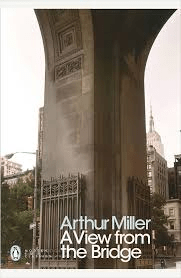
A View from the Bridge is set in 1950s New York in an Italian-American neighbourhood. It is narrated by Alfieri, a lawyer, who opens the play by describing the violent history of the Italian/American community. He tells us that second-generation Italians are now more civilized and they use the law to resolve their disagreements. But there are exceptions, one of which is the story of the play.
Eddie Carbone, an Italian American dock worker, lives with his wife Beatrice and her orphaned niece Catherine in a small apartment in Brooklyn. Eddie is protective and fatherly towards Catherine, but it slowly becomes apparent that as she approaches her 18th birthday his feelings for her are becoming dangerously unfatherly, especially as his relationship with his wife is no longer sexual. Catherine is ready to start stretching her wings and step out from the protective shadow of Eddie. He objects to her taking a job and to the way she dresses, anything that would expose her to the attention of other men. Beatrice seems to be aware that Eddie’s feelings towards Catherine are no longer purely paternal and encourages her to take the job, as a step towards eventual freedom and independence.
One afternoon Eddie breaks the news that he has agreed to accommodate two of Beatrice’s cousins, Marco and Rodolpho, who have arrived in New York as illegal immigrants. Illegal immigration was strictly enforced at this period in American history, which tells us some things don’t change, and if discovered the cousins are almost certain to be deported. However, within the protective Italian American community they are still able to work. Life back home in Italy is poverty stricken and immigrating to America using a network of people smugglers is a common means of escape.
Rodolpho is the more flamboyant of the two brothers – Marco is more brooding. While Marco plans to eventually return to Italy, Rodolpho wants to forge a career as a singer. His tendency to break into song while working on the docks attracts the wrong type of comment. Difference is suspect, and Eddie thinks (and perhaps hopes) he might be gay. This suspicion only becomes an issue when Rodolpho and Catherine start dating. Put simply, Eddie is jealous. When his attempts to ‘lay down the law’ and break them up fail, Eddie seeks advice from Alfieri, hoping that the law will prevent Catherine and Rodolpho from marrying. Of course he has no proof that Rodolpho is gay and is just marrying Catherine for a passport. Alfieri tells him the only thing he can do is report Rodolpho and Marco as illegal aliens, but this advice is framed as something that is unthinkable in the context of the ethics of the community. Time passes and things deteriorate, with Eddie becoming frantic about the trajectory of Catherine and Rodolpho’s relationship. Desperate (and drunk) he tries to prove Rodolpho is gay by kissing him. He then goes back to Alfieri, claiming that the kiss and specifically Rodolpho’s reaction, proves he is gay. Alfieri repeats his advice – the law cannot help. Eddie then does something that is taboo – even more so than being gay or wanting to sleep with your step-daughter – he reports the brothers to immigration services. The officials arrest Marco and Rodolpho and while Eddie claims the arrest is a surprise he convinces no-one. He is treated as persona non grata by the community. Alfieri bails the brothers out of custody but as soon as he is released Marco confronts Eddie, a fight breaks out and tragedy ensues.
A View from the Bridge has an interesting production history. It was first staged in 1955 as a one-act play. After it was poorly received Miller revised and extended the play to two acts. This longer play was much more successful and is the version most often performed today and is the one I read. The play’s origins go back to 1947. Miller was researching a screenplay in an area of New York near the docks. That screenplay eventually became ‘The Hook,’ which was based on a true story about corruption in the longshoremen’s union. Miller asked his friend Elia Kazan to direct the film, but when they tried to get funding for the shoot Columbia Pictures insisted in changes to the screenplay, in particular that the focus be changed from corrupt union leaders to Communists. Miller refused and the film was never made. Fast forward a few years and Kazan was making ‘On the Waterfront’, which is very closely based on ‘The Hook’. Kazan had testified before the House Committee on UnAmerican Activities naming several of his former friends and fellow Communists, leading to them being blacklisted and struggling for years to find work in America – some had to go to the extreme of moving to the UK to work in cinema and theatre. Miller had been called before HUAC but had pleaded ‘the fifth’ i.e. refused to testify. ‘On the Waterfront’ was an attempt to excuse Kazan’s betrayal of his friends. In this Hollywood version of McCarthyism, those who betray their friends are the heroes. A View from the Bridge is Miller’s dramatic response to that argument. Betraying your friends is not heroic – but neither is it a simple case of villainy. Miller seems to be arguing that those who betray their families and friends are obviously in the wrong, but that their motivations can be complex and in some ways understandable. The play is obviously much more than a simple response to McCarthyism, but this context does inform any reading of the play. And of course the drama has much more significant contemporary resonance, with the issues of deportation and what it means to be American once more front and centre of the political stage. Any modern production that does not have the immigration officers dressed as ICE thugs would be missing a dramatic open goal.
When Ibsen’s Hedda Gabler opens, Hedda and her husband Jorgen have just arrived in their new home from an extended – five or six months – honeymoon. Jorgen’s aunt, Julle, is keen to know whether Hedda is already pregnant and drops many hints on the subject, such as “I don’t expect you wasted your time on your honeymoon, did you, Jorgen?”. At first Jorgen completely ignores her. When he later wonders what they are going to do with their spare rooms, Julle says “You might find a use for them, when the time comes”. He perks up at the idea that the rooms could be used to store his books and papers! As she is preparing to leave, Jorgen says of Hedda, who has by this point joined them, “Have you noticed how well and bonny she looks? I declare she’s filled out beautifully on the trip.” “Filled out” is a strange expression to use of a 29 year old woman (obviously a potential translation issue) but is typical of the way Jorgen infantilises Hedda. It would not be surprising for a nineteenth-century couple to fall pregnant on their honeymoon given the lack of readily available effective contraception (and the long cold Scandinavian nights!). But Hedda angrily rejects any such suggestion: “Oh, do you have to…“. When Julle leaps eagerly on the hint: “Filled out?“. Tesman replies “Yes, Aunt Julle, you don’t notice it so much when she’s wearing that dress. But I…well, I have occasion to….” Tesman is scandalously suggesting he has seen her naked and is therefore better able to judge whether she has ‘filled out’. Hedda again rejects the idea, insisting “I’m exactly the same as I was when we left“. Is this because she is indeed not pregnant, or is she in denial?
Act One ends with Hedda playing her favourite game of winding up those around her. She says to her husband “Oh well, I’ve got one thing at least that I can pass the time with“. He leaps to the assumption that she is hinting at a pregnancy and is crushed when she reveals she is talking about “My pistols, Jorgen“. This scene is also the reveal that Hedda was Lovberg’s secret lover, the punchline to Mrs Elvert’s earlier reference to “a shadow of a woman that stands between us (her and Lovberg). Someone from his past…He said that when they parted, she threatened to shoot him with a pistol”.
In Act two, the Judge joins in the hectoring of Hedda about her putative pregnancy, condescendingly telling her that her boredom with married life will pass “When you’re faced with…what may I … perhaps a little pompously…refer to as a sacred and ….and exacting responsibility? (Smiles). A new responsibility, my little lady.” Such language again infantilises Hedda, denying her agency, and once again, she rejects the idea immediately: “(angry) Be quiet! You’ll never see anything of the sort!” The Judge is as keen as Julle on the idea and won’t let it lie, responding “(carefully) We’ll talk about it in a year’s time… at the very latest”. This is met with yet another absolute rejection: “(shortly) I’ve no aptitude for any such thing, Mr Brack, No responsibilities for me, thank you!” And when he tries to continue the conversation, she shuts it down once more: “Oh, be quiet I say!”
If Hedda treats her pistols as substitute children, for Lovborg and Thea, the manuscript is their ‘baby’, one Hedda manically destroys, saying as she does so: “Now I am burning your child, Thea!—Burning it, curly-locks! [Throwing one or two more quires into the stove.] Your child and Eilert Lovborg’s. [Throws the rest in.] I am burning—I am burning your child.”
Lovborg and Thea agree that this manuscript was their child: (Mrs Elvsted): “Do you know, Lovborg, that what you have done with the book—I shall think of it to my dying day as though you had killed a little child.
Lovborg. Yes, you are right. It is a sort of child-murder.
Mrs Elvsted. How could you, then—! Did not the child belong to me too?”
In the play’s final act, there is a scene which is almost universally interpreted as confirmation that Hedda is indeed pregnant. She has just confessed to Tesman to having burnt Lovborg’s manuscript and continues:
“Well, I may as well tell you that—just at this time— [impatiently breaking off.] No, no; you can ask Aunt Julle. She will tell you, fast enough.
Tesman. Oh, I almost think I understand you, Hedda! [Clasps his hands together.] Great heavens! do you really mean it! Eh?
Hedda. Don’t shout so. The servant might hear.
Tesman. [Laughing in irrepressible glee.] The servant! Why, how absurd you are, Hedda. It’s only my old Berte! Why, I’ll tell Berte myself.
Hedda. [Clenching her hands together in desperation.] Oh, it is killing me, —it is killing me, all this!”
If this ‘confession’ is intended to ensure Jorgen’s continuing devotion, it is short-lived, as he almost immediately throws himself into the attempt to recreate the burnt manuscript with Mrs Elvsted. His hypothetical child-to-be is quickly forgotten. But it is far from explicit.
If you google ‘Is Hedda Gabler pregnant?’ all the online sources agree – yes, she is pregnant, but she is in denial about it. But wait a minute – have you spotted the irony there? This argument suggests that Hedda doesn’t know her own body. All the characters who assume she must be pregnant after her honeymoon are quick to pick up on any indications she might be gaining weight (and some productions add detail such as her having morning sickness, to press the point home). Both characters within the play and critics seem to agree on this point – but Hedda herself has no agency in this issue. We are told very little about the honeymoon or the characters’ intimate life, other than the fact that Hedda finds her husband “horribly tedious”, (his academic focus is on “An Account of the Domestic Crafts of Medieval Brabant”) but we go along with the nods and the winks, the innuendo implicit in phrases such as ‘blossoming‘. Are we the audience being cast as avatars of Aunt Julle and others, clucking over an anticipated ‘happy event’ without ever once listening to Hedda?
Why does this matter? Hedda’s decision at the end of the play is usually interpreted as a form of escape, a decision to leave a situation in which she feels trapped without any other option. I tis worth remembering that the murder (as they would have seen it) of an unborn child would have been an abomination to a Victorian audience. Norway was a largely Evangelical Lutheran society (so the internet tells me) but most nineteenth century audiences would have been shocked and appalled at Hedda’s actions, both towards herself and her unborn child. While generalisations are difficult I expect she would have attracted little sympathy. This is borne out by the initial critical reactions to the play which were a mixture of bewilderment and hostility, with critics calling its 1891 premiere in Munich a “hideous nightmare of pessimism,” ‘immoral’, and Hedda herself a “beast”. Despite this reception audiences kept coming, compelled by the drama of the piece.
This is of course one of those literary puzzles to which there can never be a definitive answer. Ibsen leaves enough evidence for the reader to conclude that Hedda both is and isn’t pregnant, with the actors and producers being given a form of casting vote in terms of how they portray the character. But I would suggest this is not a simple choice and is one which can potentially influence the impact of the whole play on audiences.
Postscript
It occurred to me a while after writing the above that it treats the issue of pregnancy in a very binary way. Technically that may be true – a woman is either pregnant or she is not – but in reality the situation can be and often is more complicated. For instance, a woman may be pregnant but not realise it – quite possible in Hedda’s case. Equally the reverse can be true. More commonly, a woman might simply not be sure whether she is pregnant or not. In the days before modern pregnancy testing that must have been an almost universal experience in the early weeks of pregnancy. It is also quite possible that Hedda is unable to have children – this would explain her attempted ‘confession’ to Jorgen in Act Four – or that she had been pregnant but had miscarried – again, something that she would probably feel merited a confession. It is also not beyond the bounds of possibility that Jorgen is not the father of Hedda’s hypothetical baby, which would go some way to explaining her cry that it is killing her. So the ‘Hedda is pregnant but in denial’ interpretation of this aspect of the play is one of many supported by the text if the reader and performers are prepared to open themselves up to alternative and arguably more interesting readings.
I think I am going to try and read, and review, more plays this year, even though I remain steadfast in my view that plays are for watching not reading. Sure you can read them, but in doing so you could easily miss much of the nuance and subtlety of a play that would be brought out in performance.
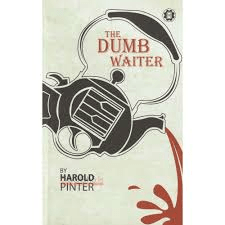
Just to explain the dates above, the internet tells me that The Dumb Waiter was written in 1957 but not performed until 1960. Either way that makes it one of Pinter’s earliest works. It is a short one-act play in which two men, Ben and Gus, wait in a basement. Ben, apparently the senior member of the two, reads a newspaper, while Gus fusses around nervously. Tea is mentioned but never quite made. As their conversation progresses it emerges that they are hit-men, waiting for an assignment and instructions on who to kill. Their conversation is dominated by mundane, everyday nonsense such as the difference between the phrase ‘light the kettle’ and ‘put on the kettle’. There is almost a vaudeville, back and forth element to their conversation, but at the same time there is a sinister undertone.
Pinter’s stage directions are very detailed and one of the reasons for this emerges when the men realise that at the back of the room is a dumbwaiter, a small lift for carrying food between floors. The waiter starts to deliver a series of food orders, as if to a restaurant kitchen – at first for plain café food – soup of the day, liver and onions, jam tart – and then for more complex orders – macaroni pastistsio, ormitha macaroundada, and scampi. Ben and Gus are dumbfounded by this turn of events, but are so used to doing what they are told that they send up what food they have – milk, biscuits, crisps and chocolate – in a pathetic attempt to comply. . In production I can imagine that this part of the play would be essentially comic, but on the page the tragic element also comes across – they are unable to understand what is happening to them, but still try to do their best. Next to the dumb waiter is a speaking tube which they try to use to communicate with whoever is sending down the orders, but to no avail.
In a break from the dumb waiter’s interruptions, the men start to rehearse the impending assassination, which complies with a strict sequences of events. In doing so they casually but shockingly reveal that their last ‘job’ was to kill a girl.
The impact of Beckett’s Waiting for Godot on this early work by Pinter is immediately obvious – two anonymous characters waiting in a remote location for something to happen, passing time with inane chat that reveals their concerns about their purpose in life. There is no conventional narrative or storyline (although in Pinter’s play there is a dramatic denouement) and absurd and unexplained events challenge the characters’ ideas. Long periods of silence allow space for the claustrophobic tension of the setting to develop. The Dumb Waiter is often produced alongside another of his one-act plays, but I can’t help wonder whether a contrasting text – something by Joe Orton for example – might work as effectively? If you want to read more British post-war plays then The Dumb Waiter is an excellent starting point. Pinter was a key figure in post-war British drama and went on to be awarded the Nobel Prize for literature in 2005, being cited for work that “”uncovers the precipice under everyday prattle and forces entry into oppression’s closed rooms”.
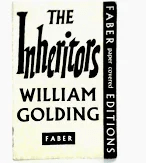
The Inheritors is a fascinating, challenging novel by the author ofLord of the Flies, with which it shares some points of similarity. It is set in prehistoric times and follows a community of stone-age people moving from their winter quarters to their summer base. The novel is prefaced by a quote from H G Wells’s Outline of History explaining how little is known about Neandethal man. Although this is presented as a key to interpreting the text that follows, it is somewhat misleading, as the reader comes to learn.
The Inheritors is told largely from the perspective of Lok, one of ‘the people’, a term they use to describe their small group. It is not clear if the people have had contact with other communities before. It is quickly clear however that they are a very primitive tribe. One way Golding illustrates this is that they struggle with most kinds of abstract or conceptual thought. We see this early in the novel, when Lok finds that the log the group has habitually used to cross a river has been removed:
“He shut his eyes and frowned at the picture of the log. It had lain in the water from this side to that, grey and rotting. When you trod the centre you could feel the water that washed beneath you, horrible water, as deep in places as a man’s shoulder. The water was not awake like the river or the fall but asleep, spreading there to the river and waking up, stretching on the right into wilderness of impassable swamp and thicket and bog. So sure was he of this log the people always used that e opened his eyes again, beginning to smile as if he were waking out a a dream; but the log was gone. “
You will note that the author uses the phrase ‘as deep in places as a man’s shoulder’. Elsewhere the term ‘old woman’ is used. So we are subtlety led to understand that these people are men and women, or consider themselves as such. But they have virtually no tools, no clothing, a very limited understanding of the world around them, and are almost completely unable to use abstract ideas (although they are able to control fire). Which prompts the reader to ask – just how primitive are they? – and critically, are they homo-sapiens, the species that went on to inherit the earth (in the terms of the novel’s title), or are they another species entirely? We are initially encouraged – by the novel’s title, the focus on the group, the first person narration and the use of the terms man and woman – to think they are the inheritors, our ancestors, but we come to realise that assumption might not be right. That doubt accelerates or is confirmed when the group comes into contact with the Others. This new group wear clothes, use tools including weapons and boats, and kill the people casually immediately on contact. The people are quickly reduced to two adults – Lok, Fa, a female, and two children, Liku and an unnamed baby. The newcomers kidnap the children and shoot arrows across the river at Lok, who doesn’t understand what is happening:
Suddenly Lok understood that the man was holding the stick out to him but neither he nor Lok could reach across the river. He would have laughed if it were not for the echo of the screaming in his head. The stick began to grow shorter at both ends. Then it shot out to full length again. The dead tree by Lok’s ear acquired a voice. “Clop!” His ears twitched and he turned to the tree. By his face there had grown a twig: a twig that smelt of other, and of goose, and of the bitter berries that Lok’s stomach told him he must not eat. This twig had a white bone at the end. There were hooks in the bone and sticky brown stuff hung in the crooks. His nose examined this stuff and did not like it.
Despite his understanding that the sticky brown stuff at the end of the arrow is unpleasant, (he has a highly advanced sense of smell) Lok is simply unable to conceive of the fact that he is being attacked. Later he again has arrows fired at him and crucially he has learnt nothing from his original encounters with the Others and reacts in a bemused way. The people are so isolated that they are unable to comprehend the danger that the Others represent – without this instinct for self-preservation they are doomed. Although wary of the Others once they have killed four of his group, Lok is also fascinated by them – running away doesn’t occur to him. Fa, more perceptive than Lok, tries to persuade him to flee, but he is focussed on rescuing the children. When Liku, the older child, is apparently killed and possibly eaten by the Others, Fa sensitively protects Lok from this fact. As we see the events of the novel from Lok’s perspective it is some time before we (and he) realise what has happened to Liku. More generally, his limited vocabulary and understanding of the world at times makes the novel hard to follow. The reader has to decode everything – the example given above of the arrow being fired at Lok is straightforward enough, but much of the time things are confused and unclear. This means that The Inheritors is a novel that demands to be read carefully. Ben Okri’s introduction to the Faber and Faber edition puts it this way:
“It is the kind of novel in which the real reading starts with the second reading. Then the work becomes clearer with every sentence and yet not so clear. In the second half, much has to be pieced together in the highly suggestive writing. Readers have to discover for themselves what is meticulously described. This makes us inhabit the restricted comprehension of ‘the people’, sometimes understanding and sometimes not.”
The novel is redolent with symbolism and particularly Biblical imagery. The group are described as the people of the Fall. In one sense this is literal, as their summer camp is next to a waterfall, but the analogy with the Adam and Eve story, with the people embodying an innocence that has no concept of sin or violence, and the Others representing the violence of Cain. It is relevant that the people have a cultural taboo against killing animals, although they will eat the abandoned or stolen prey of wild animals. The Others have developed an alcoholic drink and the scene where Lok and Fa accidentally get drunk and are completely disorientated by the experience is analogous to Adam and Eve being tempted to eat the fruit of the tree of knowledge of good and evil. If this sounds a somewhat heavy-handed use of symbolism that is more down to my summary than Golding’s writing which is done with much more sensitivity and lightness of touch.
The novel ends, famously, with two sudden changes of perspective. From the moment Fa is swept away over the waterfall, the narrator steps back, and instead of showing us the world and its events from Lok’s perspective, looks at him dispassionately. He suddenly – mid-chapter – becomes “it” and “the red creature”. We have seen this description used once before, when in Chapter 11 we see Fa from Lok’s eyes and she is described as “red as a squirrel, running mostly on all fours“, but this is the first detailed description of the people’s appearance:
“It was a strange creature, smallish and bowed. The legs and thighs were bent and there was a whole thatch of curls on the outside of the legs and arms. The back was high and covered over the shoulders with curly hair. Its feet and hands were broad, and flat, the great toe projecting inwards to grip. The square hands swung down to the knee. “
The novel’s final chapter sees another switch in perspective, almost as shocking. It is written from the viewpoint of Tuami, one of the homo sapiens group that has brought such destruction into the simple lives of the people. This group are scared – terrified – of the people and are running away from them. Tuami is plotting to kill the group’s leader and replace him. But for now they are fleeing from the strange and dangerous people who they think of as devils. They have with them the Neanderthal baby, adopted as a pet. The Others have been scarred and damaged by their encounter with the people and will carry traces of this meeting for a long time, choosing to avoid the forest where they think they live. These are the real inheritors – and they are us. As he does in Lord of the Flies, Golding exposes man’s true nature. I wouldn’t want to reduce this complex narrative to a simple parable – ‘we are the real monsters’ – but there’s no doubt that is a significant part of the overall theme of the novel.
As Golding’s second novel this is a powerful follow up to Lord of the Flies and a novel that is perhaps not read as widely as it should be. That might in part be because of its perceived difficulty and partly because (slightly surprisingly) it has never been filmed. It is thoughtful and thought-provoking. Highly recommended.
Although Changing Places was written in 1975, it is set in 1969, and those six years are significant. The events of the novel take place in parallel on campuses in England and America, and the spirit of the sixties is abroad in both. Protest and counter-culture are in the air. By 1975 Nixon was out of the White House, the Vietnam War was coming to an ignominious end, the Beatles had split up and flower power was a distant memory.
To an extent this made Changing Places anachronistic even when it was published. It was looking back nostalgically at a period in time which was very close but also gone for good. That anachronism has inevitably widened over time. Professors sleeping with their students and one another’s wives may have been the height of liberation in the sixties – today it just looks creepy.
The novel is a classic trading places situation comedy. Two English professors, mild-mannered Philip Swallow, and charismatic American Morris Zapp, swap roles in their respective universities, thinly disguised versions of Birmingham, UK and Berkeley, California. They find themselves in very unfamiliar territory both academically and socially and much of the novel’s humour derives from their struggles in their new environments in traditional fish out of water manner. Both men almost inevitably have affairs while on their academic sabbaticals; more surprising is their involvement in the student protests that sweep their campuses. While Swallow finds himself accidentally involved in the demonstrations, Zapp is well-suited to his role as mediator between students and faculty.
Lodge has fun with the format of the novel, at one point continuing the narrative through news headlines and stories and later using a screenplay format. This serves to keep the story fresh and moves it along at pace. A significant time jump two thirds of the way through, moving quickly past some of the events that had been sign-posted and are now seen in hindsight, adds to the sense of pace. The novel ends with the two couples convened in a New York hotel room trying to decide their fates. The author has fun with the idea first articulated in Northanger Abbey that the reader knows the novel is coming to a close (and therefore a resolution of any outstanding plot points) by the “tell-tale compression of the pages” but chooses instead to leave issued unresolved – until the sequel of course.
The acid test for any comic novel has to be ‘is it funny?’. The quote on the front cover of the edition I read (shown above) has a comparison to Lucky Jim, a novel that I think has largely fallen out of fashion in recent years and is now equally anachronistic. There was a time when the Kingsley Amis novel would have been in my top ten novels list, but it hasn’t aged well. I think a more interesting comparison would be with Malcolm Bradbury’s The History Man which was published in the same year as Changing Places and which takes a much more unblinking, less affectionate look at British academic life. Is Changing Places funny? It’s mildly amusing, nothing more; the satire is so gentle as to be hardly noticeable. I now need to decide whether to read the sequel, with a nagging suspicion that it might simply be more of the same. Only one way to find out I suppose.
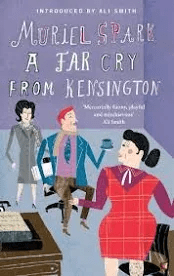
Muriel Spark is on my auto-buy list. When browsing in second hand bookshops I have a few authors I always buy if I can find them. As long as the book is reasonably priced, in decent condition, and I don’t already have it, I will always buy novels by, among a small number of other authors, Muriel Spark. Her novels are always interesting and worth reading, and A Far Cry from Kensington was no exception.
Set in 1955, A Far Cry is narrated by the no-nonsense Mrs Hawkins, a thinly disguised semi-autobiographical portrait of the author. It centres on a “rooming house” in (you guessed it) Kensington – a large house divided into separate one room apartments – where a diverse set residents live under the care and supervision of the landlady, Milly. It is a comfortable community of people in transit, typical of post-war London, settled by individuals and couples looking to establish themselves in London and in life.
Mrs Hawkins works in publishing. Some of her reminiscences (the narrative is told in flashback, some thirty years later) are based on Spark’s own time working in this field. Initially she works for the Ullswater and York Press, a chaotic publishing house that is heading for bankruptcy. I haven’t researched the novel sufficiently to say this for certain but I would put good money on the fact that Ullswater Press has a real-life equivalent that went bust in the mid-1950s, causing something of a scandal at the time as the proprietor was subsequently jailed for fraud.
The novel’s villain is Hector Bartlett, a bad writer who has influential friends who try to secure publication of his writing. Hector takes to accidentally-on-purpose bumping into Mrs Hawkins on her daily walks in the park near her office, attempting to leverage this casual relationship into an introduction to her boss. Hector the writer is described thus
“Hector Bartlett, it seemed to me, vomited literary matter, he vomited and sweated, he excreted it…His writings writhed and ached with twists and turns and tergiversations, inept words, fanciful repetitions, far-fetched verbosity and long, Latin-based words.”
Hector the man is if anything even more harshly described:
“Red hair en brosse, brown corduroy trousers, tweed coat with leather patches on the sleeves, a yellow tie, and a green check shirt….with a pronounced stoop of the shoulders which made him seem older than he was… His face was round with a second fat chin”.
Mrs Hawkins describes him to his face as a ‘pisseur de copie” a urinator of journalistic prose, and never backs down from this undeniably confrontational phrase. Spark denied that Bartlett was a portrait of anyone specific in post-war literary London, which I suppose must be right given how libellous it would otherwise have been!
Bartlett uses his influence with Emma Loy, a successful novelist, to have Mrs Hawkins sacked from Ullswater Press and subsequently from another job in publishing when she continues to use this description of him and also refuses to rewrite his copy to make it acceptable for publication. This doesn’t have a significant impact on her career and even if it would have done she is not the kind of character to back down, even in the face of a direct plea from Ms Loy. She can’t stand him, and her instincts prove spot on when there are further revelations about his damaging behaviour towards other women in the novel.
A Far Cry isn’t just a series of anecdotes about the publishing world. While the residents of the boarding house all have their brief moments centre stage, Wanda, the Polish emigre seamstress, has a defining role when she receives a threatening letter, which leads to a downward spiral that, we eventually find out, was caused by the vengeful pisseur de copie.
Central to the novel is the bizarre practice of ‘radionics’. Radionics is a form of quack therapy that survives to this day (There is a Radionics Association that awards three-year diplomas and sells crystal pendulums). It claims that diseases and other medical conditions can be diagnosed and treated by applying electromagnetic radiation such as radio waves to the body from an electrically powered device. It ‘works’ only through the placebo effect. Mrs Hawkins has no time for it and it is no surprise that Hector Bartlett is an enthusiast proponent of the concept, using it to manipulate other characters in the novel. People undoubtedly do fall prey to this sort of scam, and while radionics may have faded out somewhat, certainly in the UK, other forms of manipulation have of course taken its place. Initially I found this all a bit clumsy, but on reflection the fact that there are many modern forms of the same pseudo-science that people fall prey to every day made me reconsider and feel more charitable towards the idea as a plot device.
This is a complex and rewarding novel in which Mrs Hawkins’ narration, even with the benefit of thirty years of hindsight, reveals only glimpses of what is ‘really’ going on – for example the identity of the anonymous threatening letters to Wanda is only revealed in passing at the end of the novel, the revelation pivoting on the spelling of the word “organisers”. The reader sees the events of the novel through the eyes of 1955 Mrs Hawkins as she experiences them in real time, with only occasional reassuring interjections by the 1980’s narrator. I have enjoyed other Spark novels more, but I could admire the artistry of A Far Cry without being blown away by its sophistication.
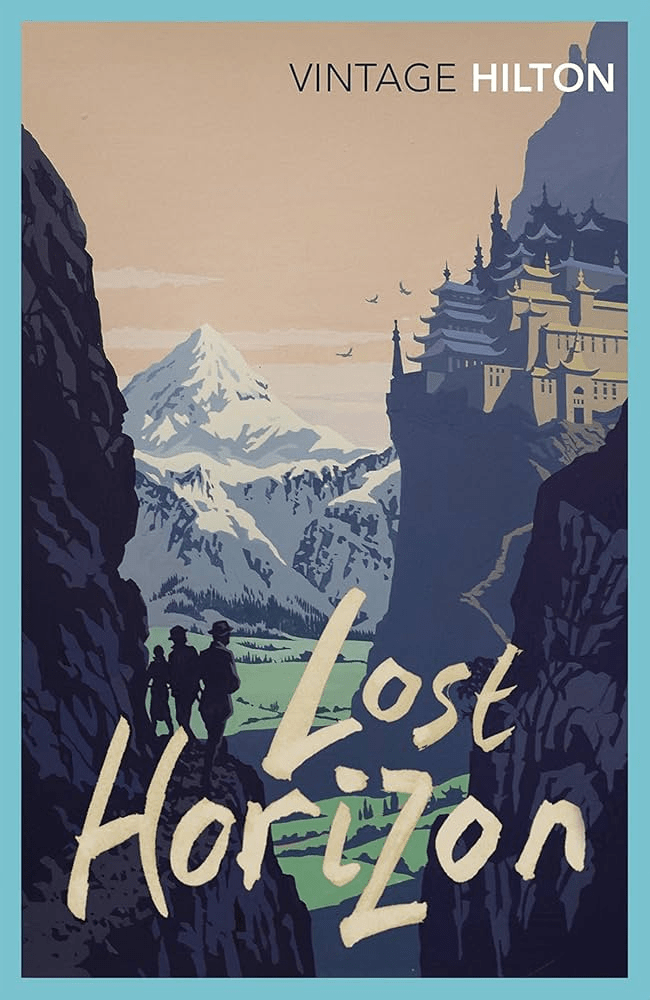
Hilton’s 1933 novel, Lost Horizons, is in many ways an unconventional adventure story. It is almost completely devoid of action scenes – there’s no fighting with ghastly foreigners; situations in which primitive natives are impressed by the explorers’ gadgets are conspicuous by their absence; there are no encounters with wildlife, traditional or Jurassic. It does admittedly share some DNA with the classic Victorian Lost World adventure story. It opens conventionally for example, with a complex framing device in which a story is told by one traveller to another about a tale they once heard:
“Cigars had burned low, and we were beginning to sample the disillusionment that usually afflicts old school friends who have met again as men and found themselves with less in common than they had believed they had.”
It takes some time before we penetrate these layers and get to the central story, in which four Western travellers, escaping from violent civil unrest in China, are taken by airplane to a secret valley in the Himalayas. Here they discover Shangri-La, a hidden and mysterious community governed by a monastery populated by enigmatic monks. Shangri-La has a secret – there is something about the valley that gives its inhabitants extremely long lives (we never discover what causes this effect, but it only applies to people who come to live in the valley, not the indigenous residents who barely feature).
The novel’s central character and narrator is Conway, an Allan Quartermain-type figure. Conway is a diplomat who is still haunted by his experiences in the First World War:
Twelve years earlier he had grown to hate the perils of trench warfare in France, and had several times avoided death by declining to attempt valorous impossibilities. Even his D.S.O. had been won, not so much by physical courage, as by a certain hardly developed technique of endurance.
Conway is accompanied by his junior envoy, Mallinson, Barnard, an American businessman, and Miss Brinklow, a missionary. Mallinson is keen to return to the outside world, but eventually learns that there is a price to Shangri-La’s gift of long life – once you go there you are never allowed to leave. While the others gradually come to terms with their life sentences, albeit in a very comfortable cage, Mallinson plots his escape, and finally persuades Conway to help him. While we are left to guess at Mallinson’s eventual fate, the last we hear of Conway is that he is trying to return to the remote and inaccessible valley.
Lost Horizons looks back nostalgically to the great adventure novels of the turn of the century when there were believed to be still undiscovered parts of the world. In those novels the focus was Africa or South America, but Hilton sets his story in an even more remote area, the unexplored zone between Nepal, Tibet and China.
“there came over him, too, as he stared at that superb mountain, a glow of satisfaction that there were such places still left on earth, distant, inaccessible, as yet unhumanized. The icy rampart of the Karakorams was now more striking than ever against the northern sky, which had become mouse-coloured and sinister; the peaks had a chill gleam; utterly majestic and remote, their very namelessness had dignity.
While British explorers and adventurers from Victorian novels would often treat the ‘foreigners’ they meet with contempt, Conway is a much more mature, might I even say liberal, traveller:
Conway had no race or colour prejudice, and it was an affectation for him to pretend, as he sometimes did in clubs and first-class railway carriages, that he set any particular store on the “whiteness” of a lobster-red face under a topee.
A persistent theme in the novel is the idea that Shangri-La will provide a safe haven for the coming global war. The idea that Europe was going to erupt into a war zone was common place at the turn of the century, but Hilton is prescient in his prediction that the same thing was going to happen again, this time on a global scale. Barnard, one of the kidnapped travellers who we eventually find out is a Wall Street financier on the run from the police, wanted for an unspecified financial crime, presumably embezzlement, is happy to stay in hiding because he believes the global economy is close to collapse. The head monk, Perrault, who established the monastery in the late eighteenth century, sees the speed of technological change happening in the world as likely to lead to war on an industrial scale:
“he saw the nations strengthening, not in wisdom, but in vulgar passions and the will to destroy; he saw their machine power multiplying until a single-weaponed man might have matched a whole army of the Grand Monarque. And he perceived that when they had filled the land and sea with ruin, they would take to the air… “But that was not all. He foresaw a time when men, exultant in the technique of homicide, would rage so hotly over the world that every precious thing would be in danger, every book and picture and harmony, every treasure garnered through two millenniums, the small, the delicate, the defenseless —all would be lost”
Perrault describes the coming war as a storm, and is clear that it will be an apocalypse of unprecedented scale and ferocity:
“The storm… this storm you talked of…”
“It will be such a one, my son, as the world has not seen before. There will be no safety by arms, no help from authority, no answer in science. It will rage till every flower of culture is trampled, and all human things are levelled in a vast chaos. Such was my vision when Napoleon was still a name unknown; and I see it now, more clearly with each hour. Do you say I am mistaken?”
Conway answered: “No, I think you may be right. A similar crash came once before, and then there were the Dark Ages lasting five hundred years.”
“The parallel is not quite exact. For those Dark Ages were not really so very dark—they were full of flickering lanterns, and even if the light had gone out of Europe altogether, there were other rays, literally from China to Peru, at which it could have been rekindled. But the Dark Ages that are to come will cover the whole world in a single pall; there will be neither escape nor sanctuary, save such as are too secret to be found or too humble to be noticed. And Shangri-La may hope to be both of these. The airman bearing loads of death to the great cities will not pass our way, and if by chance he should, he may not consider us worth a bomb.”
One inconsistency in the novel troubled me perhaps more than it should. The four travellers were kidnapped and taken to Shangri-La. Why? If people there don’t die for centuries, why the need for an infusion of fresh blood? The population of the valley may have been dwindling but we are told it is regularly topped up by explorers accidentally wandering into or near the valley. Conway and friends don’t bring any much-needed skills or experience and there’s every chance that Mallinson in particular will react violently to his kidnapping and life imprisonment, never to see family and friends again. He certainly doesn’t see Shangri-La as any kind of paradise:
There’s something dark and evil about it. The whole business has been like that, from the beginning—the way we were brought here, without reason at all, by some madman—and the way we’ve been detained since, on one excuse or another. But the most frightful thing of all—to me—is the effect it’s had on you.”
I appreciate I am over-thinking this. This is really a comic-book story in novel form that shouldn’t be taken too seriously. Hilton’s characterisation rest on stereotypes and the central conceit is more than a bit silly. The idea of a lost civilisation hidden from the outside world and containing secret treasures is a key feature of many late Victorian novels as the British empire began to approach the full extent of its reach and people came to realise there probably weren’t many more lost horizons in front of them.
Attitudes to sex in Lost Horizons
There are surprisingly frequent and explicit references to sex in Lost Horizons. Hilton has an interesting approach to this topic. References to sex in the novel are usually tangential and tentative but nevertheless surprisingly frequent and ultimately unambiguous. Traditionally adventure stories would skirt around the issue of sex, usually not mentioning it at all. But in Lost Horizons it is a part of people’s lives, just not one that can be talked about using everyday language. Instead euphemism is the order of the day. Take this example in which the missionary, Miss Brinklow, is discussed. Conway tells us that
“it was to Miss Brinklow that he spoke first. He realized that she was neither young nor pretty —negative virtues, but immensely helpful ones in such difficulties as those in which they might soon find themselves.”
Indirectly phrased this may be, but Conway is clearly saying that Miss Brinklow’s age and lack of attractiveness is going to helpful in the circumstances that they may soon find themselves – in other words that she is less likely to be raped because of her age and looks.
Later there is this exchange between Chang, their mysterious host at the monastery, and Conway, about sexual desire, and whether it can be a source of conflict in Shangri-La:
“Quite often,” replied Chang with a broad smile. “The lamas, of course, are immune, and so are most of us when we reach the riper years, but until then we are as other men, except that I think we can claim to behave more reasonably. And this gives me the opportunity, Mr. Conway, of assuring you that the hospitality of Shangri-La is of a comprehensive kind. Your friend Mr. Barnard has already availed himself of it.”
Conway returned the smile. “Thanks,” he answered dryly. “I’ve no doubt he has, but my own inclinations are not—at the moment—so assertive
How wonderfully euphemistic. ‘The hospitality of Shangri-La is of a comprehensive kind” – which translates as ‘the women in the village are available for sex if your urges become uncontrollable’. Barnard has already been down there getting some; Conway is for the time being under control.
There is more than a hint of homo-eroticism in the relationship between Conway and the much younger and more inexperienced Mallinson:
Conway reached his hand towards Mallinson’s, and the answering grip was hot and eagerly affectionate. Mallinson went on: “I don’t suppose you realize it, but I’ve been terribly alone these last few weeks. Nobody seemed to be caring a damn about the only thing that was really important—Barnard and Miss Brinklow had reasons of a kind, but it was pretty awful when I found YOU against me.”
However, they get a grip on themselves and later on both men compete for the affections of the silent, doll-like Lo-Tsen. Lo-Tsen is a Manchu princess who entered Shangri-la in 1884 as a girl of 18. Although she is now 70 she still looks 18. She is used by Chang and the monks as a way of persuading arrivals to accept their new lives in Shangri-La and we are told she is content in this role, although she is only ever seen through the eyes of other, male characters. Mallinson drops heavy hints that his relationship with her has become physical. When asked by Conway how he knows she will help him escape, he replies:
Mallinson half-turned away, his face lit with a grave shyness. “Because I DO know… Perhaps you’ll think less of me for it… but I DO know. I’m afraid you never properly understood her, Conway. She was cold on the surface, but that was the result of living here—it had frozen all the warmth. But the warmth was there.”
“To be unfrozen?”
“Yes… that would be one way of putting it.”
“And she’s YOUNG, Mallinson—you are so SURE of that?”
Mallinson answered softly: “God, yes—she’s just a girl. I was terribly sorry for her, and we were both attracted, I suppose. I don’t see that it’s anything to be ashamed of.
Again it is not particularly hard to de-code Hilton’s euphemisms – these are really single entendres, in which unfreezing her warmth is unquestionably Mallinson’s way of telling Conway that he has had sex with her, and he follows this certainty up with an assurance that her body is that of a young woman.
Novels of this kind would often be read by children, so to find such frankness about sex and sexuality is unusual. You normally find more carefully coded language to allow room for ambiguity about the nature of characters’ relationships. Here instead hot-blooded Englishmen are expected to have sex with native women and are largely unapologetic about it.
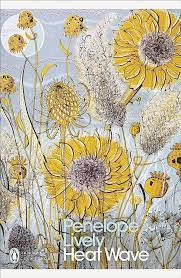
Penelope Lively’s Heatwave is set during the course of a long hot summer in rural Oxfordshire. The narrator, Pauline rents one of a pair of cottages; the other is the home of her daughter Teresa, Teresa’s husband Maurice and their young son Luke. The pair of cottages are somewhat ominously called World’s End, not a reference to the Edgar Wright film but portentous nonetheless. Pauline is a proof-reader; Maurice an author, while Teresa cares for Luke. Maurice is writing what sounds like a very pretentious history of English tourism and as part of his working routine he regularly goes back to London for meetings. He is also visited from time to time by his publisher, James and James’s girlfriend, Carol. The other inhabitants of World’s End also travel up to London from time to time – while secluded it is obviously not that remote, and these are urban, middle class people comfortable with popping off to Paris for the weekend or Venice for a month.
It is obvious from early on that Maurice is a ‘bad un’. Think Martin, the sleazy brother-in-law from Fleabag. He (44) is quite a bit older than Teresa (29) who hero-worships him. Teresa’s archetype, the long suffering wife who accepts her lot without protest, is established early – on the very first page Pauline compares her to a Hardy heroine “betrayed no doubt”. Pauline, long divorced from her philandering husband Harry, recognises the signs of Maurice’s likely adultery well before Teresa does, although the reader is given even earlier clues of his wandering. Pauline is reluctant to tell her daughter of her suspicions, waiting for some concrete evidence. She recalls the details of her own marriage to a serially unfaithful husband, who now writes to her occasionally from America where he is a college professor. Other than the slow passage of the summer and occasional trips out to cheesy tourist attractions as ‘research’ for Maurice’s awful book, the action is slow. Pauline remains watchful towards Maurice but never confronts him, and time is marked by the changing agricultural landscape and the steadily warming weather. Slowly Teresa begins to develop her own suspicions, but is also reluctant to face the issue or even discuss it with her mother. We are offered other relationships for comparison – Pauline’s bookseller friend and his agoraphobic wife, and the author of the book Pauline is proof-reading, stranded in remote Wales. Happy relationships in Heatwave are rare.
The novel opens on a warm May day, with everyone apparently “poised for this agreeable summer of industry and companionship“. Or so they believed, the narrator silently suggests. As summer passes the stresses within Maurice and Teresa’s relationship are exposed and his infidelity becomes all the more obvious. Pauline spends much of her time reminiscing. Some reviewers – in fact most, I think – claim that the damage caused by Harry’s infidelity is inter-generational and is in some obscure way the cause of Maurice’s unfaithfulness, as if Teresa has sought out a father figure for a husband who will repeat his behaviour. I am not convinced we are fated to repeat our parents’ mistakes, but Heatwave certainly seems to suggest it is unavoidable unless a dramatic break with the past is made.
Heatwave reminded me of Howards End in its portrait of a rural idyll threatened by modernisation, the way the characters live halfway between town and country and the novels’ sudden melodramatic ending in which a brutal and arbitrary form of justice is meted out. Another novel I was reminded of was J L Carr’s A Month in the Country which follows a similar structure, but is much more gentle and perhaps even kind in its treatment of its equally flawed characters.
Often, finding a way to end these reviews can be the hardest part of writing them. You can’t just stop (as some novelists do, irritatingly) – you are always on the lookout for a way of summing things up neatly with an appropriate sign-off. Many bloggers end with an invitation to readers to comment and provide their own thoughts. But one option that is not open to us it the deus ex machina out of the blue approach to ending that Lively uses in Heatwave. It was such an abrupt conclusion that it left me feeling a little cheated if I am honest.
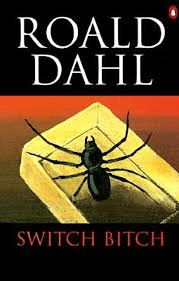
A few years ago I reviewed Patrick Suskind’s Perfume. It’s fair to say I didn’t like it very much. One commenter pointed out the similarities between Suskind’s novel and Bitch, a much earlier short story by Roald Dahl. So when I finally got round to reading Switch Bitch, the collection of four Dahl stories that includes Bitch (and apologies for the misogynistic language by the way, on which more later) there was the resounding and much-delayed sound of a penny dropping. Because Perfume isn’t just inspired by Bitch, it robs it of its central premise unashamedly. Dahl’s story tells of a scientist who develops a scent that robs men of all sexual inhibition whatsoever – they become animals who have only one thought in their heads, to have sex with the nearest available woman. Nothing, including a gun to the head, can stop them. The scent triggers an animalistic response long-buried in our Neanderthal brains. Sounds familiar? This is the central concept of Perfume. Just one more reason, were it needed, to despise Suskind’s novel.
As well as sharing a central idea, both stories are profoundly sexist. If you didn’t know it you nevertheless could easily guess that the Dahl story was written for Playboy, a soft porn magazine from the days when there were such things as soft porn magazines, which included occasional stories to give readers a break from the soft-focus photography. Their purpose was solely to titillate the invariably male reader. Dahl’s writing for adults is often characterised by unexpected endings – this was the whole premise of the long-running television series “Tales of the Unexpected” which were originally based on his short stories of the same name. But there’s an obvious problem with this structure = once it’s established the twist to each tale becomes more and more obvious. The same problem applies to the stories in this collection – there is no real surprise when the denouement of each is revealed. As the reader has known for some time, Bitch ends with the scent being accidentally discharged. This leads to a profoundly unattractive woman being ravaged, and apparently enjoying the experience. It’s horrible.
There are three other stories in this collection. In The Visitor the narrator’s uncle Cornelius, (by his own account) a preposterously successful philanderer, finds himself stranded in Egypt while on his way to Jerusalem. He is offered a room for the night by a local businessman who has built a luxurious mansion in the desert. Cornelius suspects his car has been tampered with to cause him to be stranded and meet the businessman, although why is unclear. While there Cornelius meets the man’s wife and daughter and sets out to seduce them – he likes a challenge. The inevitable sexual encounter that night happens in silence and complete darkness, (of course it does) leaving Cornelius unsure which woman he has ‘bedded’. If you don’t work out who he actually sleeps with you haven’t been paying much attention.
Our understanding of what constitutes sexual assault has evolved a lot in recent years. At the time it was published I don’t think many people would have understood that the central premise of The Great Switcheroo, in which two men devise a (profoundly improbable) plan whereby each man has sex with the other’s wife (without either wife realising the deception) is clearly a case of rape, rather than some ‘light-hearted’ fun. The sting in the tail/tale – that one wife enjoys the sex with her neighbour so much more than she does with her husband – is in part intended to ameliorate the grossness of the husband’s behaviour. He finds out his wife has hated having sex with him all their married life, so the ‘joke’ is on him. This is a modern version of the bed-trick, (which Dahl had already employed in a more conventional form in The Visitor) the principal difference being that in traditional literature it is almost always the woman who is substituted for another (the implication being that men are unable to tell who they are having sex with as long as it is dark). When this story was first published, again in a soft porn magazine, the idea of a husband tricking his wife into having sex with another man, only for the plan to blow up in his face, was mildly whimsical – some fifty years on it is appalling, distressing and hard to read. The story is told from the perspective of the husband who initiates the plan (his neighbour goes along with it enthusiastically) and ends up finding out he is a dud in bed, an anti-hero who we are invited to laugh at rather than a proto-rapist.
In The Last Act a widow reconnects with the man she left for her husband years earlier. The man is a gynaecologist, recently separated, and harbours a grudge for her breaking off their relationship. He seduces and humiliates her, and it is suggested that this makes her commit suicide. This is another appalling story – even Dahl’s biographer said it should have been scrapped.
Charlie and the Chocolate Factory had been published in 1964, well before these stories were published in Playboy. I mention this because I can almost understand a working writer selling cheap, tawdry stories to a men’s magazine simply to pay the bills. But Dahl obviously wasn’t in that position, and even if he was he could have chosen not to subsequently publish the stories in this format in 1974, by when he was also writing for films and obviously very well off.
Don’t read Switch Bitch. I always reject the idea that you can tell what an author was like as a person by his or her works, but sometimes the challenge of joining the dots between the two is almost irresistible.