
Lost Horizons, by James Hilton, 1933
Hilton’s 1933 novel, Lost Horizons, is in many ways an unconventional adventure story. It is almost completely devoid of action scenes – there’s no fighting with ghastly foreigners; situations in which primitive natives are impressed by the explorers’ gadgets are conspicuous by their absence; there are no encounters with wildlife, traditional or Jurassic. It does admittedly share some DNA with the classic Victorian Lost World adventure story. It opens conventionally for example, with a complex framing device in which a story is told by one traveller to another about a tale they once heard:
“Cigars had burned low, and we were beginning to sample the disillusionment that usually afflicts old school friends who have met again as men and found themselves with less in common than they had believed they had.”
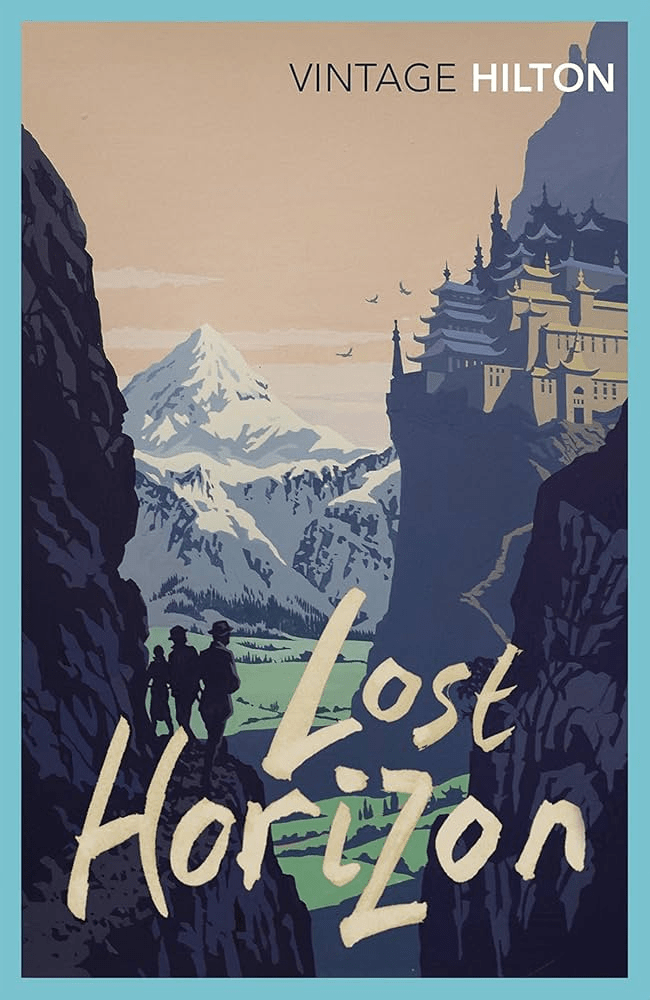
It takes some time before we penetrate these layers and get to the central story, in which four Western travellers, escaping from violent civil unrest in China, are taken by airplane to a secret valley in the Himalayas. Here they discover Shangri-La, a hidden and mysterious community governed by a monastery populated by enigmatic monks. Shangri-La has a secret – there is something about the valley that gives its inhabitants extremely long lives (we never discover what causes this effect, but it only applies to people who come to live in the valley, not the indigenous residents who barely feature).
The novel’s central character and narrator is Conway, an Allan Quartermain-type figure. Conway is a diplomat who is still haunted by his experiences in the First World War:
Twelve years earlier he had grown to hate the perils of trench warfare in France, and had several times avoided death by declining to attempt valorous impossibilities. Even his D.S.O. had been won, not so much by physical courage, as by a certain hardly developed technique of endurance.
Conway is accompanied by his junior envoy, Mallinson, Barnard, an American businessman, and Miss Brinklow, a missionary. Mallinson is keen to return to the outside world, but eventually learns that there is a price to Shangri-La’s gift of long life – once you go there you are never allowed to leave. While the others gradually come to terms with their life sentences, albeit in a very comfortable cage, Mallinson plots his escape, and finally persuades Conway to help him. While we are left to guess at Mallinson’s eventual fate, the last we hear of Conway is that he is trying to return to the remote and inaccessible valley.
Lost Horizons looks back nostalgically to the great adventure novels of the turn of the century when there were believed to be still undiscovered parts of the world. In those novels the focus was Africa or South America, but Hilton sets his story in an even more remote area, the unexplored zone between Nepal, Tibet and China.
“there came over him, too, as he stared at that superb mountain, a glow of satisfaction that there were such places still left on earth, distant, inaccessible, as yet unhumanized. The icy rampart of the Karakorams was now more striking than ever against the northern sky, which had become mouse-coloured and sinister; the peaks had a chill gleam; utterly majestic and remote, their very namelessness had dignity.
While British explorers and adventurers from Victorian novels would often treat the ‘foreigners’ they meet with contempt, Conway is a much more mature, might I even say liberal, traveller:
Conway had no race or colour prejudice, and it was an affectation for him to pretend, as he sometimes did in clubs and first-class railway carriages, that he set any particular store on the “whiteness” of a lobster-red face under a topee.
A persistent theme in the novel is the idea that Shangri-La will provide a safe haven for the coming global war. The idea that Europe was going to erupt into a war zone was common place at the turn of the century, but Hilton is prescient in his prediction that the same thing was going to happen again, this time on a global scale. Barnard, one of the kidnapped travellers who we eventually find out is a Wall Street financier on the run from the police, wanted for an unspecified financial crime, presumably embezzlement, is happy to stay in hiding because he believes the global economy is close to collapse. The head monk, Perrault, who established the monastery in the late eighteenth century, sees the speed of technological change happening in the world as likely to lead to war on an industrial scale:
“he saw the nations strengthening, not in wisdom, but in vulgar passions and the will to destroy; he saw their machine power multiplying until a single-weaponed man might have matched a whole army of the Grand Monarque. And he perceived that when they had filled the land and sea with ruin, they would take to the air… “But that was not all. He foresaw a time when men, exultant in the technique of homicide, would rage so hotly over the world that every precious thing would be in danger, every book and picture and harmony, every treasure garnered through two millenniums, the small, the delicate, the defenseless —all would be lost”
Perrault describes the coming war as a storm, and is clear that it will be an apocalypse of unprecedented scale and ferocity:
“The storm… this storm you talked of…”
“It will be such a one, my son, as the world has not seen before. There will be no safety by arms, no help from authority, no answer in science. It will rage till every flower of culture is trampled, and all human things are levelled in a vast chaos. Such was my vision when Napoleon was still a name unknown; and I see it now, more clearly with each hour. Do you say I am mistaken?”
Conway answered: “No, I think you may be right. A similar crash came once before, and then there were the Dark Ages lasting five hundred years.”
“The parallel is not quite exact. For those Dark Ages were not really so very dark—they were full of flickering lanterns, and even if the light had gone out of Europe altogether, there were other rays, literally from China to Peru, at which it could have been rekindled. But the Dark Ages that are to come will cover the whole world in a single pall; there will be neither escape nor sanctuary, save such as are too secret to be found or too humble to be noticed. And Shangri-La may hope to be both of these. The airman bearing loads of death to the great cities will not pass our way, and if by chance he should, he may not consider us worth a bomb.”
One inconsistency in the novel troubled me perhaps more than it should. The four travellers were kidnapped and taken to Shangri-La. Why? If people there don’t die for centuries, why the need for an infusion of fresh blood? The population of the valley may have been dwindling but we are told it is regularly topped up by explorers accidentally wandering into or near the valley. Conway and friends don’t bring any much-needed skills or experience and there’s every chance that Mallinson in particular will react violently to his kidnapping and life imprisonment, never to see family and friends again. He certainly doesn’t see Shangri-La as any kind of paradise:
There’s something dark and evil about it. The whole business has been like that, from the beginning—the way we were brought here, without reason at all, by some madman—and the way we’ve been detained since, on one excuse or another. But the most frightful thing of all—to me—is the effect it’s had on you.”
I appreciate I am over-thinking this. This is really a comic-book story in novel form that shouldn’t be taken too seriously. Hilton’s characterisation rest on stereotypes and the central conceit is more than a bit silly. The idea of a lost civilisation hidden from the outside world and containing secret treasures is a key feature of many late Victorian novels as the British empire began to approach the full extent of its reach and people came to realise there probably weren’t many more lost horizons in front of them.
Attitudes to sex in Lost Horizons
There are surprisingly frequent and explicit references to sex in Lost Horizons. Hilton has an interesting approach to this topic. References to sex in the novel are usually tangential and tentative but nevertheless surprisingly frequent and ultimately unambiguous. Traditionally adventure stories would skirt around the issue of sex, usually not mentioning it at all. But in Lost Horizons it is a part of people’s lives, just not one that can be talked about using everyday language. Instead euphemism is the order of the day. Take this example in which the missionary, Miss Brinklow, is discussed. Conway tells us that
“it was to Miss Brinklow that he spoke first. He realized that she was neither young nor pretty —negative virtues, but immensely helpful ones in such difficulties as those in which they might soon find themselves.”
Indirectly phrased this may be, but Conway is clearly saying that Miss Brinklow’s age and lack of attractiveness is going to helpful in the circumstances that they may soon find themselves – in other words that she is less likely to be raped because of her age and looks.
Later there is this exchange between Chang, their mysterious host at the monastery, and Conway, about sexual desire, and whether it can be a source of conflict in Shangri-La:
“Quite often,” replied Chang with a broad smile. “The lamas, of course, are immune, and so are most of us when we reach the riper years, but until then we are as other men, except that I think we can claim to behave more reasonably. And this gives me the opportunity, Mr. Conway, of assuring you that the hospitality of Shangri-La is of a comprehensive kind. Your friend Mr. Barnard has already availed himself of it.”
Conway returned the smile. “Thanks,” he answered dryly. “I’ve no doubt he has, but my own inclinations are not—at the moment—so assertive
How wonderfully euphemistic. ‘The hospitality of Shangri-La is of a comprehensive kind” – which translates as ‘the women in the village are available for sex if your urges become uncontrollable’. Barnard has already been down there getting some; Conway is for the time being under control.
There is more than a hint of homo-eroticism in the relationship between Conway and the much younger and more inexperienced Mallinson:
Conway reached his hand towards Mallinson’s, and the answering grip was hot and eagerly affectionate. Mallinson went on: “I don’t suppose you realize it, but I’ve been terribly alone these last few weeks. Nobody seemed to be caring a damn about the only thing that was really important—Barnard and Miss Brinklow had reasons of a kind, but it was pretty awful when I found YOU against me.”
However, they get a grip on themselves and later on both men compete for the affections of the silent, doll-like Lo-Tsen. Lo-Tsen is a Manchu princess who entered Shangri-la in 1884 as a girl of 18. Although she is now 70 she still looks 18. She is used by Chang and the monks as a way of persuading arrivals to accept their new lives in Shangri-La and we are told she is content in this role, although she is only ever seen through the eyes of other, male characters. Mallinson drops heavy hints that his relationship with her has become physical. When asked by Conway how he knows she will help him escape, he replies:
Mallinson half-turned away, his face lit with a grave shyness. “Because I DO know… Perhaps you’ll think less of me for it… but I DO know. I’m afraid you never properly understood her, Conway. She was cold on the surface, but that was the result of living here—it had frozen all the warmth. But the warmth was there.”
“To be unfrozen?”
“Yes… that would be one way of putting it.”
“And she’s YOUNG, Mallinson—you are so SURE of that?”
Mallinson answered softly: “God, yes—she’s just a girl. I was terribly sorry for her, and we were both attracted, I suppose. I don’t see that it’s anything to be ashamed of.
Again it is not particularly hard to de-code Hilton’s euphemisms – these are really single entendres, in which unfreezing her warmth is unquestionably Mallinson’s way of telling Conway that he has had sex with her, and he follows this certainty up with an assurance that her body is that of a young woman.
Novels of this kind would often be read by children, so to find such frankness about sex and sexuality is unusual. You normally find more carefully coded language to allow room for ambiguity about the nature of characters’ relationships. Here instead hot-blooded Englishmen are expected to have sex with native women and are largely unapologetic about it.

