
The Quiet American by Graham Greene, 1955
“After dinner I sat and waited for Pyle in my room over the rue Catinat; he had said “I’ll be with you at latest by ten”, and when midnight struck I couldn’t stay quiet any longer and went down into the street.”
Over the years, in recognition of his reputation as one of England’s greatest novelists, I have read several novels by Graham Greene – Our Man in Havana, Brighton Rock; The End of the Affair; The Third Man; and Dr Fischer of Geneva – with the aim of finding out for myself what entitled him to that status. All are impressive in their own way. Brighton Rock is a chilling portrait of a psychopath; The Third Man is an outstanding detective story, and so on – but none of them have struck me as being anywhere nearly as impressive (while still being very distinctively by Greene) as The Quiet American.
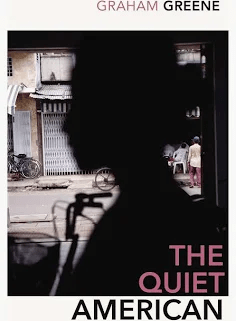
The short (less than 180 pages) novel is set in mid-1950’s Vietnam. At this time the origins of the Vietnam War were developing, with the French colonial rulers struggling to impose order upon a growing Communist insurgency and their American allies slowly being dragged into the conflict. The narrative contains an account of the domino theory which came to dominate American foreign policy for decades. If you are not familiar with this theory it argues that one country ‘lost’ to communism would lead to others in the region falling to communism like a row of toppling dominos.
“They want enough rice, I said. They don’t want to be shot at. They want one day to be much the same as another. They don’t want our white skins around telling them what they want.”
“If Indo-China goes…”
“I know the record. Siam goes. Malaya goes. Indonesia goes.”
Narrated in the first person by the cynical and aging English journalist Thomas Fowler, The Quiet American tells the story of a love triangle between Fowler, his much younger Vietnamese mistress Phuong, and a naive American ‘economic attaché’, Alden Pyle. Through this story Greene challenges the American involvement in Vietnam and eerily predicts the future course of the conflict. Greene’s was a war correspondent for The Times and Le Figaro in French Indochina 1951–1954 and the novel is clearly based on this experience, with his point of view being closely identified with his narrator, Fowler. The novel is told in flashback, with Fowler recalling his brief relationship with Pyle before the latter is murdered by insurgents.
It becomes clear very early on in the novel that Pyle is a CIA agent organising support for a local right-wing militia, seen by the American as a useful third force in opposition to the communists.
Fowler has a live-in lover, Phuong, who is only 20 years old and was previously an exotic dancer. Phuong has an ambitious sister who intend to arrange a marriage for Phuong to a Westerner. She originally thought that Fowler might marry Phuong, but he is already married. His wife back in the UK is a staunch Catholic unprepared to consider divorce, despite his record of infidelity. Pyle falls immediately in love with Phuong and asks Fowler to give her up, promising he will give her everything he, Fowler, cannot. At the same time Fowler’s editor asks him to return to England, offering him a promotion. Despite the American offering much more than Fowler can, Phuong chooses to stay with the Englishman. Pyle, always attempting to be ‘honourable’ withdraws and tries to make himself scarce. But he and Fowler are thrown together once again when they end up in a guard tower outside Saigon under attack from the insurgents. Pyle saves Fowler’s life much to his irritation. Back in Saigon, injured but recovering, Fowler lies to Phuong that his wife has agreed to a divorce. When this lie is exposed Phuong moves out an in with Pyle, realising that Fowler is never going to marry her.
The novel’s climax comes when the evidence pointing to Pyle’s involvement in a attack killing civilians becomes undeniable. Pyle attempts to justify his support for General Thé, commander of the ‘third force’ behind these attacks, explaining his theories about what is best for the Vietnamese. As a journalist, Fowler has some trusted contacts with the Viet Minh, predecesors of the Viet Cong, one of whom approach him asking for his tacit help in ending Pyle’s support for General Thé. He realises, but does not admit to himself, that this most likely means Pyle will be murdered. He goes through with the arrangement, and the result is already known. Despite his involvement, even culpability, Fowler manages to be angry at Pyle’s death, telling the American Economic Attache “They killed him because he was too innocent to live. He was young and ignorant and silly and he got involved. He had no more of a notion than any of you what the whole affair’s about, and you gave him money and York Harding’s books on the East and said “Go ahead. Win the East for Democracy”.
This was a devastating portrait of American involvement in Vietnam, extraordinarily prescient, predicting the whole course of the war. No wonder the book was seen as anti-American – it certainly isn’t sympathetic to the US. Greene obviously wrote from bitter experience. As a political statement the novel is powerful, but it succeeds on a number of other levels. The description of how women are treated in 1950’s Saigon is depressing. Phuong’s relationship with Fowler is predominantly commercial – he looks after her financially, with the implied promise of future support, and she is return allows him access to her body. She is a step above the prostitutes working the streets of Saigon or at the House of the Five Hundred Girls, shown fighting desperately for ‘business’ – but she is treated little better by the Americans. Granger, the obnoxious journalist working as part of the press corps in Vietnam, asks of Fowler’s relationship with Phuong:
“Where’d he find her? You got to be careful in this town.” He added gloomily “Thank God for penicillin”. Later he describes her as “a piece of tail”, even though it is clear that her relationship with Fowler is more than that of client and prostitute. Fowler’s narration portrays Phuong as docile and interested only in gossip about the British Royal family. He sees other Vietnamese women purely as sex objects:
“Up the street came the lovely flat figures – the white silk trousers, the long tight jackets in pink and mauve patterns slit up the thigh.”
The Quiet American is taut, precise, atmospheric, and chillingly prescient. In Fowler, Greene has created a complex, flawed, and in many ways unpleasant anti-hero with whom the reader cannot help but identify, despite his culpability in Pyle’s murder. Highly recommended.

 opening of the American transcontinental rail route, which theoretically allowed a journey around the world by land and sea in a time span that in earlier years would have been thought impossible. This is the central concept of the novel, which was obviously original and engaging in its day, although it hasn’t aged well.
