Book review

Hurry on Down by John Wain, 1953

I first read John Wain’s Hurry on Down in the early 1980’s, in a rather ragged Penguin edition that I still have. It left a very distinct impression and unlike many of the novels I have read over the years I vividly remember the plot, the set piece scenes and the extended cast of eccentric characters, such as Froulish, the undergraduate who establishes himself as a ‘character’ at the university by “carrying a grey parrot in a cage wherever he went, wearing a bowler hat indoors, standing motionless for hours on end in the exact centre of the quadrangle” (As a side observation, the idea that wearing a hat indoors, albeit a bowler, is on a level with carrying a parrot around everywhere, shows how radically social mores and conventions have changed since the 1950’s.)
When first published in 1953 the novel was widely seen as culturally significant. It marked a change in style from the traditional narrative, often about middle class characters to something much looser, unstructured, even chaotic, but with a lot to say about the world. Even as late as the 1980’s Hurry on Down was still perceived as an important book, a milestone in the development of the post-War phenomenon labelled as the Movement, associated with writers such as Kingsley Amis (Lucky Jim, which shares a lot of its DNA with Hurry on Down) and John Osborne (Look Back in Anger, whose Jimmy Porter often sounds a lot like Charles Lumley, Hurry on Down‘s protagonist). Now it is almost completely forgotten. It has no separate Wikipedia entry and only 33 reviews on Goodreads (for comparison, Russell Brand’s self-consciously infantile ‘My Booky Wook’ has over 1600 reviews!).

So what happens, and more importantly, why does it matter? Charles Lumley has just graduated and is taking time to consider his next steps in the world. His family want him to get a job, his girlfriend expects him to marry her, the wider society has expectations about his future. He is even being cross-examined by his landlady as the novel opens. But Charles has no idea what he wants to do. So he rebels, breaks contact with his family and fiance, and rejects the idea of a white collar job, a mortgage and children. Instead he essentially runs away. Initially he makes money to survive by cleaning windows and lives in a dilapidated loft with an former university acquaintance, the afore-mentioned Froulish, an eccentric novelist, and his girlfriend, Betty. Betty supports their bohemian lifestyle with income from a ‘family member’ – but Charles soon finds out she is actually taking money from a lover and is essentially working as a prostitute.

From here Charles spirals downward, taking a breathless series of increasingly menial jobs. In a bar he sees a very attractive young woman, June, and becomes obsessed with her. He accepts a role in a criminal gang smuggling drugs simply so he can have enough money to approach June. Eventually they become lovers, but this doesn’t last long as the gang is exposed. Charles escapes capture because he is in a serious car accident. While recuperating he is informed that June is being kept by her much older ‘sugar daddy’ who poses as her uncle. His world collapses and when he is finally recovered from the accident he starts again with another series of menial jobs – hospital porter, chauffeur and night club bouncer. The novel ends on a cynical note suggesting that Charles was never going to be able to escape the expectations of society, and that surrendering to them might even be the best approach.

Published only eight years after the end of the second world war, the shadow of the war is rarely mentioned, but is there in the fabric of the society Charles tries to escape from. Too young to have served, Charles would still have had to do national service, despite going to university – this is not mentioned. Nor is rationing which was just ending, nor any other impact of the war, even though most older men he meets would have served in one form or another.

Wain was not just a picaresque author writing a series of loosely connected sketches about the world of work, and what it was like to be an aimless young man in the 1950’s. His writing is memorably impressive: “It was heavy and thundery outside; early August and beginning to get that washed-out feeling of high summer, when the freshness has gone from the leaves. Not that there were any leaves in the streets where he was walking, but outside, in the country, the leaves were drying slowly, and they had whispered their message to be heard in the backyards within the smoke-ring of the city.
Elsewhere: “He tried a pub near the hospital, but it was dirty and lonely. A few old men sat staring with red-rimmed eyes into their pints, making the beer look like tears they had dripped into their glasses and were saving for some purpose.”

It would be easy to read too much into Lumley’s rejection of the status quo. He is not a revolutionary, and the novel’s ending suggest that all his attempts to escape from the straightjacket of society have been futile.

‘He thought, as he leaned on the parapet of the town’s bridge and watched the tiny brown river drifting beneath it, of all the expensive young men of the thirties who had made, or wished to make, or talked of making, a gesture somewhat similar to his own, turning their backs on the setting that had pampered them; and how they had all failed from the start because their rejection was moved by the desire to enter, and be at one with, a vaguely conceived People, whose minds and lives they could not even begin to imagine, and who would, in any case, had they ever arrived, have made their lives hell. At least, Charles thought with a sense of self-congratulation, he had always been right about them, right to despise them for their idiotic attempt to look through two telescopes at the same time; one fashioned through German psychology and pointed at themselves, the other of Russian economics and directed at the English working class.’

If Hurry on Down was a television programme shown today it would be prefaced with one of those warnings about old-fashioned attitudes that were common in the time the book is set. There is an ugly scene at a party where Charles meets a gay young man who takes a fancy to him and won’t take no for an answer – “a young man in grey suede shoes; Charles caught sight of those shoes and decided that he now knew all he wished to know about one guest at least”. This was at a time when homosexuality was still a criminal offence and social signals such as suede shoes were used as a shorthand for sexual identity. Charles is quite comfortable about threatening violence against this persistent but otherwise inoffensive young man who is interrupting his efforts to talk to June. Later there is an example of the casual use of the n-word. This is used to criticise the imperialist mindset of some unpleasant rugby players he meets at another party: “I don’t want your silly Edwardian notions of an upper-class Herrenvolk thrown up at me either. By ‘letting the side down’ all you mean is that the n-driving sahib oughtn’t to do anything that reveals that he shares a common humanity with the n-s he drives. That idea’s dead everywhere in practice, and it only survives in theory in the minds of people like you”God!” said Burge, in tones of sincere and utter loathing, “You’re talking just like a bloody Socialist.”

I wasn’t sure if Hurry on Down would be worth re-reading. Many novels age badly, and what was at the time ground-breaking experimentalism appears crass and clumsy. The fact that this novel is now largely forgotten (it doesn’t have its own Wikipedia entry!) would suggest I am in a minority on this but I think it stands up well to the passage of time. It is obviously of its era, but it’s an enjoyable read, the narrative structure works well and progresses the story forward at a fair pace. The improbable coincidences in which Charles always bumps into a former colleague to offer him his next job are forgivable and even become an in-joke which we know is coming. There is much to dislike about Charles – he is pretty amoral – but the point of view narration encourages the reader to see his point of view above others and to accept his rationalisations. Hurry on Down is worth rediscovering.
Hurry on Down by John Wain, 1953

Aside
Book review

Coming from Behind by Howard Jacobson, 1983

One of the most tired propositions about novel writing is ‘write about what you know’. In this his first novel, Howard Jacobson, stretched that saying to its limit. Jacobson is a Jewish man from Manchester who studied English at Cambridge, followed by a teaching post in Australia, then came back to teach at Wolverhampton Polytechnic. In this 1983 novel his protagonist is Sefton Goldberg, a Jewish man from Manchester who studied English at Cambridge, taught in Australia, before coming back to teach in England at ‘Wrottesley’ Polytechnic. It is hard not to see this novel therefore as at least in part autobiographical, albeit with lots of dramatic exaggeration. The novel’s title is a fairly crude pun – it opens with a scene of Sefton having sex with a student in his office, something he seems to think is one of the perks of his job. But he is not enjoying himself – he can’t stop wondering whether he has properly locked his office door, recalling a similar incident when he taught in Australia – obviously a common occurence.

Jacobson came late to the ‘campus novel’ genre – arguably Kingsley Amis kicked this off in the 1950’s with Lucky Jim, followed by Malcolm Bradbury’s The History Man in 1975, and the same year David Lodge’s Changing Places. Academia in all these novels is not portrayed as a privileged place of learning but instead as a wholly depressing experience. These fictional universities are staffed by grumpy, largely male, amoral lecturers overwhelmed by the non-academic requirements of academia.

The novel has very little of what could be called a plot. Sefton is divorcing his wife, but she never appears. His colleagues and students are all lightly sketched, one-dimensional characters with amusing idiosyncrasies such as the professor who specialises in “all the twentieth century poets whose first or last names were Tom or Thomas”. The exception to this beige brigade is the misogynistic portrait of the teacher of creative studies, Cora Peck, defined by her unconventional outfits – blue cowboy boots, white jump suits and black leather jackets. Inevitably Sefton attempts to seduce Cora but surprisingly she rejects him. I say surprisingly because the general rule of thumb in novels written by male novelists of this era is that no matter how clumsy, awkward and unappealing the male protagonists are, they are nevertheless unaccountably irresistible to almost all female characters (see for example pretty much anything ever written by Kingsley Amis.) That rule is broadly followed by Jacobson in this novel, with Cora forming the sole exception. Cora has had a number of her works accepted by a publisher, which gives Sefton another reason to despise her.

An implausible ‘twinning’ deal with the local football club in which some of the departments are going to be moved into the football stadium is introduced as a plot development – but unfortunately it makes no sense, football clubs being notoriously short on classrooms, offices and lecture halls, and is never taken seriously even within the confines of the novel. When he is not having sex with his students Sefton spends his time applying for any and all jobs broadly connected to academia, with the sole objective of getting out of Wrottesley. A Cambridge college invites him for an interview, which provides the opportunity for a set piece college dinner scene in which Sefton feels totally out of place, and where he is inevitably propositioned by the female Director of Studies.

Coming from Behind is the broadest of comedies, more Carry on Teaching than Lucky Jim. There are a series of comic set piece scenes such as when Sefton is confronted by a group of Geography lecturers, outraged that he has parked in their section of the Polytechnic’s awful car park. Throughout Jacobson relentlessly focuses on Sefton’s Jewish identity. Everything he does is seen through this lens. It is mentioned on almost every page, with long meditations on what it means for Sefton to be a Jewish man in education, at Cambridge, making love, discussing sport, walking in the countryside, being ignorant of fishing (“Being Jewish, Sefton didn’t know much about the names or breeds or needs of fish. (p.24)) and so on ad nauseum. At times Sefton specifically resents the fact that he is not being discriminated against because of his Jewish identity! That’s obviously not to say that one’s heritage and religion is not important, but when it is the only defining characteristic of an individual, the only way of looking at and experiencing the world, it gets a bit wearing.

There are moments of bad taste in the novel and language used that was common in the 80’s but today considered offensive. This is just one more barrier to squeezing any pleasure or enjoyment out of this book. I took a quick look at Amazon to see if it is still in print – it is – and while there two reviews jumped out at me. The first was the bizarre “the wife liked it” (!!) but the other was I think on the nose in describing the novel as “spiteful and intellectually snobbish”.

Coming from Behind by Howard Jacobson, 1983

Aside
Book review

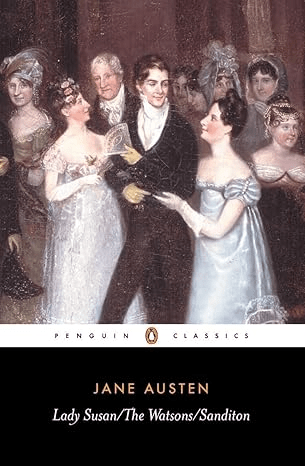
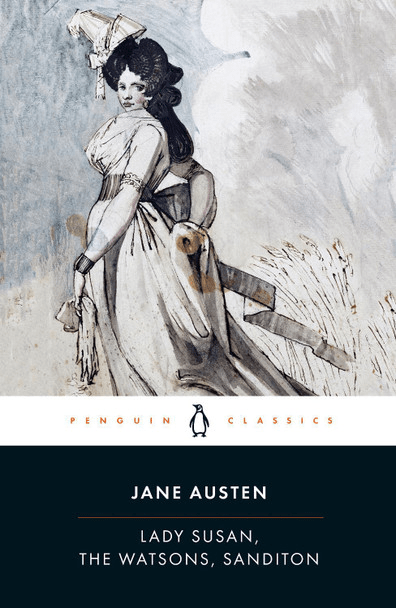
Sanditon by Jane Austen, 1817

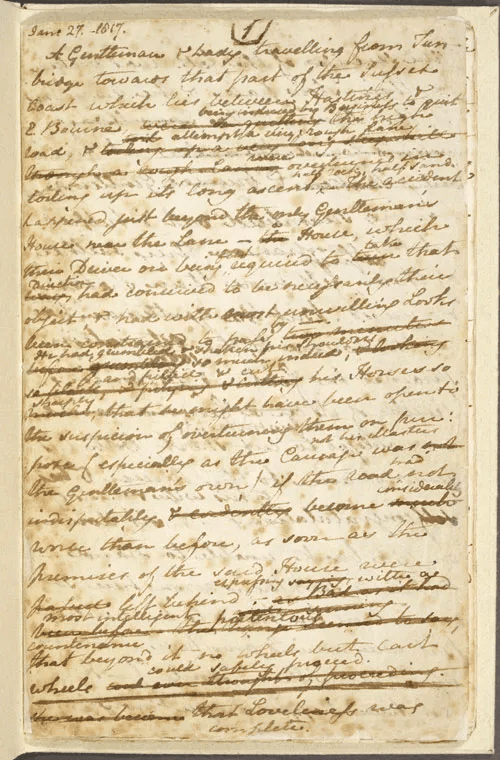
The third of the Austen novel fragments I have been reading recently is her last, incomplete work, Sanditon, written in the months prior to her tragically early death in 1817. As with the other fragments (The Watsons and Lady Susan) the interest of the text lies more in its composition than its status as a story. As such we have the advantage of the original draft (see below) with all its revisions and hesitations. You can see the manuscript online here. Someone has kindly transcribed the manuscript amendments and all, showing every change Austen made. We can see the creative process at work. Only twelve chapters long, the manuscript shows that Austen edited as she wrote – rather than writing the full text then going back to the beginning and editing, she has made substantial changes to each page. This would have meant that once complete the manuscript would have been largely ready for type-setting and publication.

The novel fragment focuses on Charlotte Heywood, one of the daughters of the Heywood family from Willingden, Sussex. The narrative opens in uncharacteristically dramatic fashion when the carriage of Mr and Mrs Parker of Sanditon crashes near the Heywood home. Mr Parker is slightly injured in the crash, and very kindly the Heywoods offer hospitality to the Parkers for two weeks until his ankle is healed. Mr Parker is what we would now think of as a property developer – he has ambitious plans to transform Sanditon, a fishing village, into a fashionable seaside resort. Once his foot is healed the Parkers return to Sanditon, taking Charlotte with them as their guest. This is in part a return of the hospitality shown them by the Heywoods, but it is also possible Mr Parker wants to show off Sanditon to as many people as possible.

The residents of Sanditon are introduced in familiar slightly breathless Austen fashion. Lady Denham, a twice-widowed woman who received a fortune from her first husband and a title from her second, lives here with her niece Clara Brereton, as does Sir Edward Denham and his sister Esther, nephew and niece to Lady Denham by her second husband. The Parkers are joined by two of Mr Parker’s sisters, his younger brother, Arthur, and finally his middle brother Sidney. There are indications that Austen planned to call this novel ‘The Brothers’ which some critics have interpreted as a potential shift of focus to a more male perspective. We will never know if that was going to be the case, but the extant chapters are all firmly written through Charlotte’s eyes as she meets this dazzling array of new characters. The whole Parker family appears to be part of the enterprise to develop Sanditon. News of a wealthy family from the Caribbean arriving shortly in the town and a girls school intending to relocate to the coast causes a stir, although it soon becomes apparent that these two parties are one and the same. The new arrivals consist of Miss Lambe, a teenaged Antiguan-English heiress, whom Austen describes as ‘half-mulatto’ and the two Miss Beauforts, English girls just arrived from the West Indies.

It is striking how complex this cast of characters is in so few chapters. Relationships between the eligible young people both planned and actual are suggested and as with the other fragmentary novels it is possible to speculate with some confidence the direction the novel was heading.

In addition to the speculation about the extent to which the novel’s original title was to be its focus, critics have also pointed to several other departures from Austen’s standard template. Sanditon, a speculative property development, is clearly going to be the novel’s primary location, and there is little to compare it to in the rest of the canon. It’s not a stately home (c.f. Mansfield Park, Northanger Abbey) but a commercial enterprise. The ambitious Parker family, looking to profit from the sea-bathing enthusiasm of Regency Britain, don’t really have any parallels in Austen’s other stories. And the introduction of a mixed race character is also a departure for Austen. We see very little of Miss Lambe in the novel, but she is intriguing:

“Mrs. Griffiths … supported herself by receiving such great girls and young ladies as wanted either masters for finishing their education or a home for beginning their displays. She had several more under her care than the three who were now come to Sanditon, but the others all happened to be absent. Of these three, and indeed of all, Miss Lambe was beyond comparison the most important and precious, as she paid in proportion to her fortune. She was about seventeen, half mulatto, chilly and tender, had a maid of her own, was to have the best room in the lodgings, and was always of the first consequence in every plan of Mrs. Griffiths.”

Miss Lambe’s mixed race is clearly no objection to acceptance into Georgian society, and Lady Denham immediately starts to plan her engagement to her nephew by marriage, Sir Edward. It would have been fascinating to see how Austen handled this sensitive issue.

Austen was an extraordinary, subtle and skilful novelist, with a profound understanding of human nature and a wonderful sense of humour. There are plenty of flashes of her brilliance in this fragment. She has a lot of mischievous fun in describing the self-identified invalid Arthur Parker for example. It is in paragraphs such as this that we see glimpses of the author’s authentic voice. It opens with Arthur describing his health:

“I am very nervous. To say the truth, nerves are the worst part of my complaints in my opinion. My sisters think me bilious, but I doubt it.”

“You are quite in the right to doubt it as long as you possibly can, I am sure.”

“If I were bilious,” he continued, “you know, wine would disagree with me, but it always does me good. The more wine I drink in moderation the better I am. I am always best of an evening. If you had seen me today before dinner, you would have thought me a very poor creature.”

Charlotte could believe it. She kept her countenance, however, and said, “As far as I can understand what nervous complaints are, I have a great idea of the efficacy of air and exercise for them—daily, regular exercise—and I should recommend rather more of it to you than I suspect you are in the habit of taking.”

“Oh, I am very fond of exercise myself,” he replied, “and I mean to walk a great deal while I am here, if the weather is temperate. I shall be out every morning before breakfast and take several turns upon the Terrace, and you will often see me at Trafalgar House.”

“But you do not call a walk to Trafalgar House much exercise?”

“Not as to mere distance, but the hill is so steep! Walking up that hill, in the middle of the day, would throw me into such a perspiration! You would see me all in a bath by the time I got there! I am very subject to perspiration, and there cannot be a surer sign of nervousness.”

They were now advancing so deep in physics, that Charlotte viewed the entrance of the servant with the tea things as a very fortunate interruption.

Sanditon by Jane Austen, 1817

Aside
Book review

The Watsons, by Jane Austen, 1803/1871

The Watsons is an abandoned fragment of a novel started by Austen in 1803 but only published in 1871. It contains themes and characters reminiscent of those in her completed works and reveals aspects of her methods of composition and construction of her novels. As a fragment of probably less than a quarter of a novel it has very little merit in its own rights, but as an insight into her working processes it is fascinating.

The epistolary format adopted in Lady Susan has been abandoned, and Austen begins experimenting with a third person narrator, although much of the narrative is told through conversation. We are introduced to the Watson family through the perspective of the youngest daughter, Emma, (who bears no similarity to the character who was to later have her own novel). Emma has been brought up by a wealthy aunt in one of those informal adoption arrangements which appears, if Austen’s portrait of the gentry of the Regency period is to be relied upon, quite common (see also Mansfield Park of course, as well as the example from real life of Austen’s older brother). Children seemed to be loaned to other families almost indefinitely largely but not exclusively for reasons of convenience. This aunt has now remarried and moved to Ireland, (in the views of the family this remarriage is highly inappropriate, already establishing the idea that making a good marriage is more important than making any kind of marriage at all) forcing Emma to return to the embrace of her now unfamiliar family. She struggles to adapt to the change in circumstances, not least because her family is significantly less well off than her aunt. We have only brief introductions but it is clear her sisters are actively seeking partners as a route out of the family home, as are almost all the daughters she was to go on to write about.

We are also introduced to the Osbornes, a titled family living nearby. Emma is quickly thrown into the social life of the community and while attending a ball in the nearby town she meets the young and rather awkward Lord Osborne. It is difficult to tell if this relationship was going to be the core of the novel – quite possibly but one can’t be sure. Emma dances with a young boy attending the ball as a kindness after he is let down by another potential partner (I don’t know enough about the social conventions of these social occasions to be able to tell whether the attendance of a ten year old, albeit one with quasi-aristocratic status, was usual or simply here as a plot device to illustrate Emma’s kindness.)

This kindness introduces a Mrs Blake, who in turn introduces Emma to her brother, Mr Howard, vicar of the parish church near Osborne Castle. It seems most likely that Mr Howard was to become Emma’s primary romantic interest – less well off than Lord Osborne, and of a lower social status, but more mature and more reliable, a classic Austen hero.

Shortly thereafter the novel ends. An Austen family memoir hints at how it was to continue:

“Mr Watson was soon to die; and Emma to become dependent for a home on her narrow-minded sister-in-law and brother. She was to decline an offer of marriage from Lord Osborne, and much of the interest of the tale was to arise from [the dowager] Lady Osborne’s love for Mr Howard, and his counter affection for Emma, whom he was finally to marry.”

Other than these glimpses of the novelist Austen was to become, there are only limited points of interest in the story for anyone other than an Austen completist. One is the author’s description of Emma:

“Emma Watson was not more than of the middle height, well made and plump, with an air of healthy vigour. Her skin was very brown, but clear, smooth, and glowing; which, with a lively eye, a sweet smile, and an open countenance, gave beauty to attract, and expression to make that beauty improve on acquaintance.”

Skin tone here is not a racial indicator but used as a mark of social standing and value. A very brown face could derive from long periods spent outdoors, something more commonly associated with farm labour, or it could derive from long periods spent abroad in the Americas. Conversely paleness was commonly associated with a withdrawn isolated but aristocratic lifestyle. But equally there were associations with healthiness or lack thereof and a robust ‘healthy vigour’ is in many cases preferable in a potential partner if children were planned. Austen notes that Emma’s skin is very brown but is nevertheless clear, smooth and glowing – in other words she looks attractive despite the brownness of her skin.

One day I might do a deep dive into this issue and see how skin tone is used to portray characters in other nineteenth century novels. The one example of a dark-skinned character that I do recall is Heathcliff, where the author repeatedly connects his dark skin with his demonic character – Nelly Dean recounts him being “as dark almost as if it came from the devil.

The Watsons, by Jane Austen, 1803/1871

Aside
Book review

Lady Susan by Jane Austen, 1794/1871

I confess I had largely written off Jane Austen’s juvenilia as stories that should probably have remained unpublished – largely I think on the basis of a very small sample size taken many years ago – but I was wrong. Lady Susan, written when Austen was 18 – in other words to all intents and purposes an adult and meaning therefore that it is hard to label Lady Susan as juvenilia anyway – is a mature, witty and sophisticated novella. It is written in the epistolary form, which quickly illustrates the shortcomings and disadvantages of the structure and is an important step in Austen’s evolution of the third-person omniscient narrative format which she perfected in her mature novels. Written in around 1794 or so the internet tells me, but not published until 1871, it is a gem!

The plot and characters

The format of the novel means that the reader has to spend time in working out the relationships of the characters. Without a narrator to spell things out for us, the clues in the opening letters give an incomplete picture. Epistolary novels were the default format for novels in the eighteenth century and Austen may have simply been following convention in adopting this style.

The novella’s central character is Lady Susan Vernon, a recent widow in her mid-thirties, (a relatively old woman in other words, for the purposes of a Georgian romantic novel) who sees herself as a liberated, independent woman. We soon find out that many of her wider family see her very differently. The story opens with a letter from our anti-heroine announcing her intention to visit her brother-in-law and his wife, Charles and Catherine Vernon, at Churchill, their country residence. Catherine’s following letter to her mother reveals that she is is far from pleased by this announcement, partly because Lady Susan had tried to prevent her marriage to Charles and partly because her guest has a reputation as a woman of negotiable affections. It is strongly implied that Lady Susan has been having a romantic liaison with the married Mr. Manwaring and is having to leave his household, where she was staying as a guest, in a hurry, the affair having been exposed. Nevertheless Charles accepts this self-invitation, less apprehensive about Lady Susan than his wife and less willing to give any credence to the rumours about his sister-in-law, his brother being Lady Susan’s recently deceased husband. (If at this point it feels like you should be taking notes then that accurately sums up the experience of reading the letters between the characters the first time around).

Catherine’s brother Reginald comes to visit Churchill and despite warnings about Lady Susan begins to be attracted to her. Lady Susan is planning to remarry once a reasonable length of time has passed since her late husband’s demise, but is keeping her options open, considering the attractions of a number of potential suitors. She also factors into her calculations the need to marry off her sixteen year old daughter Frederica to one of the several eligible young men in her sphere of influence, while reserving the choice of the crop for herself. In other words, Lady Susan is something of a monster, in the context of a romantic novel, an appalling mother and an adulteress. She is almost wholly immoral. She is also greatly charming persuasive, at least to men – other women seem to see straight through her. Her letters to her confidante, Mrs Johnson, expose her true nature and immorality, but the face she presents to the outside world is charming. It is unusual for Austen to have as her central character someone so wholly without redeeming features, even if Lady Susan can at times be a charming companion (or so she tells us), and it is obviously a mark of her development as an author that her later heroines are more complex, less two-dimensional characters. (That’s not to say that later Austen novels don’t feature characters that are close to being caricatures, but not her central figures).

The constraints of the epistolary format soon become apparent as the novel develops. Austen uses the contrast between the viewpoints of the different correspondents to allow the reader to make judgments about their trustworthiness, veracity etc, but the novel is effectively abandoned after around sixty pages with a short summary by a narrator much more recognisably Austen in tone and voice. The novella’s characterisations are more straightforward than Austen would later develop – Lady Susan is pretty (“I have seldom seen so lovely a woman as Lady Susan. She is delicately fair, with fine grey eyes and dark eyelashes; and from her appearance one would not suppose her more than five and twenty, though she must in fact be ten years older.”) but scheming and amoral; the novel’s ‘hero’, Reginald, is weak-willed, easily led and rather pathetic. There are very few letters in the novel from him and he is more a plot-device than a well-developed character. Certainly he is no Mr Darcy or Mr Knightley!

But there are many glimpses of the author Austen was to become. The language she uses is complex and nuanced. Many of the themes that dominate her mature work are present, not least a young woman’s need to make a good marriage with a man of an appropriate income. Susan is sexually liberated, immoral, and as such very much ahead of her time. She manipulates those around her shamelessly and very effectively, particularly the men in her life, and the novel’s ending suggests that she lands on her feet in the end, making a match with an impressionable, wealthy and much younger man.

I am glad I revisited Lady Susan. It provides an interesting contrast to Austen’s mature works. I do wonder whether had her health been better if she would one day have revisited the manuscript and fleshed out the narrative? Lady Susan is one of literatures lesser well known villainesses, but a compelling one nonetheless.

Lady Susan by Jane Austen, 1794/1871

Aside