J by Howard Jacobson, 2014
J, shortlisted for the 2014 Booker Prize, is set in a dystopian(ish) future after a catastrophic event known only as ‘WHAT HAPPENED, IF IT HAPPENED’. Later in the novel different variants of this expression are used, such as WHAT HAPPENED (that is, without the qualifier) indicating the speaker’s distance from the orthodox view of this event. Precisely what ‘the event’ was is never made explicit, but enough is revealed towards the end of the novel to suggest that it was a mass killing of a minority in society in which ordinary citizens participated. Several decades have passed since this event, but society is still haunted by it, seeking ways of restoring balance to an increasingly violent and disordered world.
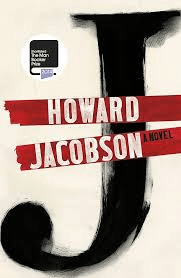
The central narrative of J is on the surface a traditional romance. Kevern, a woodworker, and Ailinn, an artist, begin a rather sweet love affair. Kevern is socially isolated and finds it hard to make friendships. He is rather neurotic and exhibits symptoms of obsessive compulsive disorder – for example he repeatedly returns to his front door to make sure it is locked and that his hallway is arranged as he needs it to be. The reader comes to realise that he has been taught to do this by his parents as a way of ensuring that he can tell if his house has been broken into. In other words it is a security measure, although precisely who or what he needs to be worried about is initially unclear. Kevern was also taught by his father to place two fingers over his lips when using any word beginning with the letter J. This we can conclude was a way of training his son never to acknowledge his Jewish identity – the words Jew and Jewish are never used in the novel and illustrate how Jewishness has been effectively extinguished by WHAT HAPPENED. The letter J becomes in the novel a symbol of the near complete erasure of Jewish people in this society and also points to the hidden identity of any Jewish survivors. The novel’s true title is actually the letter “J” with two lines struck through it – this double-crossed “J” (see above) evokes the anti-Semitic trope of the “double-crossing Jew,” serving as a visual reminder of the deep-seated prejudice that exists even in a society that claims to have addressed this prejudice. Ironically the government has since WHAT HAPPENED forced all citizens to take Jewish-sounding surnames in a twisted attempt to illustrate that anti-Semitism no longer exists. But this attempt to rewrite history and deny the existence of anti-Semitism is not working – society remains violent and troubled. We eventually come to realise that Kevern and Ailinn’s relationship has been engineered as a social experiment to see if the reintroduction of Jews to society may help rebuild society by providing a scapegoat for society’s ills. When they find this out the impact on them is devastating.
Jews are not the only people who have seen their identity reduced to simplified markers in this society: “A compliant society meant that every section of it consented with gratitude – the gratitude of the providentially spared – to the principle of group aptitude. People of Afro-Caribbean origin were suited by temperament and physique to entertainment and athletics, and so they sang and sprinted. People originally from the Indian subcontinent, electronically gifted as though by nature, undertook to ensure no family was without a functioning utility phone. What was left of the Polish community plumbed, what was left of the Greek smashed plates.“
The publisher of J compared the novel to the dystopias written by Orwell and Huxley. So far there is no evidence that the comparison has stood the test of time – for example J has an average score on Goodreads of just under 3 (on a scale of 1-5). I understand the reservations many reviewers have expressed about J on this site and elsewhere. Jacobson really makes the reader work hard – the point of view narration from members of a society where forgetting WHAT HAPPENED is a national preoccupation means we are only given glimpses of the past and have to piece things together slowly. (The ending of the novel is also unforgivably bad, but we shouldn’t define a novel just by how it ends). This is a thought-provoking novel that I suspect will be read in years to come when other Booker prize shortlisted novels have long been forgotten. It is hard for me as a non-Jewish person to fully appreciate the issues Jacobson discusses, but I believe that this portrait of being Jewish in a society in which the whole concept of Judaism has been effectively eradicated will resonate with many Jewish people.