20th century Literature, Anthony Burgess, Book review

The Complete Enderby by Anthony Burgess

Read in the Kindle edition
Julius Xavier Enderby, poet, is one of my all-time favourite literary characters.

Book 1 – Inside Mr Enderby, published under the pseudonym Joseph Kell in 1963. We first meet Enderby through the eyes of a group of time travelling school children, on an educational trip to visit some of the poets of yesteryear. There are echoes of Joyce Grenfell in the teachers admonitions to the students not to misbehave, which of course they do. Enderby lives alone, in squalor. His bathroom is his sanctum, where he composes his poetry, filing much of it in the bath which he shares with a family, indeed generations, of mice. He lives a narrow, routine existence, troubled by the outside world as little as possible. But people just won’t leave him alone.

Nasty neighbours and a nosy landlady are a nuisance, but his problems really start when he wins a literary prize, which he accepts in person at an event in London – or rather doesn’t accept, his speech getting away from him somewhat. After that he loses control of his life. Vesta Bainbridge, women’s editor of “Fem”, takes him in hand, and begins the arduous task of transforming him into husband material. She succeeds to the extent of getting him in a fit state for their marriage but the change is temporary, and he manages to escape from her (on their honeymoon in catholic Rome) as she rapidly transforms herself into his dead step-mother. At some point, apparently angered by his betrayal, his muse, always conceived as a literal companion, deserts him. Seeing no future without poetry, Enderby attempts suicide. He attempt fails, and we leave him in a rest home undergoing a cure to rid him of his infantile obsession with poetry and its trappings.

Book 2, Outside Enderby. The psychiatric transformation of our hero is no more effective nor long lasting than Vesta’s attempt, and with the return of his muse, Enderby is about to leave his job as a barman when fate once more intervenes. The bar where he works is being used as a venue for a pop group – the lead singer of which has plagiarised some of his poetry, left behind in his flight from Vesta’s home. The singer is shot by a bitter former band member, but Enderby is framed, and flees. Taking a holiday flight to Tangiers, narrowly escaping the clutches of a matronly astrologer on the way, he tracks down Rawcliffe, a failed former poet who had plagiarised his extended poem, the Pet Beast, turning it into a schlock horror film script. Rawcliffe, who is in all the anthologies, is dying, and Enderby cares for him in his last days, instead of killing him as intended. Enderby inherits Rawcliffe’s bar, and settles down into a comfortable life of exile. But the happy ending is denied him, because at the end of the novel he is visited – literally – by a personification of his muse, who is a cruel mistress, and who appears to intend to desert him, once again.

It appears that Burgess planned books one and two as a single volume, and only published them separately when a serious illness threatened to be (indeed was diagnosed as) terminal. But having created this character it seems Burgess couldn’t really leave him alone.

Book 3, A Clockwork Testament, or the End of Enderby, finds Enderby lecturing in creative writing and minor Elizabethan drama in New York. He is more of a fish out of water than ever, finding much in New York and his students to frustrate and anger him. This is a lighter revival of Enderby, putting him in comic situations in which his frustrations with the modern world are never far from the surface. Enderby makes no compromises for his new situations, and is blunt to the point of being offensive towards his black students, particularly in his liberal use of the N-word – what would have read as challenging and daring in the 1970s comes across as simply offensive in 2012, not that Burgess would have given a stuff. But this is true of many treatments of this issue, and we should be wary about imposing 21st century values on 1970s Britain, or any other period for that matter. Which I suppose is his point.

The discussion about the potentially corrupting influence of art, as exemplified by the popular response to the vulgarised film treatment of “The Wreck of the Deutschland” dominates much of the novel. This is Burgess’s response to the media storm generated by the film of Clockwork Orange, hence the otherwise inexplicable title of the third novel in the series, in case the point were to be missed (which of course it is now much easier to do, with Kubrick’s film available to watch on terrestrial television, and pretty tame stuff compared to, for example, the Saw movies.)

The fourth and last Enderby novel, Enderby’s Dark Lady, or No End to Enderby, in which Burgess imagines what might have happened to our hero if he had not taken the post in New York. Here he is offered a role scripting a musical representation of the life of Shakespeare, variously entitled Will! Or An Ass for an Actor in a very different part of America, rural Indiana. Here he is as much a fish out of water as anywhere else, and comes in for a lot of stick from the cast, crew, financial backers, and the community generally. He becomes besotted with the female lead, April Elgar, a gorgeous African American actor, who befriends him and who allows Burgess plenty of opportunities to demonstrate his scholarship and knowledge about Shakespeare’s dark lady of the sonnets.
The musical is of course chaotic, and on the opening night Enderby has to take the part of Will, which he does triumphantly (after his own fashion) – ad-libbing, breaking the fourth wall, ignoring an intervention from a US Equity equivalent representative who tries to stop the show, ending in a dance of the beginning of the world on stage with April. Instead of the usual time travelling tourists, Burgess book-ends the story with more erudition about Will and Elizabethan theatre – a story about spying and the theatre in Shakespeare’s time to open, including a theory on Shakespeare’s involvement in the development of the St James’ edition of the bible which I have never taken the time to follow up but if taken at face value appears very convincing, and ending with a science fiction tale about a time traveller going to an alternative 1590’s London to meet Shakespeare. The trip doesn’t end well, but this stand alone story is a far more interesting treatment of the parallel worlds theory than “The Long Earth”.

Why is Enderby such an endearing, successful character? He meets many of the criteria you would look for in a sit-com character – good hearted but hopelessly adrift in the modern world, always falling unwittingly into comic situations, and at the same time puzzlingly attractive to various maternal and not so maternal women. For Enderby poetry is the all-consuming mistress that he cannot allow himself to be distracted from. The comedy switches from quite low brow, scatological stuff to highbrow meditations on Elizabethan theatre and Shakespearean scholarship.

Burgess’s style, throughout the quartet, is one of the major enjoyments of the novels. He plays with language freely, at times showing off, but rarely distracting from the overall fun of the piece. Here’s an example from Book 2. Enderby is serving drinks in a bar when he meets an old acquaintance, whose breath, he notices, smells of onions:

“Then, instead of expensive mouthwash, he had breathed on Hogg-Enderby, bafflingly (for no banquet would serve, because of the known redolence of onions, onions) onions.  “Onions” said Hogg.”

I can just imagine Burgess’s pleasure at meeting the no doubt self imposed challenge of repeating “onions” four times consecutively without interruption nor syntactic trickery.

I’ve read these novels for pleasure several times since discovering Inside Enderby many years ago, and apart from the easily offended they should be a joy for all readers. I cannot recommend them highly enough.
Standard
20th century Literature, Book review, Evelyn Waugh, Vile Bodies

Vile Bodies by Evelyn Waugh

Let’s start with the title. About ten years ago a film was made of this novel, but due to wrangles with the Waugh estate the film was called “Bright Young Things” not “Vile Bodies”. (This is from memory, unverified by Wikipedia). The name change mattered, because the irony of the phrase “Bright Young Things”” is easy to miss (or dismiss), whereas there is no missing the bitterness and bleakness of the original title. And make no mistake, this is a bitter, and unblinking bleak portrait of the mid-war, middle class world Waugh inhabited, where the humour underscores the emptiness of people’s lives rather than detracting from it.
This is satire at its crystalline, brilliant, best. The plot, such as it is, follows the misfortunes of Adam Symes and his assortment of friends, relatives and acquaintances. But the series of disjointed incidents portrayed is simply a vehicle for Waugh to shine a light on the shallow, broken society of mid-war Britain. There are several deaths, too many for them to be shrugged off, including an accident with a chandelier, a suicide, and Agatha Runcible’s descent into madness and thence death arising from a motor racing accident. (The choice of name here, from a nonsense word coined by Lear, points out the nonsensical nature of the lives of many of the characters. All of these deaths are passed over very lightly, almost in passing; Simon Balcairn’s suicide in particular is quite chilling – he gasses himself, and in putting his head in the oven he at first holds his breath, realises this is missing the point, then chokes, collapses and dies. 
It would be all too easy to take this as simply a light hearted portrait of the rich and stupid at play. There is some playfulness in the novel – for example in the way Symes creates characters and themes for his gossip column, which are then picked up and copied by fashionable London. But the novel is a much more damning critique of British mid war society than this. Waugh seems full of bile towards his subjects, constantly snatching any prospect of happiness or financial stability from them. The Bright Young Things portrayed are not happy or fulfilled – their relentless parties and jaunts are just a desperate attempt to district themselves from the emptiness of their lives. The final “Happy Ending” chapter, in which Chastity’s broken life casts her up in a war zone as part of the detritus of some devastating future conflict, is a chilling summary of where the country is heading – to death, dissolution, and decay. Instead of having partying young people on the front cover, a better illustration would be Munch’s “Scream”.
 
Standard
20th century Literature, Book review, Coming Up for Air, George Orwell

Coming Up for Air by George Orwell, 1939

Apart from 1984 and Animal Farm, Orwell is best known for his journalism. And rightly so – his earlier novels have the feel of a writer learning his craft, not in terms of crafting a sentence, but in terms of developing a plot, story, and characters.
In this later novel (1939) George Bowling is a fat, forty something insurance salesman, trapped in a loveless marriage and yearning for the freedom of his bucolic boyhood of Edwardian England. The nostalgia is suffocating – I was reminded irresistibly of Peter Kay in some of the riffs on how boiled sweets were better before the War. The first person narrator insists he is not deliberately romanticising his past, and acknowledges there were many things wrong with pre-War England, but the overall impression is that the modern world is rotten with commercialism, population growth, and a lack of freedom. There are some vivid images to illustrate this, not least a sausage that tastes of fish. All highly clichéd – all of our boyhood summers were sunnier, all our food tasted more of itself, everything was less hurried and less threatening. As boys of course we could take pleasure from simple things that as older men we are bored with.
But Bowling’s ennui is much more deep rooted that this. He loathes his wife, barely tolerates his kids, and can find no pleasure in every day life. He is trapped, and looming over everything else is the threat of war. He is not particularly frightened of the coming war, but what he dreads even more is the post-war world, which he expects will be totalitarian. Here there are some strong echoes of 1984, with the boot stamping on the human face, forever, being foreshadowed by Bowling’s visions of post war society.


Orwell was a socialist, a member of the left wing Independent Labour Party, and had recently risked his life in the Spanish Civil War. But none of this political perspective appears in this novel. While Bowling fears the future, there is no suggestion anywhere that there is anything he or anyone else can do to control or affect it. There are some Communist and a trotyskist characters who make a very brief appearance in the novel, but they are dismissed as “People’s Front of Judea” figures. The Labour Party figure in the same scene is passed over without any suggestion that he, or what he represents ie working people getting together and trying to improve things is in any way a solution to the problems he identifies in society. There is an apolitical pessimism that sits strangely with what we know about Orwell’s politics – does this reflect some kind of personal despair with the way of the world – a giving up almost?

Orwell mines his journalism heavily in this novel, which adds to the suggestion that it was something written to generate funds rather than a work of inspiration. All through I kept getting echoes of other things he had written elsewhere (eg Bowling’s thoughts on urban myths, swans breaking your legs, etc). The novel spends about half of the narrative reminiscing on Bowling’s boyhood, and after a quick scene of domestic unhappiness he goes to try to rediscover his childhood haunts, and is inevitably disappointed.
All this is formulaic stuff. The plot device at the end of the novel, in which Bowling hears a radio SOS (do they still have them now?) and thinks it is for him, when it is not, followed swiftly by the accidental bombing of Little Binfield, a not so subtle pre-figuring of the war to come, is clumsy in the extreme. I must say however that my memories of some of the scenes, as well as the overall storyline of the novel, stayed with me strongly over 30+ years from first reading, so there must be more to it than I have given credit thus far.

If you want to be an Orwell completist, try this – it won’t divert you for long. But for coherent political analysis stick to the journalism.


Standard
Favourite authors lists

Comment: Favourite Authors (Four) – Poets

Favourite writers, continued – Poets.

31. William Blake, largely for Jerusalem

32. T.S. Eliot. When I studied Eliot in 6th form I was either told, or believed independently, that Eliot was impenetrably hard. Not surprisingly I found him thus. Returning to Prufrock or the Wasteland decades later something has happened, and they have become accessible, almost conversational. I find it hard to explain this transformation except to suggest that it is more complicated than just me being a bit slow aged 17.

33. John Keats. Rich, sumptuous poetry. All the more extraordinary that he produced this body of work in such a few short years.

34. Wilfred Owen – I am not in a position to argue this in any detail, but I have a suspicion that Owen wasn’t just our greatest war poet, but one of our greatest poets full stop. His works are compressed, intense, masterpieces, where every sound and syllable counts.

35. Shelley, for Masque of Anarchy, a brilliant piece of polemic which opens with this fantastic line about the Home Secretary, whom he accuses of responsibility for the Peterloo massacre:

“I met Murder on the way – He had a mask like Castlereagh”

And ends with this rousing call to arms:
“Rise like Lions after slumber
In unvanquishable number,
Shake your chains to earth like dew
Which in sleep had fallen on you-
Ye are many — they are few”
Which would make a great slogan for the Labour Party don’t you think?

I also have a soft spot for Ozymandias:

36. Elizabeth Barrett Browning, for Sonnet from the Portugese.

“How do I love thee? Let me count the ways.”

37. Kipling, for If. Nationalistic, misogynistic nonsense I know, but can’t help loving it.

38. Rupert Brooke, for Granchester. The section on the women of Cambridgeshire is hilarious.

39. John Herrick. Obscure Elizabethan poet, but some great love poems,

40. Brian Patten. Witty, warm and wise.

I caught a train that passed the town where you lived.
On the journey I thought of you.”

Honourable mention to John Cooper Clarke for Evidently Chickentown http://www.youtube.com/watch?v=OGWhjojt5dw.

Having reviewed this list I can’t avoid the suspicion I have favourite poems rather than favourite poets. So be it.

Standard
Favourite authors lists

Comment: Favourite authors (Three) – Playwrights

More favourite writers – playwrights this time.

21. Tom Stoppard – for Rosencrantz and Guildenstern are Dead, some delightful playing with ideas.

22. Samuel Beckett. When Waiting for Godot was first performed in the 1950’s it left most audiences bewildered. It is a sign of the times that there can now be a passing reference to “Happy Days” (the one with the old people in the dustbins) in the Simpsons, and the writers assume that a good proportion of people (if not kids) will get it.

23. John Osborne. I fear “Look Back in Anger” would feel a bit dated now, no matter how it is staged – it is just one of those pieces specific to the post-War, post rationing 1950s. Maybe it would work in Keep Calm and Carry On austerity Britain, but I suspect not. Plenty of other decent work such as the Entertainer to justify inclusion.
24. Joe Orton. Full of wit, energy, and mischief. Favourite play – got to be “Loot”, or “What the Butler Saw”. His diaries and biography (“Prick up your Ears”) are worth reading too.

25. Oscar Wilde. No-one can turn a phrase like Wilde.

26. Harold Pinter. Some extraordinary powerful work, exploring the mundane and banal; the dramatist who rescued silence. Favourite play – The Homecoming – intense, dramatic, incredibly subtle.

27. Noel Coward. A surprise inclusion maybe, but try Blithe Spirit.

28. George Bernard Shaw. Shaw explored some issues that most playwrights of his generation steered well away from. Now we think of Pygmalion and “I’m a good girl I am”, but of course Shaw didn’t marry off Eliza and Professor ‘iggins.

29. Alan Ayckbourn, for “The Norman Conquests”. Farce when well done is brilliant, but really complex to pull off, and in this sequence of plays Ayckbourn does it effortlessly.

30 Ben Jonson. Shakespeare’s contemporary; far fewer of his works have survived, (or did he just write less?) but there is enough to show us how extraordinary the theatre of this time must have been.

A very white, male, English (the language rather than the country, of course) list, admittedly. But it would be fairly pointless claiming admiration for writers whose work I am less familiar with.

Standard
Favourite authors lists

Comment: Favourite Authors (Two)

Favourite authors – fantasy and science fiction
  1. Douglas Adams. I first encountered Douglas Adams’ work on the radio, which is probably where it worked best. This must have been the late 70’s I guess. I can still remember the time and place, (if not the date). The books are a joy – try the Dirk Gently series as well.
  1. Tolkien. Teenage fiction perhaps, but captivating stuff. Outside the LoTR and the Hobbit, pretty unreadable. I have a sneaking suspicion that the films were better than the books, but it’s been a while since I read the latter.
  1. C.S.Lewis. Going back even further into my childhood now, but as an eight/nine year-old I found the Narnia series entrancing and magical. The Last Battle is a travesty of epic proportion, but forgivable as long as I don’t ever have to read it to my kids!
  1. Eoin Colfer. The Artemis Fowl series is for late pre-teens, and is very inventive, with some nicely dark stuff in there as well. Make sure you read them in the right order!
  1. Terry Pratchett. DiscWorld is an as well realised a creation as any other on this list.
  1. JK Rowling. What JKR does is so deceptively simple – when I first read HP and the Philosopher’s Stone I thought “I could do that” – but by the end of the series I was utterly hooked. It was great fun being part of the journey as well, and a fairly unique experience (yes, I know you can’t qualify an absolute, but you know what I mean) – no-one will ever read the Deathly Hallows again wondering if JKR would have the audacity to kill off her main character, as seemed inevitable at more than one point. No-one will ever do the midnight queue for the next instalment (unless Shades of Grey continues to sell in the way it has over the last few weeks)
  1. Roald Dahl. Pre-teen again – inevitably I guess given the topic. I am sure there is some adult sci-fi/fantasy out there but I just haven’t read it yet. Any recommendations? Some slightly more grown-up writers are…
  1. Kurt Vonnegut, for Slaughterhouse 5.
  1. Max Brooks – for World War Z. Zombie fiction can be very repetitive, but Brooks’ use of fractured first person statements works very effectively.
  1. Jasper Fforde – especially the Thursday Next books.
Just missing out – HG Wells, Jules Verne, as well as all traditional sci-fi writers such as Asimov and Clarke.


Standard
Favourite authors lists

Comment: Favourite Authors (One)

As this will be my 50th blog entry, I thought I would succumb to some list writing – in this case my 50 favourite authors. Now I haven’t prepared this list in advance, although I have of course given it some thought, so who knows if I will get to 50?

  1. Shakespeare. Of course.
  2. Stella Gibbons – see earlier blogs for some fan mail.
  3. Mervyn Peake, the stunningly brilliant author of the Gormenghast trilogy
  4. George Orwell. Never wrote an uninteresting word. If you have read 1984 and Animal Farm, and chances are you have, try the essays or journalism, or even the much under-appreciated (including by GO himself) minor novels such as Burmese Days, Coming Up for Air, or Keep the Aspidistra Flying.
  5. Raymond Chandler – see blog entry 49.
  6. Anthony Burgess – best known for Clockwork Orange, but I have a real soft spot for the Enderby novels – really funny. There is a scene where Enderby, the poet, cooks spaghetti carbonara badly – doesn’t sound funny I know but try it.
  7. Kingsley Amis – 95% of which is for Lucky Jim of course.
  8. Evelyn Waugh – try “The Loved Ones”.
  9. Jane Austen – an author you are supposed to like, but I wonder how many people just make do with the TV adaptations? But I genuinely believe she is better on the page, where the subtlety can emerge at it own speed.
  10. Charles Dickens – I have read all the principal novels many moons ago, but there is so much more to explore.

Ten is enough for now – if I had just these authors and no more I think I could probably rest happy for many years. But ten more tomorrow.

DJJ

Standard
20th century Literature, American literature, Crime, Detective, Detective fiction, Raymond Chandler, The Big Sleep

The Big Sleep by Raymond Chandler, 1939

Chandler is one of my favourite writers – top 5 at least, and pretty much everything he published is consistently readable. As such I don’t really have a favourite novel of his but if forced to choose it would probably be “The Big Sleep”. This is Chandler at his sublime best. Philip Marlowe, his iconic hard boiled detective, a loner, is the quintessential private eye, the model on which so many detectives down the ages have been based upon. We see the action through his detached, sardonic perspective, although even then many things we are left to work out for ourselves.

The principal attraction of these novels – “The Lady in the Lake”, “Farewell my Lovely”, “The Long Goodbye”, “The Little Sister” – all classics – is not the plotting, tight though this is, but the prose – Chandler had an ability to craft a phrase like few others. Take this opening from “The Big Sleep” for example, probably one of the best ever written:

“It was about eleven o’clock in the morning, mid October, with the sun not shining and a look of hard wet rain in the clearness of the foothills. I was wearing my powder-blue suit, with dark blue shirt, tie and display handkerchief, black brogues, black wool socks with dark little clocks on them. I was neat, clean, shaved and sober, and I didn’t care who knew it. I was everything the well-dressed private detective ought to be. I was calling on four million dollars.”
Doesn’t that make you want to stop and go and read the book itself? Go on, I won’t be offended. The dark little clocks are a great touch.

The plot is extremely complex, not that it matters. Marlowe is employed by the ailing General Sternwood to investigate a small blackmail problem. In doing so Marlowe gets involved with pornographic book lending (which in today’s world is almost cute), gambling, boot-legging, gangsters, and several murders. The story flies along at such pace that you don’t actually spot the join – the book was originally two shorter stories, welded together to make the novel. This is done with such craftsmanship that you don’t notice unless you are looking for it – and even then it doesn’t matter a jot. (End of chapter 19 if you are interested – everything is tied up neatly at that point with only the missing persons investigation, which Marlowe isn’t really supposed to be conducting, outstanding).

If you haven’t read Chandler before you are in for a treat. This is as good a place to start as any – it’s his first Marlowe novel. In Philip Marlowe we have one of the great literary characters – as well realised and fully rounded as any I can think of. Some Christians exhort people to ask “What would Jesus would do?”. With all possible respect to these individuals, I often wonder whether “What would Marlowe do?” would offer better advice. That won’t mean too much if you haven’t read the books, so you know what to do now, don’t you?
Standard
21st century literature, science fiction', Terry Pratchett, The Long Earth

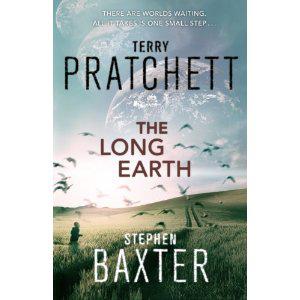
The Long Earth by Terry Pratchett and Stephen Baxter

Occasionally a new series is announced on television. The director is someone well known, the lead actors are famous, the production has obviously (from the trailers) had a lot of money spent on it. So you tune in with high expectations…. but end up a bit underwhelmed – the whole is less than the sum of the parts. Somewhere the story has been lost.

The premise of the novel is simple but well realised. The idea of multiple parallel universes has been around for a long time, but Pratchett/Baxter’s idea is to ask – “What if we could travel easily to and from these worlds?” This is the “Long Earth” of the title. The challenge these writers faced was to take this idea and overlay it with a story, without letting the conceit overwhelm the narrative. Broadly speaking I don’t think they achieved this. They explore a lot of the issues that the Long Earth presents – how would migration to these new worlds affect the old earth, what about those who are unable to travel, (stepping), what would the new worlds be like – almost like an intellectual exercise. New species and civilisations are discovered, but the heart of the novel is a journey to the far reaches of the Long Earth to discover a new form of intelligent life, that may or may not represent a threat to the rest of civilisation.

There are a huge number of threads left hanging at the end of the novel – the mysterious Black corporation, for example, is mentioned in passing as some kind of global MegaCorp, but this goes nowhere. Joshua the main character is built up as a messiah-like figure and there are references to “the Silence” that aren’t properly explored or explained. Equally there is little of the typical Pratchett whimsy – the organic matter that drives the stepping devices is a potato (why?), and we are told about but do not meet a religious cult that believes all of existence is a practical joke. There are also some obvious traces of Pratchett in the character of Lobsang, a hyper-intelligent robot that passes the Turing test and claims to be the reincarnated spirit of a Tibetan priest. But the lightness of touch which usually characterises Pratchett’s writing is largely missing. In its stead are long passages describing the journey West through the long earth. (Incidentally, the journey West is a deliberate and explicit echo of the journey across the Wild West of the USA, without the red indians/native americans.

Pratchett started a story based on the idea of the Long Earth and stepping between worlds, in the 1980’s, and abandoned it, presumably because he wasn’t able to craft a story out of it. DiscWorld might have got in the way a bit as well. Bringing in a sci-fi writer (Baxter is often described as a “hard sci-fi” writer – I can only guess this means he doesn’t normally include any fantasy element in his work) to help finish the work was misconceived – Pratchett already had the sci-fi component of his story, what he needed was a strong plot to bring to life the world he had created.

Despite a literal big bang, the book actually ends with a bit of a whimper, and it is made obvious that we are being invited to participate in a series of novels – the Long Earth perhaps becoming the new DiscWorld, with characters such as the police officer we meet but who has very little to do in this novel becoming more central, having their own plot lines, etc. If that inference is correct it is a fine ambition, and I am sure I will keep reading – for now.

Standard