21st century literature, American literature, Book review, Jonathan Safran Foer

Here I Am, by Jonathan Safran Foer, 2017

As I may have mentioned once or twice, I keep this blog as a record of what I read. If I don’t blog it’s probably because I haven’t been reading, but occasionally there are novels that really challenge my ability to say something interesting. ‘Here I Am’, Jonathan Safran Foer’s third novel, is a case in point. I read it a couple of months ago, but found it so underwhelming that when I finally found the time to write this review I had to look the title up. What is more remarkable is that it seems to have taken the author 10 years or more to write it!

‘Here I Am‘ is the story of the Blochs, a very familiar dysfunctional American family. Julia, an architect, and husband Jacob, a TV screenwriter, live in Washington DC with their three sons, Sam, Max and Benjy. Their marriage is falling apart for all the usual reasons – boredom, disrespect, mid-life crises, infidelity. An extended family provides supporting cast members including Jacob’s grandfather Isaac, planning to defer death until after Sam’s bar mitzvah; Jacob’s parents, Irv and Deborah, and others.

The Guardian’s review described “Here I Am” as

a novel of diaspora, of the elasticity of its numerous possible meanings, and of the pain caused by both the presence and the absence of the homeland it invokes. It moves from the intimate dissection of a family that has ceased to become a home for its members to the question of what Israel means to American Jews, and what they might consider to be their duty in the face of its imperilment.”

Which is a useful thematic summary, but will also give you a strong flavour of the worthiness of the novel. Worthiness can be fatal to any attempt at comedy. Because despite the big themes, this is undoubtedly intended to be an albeit dark comic novel. Divided between writing a serious novel about the experience of being a Jewish American family (already very well-explored novelistic territory) and the more comic aspects of that experience (ditto) Safran delivers neither very well.

Part of the problem is that very little happens, and it takes a long time to not happen. Minor incidents become central plot elements. Sam leaves a list of “rude” words on his desk at school then denies doing so – it is not until near the end of the novel that we find out he did write the list, as a profoundly unrealistic exercise in intellectual curiosity. Jacob “loses” the secret mobile phone on which he and a producer have exchanged explicitly sexual texts, in a pretty pathetic attempt to make himself more interesting to his wife. As mid-life crises go this is mundane stuff.

The bulk of the narrative is conveyed through the family’s conversations. The repetitive dialogues and monologues may be realistic representations of the way families talk to one another, but it felt a bit like being harangued for 500 and more pages. Realising the novel needed something by way of incident or drama, Safran Foer goes “all-in”. An apocalyptic earthquake in the Middle East strikes Israel, gifting the surrounding states an opportunity to recover lost territories/invade, depending on your perspective. A domestic chronicle suddenly becomes a diary of this catastrophe, which ends with the Israeli prime minister’s absurdly unlikely call to the men of the Jewish diaspora to return “home”. As if a country struck by an earthquake needs an influx of untrained volunteers to defend it. Jacob’s half-hearted attempt to volunteer falls flat, being turned away at the airport due to him having nothing worthwhile to contribute. As a metaphor for the turbulence in the Bloch family the earthquake and ensuing crisis is clumsy in the extreme, and as a statement on the position in the Middle East it is at best irrelevant and worst tasteless.

And if you have found the preceding paragraphs an unsatisfactory account of this novel, well you can’t say I didn’t warn you!

Standard
100 Best Novels Guardian list, 1919, 20th century Literature, American literature, Book review, John Dos Passos

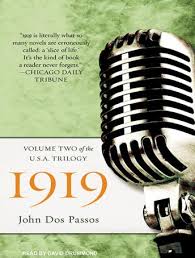
1919, by John Dos Passos, 1932

‘1919’ is the second book in Dos Passos’s ‘USA’ trilogy. Which immediately begs the question, why read only the middle book in a trilogy? You wouldn’t read only ‘The Two Towers’, would you? I think there are several reasons why I am going to resist the temptation to read the rest of ‘USA’. Firstly, ‘1919’ (and only ‘1919’) was recommended by the Guardian’s list of 100 best novels written in English; second, having now read this novel, to go back to the first volume seems a bit pointless; third1919, I just don’t have the appetite for another 800 pages of this trilogy. The novels are intended to stand alone and I am going to take the author at his word on this (even though many online reviews argue that reading the whole trilogy is the only way to properly appreciate its constituent parts).

At one time Dos Passos was ranked with the greats of American post-war literature – Hemingway, Faulkner, Steinbeck and Fitzgerald. While their novels have stood the test of time, I don’t think the same can be said for Dos Passos. ‘1919’ has only two reviews on Amazon’s UK site, compared to over 2,000 for Gatsby, and 1,500 for The Grapes of Wrath (Faulkner, by comparison, is little reviewed – go figure). ‘1919’ uses many innovative techniques, and these are some of the most successful aspects of the novel. Chapters are introduced with short scraps of text from newspaper and magazine headlines, followed by stream of consciousness, camera-reel impressions of the events of the following chapter. Interspersed elsewhere are short pen pictures of a series of American political and military figures who played a part in the First World War, and the industrial struggles in the United States at about the same time. (The Los Angeles Review of Books described these sections of the novels as “disruptive bumps in the reader’s way (which) have no bearing on the story, but add Americana-flavored flamboyance to the proceedings”. (It’s worth reading the whole of this review which is a pretty magisterial take down of the trilogy, describing it as “The Great American Novel That Wasn’t”!)

The body of the novel is a more traditional narrative telling the stories of five principal characters. Although these characters are Americans, the war takes them all to Europe, when the bulk of the novel’s events occur. Despite America’s extensive involvement in the war, none of the characters are involved directly in the conflict, serving as merchant seamen, ambulance drivers, or working with the Red Cross. There is a relentlessness about these stories – things happen, then something else happens, then yet more events; with troubled love affairs acting as the inevitable punctuation to another round of meetings, dinners, drinks, journeys back and forth between Rome and Paris, and so on. Because I didn’t care about these characters – possibly because I had not read about them in the first volume – I found these parts of the novel tiresome.

As an invocation of what it was like to be an American in Europe in 1917-1919 – privileged, largely immune from the conflict, endlessly bumping into one another – I am sure this is a faithful portrait. But apart from the tediousness of the primary narrative, there were other aspects of the novel which jarred. The condescending attitude towards Europeans often found in American popular culture crops up here far too often. Also prevalent is a racist (the n-word is used freely), anti-semitic, misogynist bundle of nasty prejudices which are given full rein and go completely unchallenged, despite Dos Passos’s apparent left wing ideals. As a small concession to this reactionary tide the novel closes with a historically arguable portrait of an attack on American Trade Unionists (the Centralia massacre) which is very sympathetic to the IWW (the international Workers of the World, also known as the Wobblies).

As an attempt to describe how a better world could have emerged from the ashes of the First World War ‘1919’ fails completely – it is desperately pessimistic. All strikes are defeated, all socialists are isolated and the Red Scare (which swept post-War America and is in many ways still underway) looks unstoppable. From 1932 Dos Passos’s defeatism is understandable, and probably explains his subsequent steady drift to the Republican right.

‘1919’ was the third from last novel in my current reading challenge. Next up is Henry James’s ‘The Golden Bowl’, leaving’ Ulysses’ to last.

Standard
100 Best Novels Guardian list, 20th century Literature, American literature, As I lay dying, Book review, Southern Gothic, William Faulkner

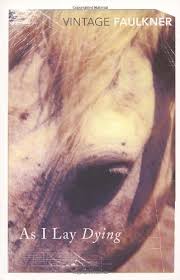
As I Lay Dying, by William Faulkner, 1930

William Faulkner’s ‘As I Lay Dying’ tells the story of the death of Addie Bundren and her last journey to her hometown, Jefferson, Mississippi. The novel opens with the dying Addie watching her son Cash construct her coffin. The ominous sounds of his carpentry echo around the house, forming an aural backdrop to the family’s hushed conversations about their mother’s imminent death. The summer heat is oppressive, but the night after Addie dies the expected rainstorm breaks, washing out the bridges and fords that lay on the long road to Jefferson. Undetermined, infinitely stubborn, the family set out with Addie’s body on the back of the wagon. The journey is of biblical proportions, with the family having to overcome trials of fire and flood.  As I lay dying

‘As I Lay Dying’ is Faulkner’s masterpiece, a virtuoso epic that is one of the most extraordinary novels I have read in a very long time. The task of doing it justice in a review is daunting, so rather than trying to explore every aspect of its astonishing variety and sophistication I am going to focus on two related aspects of the novel – Faulkner’s use of narration techniques, and the more general issue of complexity: in other words, how does the novel tell its story?

The narrative voice in ‘As I Lay Dying’ is highly complex. Ostensibly, the novel is constructed from a sequence of “stream-of-consciousness monologues, in which the characters’ thoughts are presented in all their uncensored chaos, without the organizing presence of an objective narrator” (SparkNotes). But that’s only part of the story. Underneath the naturalistic voices of the characters is another, insistent authorial voice. The narrative switches between these voices so frequently and seamlessly that it is often easy to miss the transition.

Here’s an example. The narrator here is ten-year old Vardaman. He is distressed because of his mother’s death, and struggling to process his reactions:

“I can cry quiet now, feeling and hearing my tears. It is dark. I can hear wood, silence. I know them. But not living sounds, not even him. It is as though the dark were resolving him out of his integrity into an unrelated scattering of components”.

The first sentences in this paragraph are short, child-like. Then in the sentence beginning “It is as though” another voice intrudes, and the repetition of the personal pronoun “him” is ambiguous – is this the “him” of the previous sentence, referring to one of Vardaman’s brothers that he can hear in the dark, or Vardaman himself. In other words this ultimate sentence can be read as being either by or about Vardaman. In any event, it uses a language and vocabulary that a ten-year old child would not be familiar with – it is another narrative voice.

Here’s another example from Darl, one of Vardaman’s older brothers:

“The horse moving with a light, high-kneed driving out…We go on with a motion so soporific, so dream-like, as to be uninferant of progress, as though time and not space were decreasing between us”.

Some critics have seen this change in voice, used throughout the novel, as an error. They have complained that Darl’s vocabulary, for example, is far more extensive than a Mississippi farm-hand would have known. I think it is reasonable to assume that these transitions are deliberate, which begs the question “So what’s going on?”

I can only describe the effect this technique had on me. The fragmented nature of the monologues causes the reader to concentrate to follow what is going on – no-one voice is telling us clearly what happens. Instead we slowly build up a picture of events from the thoughts and reactions of the characters. Some events are only referred to incidentally rather than directly described, and others are described from multiple, conflicting points of view. The characters’ back stories and the context of the family tragedy that unfolds has to be pieced together slowly. The presence of an ambiguous, unnamed authorial voice that intrudes into the narrative, using rich language and elaborate metaphor, gives an additional layer of complexity and opulence to the novel. The best explanation I can offer for this voice is that it is an articulation of the characters’ unconscious thoughts and feelings. This is why it invariably follows the initial, more straightforward thoughts.

The narrative voice can change within a sentence. This demands that the novel is read carefully. Another technique Faulkner uses to require this form of reading is his use of complexity.  ‘As I Lay Dying’ has an ostensibly simple structure. The storyline follows the family’s journey to Jefferson. There were however points during the narrative where I found it hard to be sure precisely what was going on. The ford-crossing scene is a good example. The family attempt to cross a flooded ford with two mules and a wagon carrying the coffin and body. The stormy waters knock them off their feet, and while the coffin is saved the mules drown, and Cash, one of Addie’s sons, breaks his leg. This scene is narrated by Darl in the present tense – “Carl and I sit in the wagon; Jewel sits the horse at the off-rear wheel”. His descriptions range from the straightforward, as in this example, to ornate, elaborate sentences we have come to expect from the elusive authorial narrator “Above the ceaseless surface they stand – trees, cane, vines – rootless, severed from the earth, spectral above a scene of immense yet circumscribed desolation”.

Darl gives the initial description of the crossing, which is followed by a past tense description from ten-year old Vardaman, and another past tense version from the Bundren’s neighbour, Vernon Tull. It is not until the narration switches back to Darl that we learn that in the accident Cash has at some point re-broken his leg, and lost all his tools, but that he has somehow rescued his mother’s coffin.

The reader is able to follow what broadly happens – the crossing is perilous, a log smashes into the wagon, and the sons fall into the water. But some of the detail is elusive, and only emerges in the later descriptions. Darl’s present tense narration puts the reader directly onto the ford with the characters, struggling with the rising waters, scared, shouting but unable to make themselves heard. This is why the description is chaotic – to capture the sense of confusion and fear that the characters are feeling.

Darl is at the heart of the novel, narrating a third of all chapters, including the one describing his mother’s last moments, even though he is not present for these scenes. In post-publication interviews Faulkner insisted on Darl’s insanity but the textual evidence for this is limited – even his act of arson can be seen as a pragmatic response to the problems the family has faced in reaching Jefferson. In his last chapter Darl’s voice has progressed from present first person narrative to third person past tense – on other words he describes his actions as if he was another person observing them.

I have never really understood the stock reaction to a wonderful book – that the reader reached the last page, only to turn back to the beginning and start again. If I had just enjoyed a steak the last thing I would want is another steak straight away (some ice-cream, maybe?). But with ‘As I Lay Dying’ this phrase began to make sense – I really did want to re-read the novel and enjoy the skill with which it is constructed all over again, and to appreciate the subtle nuances and detail with a fresh pair of eyes.

‘As I Lay Dying’ is the 96th novel in my reading challenge. I have four left: ‘Ulysses’ by James Joyce, ‘The Golden Bowl’ by Henry James, ‘1919’ by John Dos Passos, and ‘Tristram Shandy’ by Laurence Sterne. I haven’t got a particular reading order in mind – any suggestions?

Standard
American literature, Book review, science fiction'

Fahrenheit 451, by Ray Bradbury, 1953

“A book is a loaded gun in the house next door…Who knows who might be the target of the well-read man?”

Bradbury’s seminal dystopian novel is one of the key texts of the McCarthyite era in post-war America. Bradbury describes a world in many ways very much like his own, but where firemen burn books, where the population are distracted from an understanding of their lack of freedom and the threat of nuclear war by the bread and circuses of wall-sized flat screen televisions, and in-ear “sea-shell thimbles”, and where suspects are hunted down by helicopter and summarily executed on live television. Continue reading

Standard
100 Best Novels Guardian list, 20th century Literature, American literature, Book review

Babbitt, by Sinclair Lewis, 1922

‘Babbitt’, Sinclair Lewis’s satirical portrait of 1920’s America, was written only three years into the prohibition era, and published three years before that other, very different portrait of the USA of the time, ‘The Great Gatsby’. babbittThe term ‘babbitt’ was used in the US for some time (I am not sure if it is still current) to signify a person, especially a business or professional man, who “conforms unthinkingly to prevailing middle-class standards and norms”. The name itself is a cleverly constructed combination of ‘babble’, the meaningless babyish talk that Babbitt typically uses when in discussion with his friends, and ‘rabbit’, a small and vulnerable creature, the opposite of the alpha-male that he believes himself to be.

‘Babbitt’ tells the story of two years in the life of estate agent George Babbitt. The novel opens in 1920 when George is 46. He is an unthinking lower middle class businessman, married with three children, staunchly conservative in his views, and profoundly hypocritical in his behaviour. In conventional terms not much happens – he has doubts about some of his convictions, as his children grow up and begin to drift away from him, but after a brief flirtation with a more decadent and liberal group of friends he rapidly scuttles back to his safety zone, unharmed and none the wiser. His story is told by a third person narrator who largely reflects Babbitt’s thoughts and feelings, although the narrative voice occasionally steps apart from Babbitt to give the reader an alternative perspective. This different point of view is usually not really needed, because the narrator does such a good job of pointing out the contradictions inherent in Babbitt’s prejudices.

“All of them agreed that the working-classes must be kept in their place; and all of them perceived that American Democracy did not imply any equality of wealth, but did demand a wholesome sameness of thought, dress, painting, morals, and vocabulary.”

Hypocrites they may be, but some of Babbitt’s associates realise and accept that their respectable façade is dishonest. Early in the novel Jake Offutt, a politician and Henry T. Thompson, Babbitt’s father-in-law confer:

“Wonder how long we can keep it up, Hank? We’re safe as long as the good little boys like George Babbitt and all the nice respectable labor-leaders think you and me are rugged patriots. There’s swell pickings for an honest politician here Hank: a whole city working to provide cigars and fried chicken and dry martinis for us, and rallying to our banner with indignation, oh, fierce indignation, whenever some squealer like this fellow Seneca Doane comes along. Honest, Hank, a smart codger like me ought to be ashamed of himself if he didn’t milk cattle like them, when they come around mooing for it!”

As a satire on American post-war life, its small-mindedness and emptiness, its lack of genuine spirituality, its hypocrisy and prejudice, ‘Babbitt’ is effective, but perhaps a little heavy-handed. With some important exceptions, the principal characters of the novel, Babbitt’s friends and business acquaintances, are all varying reflections of Babbitt himself –stupid and prejudiced, despite considering themselves cultured and modern: There is a deeply unpleasant and sinister tone to some of their comments, such as this discussion in chapter 10:

“We ought to get together and show the black man, yes, and the yellow man, his place. Now I haven’t got one particle of race prejudice, I’m the first to be glad when a n***** succeeds, so long as he stays where he belongs and doesn’t try to usurp the rightful authority of the white man….And another thing we got to do is keep these damn foreigners out of the country. These Dagoes and Hunkies have got to learn that this is a white man’s country”

So perhaps some things haven’t changed that much?

Personally, while I enjoyed the mild sarcasm that Lewis deploys, I found the portrait of a classic mid-life crisis more interesting. When his friend Paul Riesling shoots his wife, this precipitates a moment where Babbitt comes to question the value and purpose of his life. He is unable to pinpoint the source of his dissatisfaction. There is a suggestion in the novel that Babbitt’s dissatisfaction with life derives from his unrecognised doubts about his sexuality. The first hints of this come when he is thinking about the film stars he has seen in his teenage daughter’s magazines, describing them as

blankly beautiful, suspiciously beautiful young men”.

We are told that he married without being in love with his wife, and that his sex life is very limited:

“She made him what is known as a Good Wife. She was loyal, industrious, and at rare times merry. She passed from a feeble disgust at their closer relations into what promised to be ardent affection, but it drooped into a bored routine.” (Chapter 6)

(By closer relations I don’t think Lewis means aunts and uncles). ‘Feeble disgust’ is a sad comment on their marital sex-life, and the choice of the verb “drooped” can’t be an accident! Later in their marriage, after his wife returns from an extended break with her sister out of State, Babbitt shrinks from the prospect of having reunion sex. Lewis coyly puts it thus:

“All the while he was dreading the moment when he would be alone with his wife, and she would patiently expect him to be ardent”. (Chapter 25)

Lack of interest in sex with his wife might be a symptom of Babbitt’s developing mid life crisis, but equally Lewis hints at a more specific cause:

“What did he want? Wealth? Social position? Travel? Servants? Yes, but only incidentally…But he did know that he wanted the presence of Paul Riesling, and from that he stumbled into the admission that he wanted the fairy girl in the flesh. If there had been a woman whom he loved he would have fled to her.” (Chapter 23)

In the US at this time the term fairy was used to describe a gay man. [1] Is this Babbitt’s unconscious speaking to him through his dreams, telling him to pursue his true nature? There is another hint of this in his earliest description of the fairy girl “She was so slim, so white, so eager! She cried that he was gay and valiant”. Indeed.

Wondering with this was a genuinely original insight, or whether this was a conventional modern reading of the novel, I asked Google. There is a paper from Richard Schwartz of the Department of English, Florida International University here which argues persuasively that ‘Babbitt’ is a portrait of latent homosexuality. I am not going to repeat the comprehensive arguments and evidence that Schwartz has put together, but if you are reluctant to click through to his paper consider these points that he has assembled:

“Babbitt “was an older brother to Paul Riesling, swift to defend him, admiring him with a proud and credulous love passing the love of women.” In Paul’s presence Babbitt “was awkward, he desired to be quiet and firm and deft.” At their club they eat apart from his regular group of dining companions, even though “At the Zenith Athletic Club, privacy was very bad form. But he wanted Paul to himself.” ”

There’s lots more. Incidentally, the phrase ‘love passing the love of women’ echoes that emphatic Victoria phrase, the “love that dare not speak its name” and is a quote from 2 Samuel 1.26 David’s Song for Saul and Jonathan in the New American Standard Bible.

When you read the novel from this perspective, Babbitt’s behaviour and his unresolved agonies about his life begin to make a lot more sense.

Sinclair Lewis was awarded the Nobel prize for literature in 1930, and ‘Babbitt’ was cited by the committee as being one of his main achievements. Time hasn’t been kind to this novel – there are better, funnier portraits of the period and type.

[1] <1895 “the peculiar society of inverts. Coffee-clatches, where the members dress themselves with aprons etc., and knit, gossip and crotchet; balls, where men adopt the ladies’ evening dress, are well known in Europe. ‘The Fairies’ of New York are said to be a similar secret organization. The avocation which inverts follow are frequently feminine in their nature. They are fond of the actor’s life, and particularly that of the comedian requiring the dressing in female attire, and the singing in imitation of a female voice, in which they often excel.”—‘American Journal of Psychology,’ VII. page 216

Standard
100 Best Novels Guardian list, 20th century Literature, American literature, Book review

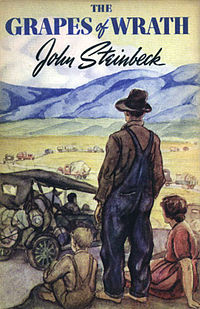
The Grapes of Wrath by John Steinbeck, 1939

‘The Grapes of Wrath’ opens with a portrait of the devastation caused by the dust bowl in 1930’s Oklahoma:

Every moving thing lifted the dust into the air…A walking man lifted a thin layer as high as his waist. An automobile boiled a cloud behind it.”grapes-of-wrath

Tom Joad has just been released on parole, after having served four years for manslaughter, killing a man with a shovel during a fight in which he had been stabbed. Tom finds his family home abandoned, and his extended family about to move to California, a journey estimated at around 2000 miles, including up and over the Rockies. He and a lapsed itinerant preacher join them, and thus begins the odyssey which is ‘The Grapes of Wrath’.

The novel draws much of its imagery and language from the bible, not least when the Joad family set off for the promised land joining a mass migration which followed in the footsteps of the original European settlers. In his documentary on the novel, Melvyn Bragg points out that the family of 12 on the Joad’s truck are

“as the 12 tribes of Israel seeking liberation. The truck itself is an ark; there is even a man named Noah on board.”

(The pedant in me wants to point out there were only eight people on the ark, and a heck of a lot of animals, but that might be counter-productive).

The Dust Bowl was caused by agricultural practices not suited to the Mid West environment, but Steinbeck treats it as a natural occurrence, a biblical plague. His condemnation of the banks that buy up the small share-cropper farms and evict the families is heartfelt, although his approach to farming technology – that tractors and combines are somehow alien machines that disconnect man from the soil and are inherently bad – is sentimental and unconvincing. However, the strength and impact of the prose is such that at the time the reader is carried along with the Joad’s distress at their (effective) eviction, and doesn’t challenge their view that they are doing the right thing.

“Funny thing how it is. If a man owns a little property, that property is him, it’s part of him, and it’s like him. If he owns property only so he can walk on it and handle it and be sad when it isn’t doing well, and feel fine when the rain falls on it, that property is him, and some way he’s bigger because he owns it. Even if he isn’t successful he’s big with his property. That is so.”

The rhythms and cadences of the language have the feeling of a revivalist sermon, all the more so when the speaker is Casy, the lapsed preacher who travels with the family. The ending phrase used here – “that is so” – has the impact of an “amen” or “this is the word of the Lord”. Steinbeck uses incomplete phrases to layer his descriptive passages:

“the main immigrant road … the path of people in flight, refugees from dust and the shrinking land, from the thunder of tractors and shrinking ownership”.

However, the Joad’s don’t feel sorry for themselves – they genuinely believe they are going to the land of milk and honey, and get quite angry when people they meet on route try to point out that not everything in California is as blessed as they expect it to be. The great continental migration from east to west is a fundamental defining part of the American narrative, which probably is one of the central reasons for this novel’s massive popularity in the US. The Joad’s journey echoes that great migration – although again the pedant in me can’t avoid noticing that in some ways it is much easier, as they have a truck to carry them, and gas stations along the way!

The journey is difficult and dangerous, but not completely a negative experience. Their lorry lasts the entire journey, including the crossing of the desert and the mountains; they meet kindness and friendship from other travellers, and they are very lucky to find a place a government camp, where Tom finds work on his first day. Later they get work picking cotton and a box-car to live in. However, the older family members find the journey very difficult, others bail out early, and soon the family has to face the hostile realities of life in California – there is very little work, and the settlers are resented bitterly by the locals, who feel threatened by the ‘Okies’.

This is an overtly political novel – driven by anger Steinbeck rages against the system that drives down wages, pits people against one another, and finds it more economical to leave fields bare than to feed people, crops to rot or be destroyed rather than harvest them and sell them at a loss:

“Here is a crime here that goes beyond denunciation. There is a sorrow here that weeping cannot symbolize. There is a failure here that topples all our success. The fertile earth, the straight tree rows, the sturdy trunks, and the ripe fruit. And children dying of pellagra must die because a profit cannot be taken from an orange. And coroners must fill in the certificate- died of malnutrition- because the food must rot, must be forced to rot. The people come with nets to fish for potatoes in the river, and the guards hold them back; they come in rattling cars to get the dumped oranges, but the kerosene is sprayed. And they stand still and watch the potatoes float by, listen to the screaming pigs being killed in a ditch and covered with quick-lime, watch the mountains of oranges slop down to a putrefying ooze; and in the eyes of the people there is the failure; and in the eyes of the hungry there is a growing wrath. In the souls of the people the grapes of wrath are filling and growing heavy, growing heavy for the vintage.”

Steinbeck outlines a clear political solution to the problem in the model, self-organising, self-policing community of Weedpatch, the government camp where the family settle for a while. Weedpatch is effectively a model Soviet commune, run by the people for the people, with leaders elected weekly and assets shared. Steinbeck’s novel is both a protest about the treatment of working people, and a warning about the inevitable results of that treatment.

And the great owners, who must lose their land in an upheaval, the great owners with access to history, with eyes to read history and to know the great fact: when property accumulates in too few hands it is taken away. And that companion fact: when a majority of the people are hungry and cold they will take by force what they need. And the little screaming fact that sounds through all history: repression works only to strengthen and knit the repressed. The great owners ignored the three cries of history. The land fell into fewer hands, the number of the dispossessed increased, and every effort of the great owners was directed at repression. The money was spent for arms, for gas to protect the great holdings, and spies were sent to catch the murmuring of revolt so that it might be stamped out. The changing economy was ignored, plans for the change ignored; and only means to destroy revolt were considered, while the causes of revolt went on.”

Tom, the novel’s central figure, slips away into the night at the end of the novel, a wanted man on the run. He is determined to take on the union organisation work of the murdered Casy. We are not told of his ultimate fate, but he leaves with these haunting words:

“I’ll be ever’where – wherever you look. Wherever they’s a fight so hungry people can eat, I’ll be there. Wherever they’s a cop beatin’ up a guy, I’ll be there. If Casy knowed, why, I’ll be in the way guys yell when they’re mad an’ – I’ll be in the way kids laugh when they’re hungry an’ they know supper’s ready. An’ when our folks eat the stuff they raise an’ live in the houses they build, why, I’ll be there.”

It would have been so nice to have been able to read ‘The Grapes of Wrath’ as a portrait of a time long past, in the way we now read Kingsley’s ‘The Water Babies’ or much Dickens’s social realism. But sadly one can’t – the problems of social deprivation and migrant labour are as acute today as they were in the 1930s. Hyperbole? Perhaps, although the statistics for the number of people dying in the attempt to cross from Mexico to the USA are still horrifying. But this is nothing compared the numbers of people trying to escape from poverty and conflict in North Africa and the Middle East, who die in their thousands in the attempt, and who are feared, stigmatised and abused in exactly the same way that Steinbeck’s characters are treated.

“In the West there was panic when migrants multiplied on the highways. Men of property were terrified for their property. Men who had never been hungry saw the eyes of the hungry. Men who had never wanted anything very much saw the flare of want in the eyes of the migrants. And the men of the towns and of the soft suburban country gathered to defend themselves; and the reassured themselves that they were good and the invaders bad, as a man must do before he fights, They said “These goddamned Okies are dirty and ignorant. They’re degenerate, sexual maniacs. The goddamned Okies are thieves. They’ll steal anything”.”

I know I’ve quoted a length from this novel. But I am not going to apologise for that – there is a poetry to Steinbeck’s prose, an almost hypnotic lushness, and it is really hard to find shorter sections that convey this adequately.

I am enough of a traditionalist to want to know what happened to the Joad’s, if they ever found the modestly comfortable life they were looking for, whether Al got the job in a garage he was so obviously suited for. But I can appreciate that Steinbeck wanted to leave some uncertainty about their future in a world where the future of America itself was becoming increasingly hard to predict.

Standard
100 Best Novels Guardian list, 20 Books of summer, 20th century Literature, American literature, Book review, Robert Penn Warren, All the King's Men

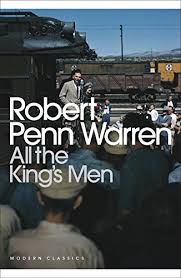
All the King’s Men, Robert Penn Warren, 1946

‘All the King’s Men’ is the story of the rise and fall of Governor Willie Stark in 1930’s America. The novel is narrated by Jack Burden, one of Stark’s assistants and “fixers”, who offers a detached, sardonic commentary on Stark’s progress to become Governor of his State. Stark starts his political life as a honest man, but through a series of compromises he slowly becomes the thing he once stood against:

“Politics is a matter of choices, and a man doesn’t set up the choices himself. And there is always a price to make a choice. You know that. You’ve made a choice, and you know how much it cost you. There is always a price.Warren

Stark appears to be a broadly progressive figure, on the side of the “little man”, introducing reforms designed to tax the rich and ease the burden of the state’s poor farmers. But despite his considerable popularity, the burden of power slowly but inevitably corrupts him, leading eventually to his demise. He never becomes a monster, but he makes a series of compromises and decisions which once taken can’t be reversed.

While Stark is the novel’s focus, the unobtrusive narrator slowly unravels his back story. Burden uses his experience as a historical researcher to dig up material to allow Stark to blackmail a former family friend, Judge Irwin. This sets in train the tragic series of events that leads to Stark’s downfall, and that of several other characters. In a distributing flashback scene, in which Burden explains how he developed his investigative skills, we are told the story of his ancestor’s involvement in the slave trade.

As a narrative character Burden, his name heavily symbolic, is reminiscent of that other observer of the tragic fall of a charismatic figure, Nick Carraway. Even the way he ends the novel

And soon now we shall go out of the house and go into the convulsion of the world, out of history into history and the awful responsibility of Time

calls back to Fitzgerald’s only slightly more memorable and evocative line

So we beat on, boats against the current, borne back ceaselessly into the past.”

Warren was America’s first poet laureate, and it shows. His prose style is luxurious and elegiac, powerfully evoking the 1930’s Deep South landscape. His use of imagery is extremely strong –

 “So I pulled the sun screen down and squinted and put the throttle to the floor. And kept on moving west. For West is where we all plan to go some day. It is where you go when the land gives out and the oldfield pines encroach. It is where you go when you get the letter saying: ‘Flee, all is discovered’. It is where you go when you look down at the blade in your hand and see the blood on it. It is where you go when you are told that you are a bubble on the tide of empire. It is where you go when you hear that thar’s gold in them-thar hills. It is where you go to grow up with the country. It is where you go to spend your old age. Or it is just where you go.”

He handles the big themes running through the novel comfortably, and while the prose sometimes teeters on the edge of taking itself too seriously, it always avoids being pretentious. Mainly this is achieved by Burden’s knowing commentary – at times he reminded me of that other great cynical poet of pre-war American life, Philip Marlowe.

“There was nothing particularly wrong with them; they were just the ordinary garden variety of human garbage” could have come straight out of the best of Chandler.

I really enjoyed this novel. Warren is an author I had not heard of before, embarrassingly, but I am pleased to have now remedied that omission. It is a powerful, tragic story. The n-word is used extensively, as is sadly common in novels of this time and place, but with that one caveat I can thoroughly recommend it.

Standard
100 Best Novels Guardian list, 20 Books of summer, 20th century Literature, American literature, Book review

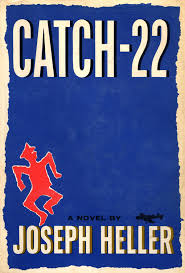
Catch 22 by Joseph Heller, 1961

I was slightly nervous on approaching a re-read of ‘Catch 22’. We are all familiar with the22 original experience of a much loved book, television programme or film being much weaker when revisited (for some reason this is particularly true of television programmes – some iconic series such as The Prisoner, or Monty Python, utterly brilliant at the time, are almost unwatchable a few decades on). Comedy that is side splitting becomes dull and predictable. Novels that once seemed compellingly relevant and important lose any impact. What once worked well in a specific cultural context now seems pointless. Would ‘Catch 22’ suffer in the same way? Continue reading
Standard
100 Best Novels Guardian list, 20 Books of summer, 20th century Literature, American literature, Book review

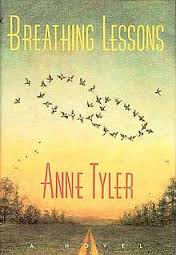
Breathing Lessons, by Anne Tyler, 1988

The title of Anne Tyler’s 1989 Pulitzer prize-winning novel refers to the lessons given to pregnant women to help cope with labour pains. As with many other themes in this novel, there is a second, subtler meaning – lessons in breathing are the lessons life teaches us. This is a novel about middle age, about being married through good times and bad, abreathing lessonsnd about disappointment. Continue reading

Standard
100 Best Novels Guardian list, 20th century Literature, American literature, Book review, Don Delillo, Underworld

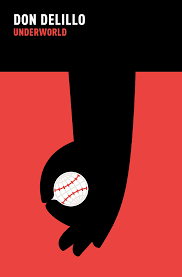
Underworld, by Don Delillo, 1997

Some novels are easy reads – the pages roll past in a blur, the events have a pace and unity that keep you turning the page, but the reader sometimes feel a bit of a passenger, riding the tide of the novel without having to do any work. Chapters are as short as the reader’s attention span, and when the novel is put down at night it can be picked up again at any time without the need to remind oneself where one left off. ‘Underworld’ is the precise opposite of that kind of novel. It is complex, dense, extremely long (832 pages), and peopled with a large cast of characters. The narrative voice is evasive, jumping from character to character and often it is not until well into a paragraph that there is any clue as to who the “I” is – and the very next paragraph it could change once again. The Underworldlanguage Delillo uses is fractured and often very poetic; his characters usually speak in incomplete sentences and there is often no indication who is speaking. The time structure of the novel is equally fragmented and the jumps in time are mirrored by jumps around the globe. This all adds up to a challenging novel, from many different aspects – but the question is, was it worth it? Continue reading

Standard