100 Best Novels Guardian list, 20th century Literature, American literature, Banned books, Book review, Henry Miller, Tropic of cancer

Tropic of Cancer by Henry Miller, 1934

‘Tropic of Cancer’ was banned in the UK and the USA for almost 30 years. Re-reading it after several decades, I am not surprised – it contains what were for the times explicit descriptions of sexual activity that you cannot find in any other conventional text of the time. Miller’s own description of the novel explained:

“This is not a book in the ordinary sense of the word. No, this is a prolonged insult, a gob of spit in the face of art”
ToC

George Orwell was an early defender of Miller, and in his 1940 essay ‘Inside the Whale’ wrote –

“I earnestly counsel anyone who has not done so to read …Tropic of Cancer. With a little ingenuity, or by paying a little over the published price, you can get hold of it, and even if parts of it disgust you, it will stick in your memory.”

He went on to say

“It is also an ‘important’ book, in a sense different from the sense in which that word is generally used. As a rule novels are spoken of as ‘important’ when they are either a ‘terrible indictment’ of something or other or when they introduce some technical innovation. Neither of these applies to Tropic of Cancer. Its importance is merely symptomatic. Here in my opinion is the only imaginative prose-writer of the slightest value who has appeared among the English-speaking races for some years past. Even if that is objected to as an overstatement, it will probably be admitted that Miller is a writer out of the ordinary, worth more than a single glance; and after all, he is a completely negative, unconstructive, amoral writer, a mere Jonah, a passive acceptor of evil, a sort of Whitman among the corpses. Symptomatically, that is more significant than the mere fact that five thousand novels are published in England every year and four thousand nine hundred of them are tripe. It is a demonstration of the impossibility of any major literature until the world has shaken itself into its new shape.”

“Whitman among the corpses” – what a phrase! It’s impossible (for me) not to read those words and recognise Orwell’s extraordinary powerful way with words. It was on the basis of this recommendation that I originally read ‘Tropic of Cancer’. My recollection is that I found it much more erotic than on re-reading, so much so that I began to wonder whether the Grove Press (no, me neither) edition I was using was bowdlerised – but apparently not. Memory can play tricks of course, which I suppose is one reason why I am re-reading many of these novels in the first place.

Briefly, ‘Tropic’ is a portrait of the life of an American expatriate down and out in Paris in the 1930s. The character is virtually penniless (or francless) and has a series of adventures, sexual and otherwise, while writing a novel. At times there is a semblance of a narrative, particularly in the novel’s closing scenes when the narrator teaches at a school in Dijon, and subsequently helps a friend escape from a relationship and return to America. It is written in a free form, stream of consciousness style, and Miller holds nothing back – it is scatological and sexually explicit. At times the narrative breaks down almost completely, and the text becomes simply layers of phrases:

“Tania is a fever, too – bright neckties on the Boulevard Montparnasse, dark bathrooms, Porto Sec, Abdullah cigarettes, the adagio sonata Pathetique, aural amplifiers, anecdotal séances, burnt sienna breasts, heavy garters, what time is it, golden pheasants stuffed with chestnuts, taffeta fingers, vaporish twilights turning to ilex, acromelagy, cancer, and delirium…” (page 5)

The first person narrator holds women in contempt – he describes them all routinely using the c-word, and there isn’t a single female character in the novel that isn’t either a prostitute or a sexual victim of one kind or another. Women exist only as objects. He describes female genitals as “that dark, unstitched wound, that sink of abominations” (251) and as an “ugly gash, the wound that never heals” and “this great yawning gulf of nothingness which the creative spirits and mothers of the race carry between their legs” (253). Later in a scene towards the end of the novel, the narrator visits a friend, who has been sleeping with a young woman:

“He came to the door stark naked. It was his night off and there was a c*** in the bed as usual. “Don’t mind her” he says, “she’s asleep. If you need a lay you can take her on. She’s not bad”. He pulls the covers back to show me what she looks like.” (291).

Freud would have a field day with this language and imagery – what psychological or sexual trauma led to Miller’s narrator feeling this way towards women?

Tempted as I am to dismiss this as misogynistic soft porn and move on, I can’t. For one thing, Miller can write;

“I am living at the Villa Borghese. There is not a crumb of dirt anywhere, nor a chair misplaced. We are all alone here and we are dead.”

He is also articulates the millennial nihilism that afflicted many in Europe as war threatened:

“For a hundred years or more the world, our world, has been dying. And not one man, in these last hundred years or so, has been crazy enough to put a bomb up the asshole of creation and set it off. The world is rotting away, dying piecemeal. But it needs the coup de grace, it needs to be blown to smithereens”

At times the tone is unsettlingly uneven – Miller moves from light comedy, such as the scene where a bidet is used inappropriately, to surrealist, fantastical descriptions, which are the parts of the novel I found the most challenging:

“Standing in the courtyard with a glass eye; only half the world is intelligible. The stones are wet and mossy and in the crevices are black toads. A big door bars the entrance to the cellar; the steps are slippery and soiled with bat dung. The door bulges and sags, the hinges are falling off, but there is an enamelled sign on it, in perfect condition, which says: “Be sure to close the door.” Why close the door? I can’t make it out. I look again at the sign but it is removed; in its place there is a pane of colored glass. I take out my artificial eye, spit on it and polish it with my handkerchief. A woman is sitting on a dais above an immense carven desk; she has a snake around her neck” (and so on – this goes on for a long time!)

Eighty years ago ‘Tropic of Cancer’ was banned because of its portrayal of sex – it is a sign of how we have moved on as a society that what is shocking about the novel today is its sexism, not its sex.
Standard
100 Best Novels Guardian list, 21st century literature, American literature, Song of Solomon, Toni Morrison

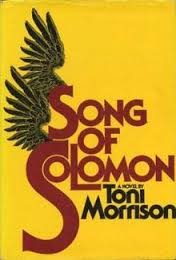
Song of Solomon by Toni Morrison, 1977

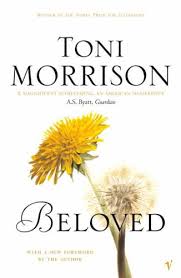
‘Song of Solomon’, makes an interesting companion text to Morrison’s later novel, ‘Beloved’ which I reviewed earlier this month. Both novels take as their subject matter the question of African American identity and experience, but while ‘Beloved’ looks unflinchingly at arguably the most difficult period of this experience, the nineteenth century, ‘Song of Solomon’ takes as its setting a later, less traumatic time span, approximately 1930-1963. SoSThe novel opens with the death of an insurance agent, Robert Smith, who believes he can fly. From this opening scene Morrison introduces her cast, the Dead family, who witness Smith’s death, along with the rest of the community of Not Doctor Street, The family derives their name from the period immediately after the end of slavery, when all former slaves had to register with the Freedmen’s Bureau, and when the answer to a question about the character’s father (who was deceased) was mistakenly entered as his name. Other unusual names are a motif throughout the novel, either as nicknames – Milkman, Guitar, Sweet – or as family names chosen at random from the bible – First Corinthians, Pilate, and Magdalene called Lena
At first the novel is a wide-ranging saga following the interwoven relationships of the Dead family across several generations. The structure is complex, with revelations about the family’s past being revealed slowly in flashback. However the novel changes pace at roughly half way, (the original New York Times review called it an “abrupt shift”) and in this latter section the narrative becomes more akin to a thriller or a detective story. Here the search for buried gold, a midnight hunt, a secret society and above all an emerging mystery surrounding the origins of the Dead family are breathlessly presented. Eventually the novel’s protagonist, Milkman, so-called because his mother breastfed him into early childhood, learns his great-grandfather Solomon was said to have escaped slavery by flying back to Africa, bringing the theme of flight full circle. Finally, another leap into flight leaves the novel to end on an ambiguous note. Morrison uses this theme –flight – as both a symbol of empowerment and escape, and of self delusion and suicide.

Morrison took a risk in making Milkman her central character – he is not very sympathetic, particularly in his relationships with women, not least his cousin Hagar, who eventually dies of (to all intents and purposes) a broken heart. He is heavily influenced by his parents, but takes most of his advantages and friendships for granted. One of the best scenes is where his sister, after decades of silence, finally lays into him:

“Where do you get the right to decide our lives? I’ll tell you where. From that little hog’s gut that hangs between your legs. Well, let me tell you something… you will need more than that. I don’t know where you will get it or who will give it to you, but mark my words, you will need more than that…. You are a sad, pitiful, stupid, selfish, hateful man. I hope your little hog’s gut stands you in good stead, and you take good care of it, because you don’t have anything else.”

I can admire Morrison’s obvious skill in this novel. She combines a compelling storyline with wonderfully crafted imagery and insights into complexities of the African American experience in twentieth century America. The skill in construction of the novel is obvious in little scenes like the following, where Milkman and Guitar spot a peacock white incongruously in the street:

“How come it can’t fly no better than a chicken?’ Milkman asked.

Too much tail. All that jewelry weighs it down. Like vanity. Can’t nobody fly with all that [stuff]. Wanna fly, you got to give up the [stuff] that weighs you down.’

In just a few lines the themes of flight, commercialism and the pursuit of wealth are neatly tied up in a brief sketch. Morrison’s penetrating insight is also shown in the portrayal of relationships between men and women, for example when Milkman describes a conquest as a “third beer”.

“She was the third beer. Not the first one, which the throat receives with almost tearful gratitude; nor the second, that confirms and extends the pleasure of the first. But the third, the one you drink because it’s there, because it can’t hurt, and because what difference does it make.”

So why the hesitation? The simple truth is that I admired and enjoyed this novel, but wasn’t blown away by it. It lacks some of the power of ‘Beloved’, and while many of the characters are memorable, not least Milkman’s aunt Pilate, yet Milkman himself is not the character the reader wants to follow. The change of tone is at the time welcome – who doesn’t enjoy the occasional midnight chase or escape from sudden death – but the uneasy shift in tone left me wanting to know more about some of the threads left dangling. Lastly, I’ve written elsewhere at my frustration with authors using the device of killing off a key character simply to provide a convenient resolution (rather than as the fulfilment of an inevitable fate)– I was surprised to see an author of Morrison’s calibre relying on this approach as well.

Standard
20th century Literature, American literature, Beloved, Book review, Toni Morrison

Beloved by Toni Morrison, 1987

‘Beloved‘ addresses the issue of slavery in nineteenth century America. It is not an easy read – the novel does not shy away from the horrors of slavery; at the same time it avoids gratuitous descriptions of the physical, sexual and psychological tortures that slaves had to face. When dealing with nightmares such as this experience the author has to walk a tightrope – to deny the magnitude of the crimes against humanity that slavery represents would be wrong, but to simply show horrifically bad things happening to people would be unbearable, and quite possibly exploitative. Morrison manages this balance by giving a voice to the slaves themselves – the story is told through the eyes of the enslaved and the newly freed.beloved

The book tells the story of Sethe and her daughter Denver after their escape from slavery. Their home is haunted by the ghost of Sethe’s daughter. Sethe’s teenage sons have run away from home, and her mother-in-law, Baby Suggs, for a long time a stabilising maternal figure in her life, has died. Sethe and her surviving daughter, are haunted by horrific events from their past which are revealed slowly through the course of the novel. In reconstructing the events for a summary of this kind it is convenient to present these events in a ordered, chronological structure, but in the novel itself there is no such order – events are presented in a chaotic, fractured manner with numerous jumps in time and space, representing the chaotic nature of the characters lives, and the difficulty they face in escaping their memories and pasts.

Paul D, one of the slaves from the plantation where Sethe and her family were once enslaved, arrives at her home, moves in, and (briefly) exorcises the ghost. But on the way back from a trip to a carnival, one of the few carefree moments the characters enjoy, they meet an ethereal young woman, calling herself Beloved, who we slowly are led to believe is the reincarnated spirit of Sethe’s murdered baby. Gradually, Paul D is forced out of the home by Beloved. At the heart of the novel is a terrible scene alluded to at several points, but finally shown, where to avoid being re-enslaved Sethe tries to kill her children, although ultimately only killing her eldest daughter, the eponymous Beloved.

Whether Beloved is an actual ghost, or a traumatised escaped slave assuming a role given to her, has diverted some readers, but Morrison quite deliberately leaves this question open, so trying to locate a definitive answer to this question is pointless. She is neither and both.

In ‘Beloved’ Morrison stares into the face of the horror that was slavery, and there are no easy escapes – although the characterisation of white people is carefully nuanced, (they are not all monsters), there is no avoiding that fact that even the ‘kind’ slave owners were guilty of a horrific crime against humanity. Morrison shows the fully diversity of the experience of black and mixed race people – some lead less tortured lives than others, but all are devastated by the experience in different ways, from the slaves who die needlessly in punishment killings and lynchings, to the free mixed race school teacher who cannot avoid the “taint” of her heritage. For too long I have known about the barbarism that was the 19th century slave trade, but avoided reading about the issue – this novel has inspired me to remedy that as soon as possible.

P.S. Just a note about the Virago edition – a really poorly printed version where the ink has bled slightly into the paper, making it all a little fuzzy. Even the cheapest mass produced editions are usually better than that!

Standard
100 Best Novels Guardian list, 20th century Literature, American literature, Book review, Harper Lee, TKAM, To Kill a Mockingbird, Uncategorized

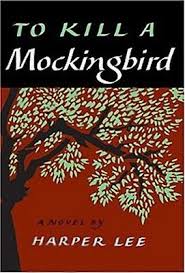
To Kill a Mockingbird by Harper Lee, 1960

The subset of people who have read ‘Go Set a Watchman’ but have not read’To Kill a Mockingbird’ must be pretty small, and until this week included me, embarrassed although I am to admit it. Yes, until this week I had not read this the ultimate American classic. I had seen the film, of course, and the stage play, but somehow never got round to the novel, until now. zzzzzzzzzzzzz

I can completely understand why the novel holds its place in the affections of American readers. It captures a lost America, and shows that while its passing is on the whole a good thing, particularly in terms of civil rights, something has been lost as well.

I wanted to address the question as to whether ‘Go Set a Watchman’ has in any way had a negative effect on the reputation of ‘TKAM’. I think this debate is based on a false premise, namely that ‘GSAW’ is a sequel to ‘TKAM’. Certainly it was published later than the original novel, and is set around 20 years later. In the later novel, Atticus is no longer seen through the innocent eyes of a young daughter’s hero-worshipping eyes, but from those of a mature, travelled woman. Of course he is no longer on a pedestal, and a lifetime of living in the deep South has taken its toll on his tolerances. Civil rights had not stood still in that time either, and what was once a liberal position had become reactionary, simply by staying still as the world moved on.

But. I think that it is important to remember that ‘GSAW’ is, in terms of composition, the earlier novel. It is in fact the first draft of ‘TKAM’. Looked at that way, Atticus doesn’t become more reactionary, but more liberal and tolerant as he developed as a character in Lee’s imagination. We also owe thanks to Lee’s editor for this metamorphosis.

There is a charming innocence to ‘TKAM’, achieved in large part through Scout’s narration. She is disarmingly honest, kind, and in the main unspoiled by the prejudices and racism around her. It has still taken its toll, of course – she uses the n-word and other insulting racial epithets freely, and would prefer Atticus to have refused to defend Tom Robinson. Tom’s tragic, off stage death doesn’t seem to trouble her, although neither does Bob Ewell’s at the end of the novel. Lee never seems entirely sure whether the trial at the heart of the novel is her focus, or the story of the agoraphobe Boo Radley which is more prominent at the novel’s opening and close. She manages to weave the two stories together at the death but it is not so much as climax as an end.

I suspect the other primary reason for the novel’s enduring importance is that it contains so many platitudes. Children believe that all the problems of the world can be solved if only people were nice to one another, and that is the principal sentiment of the novel. I started to keep a track of the platitudes, but gave up after a while:

You never really understand a person until you consider things from his point of view… Until you climb inside of his skin and walk around in it.”

“real courage is, instead of … a man with a gun in his hand. It’s when you know you’re licked before you begin, but you begin anyway and see it through no matter what.

I think there’s just one kind of folks. Folks.”

“Atticus, he was real nice.””Most people are, Scout, when you finally see them.”

“Sometimes the Bible in the hand of one man is worse than a whisky bottle in the hand of (another)… There are just some kind of men who – who’re so busy worrying about the next world they’ve never learned to live in this one, and you can look down the street and see the results.”
People are nice, once you get to know them. Never give up. Folks are all the same under their skin. This homespun philosophy gets a bit overly saccharine after a while. TKAM is a plea for tolerance, not only for the rights of black people to a fair hearing under the country’s justice system, but also for the traditions of the South. Many white people in the South had felt under attack since before the end of slavery, and Lee also offers these people a voice, less explicitly here than in ‘GSAW’, but unmistakeably nonetheless. Lee explained this is a rare commentary on her own novel once, saying:
“Surely it is plain to the simplest intelligence that To Kill a Mockingbird spells out in words of seldom more than two syllables a code of honor and conduct, Christian in its ethic, that is the heritage of all Southerners.” 
The heritage of all Southerners? Or all white Southerners? The idea that the Southern code of honor and conduct that led to mass lynchings, the KKK, and segregation was worth preserving despite everything is a challenge to the interpretation that this novel is a straightforward advocate for the civil rights cause. There is a risk that we sentimentalise the novel, and see it as a simple anti-racism tract, when the portrayal of the South is more nuanced than that.
I’d love to know if you agree?
Standard
100 Best Novels Guardian list, 20th century Literature, American literature, Book review, Ernest Hemingway, Fiesta, The Sun Also Rises

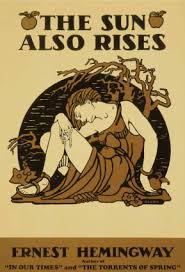
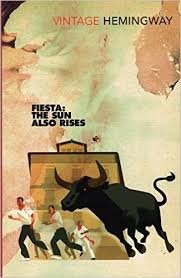
Fiesta: The Sun Also Rises, by Ernest Hemingway, 1926

The name of this novel has a complex history – at one stage it was going to be called, among other things, ‘The Lost Generation’ – and this alternative title, together with the epigraph from Ecclesiastes, beginning “One generation passeth away, and another generation cometh” provide some useful guides to interpreting this novel. yyyyyyyyyyyyyyyyyyyyyyyyyyyyyyyy

Set in the 1920’s in Paris and Spain, the events of the novel are shown from the viewpoint of the central character, Jake Barnes. Barnes recounts what happens in the moment, but he never explains – only context and snatches of conversation provide clues to the characters’ backstories. We can gather, for example, that Barnes was a combatant in the First World War, and that during that conflict he received a wound, physical or psychological, which made him impotent. Barnes is besotted with Lady Brett Ashley, a young woman who is part of the hard-drinking crowd who haunt the bars and clubs of Paris. No-one seems to work – Barnes is ostensibly a reporter for an American paper, but we hardly ever see him do any reporting, and he takes several weeks off without repercussions.

It is reasonable to infer that Barnes’ impotence, combined with his lust for Brett, would torture him, but only glimpses of this are offered to the reader. He compensates for his feelings by assisting Brett in conducting her affairs – for a woman of the 1920’s she is very liberated, and quite guilt free and open about her relationships. In a rare moment of introspection Barnes chastises himself, saying

“Send a girl off with one man. Introduce her to another to go off with him. Now go and bring her back. And sign the wire with love. That was it all right.”

The second section of the novel moves to Spain, and a fishing expedition is followed by the fiesta of the title in Pamplona, including the bull run and some of the scenes of bull-fighting for which Hemingway is probably best known. With Barnes’s connivance, Brett seduces the 19 year-old matador, and in a jealous rage one of her recent former lovers beats him (and Barnes) up. The novel ends shortly after the fiesta, with Barnes and Brett spending time together in Madrid, and wondering how their relationship might have developed had he not been afflicted:

“Oh Jake,” Brett said, “We could have had such a damned good time together.”
Ahead was a mounted policeman in khaki directing traffic. He raised his baton. The car slowed suddenly, pressing Brett against me. Yes,” I said. “Isn’t it pretty to think so?

(The mounted policeman’s raised baton proving a somewhat unnecessary piece of symbolism there I think. )

As an evocation of the fascination of bull-fighting, the scenes towards the end of this novel are unparalleled. If one is already disgusted by bull-fighting there will be nothing here to change ones mind. The portrayal of the hedonism of  Barnes and his group of friends, representatives of a lost generation, reminded me of an expatriate version of ‘Vile Bodies’. Another text worth comparing this novel to is of course Fitzgerald’s ‘The Great Gatsby’. which in a different setting has similar themes. The reader is invited to see this group of characters as resilient survivors of the fracturing of society which is slowly healing, as the sun also rises. xxxxxxxx

But. There are some issues with the novel that I wanted to explore. The first is the use of repetition. At times it is quite oppressive. I know drunk people – and many of the characters are pretty much permanently drunk – repeat themselves a lot. But it’s not much fun to read. Here’s a random example:

“Brett put her hand on my arm. 

“Don’t get drunk, Jake’ she said. ‘You don’t have to’. 

‘How do you know?’

‘Don’t’, she said. ‘You’ll be all right’. 

‘I’m not getting drunk’  I said. ‘I’m just drinking a little wine. I like to drink wine’. 

‘Don’t get drunk’, she said. ‘Jake, don’t get drunk’. 

In context, each repetition is justified and legitimate – here the effect is to emphasise both the drunkenness of the pair, and the lack of real communication between them. But the cumulative effect is somewhat wearing.

Secondly there is Hemingway’s famously sparse style. In Hemingway the quick brown fox never jumps over the lazy dog – the fox jumps over the dog. In theory this should make the novel very simple to read – but avoiding over elaborate description is one thing, and stripping the prose to its bare bones whereby one thing happens, then another thing happens, and so on, combining to deadening effect, is another. As a result although it is only just over 200 pages long this novel took me several days to complete.

Third, Barnes’s group of expatriate friends are an unpleasant bunch. They are openly anti-semitic, and the novel contains several derogatory references to homosexuality. These of course were much more acceptable attitudes than they are today, but the casual use of the n-word in a text only 90 years old isn’t reflected in the novels of many of Hemingway’s contemporaries.

Finally, the elephant in the room (metaphor deliberately mis-chosen) is the topic – bull-fighting. Hemingway glamorises the killing of animals for sport, and while this once may have seemed acceptable, today it leaves a bad taste.

As a postscript, and to be completely honest something of a boast, I spotted a fleeting reference to Marlowe’s ‘The Jew of Malta’ here. On page 66 of the Vintage edition, (which by the way contains an extraordinarily self-indulgent introduction by Colm Toibin which is all about Colm Toibin, and barely mentions the novel it is introducing), Barnes mentions a friend who is a taxidermist. Bill, another friend, replies

“That was in another country…and besides all the animals were dead”. The full quote from Marlowe is:

“Thou hast committed fornication: but that was in another country, and besides, the wench is dead.”

This so far as I can tell isolated example of wit from Bill is of course a reference to Brett.

Standard
100 Best Novels Guardian list, 20th century Literature, American literature, Book review, Uncategorized

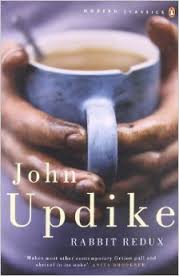
Rabbit Redux – John Updike – 1971

The Penguin Modern Classics editions of Updike’s Rabbit quartet (Run, Redux, Rich, and at Rest) contain an afterword by the author which in some ways makes the reviewer redundant, offering insight into the composition of the novels to which few could hope to achieve. Of course, I am going to have a try.

Harry ‘Rabbit’ Angstrom is a middle aged, blue-collar AmericZZZZZZZZZZZZZZZZZZZZZZZZZZZZZZZZZZZan. His wife is sleeping with a work colleague, and soon leaves Rabbit and his teenage son Nelson. Harry is in a dead end job as a print-setter, which even in 1969, the novel’s setting, was clearly becoming obsolete. The reproductions of Harry’s set type which appear in the novel are cruelly riddled with errors, suggesting he isn’t even any good at his job. While the narrative point of view is largely Harry’s/Rabbit’s, we do not gain much insight into his feelings. He seems to take his wife’s betrayal in his stride, although it obviously hits him harder than he realises, as is shown later in the novel when his behaviour begins to get more erratic. Invited out by a work colleague, a black man who Harry would normally not associate, Harry picks up Jill, a wealthy 18 year old young woman fleeing suburban Connecticut. Although more like his lost daughter than a replacement wife, she moves in with him and Nelson. Later her  ‘friend’ Skeeter, a radical Vietnam veteran follows her and also moves in, causing scandal in the neighbourhood.  While Harry and Nelson are out visiting friends the house suffers an arson attack, and Jill is killed. Finally, in the aptly named Safe Haven motel, Harry reconciles with his wife, after a fashion, and they fall asleep together.
The period setting of the novel provides an important backdrop to its events. Neil Armstrong and Buzz Aldrin land on the moon – Harry watches the landing on a fuzzy black and white television in his mother’s bedroom. Race riots break out across America, and the war in Vietnam continues to divide the country. Harry is defiantly conservative in the face of several protest voices, not least Skeeter, who challenges him on issues of race and the war.

It has to be said that Harry is not a pleasant character. He is unashamedly racist, sexually exploits the clearly vulnerable Jill, who is half his age,  and takes pleasure from hurting her during sex. He beats his wife when he finds out she has been unfaithful, and is a poor father. He has many other faults which I am not going to spell out here – suffice to say he is a hard hero to like.

It’s equally hard to avoid the simple reading of this novel that has Harry as an extended metaphor for America. Updike specifically invites this comparison in his afterword – “The character of Harry Angstrom was, for me, a way in – a ticket to the America all around me.” Skeeter’s “invasion” of Harry’s home, hard to understand otherwise, is representative of the rise of black power in America, the intrusion of what Harry/Updike sees as an alien race. His values – paternity, patriotism, fidelity – are under attack from all around. In other words this is a deeply conservative novel in which Harry struggles to at first resist, then come to terms with the changes sweeping America in the late 60’s. He is a victim throughout the novel, weakly accepting what happens to him, not challenging his wife’s lover when he confronts him, taking redundancy without complaint, even spinelessly accepting Skeeter’s moving into his house and sleeping with Jill – he doesn’t like it, but he can do nothing about it. He has a sharp tongue towards his family and friends, but is a profoundly weak man. The reader feels sorry for Harry, perhaps, but that’s the extent of it.

Reading the second novel in a quartet is not the best way to approach a writer’s output (I started the Harry Potter series by reading The Goblet of Fire, stupidly) but I am torn on whether I want to read more about Rabbit. What might bring me back, one day, is Updike’s undoubted way with a sentence:

“How sad, how strange, we make companions out of air and hurt them, so they will defy us, completing creation”.

Standard
100 Best Novels Guardian list, 19th Century literature, American literature

The Scarlet Letter by Nathaniel Hawthorne, 1850

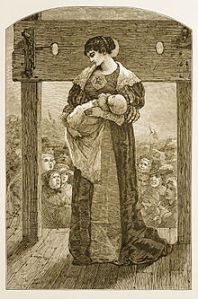
Hester_PrynneHawthorne’s ‘The Scarlet Letter’ is arguably the first classic of American literature. While the language Hawthorne uses is often archaic, this is in fact an astonishingly modern novel in its treatment of its subject matter, and in its construction. While the plot is quite straightforward, and the cast of characters limited, behind this relative simplicity is a novel of huge complexity and subtlety.
The novel is told by an anonymous narrator, who in a long introduction tells us the story on found contemporaneous records. ‘The Scarlet Letter’ is set in 17th century Puritan New England, and follows the story of Hester Prynne, a young woman found guilty of adultery. As punishment, lenient given the statute at the time, Hester is required to wear a scarlet “A” on her clothing. Thus is introduced the novel’s most powerful symbol. In an act of defiance, Hester embroiders the letter richly and lavishly, suggesting that the punishment can also be worn with pride. She refuses to hide the letter, and continues to wear it long after it is necessary.

Despite pressure from her judges, Hester refuses to name her child’s father. The paternity mystery is not really the focus of the novel – we are never told how her romance with her lover developed, and there is no great moment of epiphany when the paternity is eventually revealed. Hester’s husband, who has been presumed lost at sea, arrives in Boston just as she is forced to stand on a scaffold and face the condemnation of the townsfolk. He vows to find the father of Hester’s child, but decides to remain incognito in order to pursue his search in secret. He takes the name Chillingworth, and takes up work as a medicine man.

Following her release from prison, Hester settles with her daughter, Pearl, and earns a living with her needlework. Years pass. Pearl is a strange impish child, old beyond her years. She is fascinated by Hester’s scarlet letter. A discussion over Pearl’s care and moral well-being reintroduces the town’s clergyman, Arthur Dimmesdale. The Minister’s health is failing, and he is being cared for by Chillingworth, who slowly comes to suspect that the minister’s illness is the result of some unconfessed guilt. At some point this crystallises into the suspicion that Dimmesdale is Pearl’s father. Fearing her husband’s suspicions, and that he may reveal all or do his some harm, Hester meets the Minister in the forest. She tells him Chillingworth is her husband, and of his thirst for revenge. The forest setting for this scene is another potent and threatening symbol in the novel. After seven years of suffering and secrecy Hester and Arthur are reconciled, and realise they still love one another. She convinces Dimmesdale to leave America so they can start a new life together. Renewed by this plan, the minister returns to town, and shortly thereafter, just before the day appointed for their departure for Europe, he gives an inspirational sermon. Seemingly Inspired by the impact of this sermon Dimmesdale decides to publicly confess his sin. This seems to bring on a climax in his health, because no sooner does he do that that he dies in Hester’s arms. This melodramatic finale to the novel is followed by a short post-script which tells of Hester and Pearl’s later life.

The scarlet letter Hester wears is a potent symbol which changes its meaning through the course of the novel. Initially it is a brand of shame, but later, as Hester’s charitable woks in the community earn her peoples respect it is said “many people refused to interpret the scarlet A by its original signification. They said it meant Able, so strong was Hester Prynne, with a woman’s strength.” (161) At the climax of the novel, when Dimmesdale bears his breast to reveal, the reader is given what are in effect alternative endings to choose from. Either he has branded himself with a letter A, or a letter has been branded on him by the work of the devil. His words of confession are sufficiently ambiguous to allow of a further interpretation, rejected by the narrator but presented nonetheless and preferred by the Minister’s friends and supporters, is that “there was no mark whatsoever on his breast, more than on a new-born infant’s” (259).

The novel plays with lots of different contrasting ideas: purity and shame, town and forest, old and new England, men and women, settlers and natives, science and religion. Hawthorne is clearly interested in the impact that the settler communities of the 17th century have had on the America of his period, two hundred years later. He is surprisingly non-judgmental about Hester’s sin, which even in 19th century USA would still have been shockingly transgressive, particularly when committed with a clergyman. There is no suggestion that Hester is particularly culpable in the sin, that she seduced the otherwise morally upstanding Minister. There is however a subtle implication that Dimmesdale’s health degenerates because he has caught a sexually transmitted disease from Hester. His health fails slowly, over several years, and he becomes emaciated and pale. There is no known cure for his unnamed affliction.

‘The Scarlet Letter’ is an exceptionally complex, fascinating novel. It is decades before its time – I think it is best read as a very early symbolist novel, rather than a mystery or an historical romance, even though these readings are interesting in themselves. It is also a very brave novel, dealing as it does with issues of sex outside marriage, infidelity, and love. In fact it doesn’t just deal with love, it celebrates it:

“Love, whether newly born or aroused from a deathlike slumber, must always create sunshine, filling the heart so full of radiance, that it overflows upon the outward world”

It is sympathetic towards the fallen woman at the novel’s heart – it is the letter which is scarlet, not Hester. She is a strong, independent and sexual heroine, not a victim:

Let men tremble to win the hand of woman, unless they win along with it the utmost passion of her heart!”


Standard
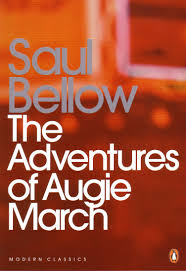
100 Best Novels Guardian list, 20th century Literature, American literature, Book review, Saul Bellow, The Adventures of Augie March

The Adventures of Augie March by Saul Bellow, 1953

To be honest, everyone comes across a book from time to time that they struggle to complete, indeed to get started with. The plot never really seems to start, the characters are undefined and un-engaging, and keeping track of who is who and what has happened doesn’t really seem worth the effort. But one persists, out of stubbornness more than any expectation that all of a sudden the novel will transform into something more compelling. For me this is a relatively rare occurrence, but Bellow’s ‘The Adventures of Augie March’ was unfortunately one such book.

The novel follows the first few decades of the life of the eponymous hero growing up in Chicago in the 1920’s and 30’s. The title deliberately echoes the Mark Twain Tom Sawyer/Huck Finn novels of 80 years or so earlier. While Twain’s narratives were, superficially at least, quite innocent, Augie March is brought up in a very different world.

So why was this book such a challenge, to the extent that I actually felt a sense of relief when I finished? I identified a number of reasons. Firstly, Bellow’s sentence construction is often awkward, almost as if English were not his first language. To offer just two simple examples:

By dumb concentration and notice-wooing struggle. The only way I could conceive, in my blood-loaded, picturesque amorousness“. (138)
“Thus Mrs Renling in her strenuous wand hacked-up way, and the whiteness that came from her compression into her intense purposes.(151)”

The intention, presumably, is to convey the fragmented nature of Augie’s internal narration. This works effectively at first, but after a while becomes wearing.

Secondly, the novel has no real plot. We follow Augie as he wanders aimlessly from job to job and relationship to relationship. Each situation involves the introduction of a large cast of characters – even on the penultimate page, more than 500 in, Bellow is still introducing new characters. Events are structured chronologically, but the episodic nature of the narrative means it doesn’t flow – I did this, then I did this, then I did something else.

Thirdly, Augie is not an engaging character. He is devoid of any insight into his own motivation – he just wanders through life. His personal attachments to other people are superficial – even his family members are discarded when he loses interest in them. His mother is left in a home for the blind, and he rarely visits her, and his disabled brother is dumped in an institution and he only visits him once in a period of several years. His love life is complicated and unconvincing.

If this was just a series of scenes of urban life in pre-war Chicago, the novel would have had a degree of integrity. But at one point Bellow seems to bore of this theme, and he takes Augie to Mexico to train an eagle to capture lizards. Yes, apparently the best way to catch lizards isn’t to trap theme, but to train an eagle to catch them. As a plot device this would be out of place in a Marx brothers film, but it gets worse, because out in Mexico Augie meets Leon Trotsky, on the run from Stalin’s secret police. Despite the major world events that occur over the span of the novel, from the end of Prohibition and the Great Depression, Augie barely notices them. Even though he has met Trotsky, his later assassination and death don’t merit a mention. The Second World War only intrudes as an interruption to Augie’s plans to finally settle down and marry.

So to summarise: no plot, boring characters, clumsy writing – yet Bellow won the Nobel prize for literature! I’m quite happy to admit I must be missing something. I’m going to guess it’s one or more of the following:

1. ‘The Adventures’ conforms strictly to the traditions of the picaresque novel, defined in the Encyclopaedia Britannica as:

a first-person narrative, relating the adventures of a rogue or low-born adventurer as he drifts from place to place and from one social milieu to another in his effort to survive. In its episodic structure the picaresque novel resembles the long, rambling romances of medieval chivalry, to which it provided the first realistic counterpart. Unlike the idealistic knight-errant hero, however, the picaro is a cynical and amoral rascal who, if given half a chance, would rather live by his wits than by honourable work. The picaro wanders about and has adventures among people from all social classes and professions, often just barely escaping punishment for his own lying, cheating, and stealing. He is a caste-less outsider who feels inwardly unrestrained by prevailing social codes and mores, and he conforms outwardly to them only when it serves his own ends. The picaro’s narrative becomes in effect an ironic or satirical survey of the hypocrisies and corruptions of society, while also offering the reader a rich mine of observations concerning people in low or humble walks of life.”

See what I mean?  Augie is an Everyman through whose eyes the reader can see his world, but his passage through it leaves few traces. So is ‘the Adventures’ a modern day American version of the classic picaresque novels such as ‘Don Quixote’? I think that is a sustainable interpretation, but I am not convinced.

2. ‘The Adventures’ also contains numerous classical references. These left me wondering if there were possibly parallels between Augie’s adventures and those of the classical characters he refers to, as happens in ‘Ulysses’. In the end I just didn’t care enough to try and find out.

3. The range and scope of the novel made me wonder whether this was Bellow’s application for the ‘Great American Novel’ competition. This scepticism wasn’t helped by the quote from Martin Amis on the back cover claiming “‘The Adventures of Augie March’ is the Great American Novel. Search no more.” There are some explicit references to other candidates in that competition, now closed of course. Does this description of Augie’s brother Simon’s spending habits ring any bells?:

‘From the barbershop we’d go to Field’s to by him a dozen or so shirts, imported Italian underclothes or slacks or shoes, all things of which he already had a surplus; he showed me drawers, closets, shelves full, and still kept buying’ (224)

I noted down several quotes from this novel during the week or so that it took to complete, but the one I should have listened to was Bellow’s advice, in Augie’s voice:

“I never blamed myself for throwing aside such things as didn’t let themselves be read with fervor, for they left nothing with me anyhow” (206)

This novel didn’t let itself be read with fervour, and even though I didn’t throw it aside, no-one could surely have blamed me if I had.

Standard
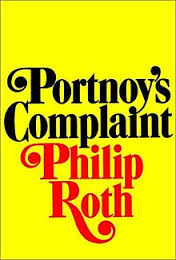
100 Best Novels Guardian list, 20th century Literature, American literature, http://schemas.google.com/blogger/2008/kind#post, Philip Roth, Portnoy's Complaint

Portnoy’s Complaint by Philip Roth, 1969

Portnoy’s complaint is both a noun and a verb – the book is another first person narrative describing the author’s childhood and later life, an autobiography with only the flimsiest attempt at disguise as a novel. Alexander Portnoy complains to his psychiatrist – at quite some length – about his domineering mother, his father crippled by chronic constipation, and the impact this has on his later ability to develop serious relationships with women. This is both his lament and his condition.

Of his mother he writes memorably:

“She was so deeply embedded in my consciousness that for the first year of school I seem to have believed that each of my teachers was my mother in disguise. As soon as the last bell sounded I would rush off for home, wondering as I ran if I could possibly make it to our apartment before she succeeded in transforming herself. Invariably she was already in the kitchen by the time I arrived, and setting out the milk and cookies. Instead of causing me to give up my delusions, however, the feat merely intensified my respect for her powers

As a young boy his relationship with his mother is simply dysfunctional, but when he hits puberty it becomes positively Oedipal. The chapter on the masturbation frenzy he embarks on at this point is a famously sustained portrayal of adolescence, and is quite filthy in some respects. It is hardly surprising given Portnoy’s frankness about every aspects of his sexual life and fantasies that the book caused a considerable controversy on publication. Even today it has the power to shock.

As with most first person narratives, the reader is automatically sympathetic to the narrator – we see the world through their eyes, hear their explanations for their conduct, get their side of the story. With such monstrously controlling parents it is hardly surprising that Portnoy rebels, pursuing relationships with non-Jewish girls. He is unarguably a misogynist. He gives his girlfriends unpleasant, objectifying nicknames – the Pumpkin, the Pilgrim, the Monkey – and abandons the latter when she is feeling suicidal. He feels guilty about this, but not guilty enough to do anything about it. Of course he blames his mother for his inability to form grown up relationships with perfectly pleasant young women, (he cites one reason why he leaves ‘The Monkey’ as her calligraphy!) but his inability to accept any personal responsibility for this begins to chafe after a while – “a Jewish man with his parents alive is half the time a helpless infant” – and you want to tell him to stop whining and grow up.

The novel takes a darker turn in the final chapters when Portnoy goes to Israel. He has a casual sexual encounter with a female soldier, but is impotent. Later in the final pages he meets up with a hitchhiker, and tries to rape her. It is quite satisfying to see her kick his ass. His misogyny seems unrestrained when the travels to Israel, possibly because of his distance from his mother.

In the end, Portnoy is his own, most astute critic. He pleads:

Spring me from this role I play of the smothered son in the Jewish joke! Because it’s beginning to pall a little at thirty-three!”

Standard
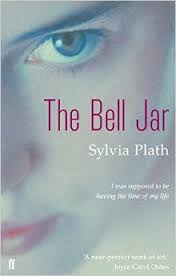
100 Best Novels Guardian list, American literature, Book review, Sylvia Plath, The Bell Jar, The Bell Jar. Sylvia Plath

The Bell Jar by Sylvia Plath, 1963

“It was a queer, sultry summer, the summer they electrocuted the Rosenbergs, and I didn’t know what I was doing in New York”.

Is there a better opening line to a novel? It wasn’t until towards the end of this book, when the narrator, Esther Greenwood, has electro-convulsive therapy as part of her treatment for severe depression, and submits to it “like a person coolly resigned to execution” (203) that I was able to join the dots – she sees what happens to her as similar to what happened to the Rosenbergs. Note also that “they electrocuted the Rosenbergs” not “the Rosenbergs were electrocuted” – suggesting the existence of a shadowy and malevolent but wholly real external force that can take people’s lives. Not only does Esther not know what she is doing in New York, but as the novel develops it becomes apparent that her confusion is much deeper rooted.

Rarely has an opening sentence more brilliantly foreshadowed the events of the novel, while at the same time setting the tone and fixing the events in time and place.

Sadly it is now not possible, if it ever was, to separate any reading of ‘The Bell Jar’ from one’s knowledge of Plath’s own life (and death). She committed suicide a few weeks after ‘The Bell Jar’ was published under a pseudonym. The novel is largely autobiographical, and horribly foreshadows, even predicts, her final days. I don’t know whether this extraordinary book is an extended suicide note, or a cry for help – but I do know that I can’t remember reading a sadder novel. The ending, where Esther’s ECT seems to have been successful, and she finally starts to recover from her illness, is a false dawn all the sadder in the context of Plath’s death.

The novel opens with Esther enjoying something of an adventure, on a work-placement with a magazine in New York. She is academically successful, has enjoyed lots of advantages in life, and seems to have the world at her feet. She has not yet mastered the art of developing relationships with men, but is starting to experiment with her new found freedom. There are some aspects of life she finds hard – men consistently try to bully her, particularly when it comes to sex, and while she stands up for herself this is not an aspect of her life she is comfortable with. She doesn’t bond easily with the other women in her lodgings, and in the background is the loss of her German father when she was nine (Plath lost her German father when she was eight).

At first she appears to be in control, and the depression that comes to dominate her life is not immediately apparent. However, subconsciously, the signs are already there. Death, murder, suicide, and objects associated with death, constantly crowd her thoughts:

A lumpy bed is “shrouded by a thin white spread” (86); a silver lighter is “in the shape of a bullet.” (103), as is Doctor Gordon’s pencil “like a slim, silver bullet” (129); a mattress falls across Esther “like a tombstone” (119); a bath tub is “coffin-shaped” (18) and a telephone sits “dumb as a death’s head” (17).

The language of death pops uninvited, and unnoticed, into Esther’s mind all the time, even when there is no apparent connection with the subject. Death is everywhere:

My penalty was the long, dead walk from the frosted glass doors of the Amazon” (95)

Pretend you are drowning’.” (103)

“I felt like a hole in the ground” (15)

“At my feet, the city doused its lights in sleep, its buildings blackened, as if for a funeral.”(106)

“Piece by piece, I fed my wardrobe to the night wind, and flutteringly, like a loved one’s ashes, the grey scraps were ferried off” (107)

“A summer calm laid its soothing hand over everything, like death” (109)

“I cracked open a peanut from the ten cent bag I had bought to feed the pigeons, and ate it. It tasted dead, like a bit of old tree bark”. (131)

(On her mother’s snoring) “The piggish noise irritated me, and for a while it seemed to me that the only way to stop it would be to take the column of skin and sinew from which it rose and twist it to silence between my hands” (119)

Finally, these thoughts cannot be resisted, and the crisis point is reached.

The thought that I might kill myself formed in my mind coolly as a tree or a flower” (92)

From this point Esther plans to kill herself, and these thoughts dominate her waking hours. She plans her suicide carefully, and her inverted thinking is reflected in the language she uses to discuss these plans:

(Of the Japanese) “They disembowelled themselves when anything went wrong” (132)

“The trouble about jumping was that if you didn’t pick the right number of storeys, you might still be alive when you hit the bottom. I thought seven storeys must be a safe distance”. (131)

Note the use of the word safe, meaning here to end in certain death, the complete opposite of its usual meaning.

Esther’s suicide attempts lead to her being sectioned. She dreads the ECT, even though finally it appears to have helped, if only temporarily. She describes her feelings during psychiatric analysis:

I had imagined a kind, ugly, intuitive man looking up and saying “Ah!” in an encouraging way, and then I would find words to tell him how I was scared, as if I were being stuffed farther and farther into a black, airless sack with no way out. Then he would lean back in his chair and match the tips of his fingers together in a little steeple and tell me why I couldn’t sleep, and why I couldn’t read and why I couldn’t eat and why everything people did seemed so silly, because they only died in the end.” (123/4)

So the father figure she is hoping for fails to appear. Equally, the young men in her life are not substitute fathers, failing to care for her.

This isn’t just a book about mental illness and suicide. It’s about growing up, about the way men behave towards women, it is about literature, and reading, and writing, and so much more. It is deeply sad, and provides an insight into the thoughts of a suicidal depressive who ultimately can’t understand her own illness, just wants it to end. In many ways it is a very difficult, challenging novel, and anyone in a similar position to Plath would fit little comfort in it. My edition carries a quotation from Joyce Carol Oates “A near perfect work of art”, and just this once I agree.

Standard