
The Bachelors, by Muriel Spark, 1960
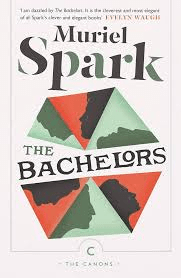
Muriel Spark’s The Bachelors revolves around a group of single young(ish) men in 1950’s London. The plot centres on a case of fraud against a bogus spiritualist Patrick Seton. Seton, a leading member of spiritualist group, The Wider Infinity, is accused (and is clearly guilty of) forging a letter from his landlady, to explain his embezzlement of £2,000. Barrister Martin Bowles is prosecuting Seton, and friend Ronald Bridges, a handwriting expert, is going to be an expert witness in the trial. Other minor characters have bit-arts including an art-critic, a journalist and a teacher.
While the story is ostensibly about the men in the novel, the women play an equally central role – the novel could easily have been called ‘The Bachelors and the Spinsters’. I suspect the choice of title reflects the women’s apparent lack of agency – they are usually subservient to and manipulated by the men, in particular Alice, Patrick’s pregnant and vulnerable girlfriend. The novel takes a sinister turn from the mildly comic when it becomes apparent that he is planning to kill her by depriving her of the insulin she needs to stay alive.
And I will release her from this gross body. He looks with justification at the syringe by her bedside, and is perfectly convinced about how things will go in Austria (all being well), since a man has to protect his bread and butter, and Alice has agreed to die, though not in so many words.
Worse, one of his fellow bachelors suspects his plot but does little to prevent it. Patrick is something of a psychopath – his murderous intentions are not really financial but sadistic, possibly triggered by Alice’s refusal to abort the baby she is carrying. She gullibly believes Patrick’s assurances that they will marry as soon as his divorce is made final. Elsie, her friend, distrusts Patrick, and seeks to secure his conviction in the forgery/fraud case to help Alice escape his malign influence.
Modern (that is to say, 1950’s) spiritualism is a central theme of the novel, and it doesn’t come particularly well out of it, as you can probably imagine. It is a means to manipulate and defraud the simple-minded. Seton, an obvious villain, is protected his supporters within the Society, who are convinced he is a genuine medium, and his trial is the satisfying climax of the novel, where just desserts are granted.
The Bachelors is a quite dark novel, despite the overall jaunty tone. Ronald’s epilepsy is presented as a parallel to the spiritualists’ attempts to contact the ‘other side’ (they use the same drugs for example) in a way I couldn’t quite understand. I appreciate epilepsy as a condition was looked at very differently in the 1950’s compared to the way it is now – it was still under the shadow of the idea of possession, more part of the middle ages than a twentieth century attitude.
This wasn’t one of Spark’s stronger novels. The characters, especially the minor ones, are not clearly defined, and I think most readers will share my experience of struggling at times to work out who is speaking and what there relationships are to the other characters present. The reader has to do a lot of the work, and while sometimes that is justified, here is simply felt frustrating. The humour doesn’t always land and the portrait of living with epilepsy as if it were a curse was depressingly out of date.
I remain convinced that Spark is an under-appreciated writer who is always worth the short time it takes to read her very condensed novels, but overall this was a miss for me.

