
I am not sure I can think of a more quintessentially 60’s novel than this. It is madcap, millennial (think Dr Strangelove), anarchic and at times plain weird. The plot, such as it is, involves a first person narrator who is researching a biography of the (fictional) inventor of the nuclear bomb, Felix Hoenikker. In this course of this investigation he finds out that Hoenikker stumbled across – out of pure academic curiosity – a way of converting water into a crystalline form – ice-nine. Ice-nine is an alternative structure of water that is solid at room temperature. When a crystal of ice-nine contacts liquid water, it becomes a seed crystal that makes the molecules of liquid water arrange themselves into the solid form, ice-nine. If ice-nine were to come into contact with a river or sea, all the world’s water would freeze in one shuddering bang.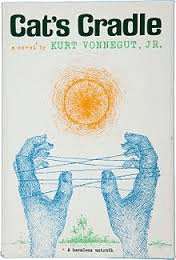 Continue reading
Category Archives: dystopian fiction
1984 by George Orwell, 1949
When I re-read a novel (as here) for the umpteenth time, I always look carefully for things I have forgotten or overlooked the last time. It’s surprising what you miss – I wrote about this here a while back. The first thing that struck me about ‘1984’ is what a brilliant opening it has. Not just the extraordinary first line – “It was a bright cold day in April, and the clocks were striking thirteen” – but the opening chapter. Orwell packs so much into these few pages it positively fizzes – Big Brother, the anti-sex league, the two minute hate, the Ministry of Truth, doublethink and newspeak. It’s such a detailed and comprehensive evocative of the new world we are plunged into that it is shocking.
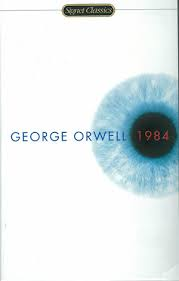 Orwell was the first writer who spoke to me personally through his works, and I absorbed all his novels, even those he wrote simply for financial reasons, and would have been happy to have seen pulped, as well as his journalism, letters, and anything else available. So making a dispassionate judgment about 1984 is impossible, and I am not even going to try. Orwell’s fierce intellect shines from every line – this has to be the most quotable novel ever written, particularly when you think that it was not written as a series of epigrams (unlike, say ‘Dorian Gray’) but as a dystopian horror story. The concepts that Orwell develops in this novel have become part of our popular and political culture – ‘Big Brother’ for example, as a short-hand phrase to describe the over-intrusion of the state into our private lives, (as well of course as a reality TV gameshow). 1984 is a passionate warning cry against the evils of totalitarianism.
But, and there is always a but, post-war ration starved Britain had already rejected the hopelessness of ‘1984’. In electing a Labour Government with a mandate for radical change, they had decided that they didn’t have to settle for the permanent rule of the party, and that things didn’t always have to be dreary and hard. The proles had rejected the lie of the ruling class that things can never get any better. Orwell seems to have completely missed that sense of optimism. Winston Smith believes that if there is hope, it is with the proles, the working class. But the proles of 1984 are so easily distracted by pulp fiction, machine produced porn, and a fake lottery that there is never any prospect of them organising and gaining a class consciousness which would allow them to “rise from slumber, in unquenchable number”. By 1949 the Attlee Government was clearly struggling – was that really the time to warn of the risks of a Soviet takeover of Western Europe?
I can’t find the faintest trace of hope in 1984. Some readers claim the post-script essay on the introduction and development of Newspeak suggests IngSoc did not last, but that seems clutching at straws. By the end of the main novel, Winston is broken, looking forward to the bullet in the back of his head as a mercy. There is no suggestion that the future holds anything but the stamping of a boot on a face, forever.
Eton-educated George, or should that be Eric, was always a stranger in the slightly smelly, uncomfortable world of the working class. His sense of alienation from the working class – even, one could argue, his submerged class hatred – is vivid in 1984. They are an utterly alien species, with goldfish like memories, no class consciousness, and representing nothing of value. Winston is amazed at their stoicism, as well as their ability to reproduce so prolifically – Orwell shares similar sentiments in, for example, ‘The Road to Wigan Pier’. If the proles are the only hope, then there is no hope. I appreciate I am criticising ‘1984’ for not being a socialist manifesto, when of course it was never intended as such. But it handed a potent weapon to the critics of socialism, and all Orwell’s subsequent comments about the intention of his writing had little impact on the perception that he was a trenchant critic of English Socialism. Which is a pity, because there are few writers in the twentieth century who wrote as interestingly or as well as Orwell on social issues.
Brave New World by Aldous Huxley, 1932
Read in a Vintage edition, with forewords by Margaret Atwood and David Bradshaw
Set 600 years in the future, Huxley’s Brave New World is run by a benevolent scientific despotism. Science has eliminated most diseases and slowed the ageing process, but has also been used to socially engineer society. Many aspects of our present society are inverted, so drug taking is encouraged, as is promiscuity, books (other than instruction manuals) are forbidden or unknown, and, in a convincing piece of cod-science, parenthood has also been eliminated – children are instead grown in factories, and engineered to fill their pre-designated station in life.
If Huxley had left it there, this would have made an interesting short piece of science fiction, a gentle satire on the way science could lead society. People are relatively happy with their lot in life, and society can even allow dissent, albeit dissent that is quickly isolated and neutered (rather than completely extinguished). There is a certain prurience in the portrayal of sexual liberation in life After Ford, (AF), but titillation in science fiction is nothing new.
However, at this point Huxley introduces a character, Bernard Marx, who is presented as an outsider, one who can see beyond the drug induced façade to the rottenness of society, the emptiness of people’s lives. During a visit to a reservation, Marx “discovers” a savage, John, living among a surviving population of unmodernised indigenous people in Mexico. John has read Shakespeare, and sees the world much as Miranda may have done when first discovering she is not alone on her island.
“Oh, wonder!
How many goodly creatures are there here!
How beauteous mankind is! O brave new world,
That has such people in ’t!”
John has been treated as an outsider all his life by the Indians he grew up with, but his reaction to the new world he finds himself in is anything but positive. He is repelled by the absence of romantic love, his perspectives having been distorted by his reading of Romeo and Juliet and the like. He finds the new world disgusting, and despite a long and didactic conversation with the Controller, Mustapha Mond, remains unconvinced about the merits of this new world:
“All right then,” said the savage defiantly, I’m claiming the right to be unhappy.”
There was a long silence.
“I claim them all,” said the Savage at last.”
When John’s desperate attempts to retreat from society fail, he kills himself in the novel’s final scene. Meanwhile Bernard does not emerge as the hero we originally expect him to be – he uses his notoriety as “discoverer” of the noble savage to sleep with a variety of important women, despite his previous objection to people being treated like pieces of meat, and offers no help to John as he struggles in his new environment.
While a more optimistic view of the future than the later “1984”, “Brave New World” is still bleak. Several of the characters are given the names of well known Communists – Marx, Lenina, Trotsky – suggesting that this world is a socialist experiment, where the attempt to nationalise parenthood and use science to eliminate difference, has failed.
Brave New World is a novel of ideas, where none of the characters are convincing or particularly interesting, and where few of the ideas are fully developed or followed through. The ending is predictable, unconvincing and melodramatic. It really only works as a companion piece to the infinitely darker “1984”. In “1984” the vision of the future is of a boot continually smashing into a face – in “Brave New World” the future is “seven and a half hours of mild, unexhausting labour, and then the soma ration and games and unrestricted copulation and the feelies.” (197)
The Book of Dave by Will Self
“The Book of Dave” has been on my “should get round to reading at some point” list for some time now, having read the blurb and been curious about where the author would take the idea. Having said that, the scenario of this novel is startlingly unoriginal. The world has suffered a catastrophe, and the small number of survivors have reverted to barbarism. They base their rituals on a surviving text, the Book of Dave, the demented ramblings of a London cabbie, who in the novel’s most contrived scene decides to have his ravings printed on metals plates to ensure their survival. Of course he did. (“Red Dwarf” did this much better, the cat civilisation basing all their beliefs on Dave Lister’s half remembered daydreams.)
Self created a language for the survivors, Mokni, which is relatively easy to follow if you speak estuary English, and take the time to sound out the words. The lexicon at the back of this Penguin edition is also helpful, if you know it is there! I was going to write about how cleverly Self allows the reader to decode the specialist terms he uses – moto, opare, moped, etc – but I stumbled across these translations about 400 pages in, by which time I suspect many readers will have abandoned ship (or pedalo). Most of this new language derives from Dave’s experienced of driving a cab, so people are fares, the sun is a foglamp, full beam or otherwise, and so on.

