20th century Literature, Book review, Ian Fleming, James Bond, Spy stories

Casino Royale by Ian Fleming, 1953

As you know, I have been reading a lot of pre-war novels recently. Even in those published more recently, in the 50’s and 60’s, the use of offensive terms to describe black and ethnic minority people and others is common place. Quite often the terms are used casually, not actively intended to offend but as part of the speaker’s everyday idiolect, Casino Royalshowever brutal that may have been. Authors setting the events of their novels in the past have to make a difficult decision whether to have their characters talk ‘authentically’ – that is using offensive words that were common terms- or to sanitise their portrayal of how people spoke and thought. As a result of all this I’ve become a bit de-sensitised to authors using offensive terminology or hateful language. In any event I knew not to expect James Bond to be politically correct or sensitive to other people’s feelings and ideas. But the venom and sheer unpleasantness of his portrayal in ‘Casino Royale’ was still shocking.
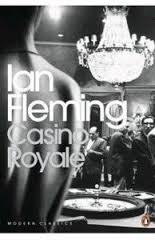
This short novel is the first of the Bond franchise, and sets the template for many of what were to become clichés about Bond. The repressed public school boy, the cold blooded killer (although he kills no-one in this novel, he does boast (twice) about his killings to date, two to be precise) his lechery, his misogyny, his tendency to drink and drive. We are told of his 00 designation, although here it is not a licence to kill, (that would come later), but rather confirmation that he has killed in the course of his work; in other words it is a designation of work experience, not an indication of authority. The femme fatale sidekick fated to die by the end of the novel is here, but missing are the dead-pan quips in the face of danger, and the gadgets provided by Q.

The novel’s plot is flimsy. The villain, Le Chiffre, a Russian Agent, controlled by SMERSH, is treasurer of a French trade union. Some villain. He is morbidly obese, and just to round the characterisation off, a sexual predator. He has lost the union’s money by investing in a chain of loss-making brothels, so tries to recover his losses at the baccarat tables at the Casino Royale. Bond’s master plan is to beat him at cards, bankrupt him, forcing into becoming a double agent. The novel is very clear that the trade union members he represents are a communist fifth column under the control of the Soviet Union, and must be broken up as part of the defence of the realm.

As a plan this obviously has its flaws, depending as it does on the luck of the draw, and is in any event always vulnerable to either Le Chiffre cheating, which is the sort of thing corrupt trade union officials are prone to, or violence after the event. The latter is the option chosen – after fluking a win at chards, Bond is kidnapped, stripped, tied to a chair and then tortured at length in a bizarre homoerotic sadomasochistic fashion which threatens his manhood painfully and literally.

As a spy novel this is flimsy stuff, but the portrayal of women, and Bond’s Neanderthal attitudes, is what I wanted to focus on. As I have said, I am not naïve enough to have expected Bond to have been a feminist. But he is an appalling throwback. When he hears he is going to have to work with a woman, he is dismayed.

“These blithering women who thought they could do a man’s work. Why the hell couldn’t they stay at home and mind their pots and pans and stick to their frocks and gossip and leave men’s work to the men”. (15)

Lynd, the female agent in question (Vesper Lynd is a homophone for ‘West Berlin’ by the way, a clue that she is a double agent) is in turns lusted over and treated with contempt by Bond. His reaction when she is kidnapped is:

“For Vesper to fall for an old trick like that and get herself snatched ad probably held to ransom…the silly bitch. “

He imagines sex with her as having the “sweet tang of rape”. (23)

The final line of the novel is the blunt “The bitch is dead now”. (This of a woman who he was planning to marry a few pages earlier)

It’s important obviously to avoid the mistake of assuming that the thoughts and ideas of the novel’s central character are those of the novelist. But equally that doesn’t mean that sometimes authors don’t use their characters to articulate their prejudices. It’s not too difficult to spot the difference between this happening, and a character being constructed to represent prejudices which are held up to ridicule or contempt. If Bond was being presented as a misogynist in order to demonstrate how out of date these ideas had become, someone in the novel would challenge him, confront his chauvinism. That never happens. Alternatively his bigotry would be confronted by the events of the novel – for example when he consistently under-estimates women they go on to prove him wrong. Again, no such thing happens – by the end of the novel the reader is invited to agree that staying at home minding pots and pans and sticking to her frocks would indeed have been the better course of action for Vesper. It is hard to escape the conclusion that Fleming, the wealthy, Eton and Sandhurst educated former naval intelligence officer, was using Bond to express his own chauvinism.

The later Bond novels do nothing to dispel this idea. These are his thoughts on lesbians and gay men in ‘Goldfinger’, all caused apparently by giving women the vote!

Bond came to the conclusion that Tilly Masterson was one of those girls whose hormones had got mixed-up. He knew the type well and thought they and their male counterparts were a direct consequence of giving votes to women and “sex equality.” As a result of fifty years of emancipation, feminine qualities were dying out or being transferred to the males. Pansies of both sexes were everywhere, not yet completely homosexual, but confused, not knowing what they were. The result was a herd of unhappy sexual misfits – barren and full of frustrations, the women wanting to dominate and the men to be nannied.”
Standard
100 Best Novels Guardian list, 20th century Literature, Book review, First World War, John Buchan, Spy stories, The 39 Steps

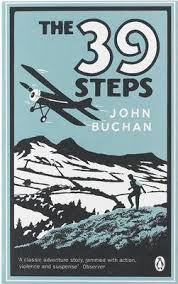
The Thirty-Nine Steps by John Buchan, 1915

This is the novel for which the phrase “what a load of old tosh!” was invented. Buchan, in a short introduction, described it as coming from a genre “which we know as the ‘shocker’ – the romance where the incidents defy the probabilities, and march just inside the borders of the possible”. This is a thinly veiled attempt to pre-empt some of the more obvious criticisms of the utter implausibility of his story. Although having been told that the story will be wildly implausible doesn’t make the plot much easier to swallow.

Positives about the novel are elusive. If the plot is ludicrous, the characterisation is not much better. The descriptive writing, which some reviewers and readers enjoy, left me cold. And the politics of the novel are appalling – a point to which I will return. However, “The 39 Steps” is an important part of the “German spies in the UK” genre, which before the war was used to bolster the re-armament position, and which after the start of the war were all part of the literary attempt to portray the Germans as cunning and dastardly, but beatable, with the right amount of pluck and stiff upper lip. Hannay, the lead character, is thinly drawn – he is a Scottish ex-patriot used to hunting on the veldt, and finds the confines of London life boring and stifling. He treats the improbable events he finds himself engulfed in as an adventure – it would be no surprise to any reader to hear that this novel was first published as a weekly serial in Blackwood’s magazine, which not many years earlier had published Conrad’s “Heart of Darkness”.

Through a series of increasingly outlandish plot twists, none of which are particularly inventive or entertaining, Hannay finds himself forming a thin blue line between the Great British Empire and the Hun. He slips through the fingers of his pursuers in a way that is so predictable as to deprive the novel of any suspense whatsoever, and the bad guys are eventually bested through a combination of Hannay’s intelligent deductions, clues left by his accomplice, and some good old British spunk. It almost defies parody. The novel is barely 100 pages long, and speeds along at a good pace, so if you have a couple hours spare I suppose there are worse ways of wasting them.

But be prepared for some really unpleasant racism and anti-Semitism, particularly the latter. This is more than simply the prevailing casual racism of the British upper classes of the early 20th century. Jewish conspiracy theories are referred to explicitly, and shown to be genuine. These ideas have no meaningful part whatsoever in the plot, other than to provide the vague suggestion that the plot underfoot is more than a simple case of one nation against another (the gang trying to steal British military secrets calls itself the “Black Stone” – amazingly the Black Stone have a secret base in the Scottish Highlands, right in the path of Hannay’s attempt to lay low). This all leaves a bad taste. It’s not thought through in any coherent way, and while done in an apparently off-hand way, without any apparent spite, represents more that the simple racist assumptions and language that were current at this time – they give a platform and credence to anti-Semitic ideologies that were to prove so poisonous only 20 years later.

Standard
21st century literature, Book review, Ian McEwan, Spy stories, The Innocent

The Innocent by Ian McEwan

McEwan is always strong when it comes to evoking a particular time and place, whether it be early 1960’s in “On Chesil Beach”, the Dunkirk evacuation (amongst others) in “Atonement”, or early 1970’s MI5 in “Sweet Tooth”, just to mention a few. The thing that jumps out from that short list for me is how precise this timing is – it is not a decade, or a generation which is invoked, but a very exact point in time and place. In “The Innocent” the setting is Berlin, 1955. Berlin is an occupied city, still literally shell-shocked, reconstruction is barely underway although the Wall has yet to go up – again giving us a very exact moment in time, a turning point in the way “On Chesil Beach” is timed between the Lady Chatterley trial and the Beatles first EP. The city is a microcosm of the Cold War and into this volatile environment Leonard Marnham, the eponymous innocent, a British telephone engineer, is dropped. Leonard is an everyman figure, innocent in many ways – sexually, politically, socially – and although he is quickly absorbed into an American plan to tap Russian telephone messages out of Berlin, he makes a terrible, indiscreet spy.

As a standard Cold War spy story in the Le Carre model, the introduction of a femme fatale, Maria, who approaches Leonard in a night club, comes on cue. Maria seduces Leonard by the book, and very soon he is under her spell. Leonard is too young to have fought in the war, but 30 year old, divorced Maria, survivor of the brutalities of the occupation of Berlin, is a wiser, more mature character who quickly becomes the senior figure in the relationship. Leonard develops a fairly sick fantasy in which he is an occupying soldier who forces himself on the helpless, vulnerable Maria. When he tries to act this out in a disturbing scene she is unsurprisingly repelled, and their relationship only survives by the intervention of Leonard’s American senior officer, Bob Glass.

The (protracted) climax of the novel comes with the return of Maria’s brutish ex-husband, Otto, a bit of a Teutonic caricature. Leonard and Maria are the only ones surprised by his return, and the denouncement is equally predictable, albeit the brutality of the episode is detailed and relentless. There then follows a scene when Leonard tries to dispose of the body (sorry, spoilers) and ends up leaving it in two suitcases in the tunnel dug to intercept the Russian telephone lines, on the Russian side of the border. When he then passes on the secret of the tunnel to the Russians, in a desperate attempt to avoid the body being found by the Americans, his fall from grace is complete, his last innocence lost.

The post-script “30 years later” chapter, when Leonard returns to Berlin just before the Wall comes down, is probably unnecessary, but does give Maria a voice, finally.

Although this is relatively early McEwan, a little derivative in its setting and characterisation, his potential as a mature novelist shines through. if you want to explore early McEwan start here rather than the award winning but badly flawed “Amsterdam”.

Standard
21st century literature, Book review, Ian McEwan, Spy stories, Sweet Tooth

Sweet Tooth by Ian McEwan

Read in the Jonathan Cape hardback first edition.

Serena begins a relationship with the writer, Tom Haley, she is “running”, without telling him she is a “spy”. This provokes a strong reaction from one of her colleagues. Much of the novel is spent reaching this point, filling in Serena’s early love affairs, including one with a professor at her university who in later turns out, to little surprise, was leaking information to the Russians earlier in the Cold War.
Serena reads Haley’s short stories, and we are given detailed synopses of them, including extensive quotes. This gives us the stories within stories which gives the novel a complex structure. Eventually the details of the MI5 funding come out in the press, no doubt leaked by this jealous colleague, and the relationship reaches at crisis.  In the final chapter there is a revelation which reframes the rest of the narrative in a very similar way to the disclosure at the end of Atonement, and prompts the reader to look at the novel in a completely different light. This technique could be irritating – it’s not really necessary – but the successes of the novel elsewhere outweigh this distraction.
The central character appears to be an open, slightly delusional, slightly dishonest, and not very likeable character, and prior to the final chapter revelation I (and I think most readers) thought this was simply a flawed narrator of the kind we are very familiar with in much contemporary fiction. The fact that McEwan has gone further than this doesn’t I think take us anywhere particularly new – one kind of flawed perspective in a narrator is very similar to another; it is not as if we get any closer or indeed further away from “the truth”.
A couple of other moans before I try to get to why I read this novel in little over 24 hours. First, the period detail which McEwan tries so hard at getting right. The problem with this is that his trying is just too apparent – for example telling us the price of a pint of beer in 1974 (13p). Period detail needs to be accurate and appropriate, but not flaunted. Second, the plot developments, other than the final twist, and too obvious – the Cambridge don who turns out to be a spy is just a bit of a cliche, and can be seen a mile off; like-wise the boyfriend who is not just that much into sex with his hot girlfriend, who shockingly turns out to be gay. And so on. Lastly, the Monty Hall problem, which McEwan doesn’t spend too much time on, thankfully, has already been done in Mark Haddon’s “The Curious Incident” and comes across as tired here.
So why did I keep reading with such interest? McEwan’s prose style is mature and well crafted – there is rarely a false note with the language (as opposed to the plot). The central character is a bit wet and dim, always a few pages behind the reader and her associates, but is generally likeable and pleasant. Some of the period and geographic detail also struck a personal chord, and many of the other writers referenced were familiar. In itself that’s not enough to account for the interest, so I think what I am going to do is let the novel settle in my mind for a bit, maybe read some reviews and reread a few chapters, and come back to it in a few weeks.
Standard