Book review

The Orwell Tour, by Oliver Lewis, 2023

I must admit I am a little jealous of Oliver Lewis. I have pointed out in previous reviews of Orwell biographies that he was relentlessly nomadic, never living in the same place for more than a handful of years. I’ve also been to several of the places he lived – Marrakesh, Southwold, Paris, London, and nearby Wallington in Hertfordshire – but with the exception of the last location I have never made the effort to seek out the blue plaques recording where Orwell lived, however briefly. (Wallington is an exception to that rule, because apart from the Stores, Orwell’s house there, and the prototypes of Manor Farm, there is very little in the village at all). Lewis had the inspired idea of visiting as many of Orwell’s homes as possible, with the thought that they might individually or collectively tell us something about the man, his background, influences and experiences. I wish I had had the same idea.
Knowing where to draw the line in terms of the places Orwell ‘lived’ is not always straightforward. For example, did he ever live in Stockton-on-Tees? We know his wife Eileen’s family owned a house there and she and Richard (their adopted son) decamped there after they were bombed out of their London flat. But did Orwell visit or stay for any length of time? There are so far as I am aware no letters from him to anyone carrying this address. D J Taylor, author of one of the best biographies of Orwell, (Orwell, the New Life) says (page 432)

The first of the V1 flying bombs, known as ‘doodlebugs’, had been launched across the channel on 13 June, a week after the Normandy landings. On 28 June one of them fell on Mortimer Crescent; no one was hurt, but the house was uninhabitable and would remain so for some time. Orwell and Eileen’s whereabouts for the next few months are far from certain. One temporary landlady may have been Inez Holden, at her new flat in George Street, Marylebone, although a note in Inez’s diary records their going to stay with the Dakins in Bristol. If so, this could only have been a short-term arrangement as Orwell was needed three days a week at Tribune. Eileen and Richard certainly spent some time at Greystone, the O’Shaughnessy family home twenty-five miles south of Newcastle, and there were short visits to Wallington…but the likelihood is that Orwell himself joined the vast floating population of displaced wartime Londoners with no fixed abode, moving on from one spare room or camp bed to another as the opportunity arose”.
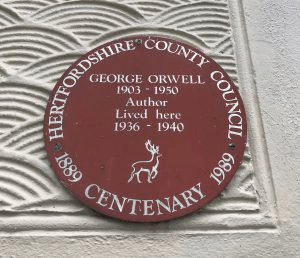
I have quoted this at length to illustrate the point that the question of where Orwell ‘lived’ is often far from straightforward and until such times as letters from or to Orwell, or any other evidence emerges, will remain unclear. There is a similar issue with Orwell’s residence at the Stores in Wallington. He held the lease to this cottage from 1936 to 1947, but the plaque on the wall states he lived there from 1936 to 1940. Even during that period he spent six months in Spain, as recorded in Homage to Catalonia, six far less interesting months in a sanatorium in Kent and a further six months recuperating in Marrakesh. After 1940 he lived in various addresses in London and in 1946 he moved to Jura. The Stores were (from what I can tell) sub-let at various points, but the record also indicates he and Eileen, occasionally joined by friends, would spend some weekends at Wallington during the war. Does this mean he lived there then? (If so, the plaque would be far more complicated!) Probably not, but again the point is that the question of where this ultra-nomad lived at any one time is not straightforward, and eventually requires us to make judgment calls about these issues.

There are a few omissions from what is otherwise a comprehensive review of the many places Orwell lived. He attended Wellington College for a single term before going to Eton. St Cyprian’s School in Eastbourne, East Sussex where Orwell went to prep school for five years as a boarder, is mentioned but not visited, possibly because the building in which it was housed has since burned down, so there would be little to see. Having said that these were key formative years for Orwell, recorded in his essay Such, Such Were the Joys (which is a grimly ironic quote from Blake). Freys College, where he taught for a term in 1933, is also mentioned but not visited. Orwell seems to have spent quite a lot of time at his wife’s brother’s family home in Greenwich, which might have been worth visiting, and was certainly close enough. Any attempt to visit every location ever associated with Orwell is probably futile, but these all seemed easy enough locations to tick off and may have been worthwhile additions to this account.

There are a few errors here as well which are less forgivable. The chapter on the Blair’s early years back in the UK after India is entitled Henley-on-Thames, Berkshire, whereas Henley-on-Thames is in Oxfordshire, as the text makes clear. The error is important because it makes more sense of Orwell’s decision to be buried in Sutton Courtenay, Oxfordshire – otherwise he had no particular association with this County, rather than it being the place of his early childhood. The description of Southwold as being “a small port clinging to the extremity of the East Anglian coastline” is technically correct, but misleading. Southwold is predominantly a Suffolk seaside town, pier and all, and the fact that as with all ports and seaside towns it is on the coast means the description of it ‘clinging’ to the coastline (rather than sloping gently down to the sea) is redundant.

I don’t think there is any doubt that we can learn more about an author by visiting the places where they lived. Orwell’s lack of interest in home comforts is summed-up vividly by the dilapidated cottage in Wallington, even if over the years it has been vastly improved, not least by the addition of a thatched roof and indoor plumbing and heating. Manor Farm just a short walk away conjures up images of the revolutionary animals of Animal Farm. I am sure the conditions in Burma could tell us a lot about Orwell’s time in the military police there. The wildness of Jura doesn’t seem to have changed a great deal since his time there in the 1940’s – anyone seeking out that remoteness and isolation must have wanted to escape something and will have paid little regard once again to the lack of home comforts.

Lewis makes some small but fascinating discoveries in the course of his journey: gravestones from the Limouzin family, Orwell’s mother’s side of the family, are found in a half-abandoned church in Burma; his measurements can still be seen in his tailor’s records in Southwold from when he ordered a suit almost 100 years ago; his name is still to be found in the visitors book in his neighbour’s house on Jura. Orwell left footprints everywhere, but at the same time he is elusive – famously, there is no known recording of his voice, which is extraordinary given that he worked in broadcasting for two years in the the 1940’s – and there are many small mysteries about his life which researchers are diligently chipping away at.

Lewis makes it clear in his introduction that this is not another biography, of which there are plenty, but it is not simply a travelogue either. It is a different way of looking at a remarkable life, and therefore a valuable contribution to the growing scholarship about the great man.
The Orwell Tour, by Oliver Lewis, 2023

Aside
Book review

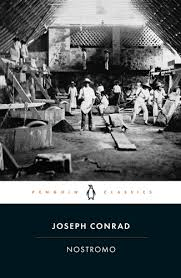
Nostromo, A Tale of the Seaboard, by Joseph Conrad, 1904

I came perilously close to abandoning Nostromo and it was only sheer bloody-mindedness that kept me going. This was a result of a combination of Conrad’s prose style and his poorly defined characters. I found the prose wooden and the characters spent far too much time pontificating about abstract concepts:

“Action is consolatory. It is the enemy of thought and the friend of flattering illusions. Only in the conduct of our action can we find the sense of mastery over the Fates”

or

“There is no peace and no rest in the development of material interests. They have their law, and their justice. But it is founded on expediency, and is inhuman; it is without rectitude, without the continuity and the force that can be found only in a moral principle.”

The novel’s cast of characters is wide, but many of them were often hard to differentiate from one another, especially given the frustrating practice of giving them multiple, interchangeable names (so for instance, the central character, Nostromo, is also known as Giovanni Battista Fidanza or Capataz de Cargadores). Conrad also adopts a narrative structure which eschews traditional chronology and tells some of the story in retrospect, some in the present. None of these techniques are objectively wrong or even particularly challenging, but Conrad’s execution of them is leaden. Although the novel is only 450 or so pages long it took me several weeks to read. You know you are struggling when you start to count the number of pages to go, and 20 pages read was a good day. To what extent this is my failure as a reader and Conrad’s as an author I cannot be sure.

The first two hundred pages (almost half the novel) are a meandering build-up to the point in the story at which the action properly begins, revolving around the struggle over ownership and control of a silver mine in the fictional South American country of Costaguana. Costaguana is an archetypal South America banana republic, with a long history of political instability. Charles Gould owns Costaguana’s primary natural asset, a silver mine, near the port of Sulaco. Revolutionary force invade Sulaco with the aim of capturing the mine. Nostromo, the head longshoreman of the port, escapes with the mine’s recently retrieved cargo of silver. Nostromo, an Italian expatriate, is a leading figure in Sulaco, with influence among the wealthy Europeans who control much of the city, but also widespread support from the working people of the town. Accompanied by a journalist, Martin Decoud, Nostromo smuggles the silver out of Sulaco, but is only able to make it as far as a small island at the head of the harbour, where he and Decoud hide the silver. The revolutionaries and the resident townspeople all believe the silver has been lost at sea and after Nostromo swims back to shore he does nothing to make them think otherwise. He avoids capture by the revolutionaries and rides out to seek help from the Government forces.

A jump forward in time shows the reader that Nostromo’s intervention has led to the creation of the independent state of Sulaco, which is now prospering. He has kept the location of the silver a secret. His partner, Decoud, left stranded on the island with only the silver for company, eventually lost his mind and drowned himself weighed down with some of the silver ingots. Over time Nostromo slowly grows rich, ostensibly because of his successful trading, but mainly because he collects the silver a little at a time so as to not arouse suspicion. But wealth does not bring happiness. Several years pass, and the independent Government decides to construct a lighthouse on Great Isabel. Nostromo fears this will lead to the remaining silver being discovered, but there is little he can do other than keep a close eye on the construction. He recommends an old friend, the widower Giorgio Viola, as the lighthouse keeper. The novel concludes dramatically with the resolution of these plot lines, but I won’t give away the ending.

I have read that Nostromo was originally conceived as a short-story, but over time the novel expanded in scale and scope. This could have had something to do with the publication in instalments of course, but also explains its rambling unfocussed structure. Conrad apparently found writing it almost as difficult as I found reading it, saying “it is like a kind of tomb which is also hell where one must write, write, write.” Nostromo was not very popular or successful when it was first published, with many finding the plotting byzantine and over-elaborate. Online you can find many people praising the novel as the best ever written, but this is surely hyperbole. When I did eventually finish it was with more of a sense of relief than anything else.

Nostromo, A Tale of the Seaboard, by Joseph Conrad, 1904

Aside
Book review

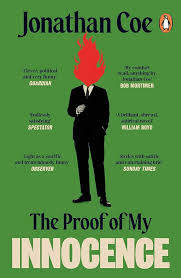
The Proof of My Innocence, by Jonathan Coe, 2024

In his summary of The Proof of My Innocence, Jonathan Coe tells us that ” I felt like writing something contemporary, ironic and harder-edged. I wanted to return, if possible, to the tone of What a Carve Up!, with some kind of metatextual crime story which would also reflect on the current political situation.” If we judge the novel by these criteria, then I think that while certainly the metatextual crime story box can definitely be ticked, I would struggle to describe this as ironic or harder-edged. I will try to explain why in this review, but the good news is that the lack of a hard-edge is not a serious problem nor does it detract from the overall enjoyability of the novel.

Coe’s well-established method is to use contemporary real-life political events as a backdrop to his stories. The Proof of My Innocence follows this pattern by being set in the tumultuous period of Liz Truss’s premiership in the autumn of 2022. It opens with her election and ends with her resignation just seven weeks later, the shortest term of office of a British Prime Minister by some considerable distance.

The novel opens with a woman detective following a suspect on a train. Just as she is about to arrest him she is interrupted by a See It Say It Sorted announcement. Being infuriated by these announcements and then making a plot point out of them, is the kind of thing an observational stand-up comedian might ‘notice’, and pretend to get worked up about, when they really aren’t that obtrusive. This scene is then swiftly followed by an apparently unrelated story-line in which Phyl, who has recently graduated from university, works in a minimum wage job at a sushi bar at Heathrow Airport. She lives with her parents and misses the freedom of university life. Phyl watches old episodes of Friends as a means of reducing the anxiety caused by the lack of direction in her post-graduate life. The friction between millennials and their Boomer parents is one of the sources of humour in the novel. Coe is unquestionably one of the latter and I am not sure his portrait of the younger generation is entirely accurate, but the Friends obsession (or insert comedy programme of your choice – another favourite is the US version of The Office) seemed spot on.

The arrival of a guest disrupts the family dynamic. Christopher Swann, a friend from her parents’ time at Cambridge University in the 80’s, writes a blog on contemporary political issues. He is planning on attending TruCon, a conference organised by a dubious right-wing group pressure group. The conference is being held at a nearby stately home, Wetherby Hall. Chris is joined by his adopted daughter, Rashida, who quickly bonds with Phyl over a shared frustrating experience with the lifts at terminal 5. Phyl is toying with the idea of writing a novel, and in discussion with Rashida about this idea she jots down three possible genres for her work: cosy crime, dark academia (such the The Secret History) and auto-fiction. The bulk of the remainder of the novel is written in the form of these three genres. The reader can’t immediately tell whether these are fictions written by Phyl or by Coe, although this is eventually revealed.

The cosy crime third of the story is set at Wetherby Hall, the venue for the TruCon conference, which opens on the day Liz Truss becomes prime minister. This section opens with a parody of this genre which is somewhat over the top:

“Christopher Swann carefully steered his car between the yellowing drystone walls of the quaint old bridge that carried the road over the brook….Just a few hundred yards after crossing the brook he entered the village of \Wetherby Pond itself. At the sound of his engine (even though he was driving a quiet, hybrid model) the ducks on the eponymous body of water took flight with a volley of complaining quacks. Christopher followed the road around the edge of the pond, his eyes taking in every unlikely detail of the old post office, the red telephone box standing outside the village shop, the row of trimly thatched cottages and an elderly resident reading a copy of the Times while sitting on a weathered oak bench.”

I genuinely can’t tell if this is deliberately bad genre writing or not, but I will give Coe the benefit of the doubt and assume it is part of the parody. I particularly liked the description of his Swann’s ‘eyes’ taking in every detail as if any other body part could have fulfilled the same function! Swann is treated as an outsider by most conference delegates, which of course he very much is. Rather than keeping a low profile he goes out of his way to antagonise the various right-wingers present, all of whom feel jubilant at Truss’s appointment, feeling this is their moment. The conference is interrupted by the news of Queen Elizabeth 2nd’s death, quickly followed by Christopher’s brutal murder. Coe is treading a fine line here – he is incorporating all the cosy crime tropes he can think of – the rural setting, a locked room mystery, secret passages, a cryptic note from the victim, etc etc – and at the same time telling the underlying story of Swann’s forty-year pursuit of the far right in the UK and their plans for the day they finally take power, which seems to have arrived.

The next section of the story is told as an example of the ‘dark academia’ genre and is based around a manuscript memoir of one of Swann’s friends at university in the 1980’s. This section continues the delicate balancing act between parody – the author’s memories of his days at Cambridge in the 80’s include love affairs, glamorous young women, hidden identities, secret societies and a sinister conspiracy to support the Thatcher Government – and advancing the narrative, leaving clues about the present-day mystery. The final section written as auto-fiction completes the murder mystery element of the novel but leaves some loose ends dangling. These are picked up in what is in effect the novel’s postscript, which reveals that much of the preceding story has been a fiction within the fiction – hence the sound of the metatextual box being ticked.

The Proof of My Innocence is full of things that the reader is encouraged to notice for themselves, the novelists equivalent of Easter eggs. Clues to the identify of the murder form part of these things we are encouraged to notice, but there’s much more – references to contemporary culture, running jokes (the laboured joke about whether an Cambridge don had a harpsichord or a clavichord in his rooms is repeated about a dozen times) wordplay, and so on. Each time we spot one of these we get a small hit of dopamine – ‘clever me!’ – that keeps us reading. And The Proof of My Innocence was eminently readable – I got through it in just over two days. By way of example, the murder mystery element of the story has the victim surviving his attack just long enough to write a few cryptic symbols before expiring (this trope goes back to at least A Study in Scarlet. The message is “r 8 / 2.” Is this a reference to someone staying in room 8 (2)? Or something happening on 8th February? Or possibly even something happening on 2nd August (those pesky Americans with their different conventions for writing dates). Or something else entirely? (Clue, it’s something else entirely). Earlier a pub Swann visits is called the Fresh Lettuce, a wry reference to the tabloid joke that haunted (haunts?) Truss as to whether her premiership would last longer than a lettuce (it didn’t). I was patting myself on the back when I spotted the fact that a plot point would revolve around a novel within the novel called My Innocence and changes made to the proof copy (hence, the Proof of My Innocence, a clever play on words). Is the enjoyment of these ‘noticeables’ a feature of the genres Coe parodies, or of his writing more generally?

Sadly, the novel slightly fizzles out. The big conspiracy Swann is planning to expose, the far-right’s plan to privatise the NHS, never sees the light of day. A memory stick with details of the plan is stolen and back up copies are quietly forgotten after his death. An alternative right-wing plan revealed within the 1980’s memoir, to defeat a strike by the NUM, is also forgotten (this was hardly a secret plan, more a statement of the obvious). Coe’s portrait of the far-right of British politics, and the extent to which it is influenced by the American right, is usually spot on, but the absence of any reference to Farage or Reform was puzzling. Wagstaff, a Tory politician who plays the role of villain in the novel, is the nearest we come to a portrait of Farage, but he is a Cambridge graduate and a life-long Tory, so not anywhere near an equivalent. Reform need the Jonathan Coe treatment. Once the meta-fictions end and the novel switches to the principal storyline we find out that the murder-mystery narratives were Phyl’s attempts at making sense of Swann’s death in a car crash before he even reached the conference. Not a particularly sensitive way of processing someone’s death I would have thought.

Coe is an author I have been meaning to read for some time. He is quite prolific having published 15 novels, roughly one every three years. His writing style is engaging and accessible. So I will definitely be reading more of his work in future. I enjoyed The Proof of My Innocence and look forward to reading Coe’s thoughts on Starmer’s Labour.

The Proof of My Innocence, by Jonathan Coe, 2024

Aside
Book review

The Blessing by Nancy Mitford, 1951

England, 1939. Grace Allingham, a young, affluent Englishwoman is engaged to be married to Hughie. But when she meets Charles-Edouard de Valhubert, a French Air Force officer, she is swept off her feet, Hughie is dumped unceremoniously and Grace and Charles-Edouard quickly marry. After a brief honeymoon he returns to the war, leaving Grace pregnant but content to wait out the months and years of war for his return. Seven years pass, and when he finally returns to England it is to collect his wife, son and the family nanny and take them back to France, to finally begin married life.

Life in France is not without its challenges. The principal characters of the novel, with the exception of the nannies who look after the children before they are sent off to boarding school, are all upper class if not aristocratic, independently wealthy, who don’t have to work, have multiple houses, staff and spend their summers in Italy. But their relationships are a mess. The comedy of the novel derives largely from stereotypes about English and French aristocrats and their very different lifestyles. The main difference between the countries is their attitude towards infidelity. The French have a ‘laissez-faire’ approach, where affairs are seen as a private matter rather than a moral failure, and even accepted as part of long-term relationships. Charles-Edouard’s problem is that he is a enthusiastic adulterer who seems untroubled by being caught in the act. Eventually Grace realises he is never going to change. She returns to England and divorces him. He is remarkably untroubled by this, continuing with his long-term affairs, confident that his wife will sooner or later see sense and return to him.

As Charles-Edouard is a man-child driven by his libido above all else, it is hardly surprising that his son, Sigi, easily outwits him. Sigi likes his parents being separated – it means that all the potential new husbands and wives in their lives have to seek his approval, and approval means treats. He is spoilt rotten and frustrates Charles-Edouard’s lacklustre attempts to woo his wife into returning to France by simply not delivering his messages. Potential suitors for his mother’s newly available hand are equally easily disposed of given Sigi’s veto over their selection. Balls are attended, afternoon tea is drunk, French properties left unlooted by the Nazis are toured, and of course assignations are conducted more or less in the open. The comedy is dated, and I suspect it felt so even in the early 1950’s when the novel was first published, being more suited to the carefree times of the 20’s and 30’s. I even wonder whether this might have been a returned-to manuscript from the 30’s, updated with scant details of the slightly longer second world war?

The only indication we are in post-war Europe is a short discussion on homosexuality. Dexter, an obnoxious American, (it is almost a given that Americans in novels of this kind are obnoxious) is ranting about the link between homosexuality, which he calls ‘perversion’, and communism. Hughie, who by this point in the novel has overcome his break-up with Grace and is courting Albertine, who is one of Charles-Edouard’s mistresses. replies “But, old thing, they’re not sick. They just happen to like boys better than girls. You can’t blame them for that, it’s awfully inconvenient, and they’d give anything to be different if they could…I probably know more about them than you, having been at Eton and Oxford“. The revelation towards the end of the novel, that Dexter was a Russian spy and life-long communist, further undermines his credibility as a judge of public morality. Other than this brief defence of ‘perversion’ the social attitudes prevalent throughout the novel are those of earlier decades, when the Mitford’s had some relevance beyond historians of English class identities.

The Blessing by Nancy Mitford, 1951

Aside
Book review

No-one writes to the Colonel, by Gabriel Garcia Marquez, 1958

No One Writes to the Colonel is a long short story or short novella, coming in at under 70 pages. Famously Marquez said that he had to write One Hundred Years of Solitude so that people would read No One Writes to the Colonel. Which is really a throwing down of the gauntlet, challenging any reader who admires his longer form work to love this short story.

An unnamed retired Colonel, a veteran of earlier Colombian wars, lives in poverty with his wife and his rooster. The rooster has been bred to fight on cock-fights, and could potentially be worth a lot of money, either in prize money or sold on to other trainers. The rooster previously belonged to the colonel and his wife’s son, who has been killed in the political violence gripping the country.

For fifteen years the Colonel been waiting for the Government pension he was promised (or perhaps more accurately he believes he was promised, because his lawyer seems to be very unsure of his eligibility). Every week he meets the mailboat and each week he is sent home empty handed, because no-one writes to the Colonel. His wife has asthma, making their daily lives all the more difficult and miserable. The story opens with the colonel preparing to go to the funeral of a town musician. The reader is told that this death is significant because he was the first to die from natural causes in many years. Initially it is unclear why natural causes deaths should be so unusual, but it soon becomes apparent that most other deaths have been as a result of political violence. Their small village is under martial law – there is a nightly curfew at 11, and the funeral procession is forbidden from passing in front of the police station.

The centre of the story is dominated by the decision as to whether or not to sell their prize rooster. Potentially it could be very lucrative once the cock-fighting season starts in the new year, but they have to find a way to get through the winter first and without jobs or the long-awaited pension, they fear they may starve before that happens. So they are forced to consider selling the rooster for well below its actual value just to survive. There is also the complication that the rooster itself eats a lot of corn, taking food out of their mouths. The Colonel’s wife sometimes has to boil stones to try to convince their neighbours that they have something to eat. So this is not a community where the old and hungry feel able to ask for help from others – whether or not that help would be offered.

Despite the eternal non-appearance of his pension, the Colonel still lives in hope, hope that one day a letter will arrive, one day his rooster will win. The story ends on a defiant upbeat note. Having decided to keep the rooster until the cock-fighting season starts, he is berated by his wife who asks

“And meanwhile what do we eat?”.

“It had taken the Colonel seventy-five years – the seventy-five years of his life, minute by minute – to reach this moment. He felt pure, explicit, invincible at the moment when he replied:

‘Shit.'”

No-one writes to the Colonel, by Gabriel Garcia Marquez, 1958

Aside