
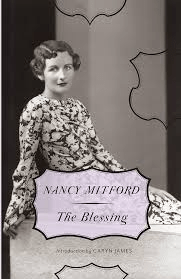
The Blessing by Nancy Mitford, 1951
England, 1939. Grace Allingham, a young, affluent Englishwoman is engaged to be married to Hughie. But when she meets Charles-Edouard de Valhubert, a French Air Force officer, she is swept off her feet, Hughie is dumped unceremoniously and Grace and Charles-Edouard quickly marry. After a brief honeymoon he returns to the war, leaving Grace pregnant but content to wait out the months and years of war for his return. Seven years pass, and when he finally returns to England it is to collect his wife, son and the family nanny and take them back to France, to finally begin married life.
Life in France is not without its challenges. The principal characters of the novel, with the exception of the nannies who look after the children before they are sent off to boarding school, are all upper class if not aristocratic, independently wealthy, who don’t have to work, have multiple houses, staff and spend their summers in Italy. But their relationships are a mess. The comedy of the novel derives largely from stereotypes about English and French aristocrats and their very different lifestyles. The main difference between the countries is their attitude towards infidelity. The French have a ‘laissez-faire’ approach, where affairs are seen as a private matter rather than a moral failure, and even accepted as part of long-term relationships. Charles-Edouard’s problem is that he is a enthusiastic adulterer who seems untroubled by being caught in the act. Eventually Grace realises he is never going to change. She returns to England and divorces him. He is remarkably untroubled by this, continuing with his long-term affairs, confident that his wife will sooner or later see sense and return to him.
As Charles-Edouard is a man-child driven by his libido above all else, it is hardly surprising that his son, Sigi, easily outwits him. Sigi likes his parents being separated – it means that all the potential new husbands and wives in their lives have to seek his approval, and approval means treats. He is spoilt rotten and frustrates Charles-Edouard’s lacklustre attempts to woo his wife into returning to France by simply not delivering his messages. Potential suitors for his mother’s newly available hand are equally easily disposed of given Sigi’s veto over their selection. Balls are attended, afternoon tea is drunk, French properties left unlooted by the Nazis are toured, and of course assignations are conducted more or less in the open. The comedy is dated, and I suspect it felt so even in the early 1950’s when the novel was first published, being more suited to the carefree times of the 20’s and 30’s. I even wonder whether this might have been a returned-to manuscript from the 30’s, updated with scant details of the slightly longer second world war?
The only indication we are in post-war Europe is a short discussion on homosexuality. Dexter, an obnoxious American, (it is almost a given that Americans in novels of this kind are obnoxious) is ranting about the link between homosexuality, which he calls ‘perversion’, and communism. Hughie, who by this point in the novel has overcome his break-up with Grace and is courting Albertine, who is one of Charles-Edouard’s mistresses. replies “But, old thing, they’re not sick. They just happen to like boys better than girls. You can’t blame them for that, it’s awfully inconvenient, and they’d give anything to be different if they could…I probably know more about them than you, having been at Eton and Oxford“. The revelation towards the end of the novel, that Dexter was a Russian spy and life-long communist, further undermines his credibility as a judge of public morality. Other than this brief defence of ‘perversion’ the social attitudes prevalent throughout the novel are those of earlier decades, when the Mitford’s had some relevance beyond historians of English class identities.

