Book review

The Blessing by Nancy Mitford, 1951

England, 1939. Grace Allingham, a young, affluent Englishwoman is engaged to be married to Hughie. But when she meets Charles-Edouard de Valhubert, a French Air Force officer, she is swept off her feet, Hughie is dumped unceremoniously and Grace and Charles-Edouard quickly marry. After a brief honeymoon he returns to the war, leaving Grace pregnant but content to wait out the months and years of war for his return. Seven years pass, and when he finally returns to England it is to collect his wife, son and the family nanny and take them back to France, to finally begin married life.
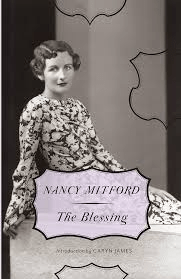
Life in France is not without its challenges. The principal characters of the novel, with the exception of the nannies who look after the children before they are sent off to boarding school, are all upper class if not aristocratic, independently wealthy, who don’t have to work, have multiple houses, staff and spend their summers in Italy. But their relationships are a mess. The comedy of the novel derives largely from stereotypes about English and French aristocrats and their very different lifestyles. The main difference between the countries is their attitude towards infidelity. The French have a ‘laissez-faire’ approach, where affairs are seen as a private matter rather than a moral failure, and even accepted as part of long-term relationships. Charles-Edouard’s problem is that he is a enthusiastic adulterer who seems untroubled by being caught in the act. Eventually Grace realises he is never going to change. She returns to England and divorces him. He is remarkably untroubled by this, continuing with his long-term affairs, confident that his wife will sooner or later see sense and return to him.

As Charles-Edouard is a man-child driven by his libido above all else, it is hardly surprising that his son, Sigi, easily outwits him. Sigi likes his parents being separated – it means that all the potential new husbands and wives in their lives have to seek his approval, and approval means treats. He is spoilt rotten and frustrates Charles-Edouard’s lacklustre attempts to woo his wife into returning to France by simply not delivering his messages. Potential suitors for his mother’s newly available hand are equally easily disposed of given Sigi’s veto over their selection. Balls are attended, afternoon tea is drunk, French properties left unlooted by the Nazis are toured, and of course assignations are conducted more or less in the open. The comedy is dated, and I suspect it felt so even in the early 1950’s when the novel was first published, being more suited to the carefree times of the 20’s and 30’s. I even wonder whether this might have been a returned-to manuscript from the 30’s, updated with scant details of the slightly longer second world war?

The only indication we are in post-war Europe is a short discussion on homosexuality. Dexter, an obnoxious American, (it is almost a given that Americans in novels of this kind are obnoxious) is ranting about the link between homosexuality, which he calls ‘perversion’, and communism. Hughie, who by this point in the novel has overcome his break-up with Grace and is courting Albertine, who is one of Charles-Edouard’s mistresses. replies “But, old thing, they’re not sick. They just happen to like boys better than girls. You can’t blame them for that, it’s awfully inconvenient, and they’d give anything to be different if they could…I probably know more about them than you, having been at Eton and Oxford“. The revelation towards the end of the novel, that Dexter was a Russian spy and life-long communist, further undermines his credibility as a judge of public morality. Other than this brief defence of ‘perversion’ the social attitudes prevalent throughout the novel are those of earlier decades, when the Mitford’s had some relevance beyond historians of English class identities.
The Blessing by Nancy Mitford, 1951

Aside
Book review

Keep the Aspidistra Flying, by George Orwell, 1936

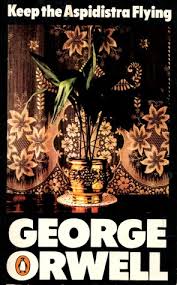
Gordon Comstock, anti-hero of Keep the Aspidistra Flying, is a failed poet, struggling with a premature mid-life crisis, and what we would now characterise as depression. He expresses his feelings as resentment at demands placed upon him by family and friends, and rages against the need to work for a living. OrwellRejecting a well-paid job in advertising, which he feels is beneath him, he instead works in a bookshop, spending long sad weeks struggling to make sure he can afford the next cigarette or pint of beer. He obsesses over the cost of everything. At first this is slightly comic, but the intensity of this obsession soon becomes wearisome. He is a misanthropic, grumpy figure who doesn’t deserve the friendship and love of those around him who care for him and look out for him, even though he goes out of his way to reject their help.

He lives a mean life in a dingy bedsit in Hampstead, working in a bookshop and in his spare time picking away at his magnum opus ‘London Pleasures’. His fantasy of himself as a poet is fed by the earlier publication of a slim volume of poetry – ‘Mice’ – which sold only 153 copies despite positive reviews. His obsession with money poisons his relationship with his girlfriend Rosemary. They have nowhere to go to be together, and Gordon’s pride means he wont allow her to pay for even a cup of coffee. Rosemary suggest a day in the countryside , with a hint that this might be the long awaited opportunity to finally consummate their relationship (Orwell was to return to this idea – of a couple travelling out into the countryside to find somewhere private to have sex – in 1984).

The day doesn’t go well – in an attempt to impress Rosemary, he wastes most of his money on lunch at a fancy hotel. Later when they are about to have sex en plein air it doesn’t happen because Gordon has forgotten to bring any contraception. Like a spoilt child he is angry with her:

“Money again, you see! … You say you ‘can’t’ have a baby. … You mean you daren’t; because you’d lose your job and I’ve got no money and all of us would starve.”

When some money does finally come his way, in the form of payment for a poem sent speculatively to an American magazine, Gordon wastes it on a fancy dinner and ostentatious tips. He gets completely out-of-control drunk, leading to a night in the cells and the sack from his job the next morning. I am not sure if Orwell intended this episode to be comic, but it is quite the opposite, not least in the assault on Rosemary.

After “sponging” for a while off Ravelston, a more prosperous literary friend, Gordon secures a post in another book shop/lending library. Determined to sink to the lowest level of society but afraid of sleeping on the street, Gordon takes an even seedier bed-sit in Lambeth, (to have fallen so low!) and isolates himself from family and friends. There is no question at this point that Gordon is clinically depressed, and he is hugely lucky to be loved by some of the most patient people on the planet. In desperation Rosemary has sex with him, and while this doesn’t jolt him from his depression, the result of this and thereby the conclusion to the novel is predictable.

Keep the Aspidistra Flying has a strong, semi-biographical flavour. It was written in 1934 and 1935 when Orwell was living in London, and clearly draws on his experiences in this period. There are numerous points of comparison between the life of the novel’s protagonist and his own. Orwell had written for The Adelphi, a left-wing literary journal edited by Sir Richard Rees, an obvious model for Ravelston, Comstock’s upper-class publisher and friend. Orwell had also worked in a second-hand bookshop in Hampstead, lived in squalid bedsits and struggled to find female companionship while attempting to write.

The novel has not aged well. Many of the social attitudes here will be uncomfortable to a modern reader. Comstock is homophobic, referring to a customer as a “nancy”. Orwell gives this character an affected lisp, and used similar language in correspondence and articles, so it is a reasonable assumption that he is here reflecting the everyday prejudice against homosexuality that was common in the 1930’s. Comstock also has disrespectful attitudes towards women, seeming only interested in them for sex:

This woman business! What a bore it is! What a pity we can’t cut it right out, or at least be like the animals—minutes of ferocious lust and months of icy chastity. Take a cock pheasant, for example. He jumps up on the hen’s backs without so much as a with your leave or by your leave. And no sooner is it over than the whole subject is out of his mind. He hardly even notices his hens any longer; he ignores them, or simply pecks them if they come too near his food.

Equally there is a horrible disdain for the working class in this novel that only someone born in the middle-class (and having been to Eton) could display. Of course one needs to be careful to not ascribe the character’s views to the author too easily, but the disgust with which the working classes – not least their terrible smelliness – seems authentic, and is on a par with some of Orwell’s other work. Take this description of a pub for example:

“A foul yet coldish air enveloped them. It was a filthy, smoky room, low-ceilinged, with a sawdusted floor and plain deal tables ringed by generations of beer pots. In the corner were four monstrous women with breasts the size of melons.” 

Comstock explores the underworld of the very poor, as Orwell himself did when Down and Out in Paris and London, but is always an outsider looking in, with the safety net of the £4 a week job waiting for him whenever he wants it. There’s a cursory discussion of socialist ideas which could help Comstock escape the money he feels trapped by, but Orwell’s heart doesn’t seem in it. Gordon’s conversations with Ravelston never progress beyond the level of point facile scoring:

Every intelligent boy of sixteen is a Socialist. At that age one does not see the hook sticking out of the rather stodgy bait.

Whatever its aspirations this isn’t a novel of ideas. It is at best part of the tapestry of 20th century literature. The portrait of the profoundly grumpy, sexist poet with a flair for getting extremely drunk may have been an inspiration for Kingsley Amis’s Lucky Jim, although there equally are some clear signs of borrowing from Sinclair Lewis’s 1922 novel Babbitt about a another individual’s struggle against the pressures of capitalism. “Keep the aspidistra flying!” is also the final line of Henry Miller’s novel Nexus (1959), and last but least it provided the title (if little else by way of inspiration) for Nancy Mitford’s 1949 “Love in a Cold Climate“.

Orwell wrote Keep the Aspidistra as a source of relatively easy income, and it shows. In a 1946 letter to a friend he wrote that this novel was one of the two or three books of which he was ashamed, saying that it was “written simply as an exercise; I oughtn’t to have published it, but I was desperate for money [-] At that time I simply hadn’t a book in me, but I was half starved and had to turn out something to bring in £100 or so.” It wasn’t until towards the end of his life, after the second world war, that he was to find his authentic voice as an  author of novels. Much of his best writing is to be found elsewhere, in his journalism, his essays and book reviews. 

Post script 2026 – I just came across this American edition of KAF on the internet, and thought I would share it as it is so marvellous:

May be an image of text that says "KEEP THE "The most powerful 35c novel he (0rwell) ASPIDISTRA has produced" LOS ANGELES TIMES FLYING GEORGE ORWELL Complete and Unabridged AN EXCITING AND MEMORABLE NOVEL THE THEWORI WOR AMOUS AUTHOR OF "1984" AND "BURMESE DAYS"

Standard