Book review, Conan Doyle, Detective, Detective fiction, Holmes, Holmes and Watson

Supplementary: The Mystery of Sherlock Holmes

If you read the comments on my recent post about ‘The Adventures of Sherlock Holmes’ you may have seen I postulated that there is a paradox at the core of how we perceive Sherlock Holmes. On the one hand he is (and so far as I can make out, always has been) enormously popular; on the other his stories are formulaic and (in the words of Bookertalk) “preposterous”.download (3)
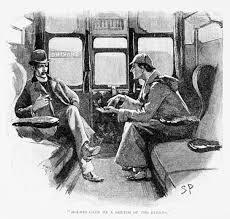
The case for the prosecution  is easily made. The Holmes stories are rigidly structured – Holmes and Watson are chatting, Holmes casually tosses over a letter he has received from his most recent client, telling him they will call at a certain hour which precisely arrives at the moment their initial assessment of the case has concluded.

“DEAR MR. HOLMES:—I am very anxious to consult you as to whether I should or should not accept a situation which has been offered to me as governess. I shall call at half-past ten to-morrow if I do not inconvenience you. Yours faithfully, “VIOLET HUNTER.”
“Do you know the young lady?” I asked.

“Not I.”

“It is half-past ten now.”

“Yes, and I have no doubt that is her ring.” (The Adventure of the Copper Beeches).

Holmes performs his parlour trick of determining the visitor’s background – “Beyond the obvious facts that he has at some time done manual labour, that he takes snuff, that he is a Freemason, that he has been in China, and that he has done a considerable amount of writing lately, I can deduce nothing else.” – (The Red-Headed League)

The game is then afoot, and Holmes quickly resolves the mystery by dint of some off-camera background research, investigations using a disguise or two, and a good dose of luck. I pointed out in my previous post that the resolution of each case is often not what the client hoped for. Of the twelve stories in ‘The Adventures’, one case fails completely (A Scandal in Bohemia), in another the client is murdered and the murderers escape (The Five Orange Pips) and in yet another Holmes solves the mystery but decides not to reveal the solution to his client (A Case of Identity).

Beyond this rigid structure, there are other issues. Apart from Holmes and Watson few other characters are brought to life – certainly not in the way they are in Sherlock for example, where they are given complex and interesting back stories. The writing is nothing out of the ordinary, and the author frequently ‘cheats’ by way of undetectable poison or by withholding information key to the resolution of the case until the last moment. Some if not many of the situations are indeed preposterous – for example in ‘The Adventure of the Speckled Band’ a  bell pull is installed in the victim’s bedroom, but it is not connected to anything (did people have bell-pulls in their bedrooms anyway? Perhaps the senior aristocracy who needed help dressing, but not in a small household as in this story).

The case for the defence would probably point out that the Holmes stories are some of the best loved in literature. Holmes has inspired many other writers, film-makers and artists, and the rich range of secondary characters in the books, from Mrs Hudson to Irene Adler, Lestrade, and of course not forgetting Moriarty may indeed be sketched briefly but are powerfully brought to life. The defence would also mention Conan Doyle’s virtual invention of the detective story, the cleverness of many of his plots, the inventiveness of Holmes’s deductions, and the strength of his enduring relationship with Watson. Descriptive writing may not be Conan Doyle’s strength, but London is brilliantly evoked.

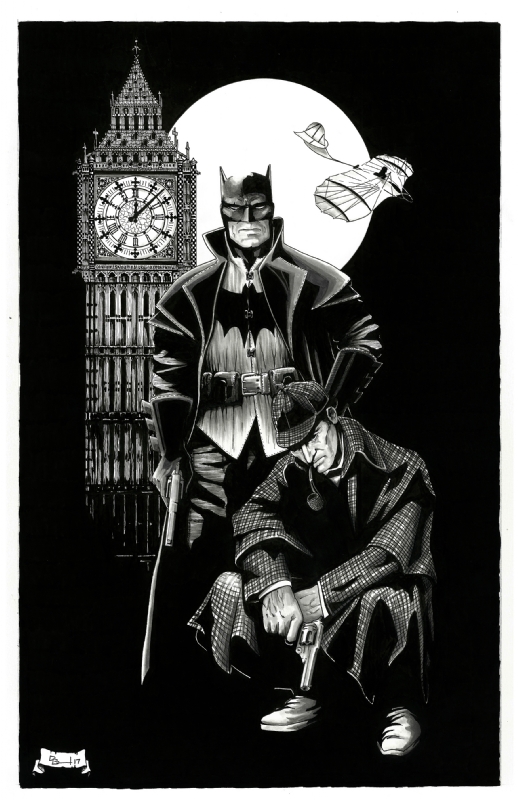
Thus far a fairly balanced case. But I think the enduring power of the Holmes stories lies elsewhere. Holmes was one of the earliest super heroes.  He has enormous strength – he can straighten a bent poker. He is utterly fearless. He has almost super-human powers of observation, deduction and intelligence, and well as a vast array of scientific and other information at his fingertips. He fights for the poor and the oppressed as well as the prosperous. He is a master of disguise, and sometimes wears a cloak. He lives among us, but apart. The country would fall without him. Yes, he’s Victorian Batman.Sherbat.jpg
And we all love a good super hero. The MCU franchise is not the most successful series of films in Hollywood history for nothing. What is more we need heroes. In Victorian England the readers of the Strand magazine would have felt threatened by trade unions, rising crime, the poor, suffragettes, and Germans, not in any particular order. Today we fear rising crime, lawlessness, terrorism, Trump. We still need Holmes out there stopping the bad guys, which is why we still have him.

Being a conscientious blogger I always try and find out if what I think is an original observation is just a cliche, and no surprise – I am not the first person by a long way to draw this parallel. Apologies, but I think the point still stands. Incidentally I don’t think it is important to get hung up on the specific super hero – the point is he plays the same role in society, offering hope to the vulnerable and scared. Which is why Holmes has developed such a rich life outside the Conan Doyle stories, and why he will remain a source of fascination and inspiration for many decades to come. Inevitably the original source material might look a little jaded in this context, but that would be to miss the point. Which I think, in my previous post, I did.
Standard

Conan Doyle’s ‘The Adventures of Sherlock Holmes’ contains 12 short stories, all originally published in the Strand magazine between June 1891 and July 1892. Some are better known than others, but all follow a fairly rigid format – a curious case is brought to Holmes’s attention by a flustered individual, often incognito, Watson’s support is engaged, and the case is then swiftly resolved. Disguises are often deployed, trusty service revolvers are pocketed, and Lestrade is ritually humiliated. In every story Holmes performs the deductions which are his hallmark, usually at the opening of the story, although rarely if ever are these deductions anything to do with the case in point.

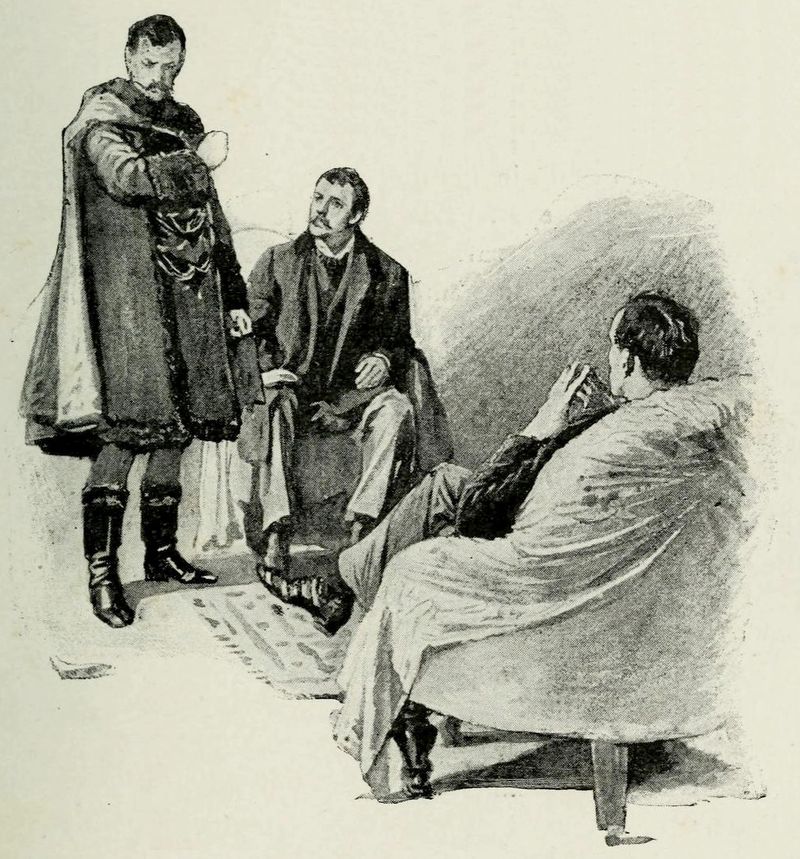
A Scandal in Bohemia is the story in which Irene Adler, ‘the woman’, makes her one and only appearance in Conan Doyle’s stories. It is a simple case of blackmail which is resolved without Holmes’s assistance, because Irene marries and decides not to pursue her victim. Holmes counts it as one of his very few failures, which suggests his definition of success is somewhat flexible, but there is no suggestion of any attraction between the two, more a mutual respect.800px-A_Scandal_in_Bohemia-04

The Red-Headed League is one of Holmes’s more ridiculous cases. A pawn broker is duped into leaving his store all day for several weeks to allow a tunnel to be dug from the premises to a nearby bank. The bank robbers could surely have found easier ways to do this than the invention of the League, which would have drawn a lot of attention to themselves, left clues all over the place, cost a lot of time and effort to establish, and could have fallen apart at any time.

A Case of Identity is one in which someone assumes a flimsy disguise, which Holmes sees through but fails to tell his client he has resolved the case. See ‘The Man with the Twisted Lip’

The Boscombe Valley Mystery. In this story Holmes bizarrely allows a murderer to go free, and a guilty man to spend months in prison, simply because the murderer is dying.

The Five Orange Pips sees Holmes allow his client to be brutally murdered and the murderers to escape the country, if not justice. Another great success!

The Man with the Twisted Lip. Someone assumes a flimsy disguise which Holmes sees through, again.

The Adventure of the Blue Carbuncle. In this story Holmes starts with the missing gem falling into his lap, and then working back to find out who stole it – an easier approach than the other way round I would have thought.

The Adventure of the Speckled Band. Conan Doyle thought this his finest Holmes story, but it is riddled with preposterous plot points.

The Adventure of the Engineer’s Thumb. A good headline, but a story in which Holmes detects absolutely nothing. Perhaps explains why this has not been an adaptor’s favourite.

The Adventure of the Noble Bachelor. A missing person story depending for its resolution of a previous relationship in America – the States is the setting for several of Holmes’s client’s backstories.

The Adventure of the Beryl Coronet. I think the real mystery – why a member of the royal family comes to pawn an incredibly valuable coronet for a fraction of its value – is ignored, instead focusing on whodunit in which footprints in the snow provide all the answers.

The Adventure of the Copper Beeches. A governess is recruited at highly inflated wages to impersonate a kidnapped heiress. Another case where the villains employ ridiculously complex means to pursue their villainy, when many other simpler options are available.

To Victorians, Holmes’s deductions and flashes of brilliance must have been dazzling, and to this day there are readers who hold Holmes in the highest possible regard. He is not the character most often portrayed on film for nothing. In recent years ‘Elementary’ and ‘Sherlock’ have given new life and new depths to the character. For me Holmes probably works best in this short story format where the weaknesses in his deductive method and approach aren’t too visible.

19th Century literature, Book review, Conan Doyle, Detective, Detective fiction, Holmes, Holmes and Watson, Sherlock

The Adventures of Sherlock Holmes, by Arthur Conan Doyle 1892

Gallery
Book review, Detective fiction

Rivers of London – Ben Aaronovitch

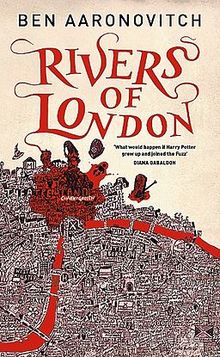
I had high hopes of ‘Rivers of London’. It was recommended to me by a couple of people whose judgment I trust. It was, broadly speaking, a fairly enjoyable read. But to be honest I was disappointed. it didn’t deliver on its initial promise. The plot was confusing, the central concept – the Magic Police – was derivative, and the subplot meandered (see what I did there?) to an anti-climax.rivers_of_london

The novel features a young officer in the Met Police; who has an encounter with a ghost at a crime scene. He takes this unexpected event pretty much in his stride. It quickly leads him into the branch of the Met that deals with magic and the supernatural, and eventually to him becoming an apprentice wizard. There are two plots, one in which a demon possesses people and turns them into murderers, and one frankly rather minor sub-plot involving a dispute between the warring gods of the River Thames – hence the book’s title.

The pace is brisk, and the narrator is engagingly naïve, frank, and amorous towards his female police partner. Aaronovitch has done a lot of work here – the portrait of life as a city copper is convincingly done. The sense of place is strong – the area around Covent Garden in particular is meticulously recreated. Continue reading

Standard
100 Best Novels Guardian list, Book review, Classics, Conan Doyle, Detective fiction, Holmes, Holmes and Watson, http://schemas.google.com/blogger/2008/kind#post, Sherlock

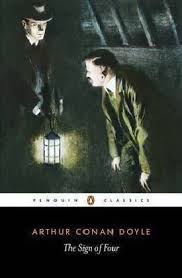
The Sign of the Four – Conan Doyle – 1890

Or, if you prefer, ‘The Sign of Four’, which is I think the better known version of this novel’s title. There is quite a significant difference between the former – meaning a sign which collectively represents four people – and the latter, which means simply 4. But as the sign itself plays no real part in the plot, other than contributing to the overall effect of mystery, the point is moot. (Just as a further irrelevant aside, in later short stories Watson refers to the case as The Sign of Four).

A quick plot summary might be a good place to start. This is an early Holmes story, where many of the familiar tropes of the sequence are just being established. Here we see the first incarnation of Holmes’ famous, if nonsensical, epithet “when you have eliminated the impossible, whatever remains, however improbable, must be the truth”. (140) We see Holmes, bored, and taking cocaine – a 7% solution – which he also offers to Watson. The method whereby Holmes is able to make fantastically accurate deductions about people from minor aspects of their appearance and behaviour is used at the opening of the novel, serving little purpose other than entertainment to relieve the boredom, and is disregarded once the crime is under investigation. And of course there are the Baker Street irregulars, the blundering police, and the mastery of disguise. All the elements are here, early on in his career.

The crime itself is, as usual with Holmes and Watson, obscure, yet easily solved. Indian treasure, pillaged from Agra during the First War of Independence, is hidden in a house in the London suburbs. One of the gang cheated out of his share of the prize returns to steal it, and in the course of the burglary someone is murdered. The villains hide on a boat on the Thames, but are chased down and captured. During the chase the treasure is thrown overboard and lost. In a lightly done parallel plot Watson falls in love with, woos, and becomes engaged to be married to the client who brings them the mystery – Watson is quite a fast worker!

Holmes’s powers are not taxed greatly. The murderer leaves footprints at the scene, and a trail of tar from the scene to their hideaway. The murderer’s accomplice has previously been seen shadowing the victim’s father, and leaves marks of his wooden leg outside the window. There is little attempt at concealment or deception. Holmes is slightly delayed in capturing the villains by their cunning ruse of hiding their boat in a boatshed, which it takes a particular genius to discover. It’s all done and dusted in less than a hundred pages, with plenty of time for some light drug taking and observational parlour tricks.

How does one explain the enduring appeal of the Holmes stories? Victorian England couldn’t get enough of the curmudgeonly consulting detective, forcing Conan Doyle to bring him back after the Reichenbach Falls attempt to kill him off. It can’t be the thinly constructed plots. While Holmes and Watson (and Mrs Hudson) may have survived as characters, the novels and stories themselves are little read, and usually discarded in any adaptation. Holmes represents the victory of rationalism and reason against the forces of nature and the threatening world outside our borders. It is hardly surprising that the villains in Holmes’ adventures are invariably foreigners, threatening our great British institutions. Tonga, the Andaman islander with the feet of a child, is described in purely animalistic terms. When first spotted on the boat, he is “a dark mass which looked like a Newfoundland dog”. (178) Closer up he seems to Watson to be a “savage, distorted creature. He was wrapped in some sort of a dark ulster or blanket, which left only his face exposed, but that face was enough to give a man a sleepless night. Never have I seen features so deeply marked with all bestiality and cruelty. His small eyes glowed and burned with a sombre light, and his thick lips were writhed back from his teeth, which grinned and chattered at us with half-animal fury” (178) Only half-animal Watson? Holmes can defeat any puzzle, any challenge, with the application of logic and knowledge. The world can be tamed. The fact that this is all smoke and mirrors, and that the final resolution usually depends on a pistol or noose rather than a logic puzzle, is passed over quickly.

If you have read any of my previous attempts at close textual analysis you might want to try the game yourself. Here are two passages from ‘The Sign of the Four’ which jumped out at me. The first describes Mary Morstan, Holmes’s client and Watson’s love interest, seen from Watson’s perspective:

“She was seated by the open window, dressed in some sort of white diaphanous material, with a little touch of scarlet at the neck and waist. The soft light of a shaded lamp fell upon her as she leaned back in the basket chair, played over her sweet, grave face, and tinting with a dull metallic sparkle the rich coils of her luxuriant hair. One white arm and hand drooped over the side of the chair, and her whole pose and figure spoke of an absorbing melancholy. At the sound of my footfall she sprang to her feet, however, and a bright flush of surprise and of pleasure coloured her pale cheeks.”

The colours are interesting – virginal white, diaphanous like a wedding dress perhaps, but with some touches of scarlet at the neck and waist, suggesting something more carnal? None of these details are accidental, from the observation that she is sitting in a basketchair, (baskets usually being used for possessions) to the fact that her “white arm” is drooping over the side of the chair. Why the whiteness of her arm needs to be emphasised here, given we have already established her ethnicity and dress, is worth asking, and what is suggested by the fact her arm droops rather than rests?

In the second scene I have picked out, Holmes and Watson are watching the boat yard, and while they do so they spot some workmen coming from work: Holmes says:

’See how the folk swarm over yonder in the gas-light’
‘They are coming from work in the yard’
‘Dirty looking rascals, but I suppose everyone has some little immortal spark concealed about him. You would not think it, to look at them. There is no a priori about it. A strange enigma is man’” (177).

This reverie is interrupted by the signal that the suspects are leaving.

The verb choice “swarm” is telling here, even though describing working men in these terms was not unusual – they are alien, threatening. But Holmes comes close to doubting their humanity. What does this tell us about the portrayal of class in late Victorian literature?
Standard
20th century Literature, Book review, Detective fiction

Comment: Spade and Marlowe

There’s no denying the huge influence Hammett had on Philip Chandler’s work. Chandler acknowledges this in “The Art of Murder” when he wrote:

“Hammett gave murder back to the kind of people that commit it for reasons, not just to provide a corpse; and with the means at hand, not with had-wrought duelling pistols, curare and tropical fish. He took murder out of the Venetian vase and dropped it in the alley.”
Even in a paean to another writer’s style, Chandler can’t avoid using his own, unique turn of phrase.
Marlowe is a subtle evolution of Spade, rather than a straight tribute act. He contains many of his characteristics, but there are some important differences. For a start, Marlowe is smarter. He is usually (but not always) one step ahead of the bad guys. There is a scene in Falcon where Spade is held at gunpoint by Joel Cairo, who wants to search his office. (The Levantine). Spade disarms him, they talk and come to an arrangement, then as he leaves Cairo asks for his gun back. Spade obliges, and is promptly help up again, and searched. My reaction reading that scene was that Marlowe would never have fallen for that – he would have taken the bullets out of the gun. Having said that, Marlowe is not infallible – he has a particular soft spot for the good old Mickey Finn. After having been tricked by Cairo, Spade enjoys the pleasures of a traditional drugged drink scene, a favourite plot device of Chandler’s (Marlowe seems to drink a lot of drugged drinks, and seems to have a blind spot for them – the reader is screaming “no, don’t drink it you fool, it will be drugged”, but he sips away anyway, then gradually his vision fades, his speech blurs, and he falls to the ground…..). The scene in the Maltese Falcon, where Spade is drugged by the Fat Man, could easily be the archetype for that recurring nightmare.

Another difference between Spade and Marlowe is that Marlowe is significantly more pious. He is a man of high principle. Marlowe will sleep with the women he encounters in his adventures, but he won’t allow them to use their sexuality to influence him – in “The Big Sleep” for example he throws the dangerous but highly attractive Carmen Sternwood out of his apartment when she climbs uninvited into his bed. Spade has fewer scruples – he sleeps with Brigid even though he knows she is using him.

Spade is also a bully, hurting his secretary when Brigid runs away, which is in no way her fault. “I won’t be able to wear an evening gown for two weeks, you big brute.” (477) Marlowe would never bruise a woman’s shoulders, certainly not his secretary, which of course he could never afford.

Another strong echo of Chandler is the scene where Spade confronts the young man, who we later find is working for the Fat Man:
“The boy spoke two words, the first a short guttural verb, the second “you”.
“People lose teeth talking like that.” Spade’s voice was still amiable, though his face had become wooden.” (457)

In the Big Sleep there is a scene where Marlowe captures Carol Lundgren and is given the same two-word response, repeatedly, and reacts with the same dry wit.

The one thing Chandler does above all others which elevates Marlowe is giving him a voice – by using a first person, interior monologue narration, we are given an insight into Marlowe’s thoughts and feelings in a way we only peep into those of Spade’s. It is this above all else that allows us to empathise with Marlowe, to walk in his steps, even if he hides some key facts and conclusions from the reader, to keep us guessing. With Spade we only see and hear what the omniscient narrator allows us to see. This leads to explanatory scenes, where the characters’ dialogue is primarily there to help the reader “catch-up”. Marlowe is the more rounded creation, and Chandler’s narratives are the more complex and interesting, but the debt he and many other detective fiction authors owe to Hammett is unambiguous and significant.

Standard
20th century Literature, Book review, Detective fiction

Supplementary: The Maltese Falcon (2) – A Different Approach

In this alternative review of TMF I wanted to consider some parts of the text in more detail, rather than the broad sweep of the admittedly complex story line.
Sam Spade, the central character and archetype of the hard-boiled American detective, is emotionally stunted. He shows no grief whatsoever at the death of his partner, Miles Archer, and avoids telling Archer’s wife, who he has been having an affair with, about his murder. Hammett shows this in the constant references to Spade’s lack of reaction and his woodenness. His only reaction is to tell his secretary to “Have the Spade & Archer taken off the door, and Samuel Spade put on” (398)
Hammett is really good at noticing the small, subtle movements we all make which convey emotion or intention but which are easily missed. Here for example Spade’s client, Brigid Shaugnessey, picks up his hat:
“She came back and stood in front of him holding the hat, not offering it to him, but holding it for him to take if he wished”. (My emphasis)
The difference in the two ways of holding a hat here is slight, but in a novel where every word counts Hammett conveys a lot about Brigid and her relationship to Spade – she is a consummate performer, and knows offering him the hat would convey “let’s go”, whereas “holding it for him to take if he wished” is a more passive gesture, conveying “let’s go?”, giving him control of the situation. Later, in the eponymous chapter, Brigid is described while Spade rolls yet another cigarette:
“She put a finger-tip to her mouth, staring across the room at nothing with widened eyes, and then, with narrower eyes, glanced quickly at Spade. He was engrossed in the making of his cigarette. ”Oh yes”, she began, “of course –“ She took the finger away from her mouth and smoothed her blue dress over her knees. She frowned at her knees.”

This is extraordinary writing. Hammett uses these small movements, even down to the width of her pupils, to tell us so much about what is going on. Brigid has widened her eyes as part of her seduction technique. She narrows them to glance at Spade, who is studiously ignoring her performance. The fingertip to the mouth is a classic sexual invitation, mimicking fellatio. When this doesn’t work she moves to smoothing her dress, drawing her attention down to her legs and groin. She is an expert temptress, using her sexuality to get what she wants. Later, after they share a supper of sausage, (little subtlety there!), “Spade’s arms went around her, holding her to him, muscles bulging his blue sleeve, a hand cradling her head, its fingers half lost among red hair, a hand moving groping fingers over her slim back. His eyes burned yellowy” (453). She has won – or has she? (Incidentally, I am not sure about the word “yellowy”).

There is a fascinating snippet of dialogue between Spade and Brigid immediately after this scene, the morning after they sleep together. He has crept out to search her apartment, demonstrating that although she may have seduced him, he is still in control. When he comes back to his apartment she is alarmed, or claims to be, and has “her right hand out of sight under a pillow”. (454). “I’m sorry angel, I thought you’d sleep through it. Did you have that gun under your pillow all night?

“No, you know I didn’t” (455)
He knows she didn’t have the gun under her pillow, because her pillow didn’t stay in place all night, suggesting that their sex was reasonably active. Pretty racy stuff for 1920’s American literature?

I’m going to write separately about the parallels between The Maltese Falcon and the writing of Raymond Chandler, but for now, while Hammett can’t hold a candle to Chandler when it comes to crafting a phrase, few can, I should acknowledge that there are still some treasures here. For example he describes Brigid’s eyes as “cobalt-blue prayers”, which I thought was extraordinary. There is also the description of the Fat Man, which was one of the best descriptions of obesity I can remember reading:

The fat man was flabbily fat with bulbous pink cheeks and lips and chins and neck, with a great soft egg of a belly that was all his torso, and pendant cones for arms and legs. As he advanced to meet Spade, all his bulbs rose and shook and fell separately with each step, in the manner of clustered soap bubbles not yet released from the pipe through which they had been blown. ” Clustered soap bubbles – isn’t that fantastic?


Standard
20th century Literature, Book review, Detective fiction

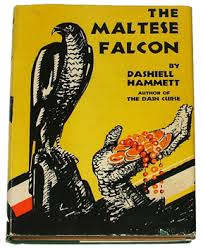
The Maltese Falcon, Dashiel Hammett, 1929

Read in Picador edition as part of “The Four Great Novels”

Dashiel Hammett’s “The Maltese Falcon” (1929) is a devastating critique of the American Dream. Often seen as a straightforward detective novel, a closer contextual reading reveals a damning indictment of American capitalism and society.

At the heart of the novel is the quest for the Maltese Falcon, an elusive golden statute encrusted with highly precious stones. The falcon is never seen, never found, always slipping through the hands of the pursuers and melting away, like the proverbial pot of gold at the end of the rainbow. There is little evidence it actually exists, but the treasure hunters seek it obsessively, and great financial and physical cost to themselves. What is this if not the perfect metaphor for the American Dream, the promise of wealth and happiness that so many Americans pursed (and pursue) but can never quite attain? When the gang think they have at one point found the statue, it turns out to be a fake, lead instead of gold. Hammett is surely saying that the American Dream, like the falcon, is a myth and a fake.

The falcon is also the loot of imperialism, made from gems and gold stolen by the Crusaders: “For years they had preyed on the Saracens, had taken nobody knows what spoils of gems, precious metals silks, ivories – the cream of the cream of the East. Hammett identifies the Crusades as not a matter of religion, but plunder: “We all know that the Holy Wars to them, as to the Templars, were largely a matter of loot”. (483)

In Hammett’s prohibition-era America, society is unjust and intolerant. The police in Hammett’s novel are incompetent and corrupt, agents of a corrupt and unjust society. At one point Spade tells Iva, Archer’s widow, in relation to talking to the police “Maybe it’d be best to say “no” right across the board”. This was Hammett’s response (in effect) when question by the McCarthy investigation into communism in the arts in America in the 1950’s (to be precise, he pleaded his 5th Amendment rights to all questions”) a stance which eventually landed him in jail. The novel ends with Spade turning his lover into the police, and turning his back on love, another rejection of the romantic illusion of middle class life.
 

Or is this all nonsense? Does knowing that Hammett was a communist, was black-listed, and jailed for his politics make such a reading of “The Maltese Falcon” sustainable? I have to admit I had never thought of it as a critique of the American Dream until I read a short biography of him. Until then I thought of it as a straightforward albeit genre-defining detective novel. Is contextual analysis, in which the author’s life is mined for lenses through which the novel can be read, a sensible approach to reading? I confess until now, I thought not, but the idea that the falcon is a metaphor for the American Dream is a pretty powerful one.
Standard
21st century literature, Book review, Crime, Detective fiction

Supplementary: The Black-eyed Blonde – Benjamin Black (2)

A lot of the reviews of this novel praised the plotting, one going so far as to say it was better than Chandler’s. My impression on a first read was that the plot of the Black-eyed Blonde was fairly linear and straightforward, and Marlowe is something of a passive observer of the narrative rather than someone who shapes it. All, in fact, very un-Chandleresque. But it is worse. I had a spare half hour on the tube yesterday, and with nothing else to read I looked again at the first chapter of this novel. What I was looking for is whether Black’s attempts at Chandler’s imagery were successful or not. Broadly they are. Inevitably there are some misses, but an above average number of hits. I won’t quote any here because out of content they can look weak, but that’s not what I wanted to write about anyway.

The plot of the Black Eyed Blonde is simple enough. Marlowe is asked by the title character to find a missing person, Nico Peterson. After a few fruitless lines of enquiry, Marlowe asks the police if they know where Peterson is, and the information is quickly returned – he died in a hit and run accident a few weeks earlier. When Marlowe tells his client this her response is (end of chapter 4) “I know”. Marlowe is so shocked by this he actually has to ask her to repeat herself, which is in itself completely un-Marlowe like.

So why did she ask Marlowe to investigate Peterson’s disappearance when she knew that he had died in a hit and run accident. The answer she offers is that she saw Peterson alive a few weeks later, and therefore believed the accident was a fake, or a case of mistaken identity. But this doesn’t explain why she withheld this information from Marlowe when she first commissioned the case. What possible reason could she have had for not just omitting this vital information, but actively misleading him? When asked in chapter one when she first realised he was missing she tells Marlowe “I telephoned him a number of times and got no answer, Then I called at his house. The milk hadn’t been cancelled and the newspapers had been piling up on his porch”. Why would she do that if she knew he had been “killed” in a hit and run. Even if this was after the subsequent sighting, why not tell Marlowe this. I suppose you could argue she was testing Marlowe’s powers as an investigator, but someone’s death in an unsolved hit and run would be a matter of public record. The fact that Peterson’s neighbour has not heard of his “death” is unconvincing as well – in reality news like that would be in the local paper and spread quickly.

The simple reason why she misleads Marlowe is so that the author can have this plot twist. And that’s not good enough – you can’t simply have characters behave illogically just to have dramatic chapter endings. In the same way the mexican thugs would not have kidnapped, tortured and killed Peterson’s sister, but left Marlowe alive to identify them. We much later learn that Clare Cavendish, the eponymous blonde, is unwittingly helping drug smugglers who want to track Peterson down, he having stolen some of their drugs. All the more reason why they would want Marlowe to have all the available information, not waste time finding out things they already know.

This is just not good enough. Chandler’s plotting was always complex and yes, sometimes a bit besides the point. He did weld together short stories, and knowing that you can sometimes see the join. (I defy anyone not knowing that to spot, for example, that the Big Sleep is two separate narratives shunted together). But his characters never behaved irrationally like this just to engineer a plot twist, or a “dah, dah, da!!” moment.

Standard
21st century literature, Benjamin Black, Book review, Crime, Detective fiction, John Banville, The Black-eyed Blonde

The Black-eyed Blonde by John Banville/Benjamin Black

This should so have been a great find. A new Philip Marlowe novel written by John Banville, writing as Benjamin Black. Raymond Chandler is one of my favourite novelist (looking back, I see I put him at number 5 in my top ten, which is there or thereabouts), and John Banville is a Booker prize winner. The Sea, which I reviewed back in June 2012, is an ultimately flawed novel but which showed a lot of craft in its writing. O it took me a few seconds to decide to buy this. The combination should have worked – Chandler is not that hard a writer to imitate, he has so many recurring motifs, it almost writes itself. There’s the sultry blonde who turns up unannounced at Marlowe’s office, and offers him a job without telling him the whole truth; the slug on the back of the head that takes Marlowe out at a key moment, the stumbled upon body, the drugged drink, and so on. The language is tougher to copy – highly distinctive, of course, but elusive, as Banville finds here.
There were, however, looking back, some warning signals. For a start there was the strange “John Banville, writing as Benjamin Black”. I can understand the use of a pseudonym, the creation of a different writing persona to make it clear to the readers that they can expect a different experience – but “writing as” is really having your cake and eating it, saying “but it’s really me, Booker prize winning stylist here after all”. Then there was the ambiguity about the relationship with Chandler’s estate – is this an authorised use of his intellectual property or not? There is nothing on the cover to indication this, although it seems obvious it must be. On investigation, it appears this is an authorised use of Chandler’s copyright, but by a company which has bought this off Chandler’s estate, rather than something approved by surviving family members. So done for commercial gain alone. Then there is the title – The Black Eyed Blonde. There’s some ambiguity there – are her irises black, or, in the more traditional use of the term, has she bruised eyes? It is in fact the former, although do people really have black irises? In a short note at the end of this novel Banville explains that this title was in Chandler’s notes as a potential title for a future novel – but he didn’t use it for a reason I suspect. However fanciful Chandler’s imagery or imagination, there was a truth at the heart of it that is lost here.


So is this a parody, a tribute, an imitation? Was Banville taking a break from “proper” writing and having a bit of commercially rewarding fun – slumming it – writing something in the style of Chandler?  I have a horrible suspicion that this was not done with the appropriate respect for Chandler/Marlowe, but was simply an attempt to screw some more money out of the estate. This cynicism might be harsh, but the real test is whether the novel works or not. Is it a success as an effective imitation of Marlowe? Can you forget, even for a moment, that you are reading a 21st century recasting of the genre? I’m afraid not. For a start, the novel lacks the pace of true Marlowe. He was a genuinely good detective – the detective here really does very little investigative work beyond asking police contacts for help, and interviewing, ineffectively, some obvious suspects. Loose ends are not followed up, whereas the real Marlowe would have tracked them down in a night. So for example a dead body is found to fake someone’s death – who was the body, was his death a convenient coincidence, or a murder? This question is never asked, whereas true Marlowe would have cared about this casual brutality. Banville’s Marlowe wastes huge amounts of time waiting for the case to break of its own accord, rather than tracking down leads. True Marlowe is also a man of deeply held convictions, and while this version does protect his client’s confidentiality, he speaks far too freely about the case to people he has no reason to trust. This Marlowe is frankly a bit slow – it takes him an age to realise his drink has been drugged, long after the reader has worked it out. Chandler’s novels are complex and sometimes confusing – this was straightforward and simple. There are other false notes struck – why does the black-eyed blonde not tell Marlowe that the man she sends him to find, Nico Peterson, was believed to have died in a hit and run incident several weeks earlier. Her reluctance to tell him this aspect of her story serves no purpose whatsoever. Later when Marlowe and Peterson’s sister are held up by two sinister Mexican thugs, they knock him unconscious, then kidnap, torture and kill her. Why would they leave Marlowe alive if they are such vicious killers?


I wonder – in 75 years will people be writing Harry Potter novels where a grownup Harry goes back to Hogwarts to investigate mysterious goings on?  Would that be as wrong as this feels? While I appreciate that there are plenty of examples where great authors works are completed and their worlds reimagined in a different context – Young James Bond for example, the completion of the Hitchhikers sextet, and the Sherlock Holmes tributes – I can’t think of a single one that has been genuinely successful. You wouldn’t do this for any other art form, and I am not convinced it is respectful to the original authors. Chandler didn’t write enough Marlowe novels – he couldn’t have done – but he left us with enough to make novels like this pointless, and a bit tawdry.
Standard
20th century Literature, American literature, Crime, Detective, Detective fiction, Raymond Chandler, The Big Sleep

The Big Sleep by Raymond Chandler, 1939

Chandler is one of my favourite writers – top 5 at least, and pretty much everything he published is consistently readable. As such I don’t really have a favourite novel of his but if forced to choose it would probably be “The Big Sleep”. This is Chandler at his sublime best. Philip Marlowe, his iconic hard boiled detective, a loner, is the quintessential private eye, the model on which so many detectives down the ages have been based upon. We see the action through his detached, sardonic perspective, although even then many things we are left to work out for ourselves.

The principal attraction of these novels – “The Lady in the Lake”, “Farewell my Lovely”, “The Long Goodbye”, “The Little Sister” – all classics – is not the plotting, tight though this is, but the prose – Chandler had an ability to craft a phrase like few others. Take this opening from “The Big Sleep” for example, probably one of the best ever written:

“It was about eleven o’clock in the morning, mid October, with the sun not shining and a look of hard wet rain in the clearness of the foothills. I was wearing my powder-blue suit, with dark blue shirt, tie and display handkerchief, black brogues, black wool socks with dark little clocks on them. I was neat, clean, shaved and sober, and I didn’t care who knew it. I was everything the well-dressed private detective ought to be. I was calling on four million dollars.”
Doesn’t that make you want to stop and go and read the book itself? Go on, I won’t be offended. The dark little clocks are a great touch.

The plot is extremely complex, not that it matters. Marlowe is employed by the ailing General Sternwood to investigate a small blackmail problem. In doing so Marlowe gets involved with pornographic book lending (which in today’s world is almost cute), gambling, boot-legging, gangsters, and several murders. The story flies along at such pace that you don’t actually spot the join – the book was originally two shorter stories, welded together to make the novel. This is done with such craftsmanship that you don’t notice unless you are looking for it – and even then it doesn’t matter a jot. (End of chapter 19 if you are interested – everything is tied up neatly at that point with only the missing persons investigation, which Marlowe isn’t really supposed to be conducting, outstanding).

If you haven’t read Chandler before you are in for a treat. This is as good a place to start as any – it’s his first Marlowe novel. In Philip Marlowe we have one of the great literary characters – as well realised and fully rounded as any I can think of. Some Christians exhort people to ask “What would Jesus would do?”. With all possible respect to these individuals, I often wonder whether “What would Marlowe do?” would offer better advice. That won’t mean too much if you haven’t read the books, so you know what to do now, don’t you?
Standard