Book review

Bleak House, by Charles Dickens,1852-53

I am not sure which was more daunting – reading the near 1000 pages of Bleak House, or trying to summarise the experience in a few paragraphs for this post. Where to begin? This could be the complete English novel. Pride and Prejudice is a more perfect romance, Wuthering Heights a more dramatic melodrama, The Big Sleep a better detective story, and The Ragged Trousered Philanthropist a more devastating social critique. But Bleak House is all of the above and so much more. It’s a dazzling display of literary technique, without ever being showy; it is a masterful exhibition of characterisation (of which more later) and the use of themes and motifs is extraordinary. So I ask again, where to begin?

Perhaps a brief plot summary, although to do justice to the byzantine complexity of this novel is quite a challenge in itself. As you may know, Bleak House revolves around the long-running Chancery suit of Jarndyce vs Jarndyce, a dispute about a series of wills and the associated inheritances. Trapped in this case are two wards of court, who go to live with their uncle, John Jarndyce, in the novel’s title location, Bleak House. Also involved in the litigation is Sir Leicester Dedlock and his wife Lady Dedlock. There is clearly an element of mystery about Lady Dedlock’s background – as early as the second chapter it is established that she has secrets. While consulting with the family solicitor, Mr Tulkinghorn, she recognises the handwriting on one of his documents.

“My Lady, changing her position, sees the paper on the table – looks at them nearer – looks at them nearer still – asks impulsively “Who copied that?”

Mr Tulkinghorn notices this reaction, and quickly finds out that the copywriter, “Nemo”, has recently died. The only person who can identify him is the crossing sweeper Jo, who lives in Tom-All-Alone’s, a slum in the poorest part of the City (Tom-All-Alone’s was very nearly the novel’s title).

The novel’s second narrator, Esther Summerson now takes over the tale. This alternating narrative structure, with one a named character, the other unnamed and omniscient, is unusual if not unique. It works well in varying the narrative voice. Esther is naive and reluctant to show her feelings about some close to home topics such as her feelings for Mr Woodcourt, whereas the omniscient narrator is more revealing. Esther starts her narrative by telling the reader about her childhood. She was raised by a Miss Barbary, who denied her affection and told her:

Your mother, Esther, is your disgrace, and you were hers“.

She is obviously illegitimate, but beyond that knows little about her parents or family. After Miss Barbary dies, Esther becomes the ward of Mr Jarndyce, one of the litigants in the long-running case. She eventually moves in with him along with two other wards in the Jarndyce case, Richard Carstone and Ada Clare.

These parallel storylines – the Jarndyce wards and the Dedlock mystery – intertwine. The mystery of Esther’s parentage is slowly revealed. Along the way Dickens takes any number of diversions, introducing a multitude of characters and sub-plots, all of whom contribute to the development of the novel.

In earlier Dickens novels the villains are often somewhat one dimensional with little to say for them in mitigation. Great characters, but not very nuanced. Bleak House doesn’t really have anyone in this role – in fact it is the law itself which is the real villain of the piece. Many of the other characters while without question fallible have a complexity that allows us to like them even when we disagree with their actions. Lord Dedlock is originally established as the stuffy aristocrat permanently at war with his neighbours and over-bearing to family and servants, but he becomes an almost endearing character by the end of the novel, loving and faithful to the memory of his wife. Tulkinghorn may initially be cast as the scheming lawyer out to fleece his clients of everything he can get his hands on, but as the picture emerges he does seem to be genuinely trying to protect the best interests of his clients, and he doesn’t deserve the fate that befalls him. The aloof Lady Dedlock finds redemption in sacrifice. Inspector Bucket, cruel towards Jo and sinister when he appears as if a ghost in his early scenes, ends up heroically trying to rescue Lady Dedlock and being thoughtful and considerate towards Esther.

Keeping track of the cast of eccentrics in the novel is part of the challenge. I counted over 60 named characters, and there’s no doubt that it is easy to forget who is who unless you are reading the novel with particular care.  Inevitably some of the minor characters are a little one-dimensional, but Dickens creates a vivid cast of grotesques, such as the appalling Mr Skimpole, eternally sponging off his friends while maintaining a pretence of his own childishness. Speaking of himself he confesses to

two of the oldest infirmities in the world: one was, that he had no idea of time; the other, that he had no idea of money. In consequence of which he never kept an appointment, never could transact any business, and never knew the value of anything! . . . He was very fond of reading the papers, very fond of making fancy sketches with a pencil, very fond of nature, very fond of art. All he asked of society, was to let him live. That wasn’t much. His wants were few. Give him the papers, conversation, music, mutton, coffee, landscape, fruit in the season, a few sheets of Bristol-board, and a little claret, and he asked no more. He was a mere child in the world, but he didn’t cry for the moon

There is a complexity to Dickens’s writing that is easy to overlook. His ear for the way people speak is acute. To give just one example, the lawyer’s formal phrase “I beg your Lordship’s pardon” is rendered “begludship’s pardon” (chapter 1) which as well as capturing the clipped tones of the courtroom also speaks to the incomprehensibility of the proceedings. Later a relative of Lord Dedlock speaks in a similar almost incomprehensible manner:

‘The debilitated cousin holds that it’s sort of thing that’s sure tapn slongs votes—giv’n—Mob.”

(“It is the sort of thing that is sure to happen so long as votes are given to the mob” – in other words a casual condemnation of increasing the popular franchise.)

Modern readers will find the relationship between Esther and her guardian, John Jarndyce, inappropriate if not abusive. It creeped me out every time she refers to him as her loving Guardian after they were engaged. My concern is not so much the substantial age gap but the power imbalance – she is his ward, legally his responsibility and therefore completely off limits. Dickens thankfully swerves at the last minute and allows Esther a more traditional marriage to the eminently suitable Allan Woodcourt.

I know the novel’s famous opening has been analysed to death but I did want to acknowledge Dickens’s audacity as a novelist to open with the one-word sentence – “London” – throwing out all the rules we have ever been taught about sentence structure, and then following it with a series of incomplete sentences:

Michaelmas Term lately over, and the Lord Chancellor sitting in Lincoln’s Inn Hall. Implacable November weather. As much mud in the streets as if the waters had but newly retired from the face of the earth, and it would not be wonderful to meet a Megalosaurus, forty feet long or so, waddling like an elephantine lizard up Holborn Hill.

It’s not until the fourth paragraph that a traditionally complete sentence appears, (“The raw afternoon is rawest, and the dense fog is densest, and the muddy streets are muddiest near that leaden-headed old obstruction, appropriate ornament for the threshold of a leaden-headed old corporation, Temple Bar” This sentence stands out and draws the reader’s attention precisely because it is complete). If one wanted, a whole essay could be constructed around Dickens’ use of this motif of mud, dirt and dust in the novel. Often the words are used euphemistically – for example where the author writes of the “stagnant channel of mud which is the main street of Tom-all-Alone’s,” That’s not mud really is it? The critic and academic John Sutherland has fun with “the laundered quality of Victorian literary language” in his article in the London Review of Books,

“Assuming, for instance, that the dust heaps in Our Mutual Friend are what Humphry House claimed, urban mountains of shit, is Dickens’s ‘dust’, the modesty of the novel, or the modesty of a man of Dickens’s class and time? One knows that Jo, in Bleak House, is a crossing-sweeper: but why are we never told what it is he is employed to sweep out of the way? (Horse dust, presumably.)

Dust also brings to mind ashes, (one of Miss Flite’s birds is named Ashes) and the inevitable association with fire and death.

Another example of Dickens’s ability to imbue minor incidents or characters with significance to the whole novel is the involvement of the brick-builders. These are impoverished labourers and their families, who we first meet when Esther is dragged off to dispense charity to them by Mrs Pardiggle. While they are there one of the babies, malnourished and sick, dies abruptly. Esther deals with the situation as best she can, and wraps the baby in one of her handkerchiefs. In a nod to Othello this handkerchief is later recognised by Lady Dedlock and is an important clue in her realisation that her long-lost daughter is really alive. The baby’s death is not just a plot-device – the handkerchief could have been left behind for any number of reasons – but also a reminder of the proximity of sudden death for the labouring classes in nineteenth century England. Later the brick-builders appear in London at Tom’s-All-Alone, and then at the novel’s climax in the chase to find Lady Dedlock. As well as playing an important role in the novel’s plot, the brick-builders represent the people who are transforming the country through their labour but sharing no part in the benefits of industrialisation. The working classes are in no way romantised though – the men are alcoholics and beat their wives, who stoically bear it all and join the men in drinking.

I’ve only really scratched the surface in looking at some of Dickens’ techniques in constructing Bleak House. It is a novel that can be read and reread time and again, and analysed from many different perspectives. Apart from its length it is not a difficult read. Sharing the monthly instalments when it was first published in the 1850’s must have been an amazing collective experience, very different from the ‘all in one go’ way of reading the novel one uses today. This was my one-a-year reread of Dickens, and although there is admittedly a sense of having ticked off another reading target for 2021 I am really glad I chose to revisit this epic of Victorian literature.
Standard
Book review, Mayor of Casterbridge, rural traditions, Thomas Hardy

The Mayor of Casterbridge, by Thomas Hardy, 1886

download (4)

Authors of classic works of literature tend to gain a reputation in popular culture – Lawrence is raunchy, Dickens is long-winded and a bit preposterous, Joyce impenetrable, Pinter full of pauses, and Shakespeare “difficult”. Sometimes these reputations are justified; more often they are cliches that are dispelled as soon as one reads the author concerned. But they are astonishingly pervasive, and sometimes damagingly so. Tell a student that Shakespeare is difficult often enough and sooner or later they will believe it. I am sometimes guilty in falling for these stereotypes and I did with Hardy. Based on the evidence of a reading of the undeniably bleak ‘Jude the Obscure‘ (which I can’t believe I reviewed six years ago!) I accepted the idea that Hardy is depressing, slow, and that his characters invariably come to an unfortunate end.

‘The Mayor of Casterbridge‘ confounded many of those expectations. It is fast paced and packed with incident. But literary clichés don’t come from nowhere and most have some truth in their origins. True to his instincts Hardy ensures that this novel’s protagonist and his family are never able to escape completely the consequences of the fatal decision taken in the opening chapter. That decision, as you may know, is made by the eponymous Thomas Henchard, then a lowly agricultural labourer. In a fit of drunken anger Henchard decides to sell his wife and child. Wife sales were by this time a well-established form of divorce, in particular in rural communities. It was widely believed that they legalised the process of separation. The ‘purchaser’ was usually the man that the wife had left her husband for. The sales were conducted publicly on market days. In other words they were akin to a piece of theatre, in which the old relationship was formally dissolved, and the new recognised and legitimised. The Wikipedia entry on wife sales is highly recommended by the way. All the textual indications are that the wife sale in ‘Casterbridge’ is not like this at all, but a spontaneous decision, done in a drunken fit of anger, regretted thereafter, and that the buyer is a stranger. In other words not an informal rural divorce at all, but a vicious form of spousal abuse in which the wife and child were treated as the husband’s property to be bought and sold.

Continue reading
Standard
Anthony Trollope, Barsetshire, Book review, Classics, The Warden

The Warden, by Anthony Trollope, 1855

‘The Warden’ tells the story of a chapter in the life of Mr Septimus Harding, warden of Hiram’s Hospital and precentor of Barchester cathedral. (Readers requiring an wardenexplanation of the term ‘precentor’ may already be getting the impression that they are not the target audience for this novel). An introduction of this kind would normally refer to the “adventures of Mr Septimus..” etc but readers of Trollope will expect no such thing. Adventure, indeed incident, is devoid from this novel. Trollope almost seems to disdain the need for such things. Portraits, conversations, lectures – these are the principal building blocks of ‘The Warden’. Continue reading
Standard
19th Century literature, Book review, George Orwell, H G Wells, science fiction', The Time Machine

The Time Machine by H G Wells,1895

Continuing with my Wells-athon, all of which have been quite short novels, I now turn to the hugely influential ‘The Time Machine’.

Time travel was not a new concept, but Wells’s novel was one of the earliest on this theme, and established some concepts and principles that remain with us. having said that, I found the behaviour of Wells’ s protagonist in many ways puzzling. If you had invented a time machine, what would you do? Where would you go? Would you go back to the nativity, to the Globe in 1605, to assassinate Hitler? Or would you travel 800,000 years into the future, as Wells’ time traveller does, without packing a sandwich, let alone a camera or a weapon? I know that is a ridiculously literal response to a science fiction story, but good science fiction is above all plausible. If I could forward travel in time I would like to know how society reshapes itself in 100 years, what new technology is developed, whether extra-terrestrial life is encountered, so many other things – but 800,000 years?? Given that the existing span of human civilization can be measured in single-figure thousands of years, it seems wildly optimistic to imagine that humans will still be around this far into the future.

I appreciate I am still being too literal – time travel is simply a device to allow Wells to speculate on how human society will evolve, and we need not get too absorbed with the precise date – this is simply the vaguely distant future. In this future humans have evolved into two distinct races, the Eloi and the Morlocks. The Morlocks live underground, and predate upon the simple-minded Eloi. Society is decaying terminally. Into this world the time traveller is pitched, loses his machine, and is forced to confront his slowly dawning realisation that this is no Utopia he had hoped man would have built for himself.

Wells’s conception of time travel is quaint. It doesn’t involve Government-led endeavours and vast resources – an independent inventor working in his shed is able to master the feat after a few years of study. He sets off in an extraordinarily blase fashion, making no preparation whatsover – this is a quick jaunt into the future, not an expedition risking life and limb, back in time for a quick bath and dinner at eight. Victorians were of course great explorers, and often quite eccentric into the bargain, but Wells’ s time traveller takes this to the extreme.

One of the most distinctive features of Wells’ writing is his focus on the personal, the everyday, even when his themes are global or astronomical. As I mentioned in my review of ‘War of the Worlds’, the Martian conflict is constrained within the English Home Counties, and described from the limited perspective of two individual observers. The scenes from ‘The Invisible Man’ are all rooted in suburban and rural England. Kipps and Mr Polly follow the same pattern – his protagonists are everymen. It is no coincidence that the central characters in ‘The War of the Worlds’ and ‘The Time Machine’ are both unnamed. This allows them to act as representatives of their class and time.

However, politically, ‘The Time Machine’ is a difficult book. Wells is commonly considered as a socialist, but his portrait of a future in which the working class has become a cannibalistic underground monster, preying on the weak and enfeebled middle classes, is profoundly pessimistic. It not only expresses “Wells’s horror at the realities of 19th-century class relations, but also his fears about what utopian socialism and communism were offering in their place” (Matthew Taunton). It is hard to travel back from the dystopia of 800,000 to 1895 and find a way to avoid this co-evolution and class war.

It’s been interesting to revisit Wells, but I remain ambivalent about his status as a writer. Influential, without question. I think his social comedies have aged less well than his science fiction. But if I ever am at a loss to put into words my thoughts and feelings about a novel or a writer, there is always one reliable solution, and that is to turn to George Orwell. Try it – he almost always has something sensible and interesting to say about any author of his time or before. Reliably, he puts his finger on this sense of unease. In ‘Wells, Hitler and the World State’, published in Horizon in 1941, he wrote:

Thinking people who were born about the beginning of this century are in some sense Wells’s own creation… I doubt whether anyone who was writing books between 1900 and 1920, at any rate in the English language, influenced the young so much. The minds of all of us, and therefore the physical world, would be perceptibly different if Wells had never existed.”

But he goes on to say

the singleness of mind, the one-sided imagination that made him seem like an inspired prophet in the Edwardian age, make him a shallow, inadequate thinker now…. Back in the nineteen-hundreds it was a wonderful experience for a boy to discover H. G. Wells….But because he belonged to the nineteenth century and to a non-military nation and class, he could not grasp the tremendous strength of the old world… He was, and still is, quite incapable of understanding that nationalism, religious bigotry and feudal loyalty are far more powerful forces than what he himself would describe as sanity. “

Orwell anatomises with extraordinary precision why Wells’s utilitarian version of socialism had not come to pass, even though the scientific advances he anticipated had been realised and indeed exceeded:

Creatures out of the Dark Ages have come marching into the present, and if they are ghosts they are at any rate ghosts which need a strong magic to slay them…Wells is too sane to understand the modern world. The succession of lower-middle-class novels which are his greatest achievement stopped short at the other war and never really began again, and since 1920 he has squandered his talents in slaying paper dragons. But how much it is, after all, to have any talents to squander.”

Creatures out of the Dark Ages have come marching into the present“. Wow.


Standard
Book review, H G Wells, invasion literature, science fiction', War of the Worlds

War of the Worlds by H G Wells, 1897

Wotw

“No one would have believed in the last years of the nineteenth century that this world was being watched keenly and closely by intelligences greater than man’s and yet as mortal as his own; that as men busied themselves about their various concerns they were scrutinised and studied, perhaps almost as narrowly as a man with a microscope might scrutinise the transient creatures that swarm and multiply in a drop of water.”

I come from the generation that finds it physically impossible to read that opening paragraph without hearing Richard Burton’s magnificent voice, providing the narration for Jeff Wayne’s album.

I really enjoyed ‘War of the Worlds’. I can’t imagine you don’t know the basic premise, but just in case, here goes: aliens attack Woking, and thence Southern England. Not so much war of the worlds therefore as Martians vs the Home Counties. And of course ‘we’ win, in a way that had allowed Europeans to win so many earlier colonial wars.

Continue reading
Standard
19th Century literature, Book review, H G Wells, science fiction'

The Invisible Man, by H G Wells, 1897

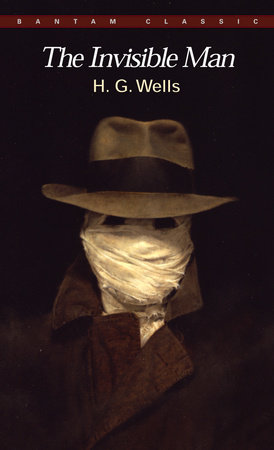
The power to transform the human body using advances in scientific understanding. 9780553213539This was the theme that captured the imagination of many nineteenth century writers, including, among others, Mary Shelley in ‘Frankenstein‘, Robert Louis Stevenson in ‘Dr Jekyll and Mr Hyde‘, and H.G. Wells in ‘The Invisible Man‘. In this late Victorian novella, Wells explores the idea of what would happen if someone, somehow, managed to make themselves invisible. Continue reading
Standard

Conan Doyle’s ‘The Adventures of Sherlock Holmes’ contains 12 short stories, all originally published in the Strand magazine between June 1891 and July 1892. Some are better known than others, but all follow a fairly rigid format – a curious case is brought to Holmes’s attention by a flustered individual, often incognito, Watson’s support is engaged, and the case is then swiftly resolved. Disguises are often deployed, trusty service revolvers are pocketed, and Lestrade is ritually humiliated. In every story Holmes performs the deductions which are his hallmark, usually at the opening of the story, although rarely if ever are these deductions anything to do with the case in point.

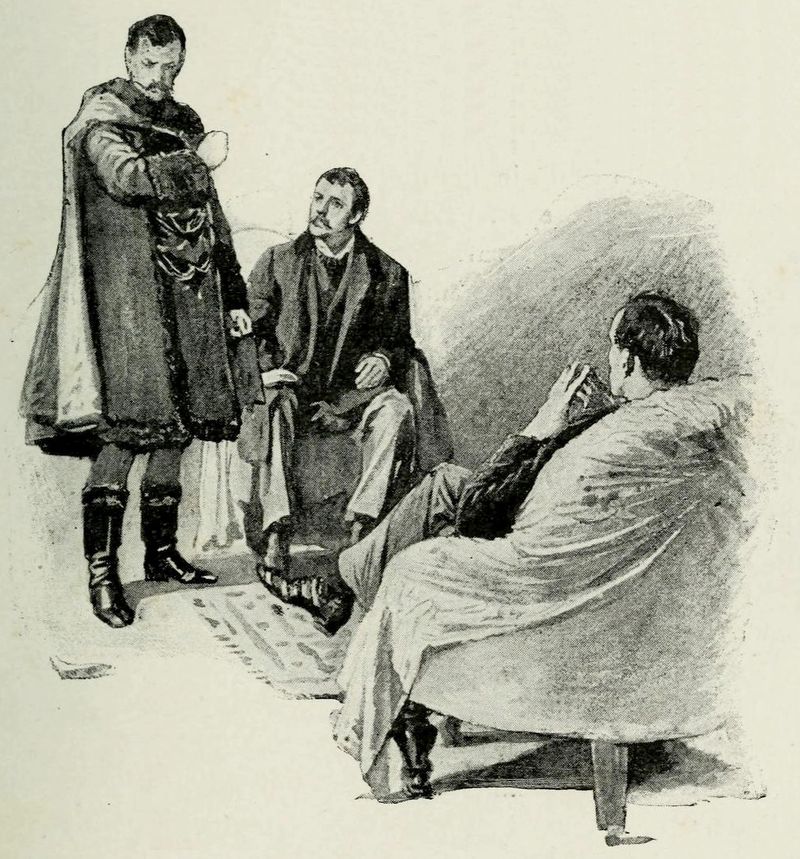
A Scandal in Bohemia is the story in which Irene Adler, ‘the woman’, makes her one and only appearance in Conan Doyle’s stories. It is a simple case of blackmail which is resolved without Holmes’s assistance, because Irene marries and decides not to pursue her victim. Holmes counts it as one of his very few failures, which suggests his definition of success is somewhat flexible, but there is no suggestion of any attraction between the two, more a mutual respect.800px-A_Scandal_in_Bohemia-04

The Red-Headed League is one of Holmes’s more ridiculous cases. A pawn broker is duped into leaving his store all day for several weeks to allow a tunnel to be dug from the premises to a nearby bank. The bank robbers could surely have found easier ways to do this than the invention of the League, which would have drawn a lot of attention to themselves, left clues all over the place, cost a lot of time and effort to establish, and could have fallen apart at any time.

A Case of Identity is one in which someone assumes a flimsy disguise, which Holmes sees through but fails to tell his client he has resolved the case. See ‘The Man with the Twisted Lip’

The Boscombe Valley Mystery. In this story Holmes bizarrely allows a murderer to go free, and a guilty man to spend months in prison, simply because the murderer is dying.

The Five Orange Pips sees Holmes allow his client to be brutally murdered and the murderers to escape the country, if not justice. Another great success!

The Man with the Twisted Lip. Someone assumes a flimsy disguise which Holmes sees through, again.

The Adventure of the Blue Carbuncle. In this story Holmes starts with the missing gem falling into his lap, and then working back to find out who stole it – an easier approach than the other way round I would have thought.

The Adventure of the Speckled Band. Conan Doyle thought this his finest Holmes story, but it is riddled with preposterous plot points.

The Adventure of the Engineer’s Thumb. A good headline, but a story in which Holmes detects absolutely nothing. Perhaps explains why this has not been an adaptor’s favourite.

The Adventure of the Noble Bachelor. A missing person story depending for its resolution of a previous relationship in America – the States is the setting for several of Holmes’s client’s backstories.

The Adventure of the Beryl Coronet. I think the real mystery – why a member of the royal family comes to pawn an incredibly valuable coronet for a fraction of its value – is ignored, instead focusing on whodunit in which footprints in the snow provide all the answers.

The Adventure of the Copper Beeches. A governess is recruited at highly inflated wages to impersonate a kidnapped heiress. Another case where the villains employ ridiculously complex means to pursue their villainy, when many other simpler options are available.

To Victorians, Holmes’s deductions and flashes of brilliance must have been dazzling, and to this day there are readers who hold Holmes in the highest possible regard. He is not the character most often portrayed on film for nothing. In recent years ‘Elementary’ and ‘Sherlock’ have given new life and new depths to the character. For me Holmes probably works best in this short story format where the weaknesses in his deductive method and approach aren’t too visible.

19th Century literature, Book review, Conan Doyle, Detective, Detective fiction, Holmes, Holmes and Watson, Sherlock

The Adventures of Sherlock Holmes, by Arthur Conan Doyle 1892

Gallery
19th Century literature, Book review, Bronte, Bronte Sisters, The Tenant of Wildfell Hall

The Tenant of Wildfell Hall, by Anne Bronte, 1848

towh

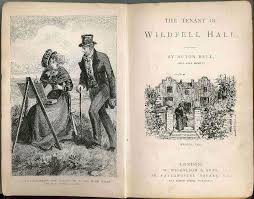
It is quite rare for me to open a classic Victorian novel and have almost no idea what it is going to be about. But that was the case here – I have somehow avoided television and radio adaptations, reviews, blogposts etc – and the kindle edition even removes the clues provided by the blurb and illustrations of the sort shown here. So what is ‘The Tenant’ as I shall now refer to it, about?

It is a traditional three part novel, with a narrative structure that may seem clumsy to a reader used to omniscient narration. Gilbert Markham, a gentleman farmer, writes to a friend about the arrival of a new tenant for the nearby and near derelict Wildfell Hall.. The novel’s opening subverts that used in ‘Pride and Prejudice’, in that instead of a male tenant arriving in a community and being the cause of local gossip and interest, here a mysterious widow, Mrs Helen Graham, is the newcomer. Mrs Graham fascinates and attracts Markham, even though she is the focus for local scandal, the detail of which is never spelt out explicitly but relates to an implied relationship with her landlord, Mr Lawrence.

The central section of the novel is recounted in Helen’s diaries, given to Gilbert to dispel his suspicions about her ‘affair’ with Lawrence, and presumably carefully transcribed by him into his letters. Helen is a much more moralistic character than Gilbert. She tells the history of her relationship with and marriage to Arthur Huntingdon. Huntingdon is a rake, and does little to disguise his flaws from Helen, who foolishly thinks she will be able to reform him. He boasts openly of his dissolute former life with its seductions and affairs:

His favourite amusement is to sit or loll beside me on the sofa and tell me stories of his former amours, always turning upon the ruin of some confiding girl or the cozening of some unsuspecting husband”. (Chapter 24)

The birth of their son, also called Arthur, exacerbates the problems with their relationship. Helen can stand Huntingdon’s drunkenness and openly conducted affairs, but when he encourages Arthur junior to drink and swear she begins to plan her escape.

The final section of the novel starts after Gilbert’s reading of the diary. By now his ardour for Helen is at full pitch, and the news that she is still married does not deter him. Her moralistic sermons have the desired affect however, and he promises to leave her alone, for six months at least. He complies but is shocked to find out, from her brother, that she has returned to her husband who has fallen seriously ill. Huntingdon dies a squalid if convenient death, leaving the path open for a reconciliation between the now rich widow and the farmer. Despite some minor confusions and misunderstandings, the lovers marry, retire to the country and live happily ever after. It is only at the novel’s conclusion that we learn that the letters have been written to Gilbert’s brother-in-law, a Mr Halford, in the form of a memoir.

In many way ‘The Tenant’ is a conventional romance, with a happy ever after marriage and children at the end of a complex courtship, where the characters slowly discover their feelings for one another. The long separation in the middle of the novel, followed by the reconciliation at the end, is reminiscent of the structure of ‘Jane Eyre’, where Jane exiles herself to avoid temptation. Helen is an extraordinarily strong woman, determined to keep her marriage vows, when she can, care for and protect her son, and keep true to her faith. True love is her reward for these sacrifices. Critics have long identified her defiance of her husband – albeit after years of psychological torment and abuse, including his conduct of an affair openly before her – as the actions of a proto-feminist. She’s certainly a strong determined character, but I think it is important to remember that she returns to her husband as soon as he needs her, putting duty to him above her personal interests, and remains faithful to him despite everything.

I had hoped that the wonderfully named Wildfell Hall would play a central role in the novel, and the portrait of it given by Markham in the novel’s opening chapter promises much:

Near the top of this hill, about two miles from Linden-Car, stood Wildfell Hall, a superannuated mansion of the Elizabethan era, built of dark grey stone, venerable and picturesque to look at, but doubtless cold and gloomy enough to inhabit, with its thick stone mullions and little latticed panes, its time-eaten air holes and its too lonely, too unsheltered situation – only shielded from the war of wind and weather by a group of Scotch firs, themselves half-blighted with storms, and looking as stern and gloomy as the Hall itself”.

The narrator then goes on to tell the reader how the garden has run to seed, and all the topiary bush animals have “spouted into such fantastic shapes as resembled nothing in heaven or earth but presented…a goblinish appearance that harmonised well with the ghostly legions and dark traditions…of the haunted hall”.

Who can read that portrait and not expected a traditional gothic novel to follow, with things that go bump in the night and half a dozen or more mad-women locked in the attic? If so they will have been disappointed, because Wildfell Hall is a minor character in the story, a haven for the escaping Helen rather than the venue for any Scooby-Doo style antics. Instead we have a disturbing story of unhappy marriages and domestic violence which must surely have been all the more shocking and transgressive when first published – rich people really didn’t do such things within the confines of marriage, or if they did we certainly didn’t read about it. We are not surprised when Heathcliff is violent towards animals, but when Huntingdon hits out at his favourite cocker spaniel – “He struck it off with a smart blow; and the poor dog squeaked, and ran cowering back to [Helen]. When he woke up half an hour after, he called it to him again; but Dash only looked sheepish and wagged the tip of his tail. He called again, more sharply, but Dash only clung closer to [Helen], and licked [her] hand as if imploring protection. Enraged at this, his master snatched up a heavy book and hurled it at its head” – the violence is a thinly veiled metaphor for domestic violence. This in many ways is more troubling for being hinted at rather than directly portrayed, for example in this sinister description of the casual violence of one of Huntingdon’s debauched friends towards his own wife: (chapter 32)

“I love thee Milicent, but I don’t adore thee’. In proof of his affection he clutched a handful of her light brown ringlets, and appear to twist them unmercifully. “Do you really Ralph?” murmured she, with a faint smile beaming through her tears, just putting up her hand to his, in token that he pulled rather too hard.”

Is ‘The Tenant of Wildfell Hall’ a good novel? Well of course it is a classic, but at the same time it is usually ranked below ‘Wuthering Heights’ and ‘Jane Eyre’. It shares many features with these novels, the slightly awkward narrative structures, the dark secrets, and troubled love affairs. But a distinct aroma of sanctimoniousness pervades ‘The Tenant’. Helen is rarely very loveable or off her guard, and goodness doesn’t she love to preach!

(Chapter 45) – We are children now; we feel as children, and we understand as children; and when we are told that men and women do not play with toys, and that our companions will one day weary of the trivial sports and occupations that interest them and us so deeply now, we cannot help being saddened at the thought of such an alteration, because we cannot conceive that as we grow up our own minds will become so enlarged and elevated that we ourselves shall then regard as trifling those objects and pursuits we now so fondly cherish, and that, though our companions will no longer join us in those childish pastimes, they will drink with us at other fountains of delight, and mingle their souls with our in higher aims and nobler occupations beyond our present comprehension, but not less deeply relished or less truly good for that, while yet both we and they remain essentially the same individuals as before”.

The supporting cast of minor characters is also weaker in ‘The Tenant’ – they tend to blur into one another and are less clearly differentiated. None of which really detracts from the overall power of the novel.

Two other brief observations. Firstly, this short scene caught my attention. It happens when Helen is running her fingers through Huntingdon’s hair:

“The head looked right enough, but when he placed my hand on the top of it, it sunk in a bed of curls, rather alarmingly low, especially in the middle”.

I can’t find that any critics have picked up on this description (which is not referred to again), but I find it hard to read any other way than that the author is suggesting Huntingdon has an ‘alarming’ depression in his cranium. What the Victorian pseudo-science of phrenology, referred to more extensively by Charlotte in ‘Jane Eyre’ would have made of that depression I can only imagine, but it surely is a heavy hint of the moral depravity to be exposed as the novel progresses, or possibly a propensity to addictive behaviours.

Finally, I am pretty sure I spotted a mistake in the novel’s portrait of the English countryside. In chapter 29 we are told “On a bright…day, in the beginning of July, I had taken little Arthur into the wood that skirts the park … and having gathered a handful of bluebells and wild-roses…”. Anne knew full well that bluebells are a spring flower, having written a poem in their praise, so is this just a simple slip, or something more interesting?

Standard
Book review, Charles Dickens, Nicholas Nickleby

Nicholas Nickleby, by Charles Dickens, 1838-9

In her reading diary Jacob’s Room is full of books’ Susan Hill describes her habit of reading one Dickens novel a year. This struck me as an eminently sensible habit – if you tried to read them all in one you would go a bit mad, and I suspect the novels would start to bleed into one another. One a year on the other hand allows plenty of time for other reading and would leave most readers with a realistic prospect of working their way through the whole canon. So I thought I would give this practice a go, starting with one of the more accessible novels, ‘Nicholas Nickleby’.nn

Nicholas Nickleby’ was Dickens’s third novel, published in monthly instalments over 18 months in 1838 and 1839. In many ways it is quintessential Dickens. Almost all of the features of a typical Dickens novel appear – the episodic switching between narrative threads, the mysterious stranger who reveals a long buried secret, fortunes lost and re-won, child-like romances, and the long drawn out death of consumptive innocents. Probably the one other most distinctive feature of all Dickens’ work is his concern with social justice. This aspect of his work is already fully formed in this novel, as for example here in this extraordinary meditation by Nicholas:

But now, when he thought how regularly things went on, from day to day, in the same unvarying round; how youth and beauty died, and ugly griping age lived tottering on; how crafty avarice grew rich, and manly honest hearts were poor and sad; how few they were who tenanted the stately houses, and how many of those who lay in noisome pens, or rose each day and laid them down each night, and lived and died, father and son, mother and child, race upon race, and generation upon generation, without a home to shelter them or the energies of one single man directed to their aid; how, in seeking, not a luxurious and splendid life, but the bare means of a most wretched and inadequate subsistence, there were women and children in that one town, divided into classes, numbered and estimated as regularly as the noble families and folks of great degree, and reared from infancy to drive most criminal and dreadful trades; how ignorance was punished and never taught; how jail-doors gaped, and gallows loomed, for thousands urged towards them by circumstances darkly curtaining their very cradles’ heads, and but for which they might have earned their honest bread and lived in peace; how many died in soul, and had no chance of life; how many who could scarcely go astray, be they vicious as they would, turned haughtily from the crushed and stricken wretch who could scarce do otherwise, and who would have been a greater wonder had he or she done well, than even they had they done ill; how much injustice, misery, and wrong, there was, and yet how the world rolled on, from year to year, alike careless and indifferent, and no man seeking to remedy or redress it; when he thought of all this, and selected from the mass the one slight case on which his thoughts were bent, he felt, indeed, that there was little ground for hope, and little reason why it should not form an atom in the huge aggregate of distress and sorrow, and add one small and unimportant unit to swell the great amount.

This is classic Dickens, with its clinical and yet at the same time passionate dissection of the social ills of Victorian Britain, but sadly also without offering any hope or constructive solutions. Yes the bad guys always come to a messy end in his novels, either the gallows, deportation or similar, and the central characters find happiness and prosperity through the bequests of long lost relatives, but the poverty disease and degradation are still all there.

The other source of enjoyment I find in Dickens is his wonderfully perceptive portraits of the fallibility of human nature. In this he probably has no peer other than Jane Austen. Mrs Nickleby is a particular favourite, bringing to mind her obvious predecessors Mr Woodhouse and Mrs Bennett, where the author’s use of reported speech conveys the full impact of her rambling complaints, without us having to work our way through them all:

To this, Mrs. Nickleby only replied that she durst say she was very stupid, indeed she had no doubt she was, for her own children almost as much as told her so, every day of her life; to be sure she was a little older than they, and perhaps some foolish people might think she ought reasonably to know best. However, no doubt she was wrong; of course she was; she always was, she couldn’t be right, she couldn’t be expected to be; so she had better not expose herself any more; and to all Kate’s conciliations and concessions for an hour ensuing, the good lady gave no other replies than Oh, certainly, why did they ask her?, her opinion was of no consequence, it didn’t matter what she said, with many other rejoinders of the same class.

There’s no denying the fact that Dickens’s villains are two dimensional, with very few shades of grey in their character, but what wonderfully wicked villains they are. Even if you have not read any Dickens, you will be able to get a good idea of the character of the schoolmaster Wackford Squeers simply through his name alone.

So why isn’t ‘Nicholas Nickleby’ considered in the top rank of Dickens’ work? That assessment is open to debate of course, but I think it reflects a consensus. Dickens had five novels in the BBC Big Read list of the 100 most loved novels (‘Bleak House’, ‘A Tale of Two Cities’,David Copperfield’, ‘Great Expectations’ and ‘A Christmas Carol’) but Nickleby was omitted. My theory is that this is because the scenes of peril in the novel are rarely sustained. The dangers characters face at different points is never very serious, and is usually resolved quickly. (This is reminiscent of the ‘fake’ deaths at the end of many Disney films: the scene in which a character appears to die, only to revive moments later is a feature of many children’s films, and it is a very reliable rule that the quicker they revive (think of Baloo surviving the fight with Shere Khan in ‘Jungle Book’, or the brief moment in ‘Robin Hood’ when we think he has been shot with an arrow and drowned) the younger the target audience.

From this perspective Nicholas lives a charmed life. When his father dies unexpectedly, rather than ending up in the workhouse, his family has a rich uncle Frank to turn to. He easily gets a job as a teacher despite his lack of qualifications. While Dotheboys Hall is a nightmarish place for the boys, for Nicholas it is far less uncomfortable, and when his patience is pushed too far he can simply beat Wackford and walk away, something of which the boys can only dream.

His sister Kate and their mother are given lodgings free of charge by the villainous uncle, and Kate is found a perfectly respectable job as a milliner’s assistant. When this does not work out another equally respectable job, as a lady’s companion, appears quickly enough. The trauma of the subsequent assault on Kate by Sir Mulberry Hawk is obviously serious, but is quickly stopped by Ralph.

Nick’s good fortune however continues. He finds a job on the stage in Portsmouth and debuts almost immediately as Romeo. Later, compelled to return to London, he again finds well-paid work straight away with the lovable merchants, the Cheeryble the brothers. Nicholas has been accompanied on his adventures by Smike, an orphan runaway from Dotheboys. Smike has the misfortune to run into Squeers, who kidnaps him, but is rescued within hours. A subsequent attempt to reclaim Smike by the use of forged documents to the effect that he is the long-lost son of a man named Snawley is avoided by the simple expedient of ignoring it.

Inevitably, romantic interest intervenes. Nicholas nobly tries to avoid making Madeline Bray, the penniless daughter of a debtor, fall in love with him, but it comes as no surprise when this plan fails. There is a far-fetched plan to marry Madeline off to Arthur Gride, an early iteration of Fagin, in return for the promise of paying off her father’s debts to be foiled. This scheme falls apart on the day of the wedding when her father drops conveniently dead. The happily-ever-after then comes in a rush as all the plots against Nicholas fall away as so much background noise.

There is much more sustained threat in Dickens’ later novels. Imagine how more scary being a pupil at Dotheboys would have been compared to being a master? Indeed, Dickens gives us this comparative experience himself with David Copperfield’s experiences at Salem House, and those of Oliver Twist in the workhouse. Ultimately, this lack of genuine peril is what makes this novel considered suitable for children. if you are looking for an introduction to Dickens for a younger reader this is an excellent place to start.


Standard
Book review

David Copperfield by Charles Dickens, 1850

Subtitled “The Personal History, Adventures, Experience and Observation of David Copperfield the Younger of Blunderstone Rookery (Which He Never Meant to Publish on Any Account)”

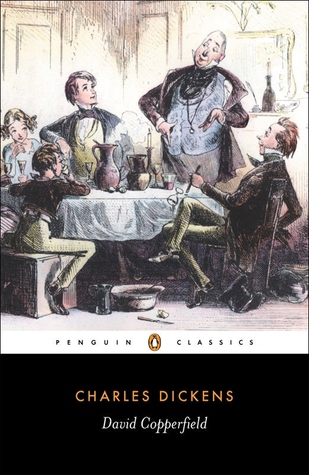
Originally published in nineteen monthly instalments, ‘David Copperfield’ takes the form of a personal narrative, with this evocative introduction:david-copperfirled

“Whether I shall turn out to be the hero of my own life, or whether that station will be held by anybody else, these pages must show. To begin my life with the beginning of my life, I record that I was born (as I have been informed and believe) on a Friday, at twelve o’clock at night. It was remarked that the clock began to strike, and I began to cry, simultaneously.”

The largely autobiographical plot follows the young David as he is orphaned, sent to school, and slowly makes his way in the world, eventually becoming a prosperous author.   Continue reading

Standard