Book review

The Island of Doctor Moreau by H. G. Wells, 1896

‘The Island of Dr Moreau’ is another example of the late Victorian fascination with the transformative powers of science. Written during an astonishingly productive period of creativity for Wells, when he also wrote the ‘Invisible Man‘, ‘War of the Worlds‘, and ‘The Time Machine‘, Wells draws heavily and widely on influences. Swift’s ‘Gulliver’s Travels‘ is an obvious influence for example for the scenes at the end of the novel when the protagonist returns to the UK and has trouble to adjusting back to modern life after spending so long alone with the beasts on Moreau’s island:

When I lived in London the horror was well-nigh insupportable. I could not get away from men: their voices came through windows; locked doors were flimsy safeguards. I would go out into the streets to fight with my delusion, and prowling women would mew after me; furtive, craving men glance jealously at me; weary, pale workers go coughing by me with tired eyes and eager paces, like wounded deer dripping blood; old people, bent and dull, pass murmuring to themselves; and, all unheeding, a ragged tail of gibing children... Particularly nauseous were the blank, expressionless faces of people in trains and omnibuses; they seemed no more my fellow-creatures than dead bodies would be, so that I did not dare to travel unless I was assured of being alone. And even it seemed that I too was not a reasonable creature, but only an animal tormented with some strange disorder in its brain which sent it to wander alone,

This is a mood, however, that comes to me now, I thank God, more rarely. I have withdrawn myself from the confusion of cities and multitudes, and spend my days surrounded by wise books,—bright windows in this life of ours, lit by the shining souls of men. I see few strangers, and have but a small household. My days I devote to reading and to experiments in chemistry, and I spend many of the clear nights in the study of astronomy. 

Wells is a great novelist of ideas, but he is also a wonderful and compelling moreaustoryteller. Here he builds the suspense and sense of horror slowly. The narrator, Edward Prendick, is rescued from a shipwreck, having survived in a small boat with two other passengers who at one point contemplate cannibalism, an early introduction to the idea of man as beast. His saviour is Montgomery,
“a youngish man with flaxen hair, a bristly straw-coloured moustache, and a dropping nether lip, was sitting and holding my wrist.…“Have some of this,” said he, and gave me a dose of some scarlet stuff, iced. It tasted like blood, and made me feel stronger.”

Another hint of cannibalism here. Montgomery has a malformed assistant onboard, whose strangeness emerges slowly. At first it is his voice:

“I heard him in violent controversy with someone, who seemed to me to talk gibberish in response to him. The matter sounded as though it ended in blows, but in that I thought my ears were mistaken.”

Later Prendick sees him for the first time and is struck by his appearance. Something is obviously wrong:

“We left the cabin and found a man at the companion obstructing our way. He was standing on the ladder with his back to us, peering over the combing of the hatchway. He was, I could see, a misshapen man, short, broad, and clumsy, with a crooked back, a hairy neck, and a head sunk between his shoulders. He was dressed in dark-blue serge, and had peculiarly thick, coarse, black hair. I heard the unseen dogs growl furiously, and forthwith he ducked back,—coming into contact with the hand I put out to fend him off from myself. He turned with animal swiftness.”

Note how references to this man are always linked with the reactions of the caged dogs:

“In some indefinable way the black face thus flashed upon me shocked me profoundly. It was a singularly deformed one. The facial part projected, forming something dimly suggestive of a muzzle, and the huge half-open mouth showed as big white teeth as I had ever seen in a human mouth. His eyes were blood-shot at the edges, with scarcely a rim of white round the hazel pupils. There was a curious glow of excitement in his face.”

The narrator moves quickly from describing him as a man to a “creature”:

“I had paused half way through the hatchway, looking back, still astonished beyond measure at the grotesque ugliness of this black-faced creature….The creature’s face was turned for one brief instant out of the dimness of the stern towards this illumination, and I saw that the eyes that glanced at me shone with a pale-green light. I did not know then that a reddish luminosity, at least, is not uncommon in human eyes. The thing came to me as stark inhumanity. That black figure with its eyes of fire struck down through all my adult thoughts and feelings, and for a moment the forgotten horrors of childhood came back to my mind.”

When they arrive at (and are dumped unceremoniously on) the mysterious island, they meet some more mysterious, strangely shaped people:

“a strange crew they were. I saw only their faces, yet there was something in their faces—I knew not what—that gave me a queer spasm of disgust…. They seemed to me then to be brown men; but their limbs were oddly swathed in some thin, dirty, white stuff down even to the fingers and feet: . They wore turbans too, and thereunder peered out their elfin faces at me,—faces with protruding lower-jaws and bright eyes. They had lank black hair, almost like horsehair, and seemed as they sat to exceed in stature any race of men I have seen.” 

The astute reader will by now have come to understand that there is more to these strange people than meets the eye. But what? Prendick is not long on the island before he meets the mysterious Dr Moreau and discovers the purpose of his experiments:

“Yet surely, and especially to another scientific man, there was nothing so horrible in vivisection as to account for this secrecy; and by some odd leap in my thoughts the pointed ears and luminous eyes of Montgomery’s attendant came back again before me with the sharpest definition…

What could it all mean? A locked enclosure on a lonely island, a notorious vivisector, and these crippled and distorted men?”

What indeed? At first Prendick concludes that the experiments are intended to turn men into beasts, and suspects he may be the next victim.

“I was convinced now, absolutely assured, that Moreau had been vivisecting a human being… These creatures I had seen were the victims of some hideous experiment. These sickening scoundrels had merely intended to…fall upon me with a fate more horrible than death,—with torture; and after torture the most hideous degradation it is possible to conceive,—to send me off a lost soul, a beast.”

Montgomery and Moreau are finally able to persuade him that the reverse is the case, and that while their experiments may seem cruel, they are being done in a noble cause. The ethics of vivisection are never far below the surface in this horror story, but it is more than a simple campaigning novel. Wells initiates a discussion about what it is to be a man, and his relationship with the rest of the  natural world, from which (as Darwin had only just explained) we come and with which we share a common ancestry.

That is not to say that Wells pulls his punches on the horror of vivisection:

“There was blood, I saw, in the sink,—brown, and some scarlet—and I smelt the peculiar smell of carbolic acid. Then through an open doorway beyond, in the dim light of the shadow, I saw something bound painfully upon a framework, scarred, red, and bandaged; and then blotting this out appeared the face of old Moreau, white and terrible.”

Wells invites the reader to draw comparison between Moreau’s unnatural man-beasts, and the plight of the working man in Victorian industrial cities.

I would see one of the clumsy bovine-creatures who worked the launch treading heavily through the undergrowth, and find myself asking, trying hard to recall, how he differed from some really human yokel trudging home from his mechanical labours; or I would meet the Fox-bear woman’s vulpine, shifty face, strangely human in its speculative cunning, and even imagine I had met it before in some city byway.

This needs care – Wells is not suggesting that the working classes are beast-like, more that they have been treated as beasts of burden, and that doing so constantly might trigger the violent outbursts of anger and rejection of the law that Moreau’s man-beasts finally enjoy. The treatment of the animals on Moreau’s island can also be read as a critique of colonialism – Prendick initially assumes the man-beasts are ‘natives’ of some kind, and explains away their brutish appearance on this basis. European settlers and traders often treated indigenous people as animals, and even conducted social experiments aimed at ‘civilising’ them in the way Moreau does his beasts.

To finish, just a couple of other points: first, it is well known that Wells was politically progressive, and considered himself a socialist. There is a fleeting reminder of this when the narrator half-quotes Shelley’s ‘Masque of Anarchy’, where the implied reference to ‘rising like lions’ is particularly apposite:

“You who listen,” I cried, pointing now to Moreau and shouting past him to the Beast Men,—“You who listen! Do you not see these men still fear you, go in dread of you? Why, then, do you fear them? You are many—”

Second, consider these laws the animals are taught to maintain their obedience:

“Not to go on all-fours; that is the Law. Are we not Men?”

“Not to suck up Drink; that is the Law. Are we not Men?

“Not to eat Fish or Flesh; that is the Law. Are we not Men?

“Not to claw the Bark of Trees; that is the Law. Are we not Men?

“Not to chase other Men; that is the Law. Are we not Men?”

I had never spotted before, nor seen it mentioned, but Orwell clearly drew inspiration from Wells here for his laws of animalism in ‘Animal Farm‘.
Standard
Book review

The War in the Air, by H G Wells, 1907

I was intending to take a break from Wells, but this novel jumped out at me from the shelves of a second hand bookshop, and as it wasn’t one I had heard of before, let alone read, I thought it worth the £1 investment!war

It is interesting how the reputations of writers and their works evolve over time. In the publisher’s introduction to this 1967 Penguin edition, written much nearer to the time of Well’s death than today – and even slightly nearer to the date the novel was first published than today – Wells’s “chief novels” are listed as “Ann Veronica, (109) Tono-Bungay, (141) The World of William Clissold (4), Brynhild, (3) Dolores (now published as Apropos of Dolores (3)), and The Holy Terror (2)”.

Now be honest, how many of these novels have you heard of, let alone read? This is a Penguin edition remember, not some obscure publisher wanting to promote Wells’ back catalogue. The numbers in brackets are the number of reviews each book has received on Goodreads – by comparison the results for three books not mentioned in this introduction are 8,473 – The Time Machine; 5,726 – War of the Worlds; 4,322 – ‘The Invisible Man’.

Why did Penguin focus on these now largely forgotten novels, and ignore his science fiction – in the introduction to one of his science fiction novels? It is not the case that the more popular novels I have mentioned have only recently become popular – they have been in print since first published, and formed the basis of many films, television programmes, sequels, and of course radio adaptations?  Usually I can offer some speculation on these questions, but this time I am completely stumped? Anyone?

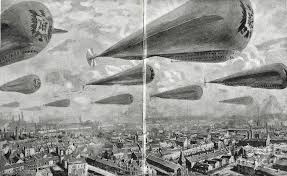
‘The War in the Air’ (66), another invasion novel, is subtitled ‘And particularly how Mr Bert Smallways fared while it lasted’. The novel is Wells’s speculation on how human flight, just taking off (if you will excuse the pun) when written, will affect warfare. The novel is a strange mixture of fairly low comedy – much of it is written as the misadventures of Wells’s everyman character, as sort of English Good Soldier Schweik – and combat scenes. Wells’s predictions are partly wrong – aerial combat did not develop the way he thought it might, largely due to the practical limitations of airships – and partly completely right, in terms of the devastation of global war. The comedy doesn’t really work, and fits uncomfortably with the war scenes, which explains I think why this novel is largely forgotten while others such as ‘War of the Worlds’ continue to grip our collective imagination.

Steampunk aficionados have claimed this text as one of their own but even this community of readers will find it hard to enjoy much in this labouring and poorly constructed novel.

Standard
19th Century literature, Book review, George Orwell, H G Wells, science fiction', The Time Machine

The Time Machine by H G Wells,1895

Continuing with my Wells-athon, all of which have been quite short novels, I now turn to the hugely influential ‘The Time Machine’.

Time travel was not a new concept, but Wells’s novel was one of the earliest on this theme, and established some concepts and principles that remain with us. having said that, I found the behaviour of Wells’ s protagonist in many ways puzzling. If you had invented a time machine, what would you do? Where would you go? Would you go back to the nativity, to the Globe in 1605, to assassinate Hitler? Or would you travel 800,000 years into the future, as Wells’ time traveller does, without packing a sandwich, let alone a camera or a weapon? I know that is a ridiculously literal response to a science fiction story, but good science fiction is above all plausible. If I could forward travel in time I would like to know how society reshapes itself in 100 years, what new technology is developed, whether extra-terrestrial life is encountered, so many other things – but 800,000 years?? Given that the existing span of human civilization can be measured in single-figure thousands of years, it seems wildly optimistic to imagine that humans will still be around this far into the future.

I appreciate I am still being too literal – time travel is simply a device to allow Wells to speculate on how human society will evolve, and we need not get too absorbed with the precise date – this is simply the vaguely distant future. In this future humans have evolved into two distinct races, the Eloi and the Morlocks. The Morlocks live underground, and predate upon the simple-minded Eloi. Society is decaying terminally. Into this world the time traveller is pitched, loses his machine, and is forced to confront his slowly dawning realisation that this is no Utopia he had hoped man would have built for himself.

Wells’s conception of time travel is quaint. It doesn’t involve Government-led endeavours and vast resources – an independent inventor working in his shed is able to master the feat after a few years of study. He sets off in an extraordinarily blase fashion, making no preparation whatsover – this is a quick jaunt into the future, not an expedition risking life and limb, back in time for a quick bath and dinner at eight. Victorians were of course great explorers, and often quite eccentric into the bargain, but Wells’ s time traveller takes this to the extreme.

One of the most distinctive features of Wells’ writing is his focus on the personal, the everyday, even when his themes are global or astronomical. As I mentioned in my review of ‘War of the Worlds’, the Martian conflict is constrained within the English Home Counties, and described from the limited perspective of two individual observers. The scenes from ‘The Invisible Man’ are all rooted in suburban and rural England. Kipps and Mr Polly follow the same pattern – his protagonists are everymen. It is no coincidence that the central characters in ‘The War of the Worlds’ and ‘The Time Machine’ are both unnamed. This allows them to act as representatives of their class and time.

However, politically, ‘The Time Machine’ is a difficult book. Wells is commonly considered as a socialist, but his portrait of a future in which the working class has become a cannibalistic underground monster, preying on the weak and enfeebled middle classes, is profoundly pessimistic. It not only expresses “Wells’s horror at the realities of 19th-century class relations, but also his fears about what utopian socialism and communism were offering in their place” (Matthew Taunton). It is hard to travel back from the dystopia of 800,000 to 1895 and find a way to avoid this co-evolution and class war.

It’s been interesting to revisit Wells, but I remain ambivalent about his status as a writer. Influential, without question. I think his social comedies have aged less well than his science fiction. But if I ever am at a loss to put into words my thoughts and feelings about a novel or a writer, there is always one reliable solution, and that is to turn to George Orwell. Try it – he almost always has something sensible and interesting to say about any author of his time or before. Reliably, he puts his finger on this sense of unease. In ‘Wells, Hitler and the World State’, published in Horizon in 1941, he wrote:

Thinking people who were born about the beginning of this century are in some sense Wells’s own creation… I doubt whether anyone who was writing books between 1900 and 1920, at any rate in the English language, influenced the young so much. The minds of all of us, and therefore the physical world, would be perceptibly different if Wells had never existed.”

But he goes on to say

the singleness of mind, the one-sided imagination that made him seem like an inspired prophet in the Edwardian age, make him a shallow, inadequate thinker now…. Back in the nineteen-hundreds it was a wonderful experience for a boy to discover H. G. Wells….But because he belonged to the nineteenth century and to a non-military nation and class, he could not grasp the tremendous strength of the old world… He was, and still is, quite incapable of understanding that nationalism, religious bigotry and feudal loyalty are far more powerful forces than what he himself would describe as sanity. “

Orwell anatomises with extraordinary precision why Wells’s utilitarian version of socialism had not come to pass, even though the scientific advances he anticipated had been realised and indeed exceeded:

Creatures out of the Dark Ages have come marching into the present, and if they are ghosts they are at any rate ghosts which need a strong magic to slay them…Wells is too sane to understand the modern world. The succession of lower-middle-class novels which are his greatest achievement stopped short at the other war and never really began again, and since 1920 he has squandered his talents in slaying paper dragons. But how much it is, after all, to have any talents to squander.”

Creatures out of the Dark Ages have come marching into the present“. Wow.


Standard
Book review, H G Wells, invasion literature, science fiction', War of the Worlds

War of the Worlds by H G Wells, 1897

Wotw

“No one would have believed in the last years of the nineteenth century that this world was being watched keenly and closely by intelligences greater than man’s and yet as mortal as his own; that as men busied themselves about their various concerns they were scrutinised and studied, perhaps almost as narrowly as a man with a microscope might scrutinise the transient creatures that swarm and multiply in a drop of water.”

I come from the generation that finds it physically impossible to read that opening paragraph without hearing Richard Burton’s magnificent voice, providing the narration for Jeff Wayne’s album.

I really enjoyed ‘War of the Worlds’. I can’t imagine you don’t know the basic premise, but just in case, here goes: aliens attack Woking, and thence Southern England. Not so much war of the worlds therefore as Martians vs the Home Counties. And of course ‘we’ win, in a way that had allowed Europeans to win so many earlier colonial wars.

Continue reading
Standard
19th Century literature, Book review, H G Wells, science fiction'

The Invisible Man, by H G Wells, 1897

The power to transform the human body using advances in scientific understanding. 9780553213539This was the theme that captured the imagination of many nineteenth century writers, including, among others, Mary Shelley in ‘Frankenstein‘, Robert Louis Stevenson in ‘Dr Jekyll and Mr Hyde‘, and H.G. Wells in ‘The Invisible Man‘. In this late Victorian novella, Wells explores the idea of what would happen if someone, somehow, managed to make themselves invisible. Continue reading
Standard
100 Best Novels Guardian list, 20th century Literature, Book review, H G Wells, HG Wells, humour, The History of Mr Polly

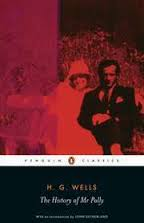
The History of Mr Polly by H G Wells, 1910

Most Victorian novels were about prosperous people. Yes, they sometimes had money worries, but they weren’t urban working class. Dickens changed all that, and people from all parts of the class spectrum became suitable subjects. However, the petit bourgeoise, the shop keeping class, technically bosses in that they were self employed, but dirt poor nonetheless, were largely ignored. That changed with the Grossmiths’ ‘Diary of a Nobody‘ in 1892, and ‘The History of Mr Polly‘ is an early entry in this ‘little man and his troubles’ or ‘white collar’ genre.

Mr Polly‘ opens with him sitting on a stile, grumbling. He hates his life. He doesn’t love or particularly even like his wife, he finds his job as a shopkeeper dull and unfulfilling, and he mourns the absence of any romance or culture in his life. He also suffers horribly from chronic indigestion, representative of his dissatisfaction with life. The first half of the novel is a flash-back from this point, chronicling how he has always felt this way, more or less, and how he reaches this nadir. He settles on suicide as the only logical escape and having made that decision implements his plan quite calmly. Inevitably he botches the job and in the process burns half his street down. Ironically this provides him, in the form of insurance money, an escape route and he runs away. The final section of the novel sees him settled as a handyman at a country pub, living a bucolic but largely culture-free lifestyle that seems to suit him. This life is threatened by uncle Jim, the nephew of the landlady, a thug who menaces her for money. Polly discovers the hero inside himself, stands up to Uncle Jim, and in comic bumbling fashion defeats him.

Polly is quite an engaging anti-hero. He reminded me of Anthony Burgess’s Enderby, one of my comic legends. He has a kind heart, and does his best to avoid causing harm. he takes the hardships in life as they come and looks for pleasure in small things. He has a way of mangling the language which is intended as humorous, and which just about manages to raise a smile. Despite his ineptitude in most things, somehow he manages to come out on top. Some of the set-piece scenes in the novel, such as his father’s funeral, where remote relatives descend on the wake and have a great day insulting one another, are enjoyable. If one looks hard for more serious themes, such as any traces of Wells’ Fabianism, they can be found, but the novel is not openly political. The main ‘message’ of Mr Polly’s history is that one should be true to oneself:

when a man has once broken through the paper walls of everyday circumstance, those unsubstantial walls that hold so many of us securely prisoned from the cradle to the grave, he has made a discovery. If the world does not please you, you can change it. Determine to alter it at any price, and you can change it altogether. You may change it to something sinister and angry, to something appalling, but it may be you will change it to something brighter, something more agreeable, and at the worst something much more interesting. There is only one sort of man who is absolutely to blame for his own misery, and that is the man who finds life dull and dreary”

Mr Polly didn’t have such a terrible life. While slowly going bust in his shop, he didn’t suffer the privations many people experienced, and enjoyed many of the comforts of his Edwardian idyll – an idyll that was to be lost forever just a few years after this novel was published.

Standard