Book review

It has been a long time since I have read any science fiction, but while browsing in my local library, The Futurological Congress, a black humour science fiction novel by Polish author Stanisław Lem, caught my eye. I’ve long been interested in dystopian novels – 1984, Brave New World, etc – and I wondered what the future looked like in the early 1970’s, when 2026 seemed an impossibly long way away. It wasn’t a surprise that like most novels of its kind, some aspects of the future are captured with eerie precision and others are wildly wrong. Which always makes me wonder which of the technological innovations we think are inevitable – the rise of AI, self-driving cars, etc – will actually happen, and instead what undreamt of changes will occur in our future?
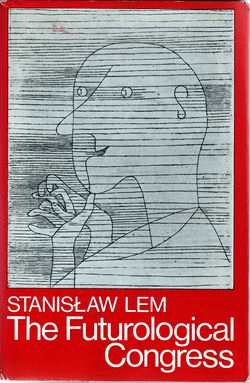
In The Futurological Congress, Lem’s protagonist, Ijon Tichy, attends the Eighth World Futurological Congress in Costa Rica. The novel is set in an indeterminate future (but not too far ahead, because a later time jump takes Tichy to 2039). The conference is being held to consider the world’s population crisis. Futurologists predict the future from existing trends – and at this point in humanity’s story all predictions for the future of the world are bleak.

Lem’s description of this future is at first dominated by absurdity. Tichy’s hotel room is ‘guaranteed bomb-free’ and includes a palm grove and an orchestra. Conference papers are distributed in hard copy (paper always seems very resilient when people thought about the future of business or education) but speakers call out paragraph numbers to save time. The hotel’s water supply is drugged with a chemical that makes the user profoundly good-natured.

Shortly after the start of the congress, the hotel it is being held at comes under attack by protestors. After an attempt to ignore the bombs Tichy and some other attendees and hotel staff take cover in a sewer beneath the hotel. From here he is evacuated only to realise he is still hallucinating. The next rescue attempt ends with the helicopter taking him away crashing. He wakes up in a hospital to find his brain has been transplanted into the body of a young black woman. This then happens all over again – waking up from a hallucination, attack by mysterious forces, rescue and body transplant – which would I suspect make most people wonder about the nature of reality they are experiencing, but Tichy seems accustomed to a world in which bizarre things happen as a matter of course. Finally, in yet another hospital, he is cryogenically frozen (cryonics was just becoming a ‘thing’ in the US in the late 60’s) and wakes up (in scenes familiar from Austin Powers, Futurama and Sleeper – take your pick) in the year 2039.

When the novel jumps forward to 2039, the tone switches dramatically from being a freewheeling comedy to a rather bleak dystopia. From this point the novel is written in the format of a journal. Initially, 2039 (presumably 2039 Costa Rica?) seems utopian. Everyone is happy, all society’s ills have been cured, war is no more, and everything is abundant. Drugs are used to control everyone’s perception of reality and can do just about anything:

“The most recent of the iamides, heavily advertised – authentium. Creates synthetic recollections of things that never happened. A few grams of dantine, for instance, and a man goes around with a deep conviction that he has written The Divine Comedy. Why anyone would want that is another matter and quite beyond me.”

But slowly Tichy becomes disillusioned with this chemically enhanced ‘paradise’. He stops taking any drugs but doesn’t realise that the air itself is suffused with perception-altering chemicals. Finally his friend, Professor Trottelreiner, tells him a terrible secret:

“By introducing properly prepared mascons (reality-masking chemicals) to the brain, one can mask any object in the outside world behind a fictitious image—superimposed—and with such dexterity, that the psychemasconated subject cannot tell which of his perceptions have been altered, and which have not. If but for a single instant you could see this world of ours the way it really is — undoctored, unadulterated, uncensored — you would drop in your tracks!”

A small dose of an unmasking drug allows Tichy to see the world as it really is: instead of being in a five-star restaurant he is in a dank concrete bunker eating “the most unappetizing gray-brown gruel, which stuck in globs to my tin“. No-one drives a car – they run in the road believing they are doing so, and instead of travelling up and down in lifts they climb the empty elevator shafts. Everyone lives in abject squalor eating horrible muck, all the time believing they are living in luxury. The world is being destroyed by over-population – the very problem that the original Futurological Congress was intending to address. Only a small number of soothseers know the real state of the world. This is Tichy’s red pill moment – the terrifying realisation that the world is actually squalid and disgusting. When finally he is returned to his original time, hiding in the sewers from the bombers attacking the conference, we are left in doubt as to whether this is a return to reality or yet another chemically induced nightmare.

As well as its bleak portrait of the future, the other predominant feature of The Futurological Congress is its experimental use of language. I can imagine that translating the text from Polish to English must have been challenging to say the least, and many of the words must surely be approximations, given that Lem made many of them up in the first place. Take a paragraph like this for example:

In just the last issue of Science Today there had been an article on some new psychotropic agents of the group of so-called benignimizers (the N,N-dimethylpeptocryptomides), which induced states of undirected joy and beatitude. Yes, yes! I could practically see that article now. Hedonidil, Euphoril, Inebrium, Felicitine, Empathan, Ecstasine, Halcyonal and a whole spate of derivatives. Though by replacing an amino group with a hydroxyl, you obtained instead Furiol, Antagonil, Rabiditine, Sadistizine, Dementium, Flagellan, Juggernol and many other polyparanoidal stimulants of the group of so-called phrensobarbs (for these prompted the most vicious behavior, the lashing out at objects animate as well as inanimate—and especially powerful here were the cannibal-cannabinols and manicomimetics).

In the 1970s Poland was still part of the Soviet bloc. The Futurological Congress is (at least in part) a commentary on the communist state that told its citizens they were living in a socialist utopia, but where their actual experience of life was of hardship and want. In 1984 George Orwell makes a similar point – in that novel, instead of chemicals, the state uses terror to force its citizens to believed that rations are being increased even as they are cut. Perhaps Lem was telling us to wake up and take over-population seriously, and not put our faith in political ideologies?
The Futurological Congress by Stanisław Lem, 1971

Aside
Book review

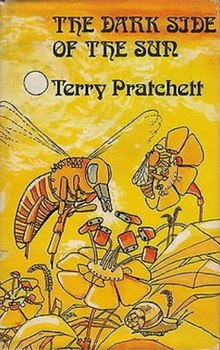
The Dark Side of the Sun (playing on the title of Pink Floyd’s iconic 1973 album ‘The Dark Side of the Moon’, which to be fair makes a lot more sense) was first published in 1976, long before the Discworld series started with The Colour of Magic in 1983. It’s largely forgotten now, kept in print by Pratchett completists I suspect. It’s a fun, lightly sketched sci-fi adventure with numerous throw-away ideas. Fans of Pratchett’s later work will find references to Discworld jumping off the page every so often, which to be honest provided most of the entertainment. 

The novel is really a mystery written in a lightly comic tone very reminiscent of Douglas Adams. Set far in the future the galaxy is populated by fifty-two different sentient species, all of which evolved in the last five million years. Scattered across space are artefacts of ‘the Jokers’ an apparently extinct race of master engineers who may or may not have been the reason life arose in the first place. The only surviving piece of Joker text is a poem which says they have gone to a new home “at the dark side of the sun”.

Dom Sabalos, the novel’s protagonist, sets out with his tutor, Hrsh-Hgn and his Man-Friday robot assistant, on a quest to find the Jokers world. As he travels to the various populated planets he is hunted by a robot assassin who keeps missing despite having good luck engineered into his programme. Something or someone wants Dom to survive to find the Jokers. 

As a sci-fi story The Dark Side of the Sun is eminently forgettable. The science is so lightly sketched as to be closer to magic, and the characters are fairly one-dimensional. The ending is a bit baffling if I am honest. There are some clever ideas alongside quite a lot of clichéd characters and situations. But this will not matter to Discworld fans, who will find lots of points of comparison between this novel and the series. Hogswatchnight and Small Gods both first appear here, without much if any detail about what they are other than annual holidays or celebrations. This is very much in the style of Dark Side – not much detail is provided and the reader is left to fill in most of the gaps, making the novel an immersive experience as we build the world ourselves with the author acting as guide. 

Sir Terry was famously progressive, way before his time (books and programmes from the 1990’s now often come with warnings that they represent ideas and terms that were commonly used at the time but now may be considered offensive). Sir Terry’s works on the other hand have stood the test of time magnificently, and even this early in his writing career he is standing up for fairness and respect. At one point his robot speaks disrespectfully of one of the alien races they encounter, and his is firmly put in his place:

“There’s guards all over the place, boss. I can’t find that gecky frog anywh-”

“That’s shape-hatred talk, Isaac.”

OK, yes it’s a joke about what we now call political correctness, but the point is that the protagonist rejects the idea of judging people because of their body shape. In the 70’s jokes about otherness were the staple of most comic routines, but here we have Pratchett avowing such ideas.

There’s an early incarnation of the Assassins Guild here as well – when an assassin tries to kill Dom he is asked at one point: “I hope you were given due notice” to which he replies “Oh yes, three days and a regular United Spies contract.”

There’s even a character (a planet sized being) who speaks in caps, as famously practised by Death. 

If you enjoy Discworld then you might find some moments of The Dark Side of the Sun diverting. As sci-fi it’s inevitably dated and doesn’t pretend to be more than a fairly derivative piece of light entertainment. The switch to fantasy was the light-bulb moment for Pratchett and once he began the DW series he never really looked back. It’s still interesting to read this early work with its little hints of what was to come, but I recognise this won’t be for everyone.

The Dark Side of the Sun by Terry Pratchett, 1976

Aside
Book review

“I don’t know what’s worse: to not know what you are and be happy, or to become what you’ve always wanted to be, and feel alone.”

Published in this edition by Orion books in their Science Fiction masterworks series, Flowers for Algernon is a much loved sci-fi classic. Flowers For Algernon (S.F. Masterworks), Daniel Keyes, Used Excellent Book

Charlie Gordon has an IQ of 68. He enjoys working at his menial job at a bakery. In the evenings he attends a college for “Retarded Adults”. Here he meets Professor Nemur who is looking for a a human guinea pig for his new surgical technique to increase intelligence. The surgery has already been performed successfully on a mouse named Algernon, who is now something of a super-mouse, able to solve maze puzzles with ease.

The novel takes the form of Charlie’s own ‘progress reports’ notes (i.e. his diary). Initially the diary entries are illiterate, full of phonetic spellings and without any punctuation. Following the operation they improve dramatically as Charlie begins to expand his understanding and knowledge. It is never really explained why the researchers try this procedure out on someone of below normal intelligence. Is it because if the surgery doesn’t work they won’t be sued? Or is it because the boost to intelligence will be so dramatic that in a normal human the impact would be too unpredictable?

As Charlie’s IQ soars he quickly leaves his old life behind. He struggles to cope with the dramatic changes to his abilities and understanding. This causes emotional turmoil, and is the basis of a lot of commentary about the apparent trade off between the benefits of intelligence and blissful ignorance. I was hoping that Keyes would have something to say about how a super-intelligent human might see the world differently. Sadly Charlie is more like a troubled teenager, trashing his room, refusing to do his homework and having rows with his family.  There is little else to show for his new abilities. He makes no scientific breakthroughs, discovers nothing.

Or not quite nothing. Charlie takes over the research into intelligence and discovers a flaw in the process meaning his boost in IQ is likely to be temporary. He faces this fate with a degree of resignation, even visiting the depressing institution where he is likely to end up. He tries to use the time left to him wisely, but all too quickly the old Charlie is back. Keyes reflects this degeneration poignantly through Charlie’s reversion to the fractured English used in his original notes.

Flowers for Algernon was originally a short story which Keyes later expanded into novel-form. I think the central concept – artificially enhanced intelligence – is a slight idea that probably fits better into the more straightforward format of the short story. Asking it to carry the weight of a full-length novel without any additional support is too much. Keyes doesn’t seem to know what to do with Charlie once he is super-intelligent, apart from showing him as a bit of a brat. As I mentioned in opening, this novel is much loved. People seems to have a nostalgic affection for Charlie and his mouse. So what are people seeing that I have missed? The novel has almost half a million ratings on Goodreads, scoring overall on average more than 4 (out of 5 – for comparison, Brighton Rock scores lower than 4). Reviews consistently talk about the novel being heartwarming and touching. My heart was neither touched nor warmed. I found the story profoundly predictable – there was never a moment’s doubt that Charlie’s boost in intelligence was going to be temporary. Super-intelligent Charlie is pretty unlikeable. He does nothing tangible with his enhanced powers – he learns languages, writes musical compositions, and so on, but there’s no substance to this, and the hoped-for insight into any of his areas of study never arrive. More to the point there’s no attempt to consider what super-intelligence actually means – is it just being cleverer than every one else, or is it a different level of consciousness? It was this kind of insight I was hoping for. Instead we are invited to feel sentimental for a dead mouse.

Writing in 1981, Philip K. Dick. 1981 defined sci-fi as:

“our world transformed into that which it is not or not yet. This world must differ from the given in at least one way, and this one way must be sufficient to give rise to events that could not occur in our society—or in any known society present or past. There must be a coherent idea involved in this dislocation; that is, the dislocation must be a conceptual one, not merely a trivial or bizarre one—this is the essence of science fiction, the conceptual dislocation within the society so that as a result a new society is generated in the author’s mind.”

This of course is one of many definitions of the genre, but it is one that commanded my attention as being a serious attempt to engage with the problem of genre rather than simply provide a template for is it/isn’t it decisions. Flowers for Algernon satisfies the criteria for science fiction in many of the more narrow definitions of the genre, but fails to make the cut here if Dick’s more comprehensive and compelling definition is used. Super-intelligence doesn’t ever once hint at generating a new type of society. The surgery which improves Charlie’s intelligence is given some credibility – there is talk of enzymes and amino acids – but the researchers could just as easily have given him a “make-you-clever” pill. Nothing else changes in the world – the changes are all within Charlie and his perceptions and abilities. Every other aspect of the society is recognisable, and we are not even given a hint of the way the world might change if the surgery had been successful. In other words, I am not convinced that Flowers is even science fiction, let alone a masterwork.


Flowers for Algernon, by Daniel Keyes, 1959

Aside
Book review

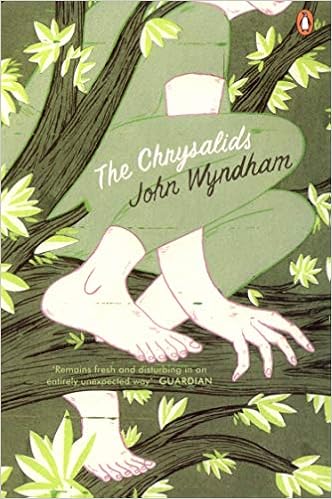
The Chrysalids, by John Wyndham, 1955

KEEP PURE THE STOCK OF THE LORD; WATCH THOU FOR THE MUTANT.

What did novelists do for their plots and settings before the Cold War and the possibility of a post-apocalyptic primitive society? Although writers have always speculated about the end of the world, it was only really once the apocalypse became a practical, foreseeable possibility that science fiction kicked into gear and began imagining how the survivors might live.

In Wyndham’s post-apocalypse Canada, set many years after “the tribulation” which has destroyed most of humanity and caused serious problems with birth deformities, society is slowly recovering, in part by following a strict system of genetic purity. Their form of fundamentalist Christianity (they wear a cross on the front of all clothing) believes that to avoid another Tribulation they must enforce a rigid definition of normality. This inevitably forces them to practice eugenics in which any minor mutation or difference is considered blasphemous. Aberrant crops are destroyed, babies are euthanized if they display the slightest variation and failed to pass inspection. Other human mutations not apparent at birth are subsequently sterilized and banished.

We learn about this society through the narration of David Strorm, a young man from the rural community of Waknuk. David dreams of cities, planes and horseless carts, but he keeps these dreams secret to avoid suspicion – difference even of the imagination is feared. He befriends Sophie, a girl who hides the fact she has six toes on her feet. Sophie’s mutation is discovered and her family are forced to flee. This is how David and the reader learn how difference is treated in Waknuk. But David has another darker secret – he and other local children are telepaths, able to communicate in thought pictures across distance. They are the Chrysalids of the novel’s title, a new advanced form of humanity, a larval form of something more than homo-sapiens, and therefore taboo in their society.

The group keep their powers hidden with the help of David’s sympathetic uncle, Axel, who goes to the extreme of killing the husband of one of the group’s members who was planning to blackmail them. David’s younger sister Petra develops telepathic powers as she grows, and it becomes clear that these are of a different order from the others – when her horse is attacked by a predator she calls telepathically for help across the entire region, stunning those closest to her. This arouses suspicions. Two members of the group are tortured for information, causing David, his cousin Rosalind and Petra to run for their lives.

The future following a nuclear holocaust was never going to be much fun. Wyndham shows humanity slowly recovering, and exercising genetic purity as a difficult but necessary discipline. Any discussion of eugenics only a decade after the Second World War and the holocaust was always going to be difficult topic, but Wyndham doesn’t blink from the upsetting issues it presents. Good science fiction is about more than just technology, but uses the scenario as a springboard for a discussion of moral and philosophical issues. Here Wyndham uses the tribulation as an allegory for the tensions between change and conservatism in post-war 1950’s Britain and a meditation on difference, both visible and hidden.

Is this a novel for young adults? Definitely. It may not have been written as such, but most teens will enjoy the growing awareness of David’s special abilities, the knowledge that he is not alone, and the exciting pursuit of the young telepaths across a landscape peopled by mutants. The novel’s conclusion however is its weak point. Wyndham wraps things up with a brisk deployment of deus ex machina as a rescue party of scientifically advanced telepathic New Zealanders contacted by Petra arrive in the midst of a battle between the Waknuk settlers and their genetically challenged enemies. It’s not quite a happy-ever-after ending – the New Zealanders are in some ways as brutal eugenicists as the Waknuk fundamentalists. But any doubts about the wisdom of their approach are waved aside as David and friends are whisked away to New Zealand where their technological society is presented as a utopia. This is fundamentally an optimistic novel – nuclear war can be survived, and a better world will emerge despite the forces of reaction.

Standard
Book review

Mostly Harmless, by Douglas Adams, 1992

There’s an obvious, I might even say lazy, reading of Mostly Harmless that goes something like this:

It is well known that Adams struggled with writing these novels. His lack of interest in the process is apparent in the steady decline in quality across the series, ending with this novel in which the plot is confused, the multiverse theory is wheeled out several times to explain away any inconvenient plot holes, and the ending is the author slamming the door on any further possible sequels. (In fact this novel was published posthumously, so that wasn’t really an issue as it turned out!) The dark and frankly depressing tone of the novel is largely a feature of Adams’s melancholy mood during the time he wrote it.

And of course much of that is true. The question is not whether this is a fair summary of the novel but whether there is something more interesting to be said about it?

Mostly Harmless, the fifth book in the “increasingly inaccurately named Hitchhikers’ Trilogy” derives its title from a joke earlier in the series, when Arthur Dent discovers that the entry for Earth in The Hitchhiker’s Guide to the Galaxy representing 15 years’ worth of research by Ford Prefect, consists of the word “Harmless”, which is later updated toMostly harmless”.

Arthur Dent, the one constant throughout the series, loses the love of his life, his girlfriend Fenchurch, when she disappears into an alternative time stream during a hyperspace jump. An understandably depressed Arthur wanders the galaxy, eventually ending up stranded in yet another lonely planet, where he decides to become a sandwich maker, as one does. In a parallel storyline, Ford steals a new and as yet-unpublished version of the Hitchhiker’s Guide as an act of rebellion against the guide’s new owners. In a third strand Tricia MacMillan is tortured by the thought of what her life might have turned out to be if she had left with the alien she once met at a party who invited her to travel the galaxy with him. Finally a Trillian from a separate timeline conceives a child, Random Dent, using donated sperm from Arthur.

Now if you step back a minute there’s no doubt that this as a plot outline shows some promise. Admittedly there is a considerable amount of repetition from previous novels – being stranded on a lonely planet is pretty much where we started after all (with Ford on earth). The satire is a bit heavy-handed, and the multiverse idea isn’t exactly original. But it’s a good start nonetheless. Tricia/Trillian finally gets some serious page time being more than just arm-candy for Zaphod, and the idea of the unintended consequences of over-enthusiastic sperm-donation coming back to haunt the donor is worth pursuing. So I think what I am trying to argue is that there is a good novel here struggling to get out, but not quite making it. The re-imagining of the guide as a sinister force that can navigate through time and space, inhabiting all possible universes at the same time, takes the quite benign original concept of the guide – not much more than a book after all – and turns it into a destroyer of worlds. The ending, with Ford laughing wildly at the absurdity of the universe, and Arthur finally experiencing a “tremendous feeling of peace”, feels like an entirely fitting way of Adams’s saying goodbye to his characters. 


Mostly harmless is undeniably bleak at times. Its plotlines are often left dangling – I would really like to know what happened to Fenchurch, Zaphod and Trillian for example. But (and I am very conscious I have written this many times before, of other writers and possibly of Adams as well) a badly constructed, bleak, and confused novel by Douglas Adams is still a thing of great joy. With more time this might have been a fitting finale to the series.


Standard
Book review

So long, and thanks for all the fish, by Douglas Adams, 1984

It will not take most readers long to work out that So Long and Thanks for All the Fish, the fourth book in the Hitchhiker’s Guide to the Galaxy trilogy, is a very different type of novel from its predecessors. These were all (more or less) novelisations of other iterations of the story, mainly the radio series in which Hitchhiker first appeared. Fast paced and fizzing with ideas, these earlier novels can be consumed in one sitting. So long, on the other hand, is a much more reflexive novel. Adams tries to capture some of the spirit of Hitchhiker etc, but eventually settles down to a much more traditional, earth -bound romance. 

At the end of Book 3 in the series, Life, the Universe and Everything, Arthur Dent, Adams’s eternal everyman, and his alien friend Ford Prefect were stranded on earth millenia before the present day. Things have now obviously moved on, because Arthur and Ford are no longer together. This is really Arthur’s novel, and Ford fades into the background playing only a minor role towards the end.  Having hitchhiked across the galaxy, Arthur is dropped back on Earth, even though the planet was. as you will recall, destroyed by the Vogons to make way for a hyper-space bypass. Arthur is surprisingly calm about this, and continues to do what he knows best – hitchhike, restlessly trying to understand what has happened to restore the earth, and where all the dolphins have gone? He has a hunch the two things are connected.

On his travels he catches a lift with a man named Russell and his sister Fenchurch. Fenchurch is withdrawn and uncommunicative, and Russell hints that she is mentally unwell. It slowly becomes clear that Fenchurch’s condition is connected to the demolition of the Earth and its subsequent reappearance, which the rest of the population avoids thinking about by claiming it was mass hysteria. Arthur is fascinated by Fenchurch, partly because he is strongly attracted to her, but also because he suspects that she is one of very few people left on earth who might be able to understand what he has experienced.

As the novel unfolds their paths keep crossing and uncrossing. Arthur finds Fenchurch hitchhiking, gives her a lift, but on parting manages to lose her phone number. He then miraculously rediscovers her by searching for the cave he lived in on prehistoric Earth – her flat is on the same spot on this quasi-Earth. There is something strange about Fenchurch, and it is only when Arthur finally works it out that they are able to properly connect with one another. It transpires that Fenchurch was the woman mentioned in passing in the opening chapter of the previous novel who, moments before the earth’s demolition, had stumbled across the answer to life, the universe and everything. Someone who in the previous novel was just a throw-away gag becomes here a central character. The destruction of the earth had interrupted her epiphany, and Fenchurch is now left with a nagging sensation that a tantalising breakthrough is just out of reach – and the thought is making her ill.

Eventually, they are reunited with Ford Prefect, and they set off once again across the universe to visit the planet where God’s Final Message to His Creation is written, in the hope that it might give them some peace. On the way they encounter Marvin, the paranoid android, still as misanthropic as ever, but now some 37 times older than the known age of the universe and on his last circuits.

Neil Gaiman’s introduction reveals some of the pain Adams went through in composing So Long, but if you didn’t know it would probably still be apparent. At one point for example he retells in detail an urban legend (the one about the man sitting opposite you in a cafe who helps himself to your biscuits). It’s exquisitely told, but it’s padding nonetheless. (There was a point to this story, but it has temporarily escaped the chronicler’s mind.) Gaiman reveals that Adams’ editor moved in with him in a vain attempt to ensure that the book was completed to deadline. This might have led to some of the unevenness of tone of the novel, a feeling that every word was an effort and that the end comes as much to a relief as Adams as it did to Marvin. But a bad book by a genius can’t but help but be a work of genius, even if it is flawed. There are many moment to savour in So Long, not least the title which like many of Adams’s phrases has entered the general lexicon. This is not Adams at his best or his most inventive, and the jokes are a little dated (“There is a feeling which persists in England that making a sandwich interesting, attractive or in any way pleasant to eat is something sinful that only foreigners do.”) but it must still be treasured as part of the wider contribution he made to our culture.


Standard
Book review

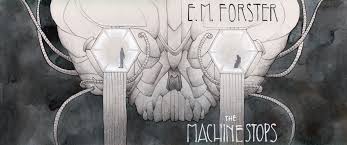
The Machine Stops, by E M Forster, 1909

The Machine Stops is a strangely prescient Edwardian novella by an author better known for his writing on the delicate nuances of class behaviour amongst English people abroad. I tend to think of Forster as a modernist, but this text is closer to the Victorian science fiction of Wells and Verne than it is of the Bloomsbury authors Forster is commonly associated with. Forster

In The Machine Stops Forster describes a world set far in the future, where humanity lives underground, all their needs met by the omnisicient, all powerful, ‘Machine’. People live alone in isolated cells and only communicate using a version of skype (obviously Forster doesn’t call it that, he wasn’t that far-seeing, but that’s what it in effect is, even down to the fact that nuances of expression are lost on the video screens) and avoid all physical interaction with one another. They also appear scared of the sun, which I believe is intended to remind us of Wells’s troglodyte Morlocks in ‘The Time Machine’.

Vashti, a “swaddled lump of flesh”, is the character we follow through the eyes of an omniscient narrator. The story opens thus:

“Imagine, if you can, a small room, hexagonal in shape, like the cell of a bee.”

Who is it that is inviting us to imagine this room? Someone is telling us a story about a time set a long way in our future, but also I would suggest, in the past of his hypothetical audience, when cell-living, near universal in the time of the Machine, is no longer the norm, so much so that it has to be pictured rather than just known. Thinking of an hexagonal room requires no great feat of imagination unless it is or has become something out of the ordinary. Is this Forster inviting his 1909 readers to imagine a future, or the narrator looking back on the time of the Machine before its stopped?

Some of this writing is clumsy – ‘hexagonal in shape’ – is tautology surely? “Hexagonal” would have sufficed. However the room’s shape leads the narrator to the text’s first, complex, image – it is like both a cell and simultaneously like part of a beehive. The use of the word cell suggests that Vashti – and everyone else living in the control of the machine – is its prisoner, entirely dependent on it for food, water, light etc. At the same time the room is part of a hive community, in which everyone has a pre-determined role in life and little choice in their future.

Vashti is contacted unexpectedly one day by her son Kuno, who has a mysterious message he can only tell her face to face. Against her best instincts she travels by plane to his cell, where he outlines his concerns about the Machine and the soullessness of existence underground. He hints that the surface world is not, in fact, uninhabitable, as people have been led to believe.

Vashti rejects her son’s confidences, and returns to her empty life of routine and order. Rather than stopping suddenly the machine slowly begins to fail over a period of years, before an final cataclysmic collapse in which Vashti, Kuno, and everyone else living underground dies.

The topicality of Forster’s observations about the risks of mankind becoming overly dependent on technology need hardly be spelled out. We are now all highly reliant on machines, (rather than a machine), but we are still vulnerable to the kind of technical or mechanical failure Forster anticipates. We also live very sheltered, sedentary lives compared to our grandparents, and are retreating from nature. In other words technology is a mixed blessing. Forster also anticipates the rise of social media, and its impact on social relationships. He notes of Vashti that

“she knew several thousand people; in certain directions human intercourse had advanced enormously.”

But is the text ultimately anything more than a curiosity? Certainly it is that, without doubt, but I am not surprised Forster moved on to novels about middle class people and their subtle class distinctions, because as a story The Machine Stops is a failure. The two main characters are two-dimensional. The ending is sign-posted in the title, so hardly comes as a surprise. And as social commentary the story is a little preachy. When you compare what Wells was able to do with similar ideas one begins to appreciate how little Forster makes of his unquestionably original insights.


Standard
Book review

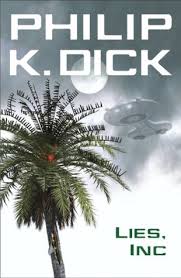
Lies, Inc, by Philip K Dick

I can count on the fingers of one hand the number of books that I have failed to finish in the last few years. Mainly this has been through sheer stubbornness – I can’t imagine any other reason why anyone would work their way through the nine volumes – nine! – of Samuel Richardson ‘Clarissa’, or get beyond the first few pages of F R Rolfe’s hilariously bad ‘Hadrian 7‘. But I didn’t finish, or get beyond halfway, Philip K Dick’s ‘Lies, Inc’.Lies inc

‘Lies, Inc’ was originally a short story, ‘The Unteleported Man’. It’s a perfectly ordinary sci-fi story about the establishment of a space colony. For reasons known only to himself, Dick decided to turn the story into a novel. Instead of expanding the plot, adding characters, etc, he injected (deliberate choice of verb) a long middle section involving a drugs trip. Characters turn into rats, the plot collapses, and frankly it becomes utterly unreadable.

Don’t just take my word for it. I turned to Goodreads to try and find out whether I was missing the point somewhere, and there is a strong consensus that this novel is an utter car crash. One reviewer advised that even PKD completists should avoid it, reserving it only for ‘PKD masochists’.

Continue reading

Standard
Book review

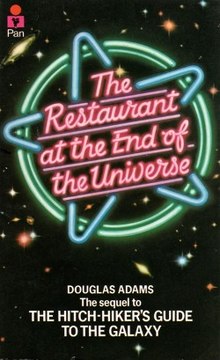
The Restaurant at the End of the Universe by Douglas Adams, 1980

The Restaurant at the End of the Universe, the sequel to The Hitchhiker’s Guide to the Galaxy, picks up immediately where Hitchhiker ends, with our hapless adventurers under attack from the Vogons, despite there being no tea. Having faced imminent death 220pxRestaurantAtTheEndOfTheUniverse.jpgseveral times before, this causes them less concern that you would expect, and another last minute rescue leads to the party (Arthur Dent, earthling, Trillian, hitchhiker, Ford Prefect, researcher for the Hitchhiker’s Guide to the galaxy, Zaphod Beeblebrox, President of the Galaxy, and Marvin, the paranoid android) being separated once again.
Zaphod and Marvin are transported to the offices of The Hitchhiker’s Guide to the Galaxy on Ursa Minor Beta. Zaphod is determined to trace down whoever left a message in his brain, even if it turns out to be himself. The Guide’s offices are taken prisoner and carried to Frogstar World B. FWB is a benighted planet whose economy has been ruined by a critical mass of shoe shops. The intention is to destroy Zaphod’s mind by sending him into the Total Perspective Vortex, a torture device designed to show people how small they are compared to the size of the Universe. Zaphod emerges unscathed because after all, he is Zaphod Beeblebrox.

Through some trickery with artificial universes, the party is reunited long enough for breakfast at Milliways, the Restaurant at the End of the Universe. Marvin has to take the slow route, parking spaceships while waiting for the humans to arrive (or is it return?). The Restaurant at the End of the Universe is one of Adams’s most magnificent creations. I always loved the selectively bred cow that actually wants to be eaten:

“Four rare steaks please, and hurry, we haven’t eaten in five hundred and seventy-six thousand million years.”

The animal staggered to its feet. It gave a mellow gurgle.

‘A very wise choice, sir, if I may say so. very good…I’ll just nip off and shoot myself.” He turned and gave a friendly wink to Arthur. “Don’t worry, sir” he said, “I’ll be very humane”. 

There’s a very special, poetic aspect to the way the end of the universe is described by the show’s host, undercut by the Second Coming of the Prophet Zarquon. We also get to meet Hotblack Desiato at the restaurant, a rock star spending a year dead for tax purposes. After a further narrow escape from imminent death, this time by diving into a star to provide backing effects for a rock concert, which is to be honest a pretty rock and roll way to go, Zaphod and Trillian get to meet the man who runs the universe, while Arthur and Ford discover the origins of life on earth, and why everyone is so bloody useless (which is probably something to do with the fact that we are all descended from hairdressers and telephone sanitisers).

Adams’ commentary on modern life is razor sharp. I especially enjoyed the way the Golgafrinchams (Ark B) make leaves their currency to disprove the argument that money doesn’t grow on trees, and then tackle their galloping hyperinflation by burning down all the forests. Isn’t that austerity economics for you? I was slightly concerned that Restaurant wouldn’t sustain the brilliance of Hitchhiker, but I shouldn’t have worried. Yes there are some uneven patches – I never quite understand the point of Zarniwoop –  but the concepts are extraordinary and the jokes never miss. Marvin continues to be a paradoxical source of joy (“The first ten million years were the worst,” said Marvin, “and the second ten million years, they were the worst too. The third ten million years I didn’t enjoy at all. After that I went into a bit of a decline”). I think it is best not to see ‘Restaurant’ as a sequel but more as the second half of ‘Hitchhiker’, best read one after the other with as short a break as possible. I am minded not to push on with the third, fourth and fifth books of the trilogy – I absolutely understand why they were written, but there is a certain polished perfection to these two novels that might be tarnished by anything that doesn’t meet their sustained genius. What do people think?

Standard
Book review

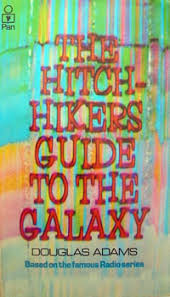
Hitchhiker’s Guide to the Galaxy, a trilogy in five parts, Douglas Adams, 1979

When the world is demolished to make way for an intergalatic bypass, Arthur Dent, one of only two survivors (and an alien, some dolphins, and two mice) embarks on an extraordinary journey to discover the answer to the great question of life, the universe and everything.

Re-reading ‘Hitchhiker’ after far too many years was a delight. It was like meeting an old friend for a few wonderful hours. Having grown up with the radio series, then the books, the television series, and finally the film, long stretches of the text were as familiar as a long lost childhood toy. Hitchhiker forms a central part of the cultural zeitgeist of the late 70’s and 80’s. Concepts such as the babelfish, the infinite improbability drive, Marvin the paranoid android (“I think you ought to know I’m feeling very depressed”) the Adamsrestaurant at the end of the universe, and life the universe and everything, now have their own existences far beyond the confines of this novel.

There’s a wonderful rhythm and pace to this novel which it is hard to convey from short excerpts, which provides an excellent excuse to quote the extended section from the visit to Magrathea at the end of this review. Adams is a master at setting up jokes, and is never happier than when interrupting the plot development for a bit of silliness. The premise of the guide being allowed to explain the concepts and background to the reader, rather than using character exposition, also works really well and is one of the many pleasures of this fabulous novel.

If I were to describe Hitchhiker as a science fiction novel a proportion of potential readers would switch off. Sci-fi is perceived as a male dominated arena, where character is secondary to world-building. There are certainly a lot of scientific ideas in the novel, and much of it happens in outer space, but Hitchhiker defies simple categorisation. Above all it is funny, funny in wise and interesting ways. Adams had a way of looking at the world which made it fresh, and had fun with language, such as here, when Ford Prefect, the hitchhiker from Betelguese, warns Arthur Dent, (I can never see his name without repeating the silly joke ‘Dentarthurdent’) the novel’s permanently bemused everyman, that jumping into hyperspace feels like being drunk:

What’s so unpleasant about being drunk?”

“Ask a glass of water!”

And here is a wonderful example of Adams’s silliness, combined with the ability to make the reader think, the extended quote promised earlier:

 “Another thing that got forgotten was the fact that against all probability a sperm whale had suddenly been called into existence several miles above the surface of an alien planet. And since this is not a naturally tenable position for a whale, this poor innocent creature had very little time to come to terms with its identity as a whale before it then had to come to terms with not being a whale any more. This is a complete record of its thoughts from the moment it began its life till the moment it ended it.

Ah … ! What’s happening? it thought.

Er, excuse me, who am I?

Hello? Why am I here? What’s my purpose in life?

What do I mean by who am I?

Calm down, get a grip now … oh! this is an interesting sensation, what is it? It’s a sort of … yawning, tingling sensation in my … my … well I suppose I’d better start finding names for things if I want to make any headway in what for the sake of what I shall call an argument I shall call the world, so let’s call it my stomach.

Good. Ooooh, it’s getting quite strong. And hey, what’s about this whistling roaring sound going past what I’m suddenly going to call my head? Perhaps I can call that … wind! Is that a good name? It’ll do … perhaps I can find a better name for it later when I’ve found out what it’s for. It must be something very important because there certainly seems to be a hell of a lot of it. Hey! What’s this thing? This … let’s call it a tail – yeah, tail. Hey! I can can really thrash it about pretty good can’t I? Wow! Wow! That feels great! Doesn’t seem to achieve very much but I’ll probably find out what it’s for later on. Now – have I built up any coherent picture of things yet?

No.

Never mind, hey, this is really exciting, so much to find out about, so much to look forward to, I’m quite dizzy with anticipation …

Or is it the wind? There really is a lot of that now isn’t it? And wow! Hey! What’s this thing suddenly coming towards me very fast? Very very fast. So big and flat and round, it needs a big wide sounding name like … ow … ound … round … ground! That’s it! That’s a good name – ground!

I wonder if it will be friends with me?

And the rest, after a sudden wet thud, was silence.

Curiously enough, the only thing that went through the mind of the bowl of petunias as it fell was Oh no, not again. Many people have speculated that if we knew exactly why the bowl of petunias had thought that we would know a lot more about the nature of the universe than we do now.”

(Gloriously, this quote in Goodreads has the following tags: petunias, sperm-whale).

If you haven’t read Hitchhiker’s by now, chances are you probably won’t, but I am still going to recommend you do anyway. It will only take you an afternoon, at most, and if you hate it then what have you lost? If you love it just a small fraction as much as I and so many other people do, you’re welcome.

Standard