Having recently broken my short story review duck, I decided to read another collection, this time by the Edwardian modernist E. M. Forster. This edition, available as a Penguin 20th Century classic, is a good introduction to Forster, because it so clearly demonstrates what is wrong with his work, avoiding the need (if you are lucky enough to start here) to go on and read the novels.
The problem is essentially one of perspective. All of these stories, and I think this comment also applies to many if not all of the novels, are written from the narrow upper-middle class point of view from which Forster is never able to move away, no matter how he tries. All his point of view characters are to a greater or lesser extent prosperous, never seem to have to work, have servants or paid companions, and can afford long, indulgent if apparently unenjoyable journeys across southern Europe. Working class people and foreigners do appear in Forster, but the world is never seen from their perspective, and to be blunt they always seem two-dimensional participants.
Forster does, to be fair, consistently side with the people who are polite and condescending to these “others”. In novels such as Howards End and Where Angels Fear to Tread this extends as far as being able to contemplate relationships across class and national divides, but these relationships almost always end in tragedy or violence. Howard Bast is murdered, (Howards End) Gino loses his wife and baby (Where Angels) and Dr Aziz (Passage to India) has his life ruined by the false accusations made against him. Here the Greek family who are kind to Mr Lucas in The Road from Colonus are wiped out in a freak accident the day he moves on.
I don’t know whether Forster was unable to see the world through the eyes of the people who obviously fascinated and attracted him, or simply chose to write about what he knew. The relentlessness of yet another group of fussy English people settling into yet another picturesque Southern European town, with its hotels, its funny foreigners, the stereotypical alpha-male trying to assert himself by speaking English loudly, the older women, often in pairs, fussy about their luggage, eventually becomes wearisome.
Forster kept his sexuality a well-guarded secret in his lifetime, refusing to publish Maurice until after his death, but the homo-erotic gaze is also apparent here, not least in The Story of the Siren where a young Italian diver entrances the narrator:
“With a jerk he became alive, seizing my arm and saying “…I will show you something beautiful”….He drew me away from the light till I was standing on the tiny beach of sand…there he left me with his clothes…for a moment he stood naked in the brilliant sun…the man is past all description. His effect was that of a silver statue.”
(I’ve edited some text here to emphasis the point. Quite why he needs to be naked to go diving to recover a book, which surely would have floated anyway (thus avoiding the need for the naked diving) is unclear.)
These stories differ from the novels in one important way, and that is in their handling of the supernatural. In the introduction to the 1947 edition Forster describes them as “fantasies”. An element of the other-worldly is introduced in most tales. In some it is creatures such as Pan, fauns or sirens; in others it is the afterlife – one character goes to heaven, finds it boring, and leaves. Another character escapes from a boorish fiance by becoming a tree. At some points these injections of fantasy seem largely whimsical, and to this reader at least a little nauseatingly so. Elsewhere the allegorical nature of the tale is more obvious. In The Other Side of the Hedge for example, life is described in Bunyanesque terms as a walk beside a hedge, on one side of which is a hard-paced race with no obvious end in sight, and on the other an Elysian paradise of fields and recreation.
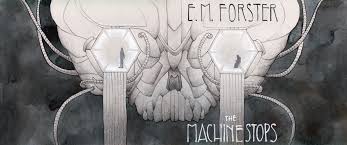
The Story of a Panic, the first story in the collection, demonstrate many of the inherent problem in Forster’s use of the fantasy genre. It is a silly melodramatic story about a sulky teenage boy, Eustace, (possibly the inspiration for Eustace Scrubb?) who one day, while on a walk in the ubiquitous Italian countryside, is possessed by the spirit of Pan. Instead of narrating the story in a way that is at least marginally sympathetic to the child, giving us some insight into what happens to him, Forster narrates the tale through the eyes of an older English tourist, who insists on being addressed formally, and looks sneeringly down on the Italians working in the hotel. This strange little mis-firing tale establishes the template for many of the other stories in the collection, where essentially the same mystical experience is predictably repeated using the same set of characters and features. The tiresome and repetitive nature of these motifs almost became too much for me by the end of the collection, to the point where I didn’t want to read on because a) I knew what was coming, and b) I felt patronised by it. The most interesting story in the collection, The Machine Stops, which I reviewed earlier this year, is an exception to the fantasy genre, and is all the more refreshing for it.