Book review

We Solve Murders, by Richard Osman, 2024

I think it would have been a reasonable assumption that in moving away from The Thursday Murder Club, Richard Osman was going to try something a bit different. He strongly implies as much in the acknowledgements to the fourth book in the series. Yet while We Solve Murders superficially inhabits a totally different world from the TMC series, if you scratch the surface we are right back in Coopers Chase.
We Solve Murders introduces the reader to Amy Wheeler, a bodyguard to the rich and famous. Amy is seriously hard-core, totally unafraid of the dangerous life and death situations she regularly finds herself in. She has a long-distance relationship with her husband, who plays only a very minor role in the book, but seems much closer to her father-in-law, retired copper and widower Steve. Steve loves his quiet life – pub, crossword, and chatting to his late wife – and is very reluctant to be pulled away from this retirement when Amy calls for his help. Amy’s client, Rosie D’Antonio, the world’s second most successful novelist forms the unlikely third wheel of this team as they career around the world trying to do what the novel’s title promises they will – solve murders.

Because someone has been killing influencers – young naïve people with small social media followings who travel to exotic locations to promote brands that mysteriously don’t seem to actually exist. This isn’t really one of the novel’s puzzles – we are told by the novel’s criminal mastermind who narrates occasional chapters that these killings are a retaliation for when his money smuggling operation is called into question. While the use of gullible and well-meaning influencers to unwittingly move money around the world is an innovative idea, I am not sure that’s how money smuggling really works anymore, is it? Surely it’s moved around online nowadays? Not that I claim any expertise in this issue I hasten to add. Amy is set up as the fall guy for the murders, which is a really silly choice as she is not going to allow this to happen without putting up a ferocious fight.

While the novel is set in several exotic locations – a private island off the coast of South Carolina, St Lucia, Dubai, and Dublin (!) – there’s no real sense of place in any of them. They could have been anywhere. I had to wonder whether these locations were chosen more for the inevitable film adaptation than the narrative? There’s also no really sense of peril – Amy, Steve and Rosie are held at gun-point and shot at more than once, but I didn’t for a second think they were going to die. Neither did they if the way they respond is to be believed – plot armour is one thing, but characters behaving as if they know they have plot armour is another!

Rosie is a source of much of the novel’s slapstick comedy – she is an archetypical randy pensioner, and being incredibly rich she can conveniently summon up private jets and helicopters at a moment’s notice. She has a sense of adventure which means she can be extremely reckless, in counterpoint to Steve’s deeply conservative instincts. He always yearns to be back home with his cat, Trouble. The novel’s ending is both predictable and to be honest not that interesting – the exposure of the bad guy’s identity is very much a ‘so what?’ moment. But that’s missing the point, because this is cosy crime after all, however badly disguised as a thriller, and it’s the gentle humour that keeps the pages turning, not any sense of adventure. One of the novel’s climactic scenes happens at a pub quiz, which tells you all you really need to know.

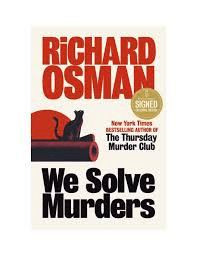
The hard-back edition of this novel has a strangely neutral design – it’s definitely moved away from the distinctive Thursday Murder Club ‘branding’ – but to where? The author’s name dominates the front cover, and the portrait of Trouble is the only real ornamentation on an otherwise stark black and red design. I think it reflects some uncertainty on the part of the publishers – whether to market the novel as ‘more of the same’ (the text “Best selling author of the Thursday Murder Club” appears above the title) or a new direction for the author. I can’t blame Osman for staying close to what has been a hugely successful and rewarding formula for him. It may not seem like it but I did enjoy reading We Solve Murders despite my reservations, but I wasn’t challenged by it in any way. Osman is by now such an accomplished novelist that as a reader you can leave yourself in his hands knowing he is going to safely guide you to the conclusion with everyone you care about in one piece, all ends neatly tucked away and the opening lines to the sequel already inked in. (In fact I fully expected the opening chapter of the sequel to appear at the end of this edition – it’s that kind of book – but it didn’t; instead we are neatly guided back towards TTMC).

In conclusion, you won’t be at all surprised to read that if you enjoy TTMC you will enjoy We Solve Murders. I do and I did.
We Solve Murders, by Richard Osman, 2024

Aside
Book review

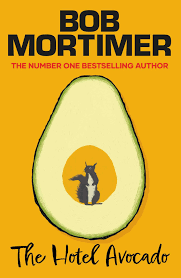
The Hotel Avocado by Bob Mortimer, 2024

My track record for predicting how celebrity novelists are going to pursue their novel series is poor. I predicted Richard Osman would kill off one of his main characters in the second instalment of the Thursday Murder Club, but after four novels in the series they are still all going strong. Then n my review of The Satsuma Complex I forecast that it would be a one-off and we would hear no more of Gary, Emily and Grace – which was equally off-target!

The Hotel Avocado is the sequel to The Satsuma Complex (are we going to see a series of fruit based novel titles from television’s latest national treasure?) Set almost immediately after the events of Satsuma, Emily has inherited her father’s hotel in Brighton and started to renovate it. Gary remains working in his law firm in London, travelling down to see Emily at the weekends. He has to decide whether to commit to his relationship with Emily and move down to live with her in Brighton, leaving his neighbour Grace to a rather lonely life, or whether he tries to make a long(ish) distance relationship work. Emily seems content with the relationship as it is – she is working flat out on preparing the hotel for opening and has no time in the week for romance or relationships. Her plans for the hotel are greatly helped by Mark her very hard working but socially awkward facilities manager and Pete, her super-efficient painter and decorator. Things are complicated by the fact that Emily and Pete once dated and clearly retain a residual attraction for one another.

Both Gary and Emily flirt with breaking relationship boundaries. Gary invites a work friend, Roma, to sleep over at his flat, and Emily gets uncomfortably close to Pete. While neither are unfaithful the implication is that their relationship is vulnerable. All that becomes rather redundant when the main plot line of The Satsuma Complex resurfaces. The end of that novel left Gary waiting to be a key witness in the trial of several corrupt Metropolitan police officers. He is visited by the menacing Mr Sequence and his equally violent sidekick Brian, and offered money not to testify at the forthcoming trial. It is made very clear what will happen to him if he refuses. He can’t go to the police over these threats and attempts to pervert the course of justice, because the corrupt officers have friends still on the Force. Gary flees to Brighton, but Sequence and Brian track him down – they always seem able to predict his movements – and Emily and her hotel are dragged into the affair.

For a comic novel, the scenes in which Gary and Emily are menaced with increasing ferocity by Sequence and Brian are quite dark and slowly come to dominate the novel. People get hurt with the promise of a lot more to come. The bad guys are convincingly violent and uncompromising and there’s little Gary can do to protect himself and his loved ones other than comply with their threats. The whimsy that dominated the first novel fades into the background as Emily and Gary are bullied, menaced and beaten. In a sub-plot Emily applies for planning permission to hang a massive avocado sign outside her hotel as an advertising feature and bribes the chair of the planning committee to ensure permission is granted. When it is refused she installs it anyway and the sign quickly goes viral.

Surprisingly I actually preferred the crime elements of this novel compared to the quirky comedy. They don’t always sit together comfortably and while we know that Gary and his friends will be OK in the end, there aren’t many laughs in these scenes. But I thought they showed signs of more care and attention from the author – once freed from the burden of trying to make the reader laugh he can get on with telling what became a quite gripping story. The element of peril was real – or as real as it can get in a comic novel. We also see fewer autobiographical elements in the novel (unless the author once ran a hotel in Brighton) as the author moves away from his source material, which helps give the narrative more freedom. Slowly the potential of the author as a serious novelist, rather than (god-forbid) someone cashing in on his celebrity, is emerging.

The Hotel Avocado by Bob Mortimer, 2024

Aside
Book review

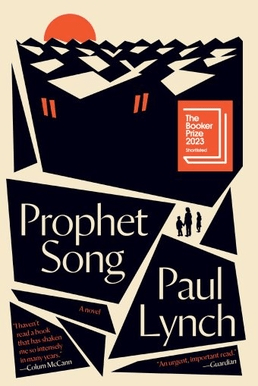
Prophet Song, by Paul Lynch, 2023

Wow. Prophet Song is the most impactful novel I have read in a very long time. Some critics have compared it to 1984 and The Handmaid’s Tale, and I think they are right. At one point I found reading it so traumatic (if you have read it you will know immediately what scene I am referring to) that I had to put the book down for 24 hours. It’s extraordinary.

The novel is set in Dublin shortly after the election of a far-right nationalist Government, the National Alliance Party. No specific timescale is given but everything else in the novel is set in the present. The Government introduces emergency powers that are in effect martial law. A new quasi-military police are given far-reaching powers to quash any dissent or opposition, a classic fascist strategy. Events are told through the Slack family. Larry, a teacher and trade unionist, is arrested and held without charge while attending a protest. He quickly becomes one of the disappeared, a non-person whose existence is denied by the state. Human rights lawyers trying to locate the disappeared are themselves threatened and arrested. Larry leaves behind Eilish, his wife; Mark, their sixteen-year old son son; their daughter, Molly; thirteen-year-old Bailey; and baby Ben. Amnesty International says that “Enforced disappearance is a crime under international law and an insidious practice that not only persists as a relic of past conflicts but also still looms large as a contemporary instrument of oppression used by the states across the world as a tool to silence dissent and instill fear.”

Lynch’s brilliance in setting Prophet Song in Ireland begins to pay off. This is not some distant South American banana republic where human rights have only ever tenuously existed – this is a modern European country. But people were disappeared in the states of the former Yugoslavia – Bosnia, Serbia and others – and there is evidence of this happening in the Ukraine as well. Being European is no guarantee of human rights, and if we think of flagrant breaches of human rights as being something that happens elsewhere, we are wrong. But the Irish setting has an even deeper impact that this, because in Northern Ireland people were ‘disappeared‘ in the 1970’s by masked armed men appearing at their doors in the night, taking them away to be shot in the head in some remote countryside, never to be seen again. (For the avoidance of any doubt, of course I understand that Northern Ireland and Ireland are not the same country – but the experience of the Troubles affected people from both sides of the border, and that shared trauma clearly forms a backdrop to Prophet Song). Lynch also seems to be drawing inspiration from the approach taken Margaret Attwood in The Handmaid’s Tale in which everything that happens in the novel has happened in real life elsewhere in the world.

As well as her family, Eilish cares for her father, Simon, who has dementia. Vulnerable people – the very young and the very old in particular, suffer disproportionately in times of unrest. Simon has occasional bouts of lucidity during which he encourages Eilish to take the rest of her family and leave the country, but she stubbornly refuses, despite being warned that “History is a silent record of people who could not leave“. It is not as simple as that – history is also “a record of those who did not have a choice, you cannot leave when you have nowhere to go and have not the means to go there, you cannot leave when your children cannot get a passport, cannot go when your feet are rooted in the earth and to leave means tearing off your feet.”

Mark is called up for military service shortly before he turns seventeen. He refuses to support a regime which has captured and possibly killed his father, and goes into hiding. Refusing his mother’s attempts to persuade him to leave the country he joins a rapidly growing force fighting to overturn the regime. At this point Mark fades from the narrative like his father before him. The rebel force make progress and capture parts of Dublin, providing a glimmer of hope, but the fighting intensifies in Eilish’s area, with bombs falling on the houses and streets. Daily life becomes more and more dangerous, with civilian casualties inevitable. The rebel forces are not portrayed as saviours but as equally vicious as the Government forces. Bailey is seriously wounded during a shelling attack. Eilish tries to take him to hospital but it is being bombed and evacuated. She finds another hospital but when she returns the next night to check on him he has also been ‘disappeared’, apparently taken as a suspect rebel soldier despite his age. Finally, in a desperately upsetting and gruesome scene Eilish finds his broken body in the morgue, showing signs of having been tortured before being killed. Initially my instinctive reaction to this traumatising scene was that Lynch had gone too far, that the Government forces would have no reason to torture a young teenager, but a moment’s thought made me realise that such scenes are happening right now across the world, that age is no protection for children in war zones, (the ongoing tragedy in Gaza was brought vividly to mind) they have no special status, and that the idea this could not happen in a Western Europe capital is simply wrong.

Somehow Eilish finds the strength to go on, and she flees with her two remaining children as refugees from the fighting, trying to cross the border into Northern Ireland. This becomes a story of ‘illegal’ immigrants, so stigmatised in the UK and across Europe at the moment. The refugees are exploited by people smugglers and corrupt border crossing guards. Seeing this experience through the eyes of already traumatised people (as of course refugees often are) humanised the refugees in the face of the often heartless headlines we read about ‘economic migrants’ and the rest.

Lynch’s point – that these things could so easily happen to us, as they are already happening to so many people, and we should reject any complacency that ‘it can’t happen here’ – is inescapable. If there were to be any doubt, towards the end of the novel he drives the point home:

“and the prophet sings not of the end of the world but of what has been done and what will be done and what is being done to some but not others, that the world is always ending over and over again in one place but not another and that the end of the world is always a local event, it comes to your country and visits your town and knocks on the door of your house and becomes to others but some distant warning, a brief report on the news, an echo of events that has passed into folklore”

Prophet Song is an extraordinary, challenging novel, and I can’t recommend it highly enough. It is undeniably a difficult read but an important one, and a very worthy winner of the 2023 Booker Prize.

Gaza

Prophet Song, by Paul Lynch, 2023

Aside
Book review

Julia, by Sandra Newman, 2023

My first review of 2025 is of Sandra Newman’s compelling Julia, a retelling of the events of George Orwell’s 1984 from the perspective of Winston Smith’s young lover, whom he betrays in the novel’s bitter climax in Room 101 “‘Do it to Julia! Do it to Julia! Not me! Julia! I don’t care what you do to her. Tear her face off, strip her to the bones. Not me! Julia! Not me!'”

Which poses the very simple question as to whether 1984 needs to be retold from Julia’s perspective. The source novel is told from Winston’s point of view. Through Winston (and bearing in mind his relationship with her is quite short and comprises a few snatched moments and afternoons) we learn a little about her background and childhood, her life as a mechanic in the Fiction Department of the Ministry of Truth, and her living arrangements, sharing a hostel room with thirty other young women.

Julia sent me back to 1984 to try and ascertain how much was the author’s creation, filling in the gaps left by Orwell’s account, and how much was based on the source material. I was surprised at how much the original novel does actually tell us about Julia – she certainly isn’t the two dimensional character some critics would have you believe, and I don’t think she necessarily needed to be re-imagined by this novel to be made more believeable or rounded. Of course the original novel doesn’t contain her full life story or her internal monologue – Winston’s point of view narration precludes this. More honestly, Winston isn’t that interested in Julia’s background or history. Their relationship is not simply one of an older man being sexually attracted to a younger, more independent woman – Winston is genuinely interested in Julia’s ideas and is guided by her in acts of rebellion other than ‘sex-crime’ – “In some ways she was far more acute than Winston, and far less susceptible to Party propaganda. Once when he happened in some connexion to mention the war against Eurasia, she startled him by saying casually that in her opinion the war was not happening. The rocket bombs which fell daily on London were probably fired by the Government of Oceania itself, ‘just to keep people frightened’. This was an idea that had literally never occurred to him. She also stirred a sort of envy in him by telling him that during the Two Minutes Hate her great difficulty was to avoid bursting out laughing.”

A lot of the critical commentary on Julia is based on the assumption or claim that the original novel is in some way unfair to her. The Guardian put it this way: “This ambitious retelling from Julia’s point of view gives Winston Smith’s lover the agency she lacked. ” Is this fair? Did Orwell have a ‘women problem’? And does 1984 underplay Julia’s role, reducing her to a sexual partner and victim, requiring this attempt to rehabilitate her? Certainly women play only minor roles in most of his earlier novels, and the one exception, Dorothy in A Clergyman’s Daughter, is a largely unconvincing portrait used principally as an avatar for Orwell to recycle some of his journalism. But I think there is a case to made for Julia being one of his most fully-rounded female characters. She is independent, brave, forthright, and kind. The Julia we are introduced to in Newman’s novel is very closely modelled on Orwell’s original – Newman has been very respectful to the source material, and only made one significant change. Fairly early in in the novel Julia is recruited into the Thought Police, and in addition to her relationship with Winston she is instructed to seduce a number of other Outer Party members and encourage them to commit thought- and sex-crimes.

The idea that Orwell’s version of Julia lacks agency is unfair and wrong – it is Julia who initiates the affair with Winston, finds them somewhere to go to have sex, and has previously had many other lovers. She is a strong woman who knows what she wants and is perfectly willing to take calculated risks. Newman’s Julia is not significantly more independent than Orwell’s – arguably her early recruitment into the Thought Police actually reduces her agency. From that point she is compelled to follow their instructions and cannot freely pursue her own choices.

Day to day life in Airstrip One is vividly described in 1984. These descriptions would have been painfully familiar to Orwell’s original audience in a Britain only slowly emerging from the hardships of the Second World War. Newman builds upon this portrait, giving more detail on the petty humiliations that young women have to face. She describes the Party’s ArtSem (artificial insemination) programme which is used as cover when women fall pregnant outside of marriage and other aspects of women’s lives which the original novel did not describe or consider. Overall the Airstrip One she describes is vividly recognisable and very faithful to Orwell’s portrait.

As long as Julia remains safely within the guide rails of the source material, the novel remains on track, but the text fails to convince as soon as it goes beyond the undeniably bleak ending of 1984. Newman understandably chooses to omit Orwell’s suggestion that Julia has been lobotomised during her torture and goes on to suggest that the end of Big Brother’s rein of terror is imminent. This is nowhere suggested in the source text – quite the opposite, Orwell suggests that Big Brother is unbeatable (although the appendix on Newspeak implies that one day IngSoc’s rule comes to an end).

Orwell’s handling of Winston’s torture, and in particular the climax of this process in Room 101, is a very hard read. Newman takes this several steps further – the descriptions of Julia’s abuse is really hard to stomach. Orwell would not have been allowed by his publishers to be this explicit, but sometimes less is more. Newman doesn’t blink and follows through with the implication that the ultimate torture conceived for Winston is applied instead to Julia. The horror of this is undermined by the deus ex machina resolution Newman applies, which is that Julia survives the torture because the time each victim has in Room 101 is limited to fifteen minutes, because of the sheer volume of torture candidates. This is a serious misstep – I understand why Newman wanted to show the horrific consequences of Winston’s betrayal and at the same time keep Julia alive, but this resolution is deeply improbable in a world of bitterly realistic situations.

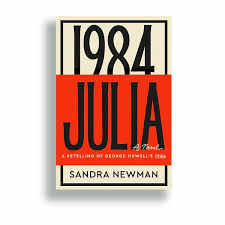
Novels based on and inspired by well-known original texts need to overcome some high hurdles to avoid being dismissed as mere fan-fiction. They need to be respectful to the source material – in most respects Newman does this, with some important exceptions. They need to have a clear reason for returning to the source material, and I think Newman ticks that box as well, giving a clear and recognisable voice to a character who often appears enigmatic in the source text, and exploring what life on Airstrip One would be like for women, a subject Orwell is largely silent on. The tightrope between simply being an attempted impersonation of Orwell’s voice and being faithful to his creation is an awfully difficult line to tread and I think for the most part, with one or two significant exceptions, Newman achieves this. It often felt like I was reading an authentic description of life under Big Brother, chapters that Orwell would have not disowned. For these good reasons alone Julia is definitely worth reading. I did have just one minor complaint – the cover design is awfully drab. It tries to suggest the relationship between the novel and the source text but I am sure there must be better ways of doing it.

Julia, by Sandra Newman, 2023

Aside