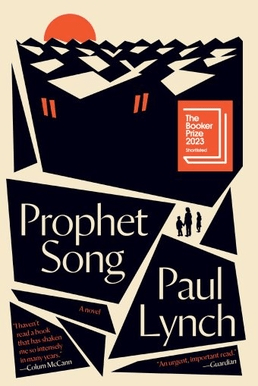
Prophet Song, by Paul Lynch, 2023
Wow. Prophet Song is the most impactful novel I have read in a very long time. Some critics have compared it to 1984 and The Handmaid’s Tale, and I think they are right. At one point I found reading it so traumatic (if you have read it you will know immediately what scene I am referring to) that I had to put the book down for 24 hours. It’s extraordinary.
The novel is set in Dublin shortly after the election of a far-right nationalist Government, the National Alliance Party. No specific timescale is given but everything else in the novel is set in the present. The Government introduces emergency powers that are in effect martial law. A new quasi-military police are given far-reaching powers to quash any dissent or opposition, a classic fascist strategy. Events are told through the Slack family. Larry, a teacher and trade unionist, is arrested and held without charge while attending a protest. He quickly becomes one of the disappeared, a non-person whose existence is denied by the state. Human rights lawyers trying to locate the disappeared are themselves threatened and arrested. Larry leaves behind Eilish, his wife; Mark, their sixteen-year old son son; their daughter, Molly; thirteen-year-old Bailey; and baby Ben. Amnesty International says that “Enforced disappearance is a crime under international law and an insidious practice that not only persists as a relic of past conflicts but also still looms large as a contemporary instrument of oppression used by the states across the world as a tool to silence dissent and instill fear.”
Lynch’s brilliance in setting Prophet Song in Ireland begins to pay off. This is not some distant South American banana republic where human rights have only ever tenuously existed – this is a modern European country. But people were disappeared in the states of the former Yugoslavia – Bosnia, Serbia and others – and there is evidence of this happening in the Ukraine as well. Being European is no guarantee of human rights, and if we think of flagrant breaches of human rights as being something that happens elsewhere, we are wrong. But the Irish setting has an even deeper impact that this, because in Northern Ireland people were ‘disappeared‘ in the 1970’s by masked armed men appearing at their doors in the night, taking them away to be shot in the head in some remote countryside, never to be seen again. (For the avoidance of any doubt, of course I understand that Northern Ireland and Ireland are not the same country – but the experience of the Troubles affected people from both sides of the border, and that shared trauma clearly forms a backdrop to Prophet Song). Lynch also seems to be drawing inspiration from the approach taken Margaret Attwood in The Handmaid’s Tale in which everything that happens in the novel has happened in real life elsewhere in the world.
As well as her family, Eilish cares for her father, Simon, who has dementia. Vulnerable people – the very young and the very old in particular, suffer disproportionately in times of unrest. Simon has occasional bouts of lucidity during which he encourages Eilish to take the rest of her family and leave the country, but she stubbornly refuses, despite being warned that “History is a silent record of people who could not leave“. It is not as simple as that – history is also “a record of those who did not have a choice, you cannot leave when you have nowhere to go and have not the means to go there, you cannot leave when your children cannot get a passport, cannot go when your feet are rooted in the earth and to leave means tearing off your feet.”
Mark is called up for military service shortly before he turns seventeen. He refuses to support a regime which has captured and possibly killed his father, and goes into hiding. Refusing his mother’s attempts to persuade him to leave the country he joins a rapidly growing force fighting to overturn the regime. At this point Mark fades from the narrative like his father before him. The rebel force make progress and capture parts of Dublin, providing a glimmer of hope, but the fighting intensifies in Eilish’s area, with bombs falling on the houses and streets. Daily life becomes more and more dangerous, with civilian casualties inevitable. The rebel forces are not portrayed as saviours but as equally vicious as the Government forces. Bailey is seriously wounded during a shelling attack. Eilish tries to take him to hospital but it is being bombed and evacuated. She finds another hospital but when she returns the next night to check on him he has also been ‘disappeared’, apparently taken as a suspect rebel soldier despite his age. Finally, in a desperately upsetting and gruesome scene Eilish finds his broken body in the morgue, showing signs of having been tortured before being killed. Initially my instinctive reaction to this traumatising scene was that Lynch had gone too far, that the Government forces would have no reason to torture a young teenager, but a moment’s thought made me realise that such scenes are happening right now across the world, that age is no protection for children in war zones, (the ongoing tragedy in Gaza was brought vividly to mind) they have no special status, and that the idea this could not happen in a Western Europe capital is simply wrong.
Somehow Eilish finds the strength to go on, and she flees with her two remaining children as refugees from the fighting, trying to cross the border into Northern Ireland. This becomes a story of ‘illegal’ immigrants, so stigmatised in the UK and across Europe at the moment. The refugees are exploited by people smugglers and corrupt border crossing guards. Seeing this experience through the eyes of already traumatised people (as of course refugees often are) humanised the refugees in the face of the often heartless headlines we read about ‘economic migrants’ and the rest.
Lynch’s point – that these things could so easily happen to us, as they are already happening to so many people, and we should reject any complacency that ‘it can’t happen here’ – is inescapable. If there were to be any doubt, towards the end of the novel he drives the point home:
“and the prophet sings not of the end of the world but of what has been done and what will be done and what is being done to some but not others, that the world is always ending over and over again in one place but not another and that the end of the world is always a local event, it comes to your country and visits your town and knocks on the door of your house and becomes to others but some distant warning, a brief report on the news, an echo of events that has passed into folklore”
Prophet Song is an extraordinary, challenging novel, and I can’t recommend it highly enough. It is undeniably a difficult read but an important one, and a very worthy winner of the 2023 Booker Prize.
Gaza