
Maria Edgeworth was, in her time, an extremely successful author, and is claimed as an influence on a number of other writers, not least of which is Jane Austen. ‘Castle Rackrent’ is an early work, a short novella with a title suggestive of the gothic, but actually totally devoid of anything mysterious, other-worldly or supernatural.
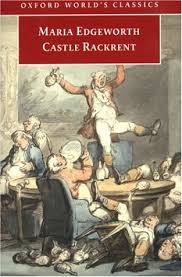
Castle Rackrent is the tale of how four generations of Rackrent heirs mismanage and squander their estate. The narrative is told through the family steward, Thady Quirk, who is sometimes cited as an example of an early if not the first unreliable narrator. Thady has only a limited grasp of what is going on most of the time; his one dominant interest is loyalty to his master, whoever that happens to be. The heirs are variously spendthrifts, litigious, gamblers and careless with money, but the end result is always a continuation of the slow decline of the castle and its estate.
There is very little here by way of a plot. Each Rackrent inherits the castle, makes a mess of it is fairly quick time, then expires. As a satire on the land-owning classes of the English aristocracy in Ireland the novel has some limited interest, but it is gentle satire indeed. When the novel was published the UK and Ireland were working to formalise a political union, and Edgeworth clearly illustrates the dangers or weaknesses of English dominance of Ireland, so the satire had some immediate relevance which has long since faded.
The novel is bookended by a preface and conclusion by an anonymous editor, as well as being interspersed with footnotes which provide an ironic commentary on the text. This has a distancing effect – the reader is invited to treat the novel more as a second-hand artefact, a personal memoir rather than as a narrative. Thady himself appears as only an otherwise minor character in the novel, and his voice seems unauthentic – there is little attempt to capture the accent or language of an Irish native. The text has some examples of local dialect but these seem shoe-horned into the text for local ‘colour’ rather than with any authenticity.
The text also has a breath-taking example of anti-semitism. This is how Thady, admittedly not the most reliable observers, describes his first meeting with his master’s new bride:
I got the first sight of the bride; for when the carriage door opened, just as she had her foot on the steps, I held the flam full in her face to light her, at which she shut her eyes, but I had a full view of the rest of her, and greatly shocked I was, for by that light she was little better than a blackamoor, and seemed crippled; but that was only sitting so long in the chariot…‘Will I have a fire lighted in the state-room to-night?’ was the next question I put to her, but never a word she answered; so I concluded she could not speak a word of English, and was from foreign parts. The short and the long of it was, I couldn’t tell what to make of her; so I left her to herself, and went straight down to the servants’ hall to learn something for certain about her. Sir Kit’s own man was tired, but the groom set him a-talking at last, and we had it all out before ever I closed my eyes that night. The bride might well be a great fortune—she was a JEWISH by all accounts, who are famous for their great riches. I had never seen any of that tribe or nation before, and could only gather that she spoke a strange kind of English of her own, that she could not abide pork or sausages, and went neither to church or mass. Mercy upon his honour’s poor soul, thought I; what will become of him and his, and all of us, with his heretic blackamoor at the head of the Castle Rackrent estate? I never slept a wink all night for thinking of it; but before the servants I put my pipe in my mouth, and kept my mind to myself, for I had a great regard for the family; and after this, when strange gentlemen’s servants came to the house, and would begin to talk about the bride, I took care to put the best foot foremost, and passed her for a nabob in the kitchen, which accounted for her dark complexion and everything.
This bride then refuses to surrender her family jewels to her husband, so he proceeds to lock her in her room for seven years, until he finally dies in a duel and she is released, to quite understandably fly the country.
I appreciate this description is Thady’s, not the author’s, and is being presented to the reader as an example of his prejudice and backwardness. The principle intent here seems to present the reader with a comedic situation rather than satirise or comment on attitudes towards anti-semitism or indeed the relationships between abusive husbands and their wives. Compare how Anne Bronte compassionately deals with the latter issue a few years later in ‘The Tenant of Wildfell Hall‘.
Edgeworth’s novels remain widely in print, and seem to be read if Goodreads reviews are anything to go by. So far I have yet to see the attraction. If you have read any of her other novels that you can recommend please let me know.


Fascinating post. I’ve come across Maria quite a bit lately, most recently in V Woolf’s ‘Common Reader’, vol 1, where there’s an essay about, among others, her ‘portentous bore’ of a father. It’s an extraordinary essay about a remarkable family (I posted about it and the Lunar Society a few times). I’ve not read this novel, an omission that must be rectified. Your extract is certainly pretty unsavoury, but she was noted for her relatively emancipated and advanced views (for the time), so maybe she was being satiric about anti-Semitism. Let’s hope so.
LikeLiked by 1 person
Any of her other works you’d recommend?
LikeLike
Oh dear, I don’t know enough about her to say. My post about the Edgeworth’s as mentioned in the Woolf essay give some links to some related materials, including some reviews and a novel based on her father’s friend Day’s experiment to create a wife: here’s the link http://tredynasdays.co.uk/2018/07/virginia-woolf-lives-of-the-obscure/
LikeLiked by 1 person
Tried this just because it’s a classic, found it difficult and as you point out, no plot. Won’t be trying any more of hers…
LikeLiked by 1 person
Waiting for someone to say “You must read this” – otherwise agreed.
LikeLiked by 1 person