
Or to give it its full title, ‘A Christmas Carol in prose, being a Ghost story of Christmas’.
I challenge you to find a better first line that the one Dickens uses to open ‘A Christmas Carol’:
“Marley was dead: to begin with.”
I love that use of the colon in the middle of this sentence. It works perfectly, giving a long pause before the punchline. This is an author at the top of his page. The reader is compelled to know who Marley is, and why his death seems such a temporary state of affairs.
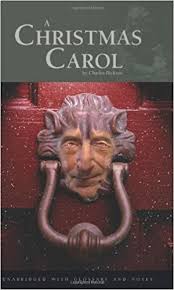
‘A Christmas Carol’ is a miniature masterpiece, and seems more popular than ever. The reasons for its success aren’t hard to find. Dickens is hardly known for the economy of his writing – he is usually pretty verbose – but when he needs to he can cover a lot of ground very quickly. In less than 100 pages he manages to give us so much. Where to begin?
Well first the novel gives us a vivid, definitive portrait of a miser, to the extent that not only has ‘Scrooge’ become synonymous with the word, but that some of his phrases, such as ‘humbug!’ have also passed into common usage:
Oh! But he was a tight-fisted hand at the grindstone, Scrooge! a squeezing, wrenching, grasping, scraping, clutching, covetous, old sinner! Hard and sharp as flint, from which no steel had ever struck out generous fire; secret, and self-contained, and solitary as an oyster. The cold within him froze his old features, nipped his pointed nose, shrivelled his cheek, stiffened his gait; made his eyes red, his thin lips blue; and spoke out shrewdly in his grating voice. A frosty rime was on his head, and on his eyebrows, and his wiry chin. He carried his own low temperature always about with him; he iced his office in the dog-days; and didn’t thaw it one degree at Christmas.”
It is easy to forget the impact of the text as a a ghost story. It has some genuinely chilling moment, such as when Scrooge pleads for a chance from the voiceless ghost of Christmas yet to be. Dickens is sometimes not given credit for his skill as a writer, with critical comment focusing on his storytelling and characterisation. But he takes us into Scrooge’s mind, capturing wonderfully his fear and paranoia, such as here when he is searching this rooms for the ghosts Marley has told him will come to visit:
Nobody under the bed; nobody in the closet; nobody in his dressing-gown, which was hanging up in a suspicious attitude against the wall.
Scrooge’s story is not just a portrait, but it is also a story of redemption, which tells us that no-one however troubled or lost is completely beyond hope. Scrooge’s backstory is filled in very lightly, with just a few sketches of his early life during his time with the ghost of Christmas Past, but it is more than enough for us to understand how he has come to be the pathetic sad man he is.
The text also includes some descriptive passages and scenes which have come to define a Victorian Christmas. It is for historians to judge whether Dickens defined many of the traditional features of Christmas that we now treasure, or simply recorded them. But either way there is no doubt that he captures brilliantly some of what we now think of as quintessentially Christmassy elements. As it is nearly Christmas I am going to indulge myself by including below some long excerpts from the text with little by way of annotation or analysis – it quite obviously doesn’t need it. But look out for the wonderful, opulent use of verbs and adjectives, and the way almost everything is personified, from the misanthropic ice to the old bell peeping down from its tower – everything can join in the Christmas celebrations!
Meanwhile the fog and darkness thickened so, that people ran about with flaring links, proffering their services to go before horses in carriages, and conduct them on their way.The ancient tower of a church, whose gruff old bell was always peeping slily down at Scrooge out of a Gothic window in the wall, became invisible, and struck the hours and quarters in the clouds, with tremulous vibrations afterwards as if its teeth were chattering in its frozen head up there. The cold became intense. In the main street, at the corner of the court, some labourers were repairing the gas-pipes, and had lighted a great fire in a brazier, round which a party of ragged men and boys were gathered: warming their hands and winking their eyes before the blaze in rapture. The water-plug being left in solitude, its overflowings sullenly congealed, and turned to misanthropic ice. The brightness of the shops where holly sprigs and berries crackled in the lamp heat of the windows, made pale faces ruddy as they passed.Poulterers’ and grocers’ trades became a splendid joke: a glorious pageant,with which it was next to impossible to believe that such dull principles as bargain and sale had anything to do. The Lord Mayor, in the stronghold of the mighty Mansion House, gave orders to his fifty cooks and butlers to keep Christmas as a Lord Mayor’s household should; and even the little tailor, whom he had fined five shillings on the previous Monday for being drunk and bloodthirsty in the streets, stirred up to-morrow’s pudding in his garret,while his lean wife and the baby sallied out to buy the beef”
The walls and ceiling were so hung with living green, that it looked a perfect grove; from every part of which, bright gleaming berries glistened. The crisp leaves of holly, mistletoe, and ivy reflected back the light, as if so many little mirrors had been scattered there; and such a mighty blaze went roaring up the chimney, as that dull petrification of a hearth had never known in Scrooge’s time, or Marley’s, or for many and many a winter season gone. Heaped up on the floor, to form a kind of throne, were turkeys,geese, game, poultry, brawn, great joints of meat, sucking-pigs, long wreaths of sausages, mince-pies, plum-puddings, barrels of oysters, red-hot chestnuts,cherry-cheeked apples, juicy oranges, luscious pears, immense twelfth-cakes,and seething bowls of punch, that made the chamber dim with their delicious steam. In easy state upon this couch, there sat a jolly Giant, glorious to see;who bore a glowing torch, in shape not unlike Plenty’s horn, and held it up,high up, to shed its light on Scrooge, as he came peeping round the door.
For, the people who were shovelling away on the housetops were jovial and full of glee; calling out to one another from the parapets, and now and then exchanging a facetious snowball—better-natured missile far than many a wordy jest—laughing heartily if it went right and not less heartily if it went wrong. The poulterers’ shops were still half open, and the fruiterers’were radiant in their glory. There were great, round, pot-bellied baskets of chestnuts, shaped like the waistcoats of jolly old gentlemen, lolling at the doors, and tumbling out into the street in their apoplectic opulence. There were ruddy, brown-faced, broad-girthed Spanish Onions, shining in the fatness of their growth like Spanish Friars, and winking from their shelves in wanton slyness at the girls as they went by, and glanced demurely at the hung-up mistletoe. There were pears and apples, clustered high in blooming pyramids;there were bunches of grapes, made, in the shopkeepers’ benevolence to dangle from conspicuous hooks, that people’s mouths might water gratis as they passed;there were piles of filberts, mossy and brown, recalling, in their fragrance,ancient walks among the woods, and pleasant shufflings ankle deep through withered leaves; there were Norfolk Biffins, squat and swarthy, setting off the yellow of the oranges and lemons, and, in the great compactness of their juicy persons, urgently entreating and beseeching to be carried home in paper bags and eaten after dinner.
The Grocers’! oh, the Grocers’! nearly closed, with perhaps two shutters down, or one; but through those gaps such glimpses! It was not alone that the scales descending on the counter made a merry sound, or that the twine and roller parted company so briskly, or that the canisters were rattled up and down like juggling tricks, or even that the blended scents of tea and coffee were so grateful to the nose, or even that the raisins were so plentiful and rare, the almonds so extremely white, the sticks of cinnamon so long and straight, the other spices so delicious, the candied fruits so caked and spotted with molten sugar as to make the coldest lookers-on feel faint and subsequently bilious. Nor was it that the figs were moist and pulpy, or that the French plums blushed in modest tartness from their highly-decorated boxes,or that everything was good to eat and in its Christmas dress; but the customers were all so hurried and so eager in the hopeful promise of the day,that they tumbled up against each other at the door, crashing their wicker baskets wildly, and left their purchases upon the counter, and came running back to fetch them, and committed hundreds of the like mistakes, in the best humour possible;


Pingback: Book review: Nicholas Nickleby, by Charles Dickens, 1838-9 – The Reading Bug