Book review

It is often an instructive experience to revisit ‘children’s’ stories occasionally. Rereading them as an adult can reveal layers of meaning not obvious to a younger reader. As a child I wasn’t initially aware of the Christian allegory in the Narnia stories, for example (until being beaten round the head with the idea in The Last Battle). Similarly, books like Alice in Wonderland and Gulliver’s Travels both work successfully as adventure stories for children and as more complex novels for adults.Black Beauty by Anna Sewell - First Edition - c. 1950s - from ...
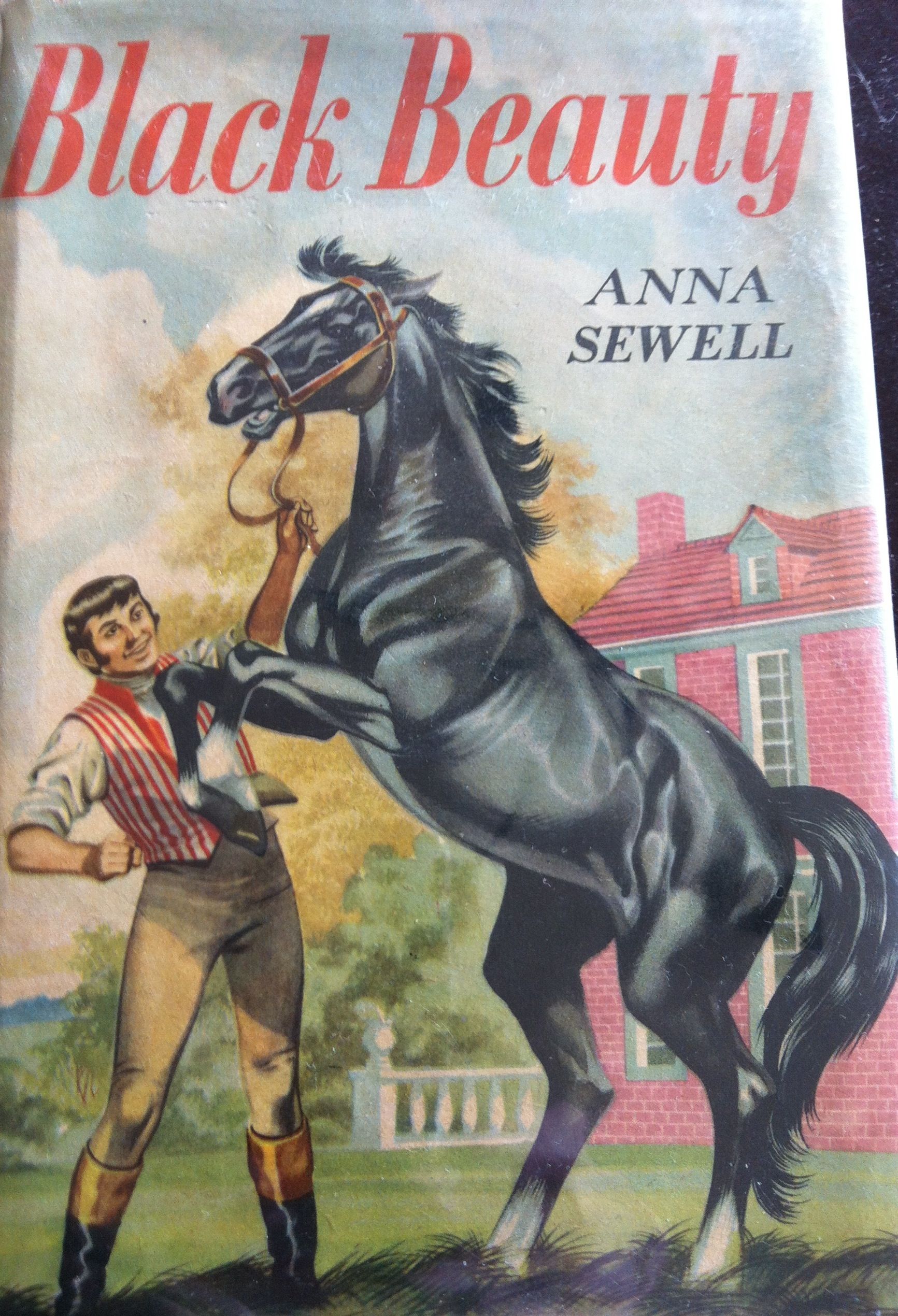
Anna Sewell’s Black Beauty is another case in point. Written as a first person narrative by the title character, it was originally conceived as a plea for compassion in the treatment of working horses (in much the same way as The Water Babies was a campaigning tract about the treatment of child chimney sweeps). Sewell wanted to bring the plight of working horses to public awareness and in particular to end the practice of unnaturally raising carriage horses’ heads with the “bearing rein”. Stripped of its social and historical context it is now a straightforward story about the life of a horse.

But I was struck on reading the novel how clearly it also reads as an anti-slavery tract. Forget for a minute that this is a book about horses, and read these lines from early in chapter one:

Our master was a good, kind man. He gave us good food, good lodging, and kind words; he spoke as kindly to us as he did to his little children. We were all fond of him, and my mother loved him very much….I was a dull black, so he called me Darkie.”

As long as Black Beauty is well cared for he accepts his enslavement with resignation. He describes how he is broken into wearing reins and a bridle:

I had of course long been used to a halter and a headstall, and to be led about in the fields and lanes quietly, but now I was to have a bit and bridle; my master gave me some oats as usual, and after a good deal of coaxing he got the bit into my mouth, and the bridle fixed, but it was a nasty thing! Those who have never had a bit in their mouths cannot think how bad it feels; a great piece of cold hard steel as thick as a man’s finger to be pushed into one’s mouth, between one’s teeth, and over one’s tongue, with the ends coming out at the corner of your mouth, and held fast there by straps over your head, under your throat, round your nose, and under your chin; so that no way in the world can you get rid of the nasty hard thing; it is very bad! yes, very bad!

There’s no attempt to disguise the distress Beauty experiences during his “breaking in” (a phrase also used to describe the brutal treatment of slaves until they came to accept their captivity). But however accepting of his condition, Beauty is aware that he is still a possession, vulnerable to being sold to a new, less kind master at any time:

I was quite happy in my new place, and if there was one thing that I missed it must not be thought I was discontented; all who had to do with me were good and I had a light airy stable and the best of food. What more could I want? Why, liberty! …Straps here and straps there, a bit in my mouth, and blinkers over my eyes. Now, I am not complaining, for I know it must be so. I only mean to say that for a young horse full of strength and spirits, who has been used to some large field or plain where he can fling up his head and toss up his tail and gallop away at full speed, then round and back again with a snort to his companions—I say it is hard never to have a bit more liberty to do as you like.

He also knows that if he breaks down physically and becomes no longer useful or wanted he is likely to be disposed of, either sold on to ever more difficult work, or sent to “the dogs” – that is to say slaughtered and sold as dog food. When his friend Merrylegs the pony is sold to a neighbour it is seen as a kindness that

“it was on the condition that he should never be sold, and that when he was past work he should be shot and buried. “

(This line of argument, that Black Beauty is a form of slave narrative, is developed by the wonderfully named Bonnie Blossom in this article.)

I am not arguing that Black Beauty is an anti-slavery tract, not least because slavery had been abolished in the USA a decade before it was published, and much earlier in the UK – the moral argument had been won. But awareness of the brutality of slavery was still very much in the public imagination, and viewing our treatment of domestic animals as being analogous to the way slaves were once treated, adopting some of the traditional narratives and characteristics of slave stories, gives a powerful emphasis to Sewell’s argument for kinder treatment of horses. Putting it simply, we feel for the mistreated horses in the novel because they are treated like slaves.

This is a progressive novel in other ways. Sewell argues forcefully for the retention of the Sabbath as a day of rest. Beauty’s driver, Jerry, is tempted to work on Sunday’s for a reliable customer, but turns down the work as he wants to preserve his time with his family:

“If working  men don’t stick to their Sunday … they’ll soon have none left; it is every man’s right and every beast’s right. By God’s law we have a day of rest, and by the law of England we have a day of rest; and I say we ought to hold to the rights these laws give us and keep them for our children.”

This initial position of not working on the Sabbath for religious considerations is then generalised into a wider argument for the protection of working men’s conditions of employment, and their collective power through industrial action, specifically withholding their labour (a later chapter is called “A Strike for Liberty”):

“That may sound well enough, but it won’t do; every man must look after his own soul; you can’t lay it down at another man’s door like a foundling  and expect him to take care of it; and don’t you see, if you are always sitting on your box waiting for a fare, they will say, ‘If we don’t take him some one else will, and he does not look for any Sunday.’ Of course, they don’t go to the bottom of it, or they would see if they never came for a cab it would be no use your standing there; but people don’t always like to go to the bottom of things; it may not be convenient to do it; but if you Sunday drivers would all strike for a day of rest the thing would be done.”

Elsewhere Sewell argues from a moral standpoint that:

“With cruelty and oppression it is everybody’s  business to interfere when they see it”

This is typical of the muscular Christianity that informs much of the reforming literature of the Victorian era.

The novel also contains a striking portrait of the Charge of the Light Brigade in the Crimean War, told from the perspective of Captain, “An Old War Horse”. We are not told directly that his reminiscences are of this battle, but the descriptions are unmistakeable:

“I cannot tell all that happened on that day, but I will tell of the last charge that we made together; it was across a valley right in front of the enemy’s cannon. By this time we were well used to the roar of heavy guns, the rattle of musket fire, and the flying of shot near us; but never had I been under such a fire as we rode through on that day. From the right, from the left, and from the front, shot and shell poured in upon us. Many a brave man went down, many a horse fell, flinging his rider to the earth; many a horse without a rider ran wildly out of the ranks; then terrified at being alone, with no hand to guide him, came pressing in among his old companions, to gallop with them to the charge.

“Fearful as it was, no one stopped, no one turned back. Every moment the ranks were thinned, but as our comrades fell, we closed in to keep them together; and instead of being shaken or staggered in our pace our gallop became faster and faster as we neared the cannon…..

our gallant company was cruelly overpowered, and those who remained alive after the fierce fight for the guns came galloping back over the same ground. Some of the horses had been so badly wounded that they could scarcely move from the loss of blood; other noble creatures were trying on three legs to drag themselves along, and others were struggling to rise on their fore feet, when their hind legs had been shattered by shot. After the battle the wounded men were brought in and the dead were buried.”

I said, “I have heard people talk about war as if it was a very fine thing.”

“Ah!” said he, “I should think they never saw it. No doubt it is very fine when there is no enemy, when it is just exercise and parade and sham  fight. Yes, it is very fine then; but when thousands of good brave men and horses are killed or crippled for life, it has a very different look.”

The enemy must have been awfully wicked people, if it was right to go all that way over the sea on purpose to kill them.”

This vivid description of the battle makes an interesting contrast to the jingoism of Tennyson’s better known account. Sewell uses the apparent naivety of the horses to point out the simplicity of seeing war as ourselves versus “awfully wicked people”.

There is also a fascinating description of Beauty’s reaction to his first encounter with a steam train, which captures much of the Victorian shock at the force of this new technology.

I shall never forget the first train that ran by. I was feeding quietly near the pales which separated the meadow from the railway, when I heard a  strange sound at a distance, and before I knew whence it came—with a rush and a clatter, and a puffing out of smoke—a long black train of something flew by, and was gone almost before I could draw my breath. I turned and galloped to the further side of the meadow as fast as I could go, and there I stood snorting with astonishment and fear. In the course of the day many other trains went by, some more slowly; these drew up at the station close by, and sometimes made an awful shriek and groan before they stopped. I thought it very dreadful, but the cows went on eating very quietly, and hardly raised their heads as the black frightful thing came puffing and grinding past.

Reading the novel as a form of slave narrative, chapters on the Crimean War and the coming of the steam train – these are all points of interest. But the novel as a whole is repetitive. Beauty is sold to a new owner, he gets to know him and his new role, there is an encounter with another horse, and then an incident that leads to the next owner. Repeats over forty or more chapters. Events are described through the child-like innocent eyes of Beauty or his friends, with sufficient context for the reader to identify the wider commentary implicit and explicit in the narrative. All washed down with a gentle Christian sensibility (at one point a human watches a character leave and says to himself “Inasmuch as ye have done it to one of the least of these”, which as I am sure you know is from Matthew in the King James text of the Bible). There’s a banality to the repetition of the story arc over time which leaves the reader restless for the inevitable happy ever after. 

Footnote

A while back I wrote about the use of the word “gammon” as a term of disrespect. There is another instance here where it is used as a euphemism for “hypocrite”. Beauty’s driver takes a fare for an urgent job having previously refused one. Asked how much he earned he replies:

A good deal more than I generally get…..what he gave me will keep me in little comforts for several days.”

“Gammon!” said one.

“He’s a humbug,” said another; “preaching to us and then doing the same himself.”

Black Beauty, by Anna Sewell, 1877

Aside
Book review

Harold Wilson, by Ben Pimlott, 1992

Harold Wilson was Prime Minister of the United Kingdom from 1964 to 1970, and again from 1974 until his retirement in 1976. In that time he won four general elections, making him the most successful ever leader of the Labour Party. His Governments were characterised by a series of progressive social reforms set against a background of Image result for harold wilson ben pimlottchallenging economic circumstances. Wilson was a pragmatic politician usually seen as coming from the left of the party when he first emerged from the diverse group of new MPs elected in 1945, although over time, as the political centre shifted, he became more associated with the traditional centre of Labour politics. He is now looked back on as a relatively slight figure, buffeted by external forces which he was never really able to control, rather than the dominant force in British politics that he was for so many decades.

Continue reading

Standard
Book review

I am having a really poor run at the moment – this was the latest of a series of disappointing novels, in many ways the worst of the lot! It was Coetzee’s first Booker Prize winner, the other being Disgrace in 1999.

Life & Times of Michael K is set in a dystopian South Africa in which a civil war is being fought. The protagonist Michael K is born with a hare lip. He is also what was once thought of as “simple” and although not an orphan was effectively abandoned as a child and sent to live in an institution. A doctor who later treats him explains:

He is a simpleton, and not even an interesting simpleton. He is a poor helpThe Life and Times of Michael K, J. M. Coetzee, Good Bookless soul who has been permitted to wander out on the battlefield, if I may use that word, the battlefield of life, when he should have been shut away in an institution with high walls, stuffing cushions or watering the flower beds

In many ways this is a simple journey story. Michael works as a gardener and his mother is an ailing domestic servant. Law and order is breaking down in the coastal city where they live. Michael’s mother persuades him to help her escape the conflict and privations of the city and take her on a biblical exodus to her home town near the mountains. She dies during the journey, but Michael continues his pilgrimage alone, carrying her ashes with him. He settles in an abandoned farmstead, living off the land and making rudimentary attempts to grow food.

Michael’s time in the wilderness also has biblical overtones – his attempts to scratch a living from the surface of the earth is a hard, unremitting grind for the reader. The allegorical nature of Michael’s suffering is subtle but nevertheless unavoidable – this must be an allegory because otherwise it would be utterly meaningless.

Eventually he is captured as an undocumented citizen, suspected of working for the resistance, and sent to a prison camp. By now his fragile health has deteriorated further, and he appears to be starving. I haven’t been able to locate the original source of this claim, but I have read that Coetzee has said in interviews that the inspiration for this novel was a newspaper article about a captured panda that refused to eat the food it was fed in captivity. Once captured Michael K adopts the same approach, although there is no suggestion that this is a hunger strike or anything other than an illness. It is more an inability to eat than a refusal. He continues to lose weight, and the doctor who narrates the novel’s second section struggles unsuccessfully to understand his motivation for refusing food. I wasn’t comfortable with the portrayal of an illness as a philosophical protest or existential statement.

Michael eventually escapes from the camp, and in the last section returns to the city. He meets some vagrants who appear more attuned to life outside civilisation, and who effectively adopt him. At this point, with no suggestion that Michael has come to any resolution of his situation, the novel ends abruptly and inconclusively.

It is hard to care for Michael K. He is passive and has nothing of interested to say about his experiences. It is possible we are intended to see him as a Forrest Gump-like figure, with his simple lifestyle and even simpler thought processes giving us insights into the human condition. If that was the intention then I can’t say it worked. Towards the end of the novel Michael acquires a more analytical monologue which for some reviewers sits unconvincingly with his former passivity and incomprehension. His thoughts become positively philosophical:

How fortunate that I have no children, he thought: how fortunate that I have no desire to father. I would not know what to do with a child out here in the heart of the country, who would need milk and clothes and friends and schooling. I would fail in my duties, I would be the worst of fathers. Whereas it is not hard to live a life that consists merely of passing time. I am one of the fortunate ones who escape being called.

Michael is an innocent adrift in a world of sin and corruption, but my appetite for parables is a bit jaded at the moment – perhaps I need some escapism and an interesting story instead? The New York Times said in a review that Coetzee’s theme in this novel is “the wild and merciless power of inanity.” If you are looking for a novel about the inane then look no more, this is the one.


Life & Times of Michael K, by J M Coetzee, 1983

Aside
Book review

Notorious for being described by one of the 1994 panel of Booker judges* as “crap”, How Late is Was, How Late is a stream of consciousness novel written in ‘Glaswegian demotic’. It spans a week in the life of Sammy, a shoplifter and ex-convict, who gets drunk, fights with the police, and is beaten by them so badly that he is blinded. The assault happens in the opening weekend leaving the bulk of the novel to relate his clumsy and sometimes tragi-comic attempts to come to terms with his condition, to navigate the streets of Glasgow, and make a half-hearted claim for disability benefit. He refuses almost all help despite desperately needing it, and slowly reveals a small amount about his past, including two long spells in prison.
The language of the novel will be a challenge for many readers. Here’s a short extract by way of illustration:

Ye wake in a corner and stay there hoping yer body will disappear, the thoughts smothering ye; these thoughts; but ye want to remember and face up to things, just something keeps ye from doing it, why can’t ye no do it; the words filling yer head: then the other words; there’s something wrong; there’s something far far wrong; ye’re no a good man, ye’re just no a good man. Edging back into awareness, of where ye are: here, slumped in this corner, with these thoughts filling ye. And oh christ his back was sore; stiff, and the head pounding. He shivered and hunched up his shoulders, shut his eyes, rubbed into the corners with his fingertips; seeing all kinds of spots and lights. Where in the name of fuck…”

You will note how the narrative point of view and tense wanders. Initially the narrative is in the first person, but then the text starts referring to Sammy as “he” – illustrating, I suppose, his sense of alienation – he sees himself as a secondary character. If you read that and thought it was relatively easy to follow, just think of the cumulative impact of nearly 400 pages of its unrelenting incoherence. The 4000 “fucks” weren’t really a problem for me – people do speak that way – but the question was do I want to listen to them? Did Sammy have anything interesting to say, or is he just a confused incompetent?

How Late sat on my bookshelves unread for what was probably decades. I was put off by the extraordinarily dull cover (see above) and more seriously by the ferocious dialect. In truth it really only takes a few pages to understand the conventions Kelman uses, such as “the gether” for “together”, “sodjers” for police, and so on, and to get into the rhythm of the Glaswegian voice.

I was hoping some coherence would be brought to the narrative – that we would find out more about why his girlfriend has disappeared for example. But we never do, and puzzlingly Sammy never makes any attempt to find out. He is anxious to ensure that family and friends don’t find out about his blindness, and even when he eventually consults a doctor there is no serious discussion on whether the condition is temporary or permanent, possible referral to a specialist, or any treatment. Earlier the police arrest Sammy for reasons that are never explained but may be something to do with an associate who has a more substantial criminal record. Any hope that these threads will combine or end up making any sense are left unfulfilled. 

I kept waiting for the book I hoped Kelman was writing to emerge from the shadows, but to my huge disappointment it never did. There is clearly a lot Sammy decides not to tell us – although why he would conceal it from himself is not obvious – and while we do find more out about him over the course of the novel, much is left unsaid. What I expected to happen is that the slow reveal would finally piece together, and that pieces would fall into place, revealing the explanation for the randomness of Sammy’s life, why he refuses to seek help for his blindness, where his girlfriend has gone and why he doesn’t seem that interested in finding out. Late in the novel his teenage son Peter is introduced. He obviously cares for his father and is anxious to help him, but Sammy rejects his offers of help (apart from his money) and lies comprehensively to him, swearing him to secrecy about his sight loss for reasons which seem more to do with pride than anything else. Perhaps it is just middle-class of me to expect Sammy’s like to have some structure or reason, rather than just being the one big mess it is.

Overall this was hard work. Sammy is profoundly unlikeable, showing occasional glimpses of intelligence which are misleading – he quickly reverts to a bovine refusal to accept any assistance or attempt to improve his desperate situation. I appreciate that in creating Sammy Kelman wanted to give a voice to the oppressed working class, and Sammy’s independent streak and refusal to accept assistance is in some ways admirable, but in fact the novel does the working class a disservice. Most working people simply would not behave in the irrational way Sammy does throughout the novel. They accept help when needed, and their relationships are important enough for them to ask after their partner when they disappear. Their lives may be chaotic and disorderly, but they are not without reason.


*Julia Neuberger. In a later, generally positive review, the Guardian called the novel “a miserable slog” and in a masterly understatement “unlikely to improve anyone’s beach holiday”!

How Late it Was, How Late, by James Kelman, 1994

Aside
Book review

The Loved One by Evelyn Waugh, 1948

This was an umpteenth re-read – I revisit The Loved One (subtitled An Anglo-American Tragedy) for a chuckle every now and again. It’s not a novel (Waugh called it a novelette) that takes itself very seriously, but it is all the better for that. It also has a lot of fun at the expense of both Americans and English ex-pats in America, so what’s not to like?Image result for loved ones waugh

Sir Ambrose Abercrombie, august representative of the British community of ex-pats in Los Angeles, descends upon Dennis Barlow, a minor poet brought to Hollywood to write the script for a film biography of Shelley, to express his concern about Barlow’s new job and how it reflects on the British community in Hollywood. Barlow has abandoned his script writing for something much more valuable to society – he works at the Happier Hunting Ground, a pet cemetery.

Barlow, tasked with the funeral arrangements of his ‘housemate’ who has killed himself having been dismissed from his job in one of the studios, “developing scripts”, (there are a lot of euphemisms and avoidances such as this in this novel) visits Hollywood’s famous funeral grounds, Whispering Glades. There he quickly falls for cosmetician (she puts make-up on corpses) Aimée Thanatogenos. He woos her with quotations from the British classics, passing them off as his own. But he has a rival, the senior mortician Mr Joyboy. Aimee is torn between her feelings for Barlow and Joyboy, but despite the helpful advice columnist of local agony aunt “Guru Brahmin” she gets engaged to Barlow. Subsequently, when she finds out his poems are plagiarised, she dumps him (in fact, she ghosts him!) and returns to Joyboy. The coffin is nailed firmly shut when she attends the funeral of Mr Joyboy’s mother’s parrot at the Happier Hunting Ground, where Barlow is in attendance. The scene is set for a macabre, blackly comic finale.

Waugh was at his comic best when he gave his satirical targets both barrels, holding nothing back. Here his contempt for Hollywood, Americans, ex-pats, you name it, is out in the open and given full rein. This is more a sketch than a fully developed novel, lacking the depth of Waugh’s other work, but it is fun despite the darkness.


Standard
Book review

Hotel du Lac, by Anita Brookner, 1984

I am sure there are exceptions, but most great novels have great opening lines. “It was the best of times”, “All happy families”, “It was a bright cold morning” and so on. Anita Brookner by contrast chose to open Hotel du Lac with the following:

“From the window all that could be seen was a receding area of grey.”

Which won’t be going into any collections of great opening lines any time soon. This self-consciously down-beat opening sets the tone of the novel – this is going to be a mono-chromatic sketch where the reader is going to have to do a lot of the work.Image result for Hotel du Lac, by Anita Brookner, 198

Edith Hope, author of romantic novels such as Beneath the Visiting Moon and The Stone and the Star, has fled from London to the Hotel du Lac in disgrace. Initially we are not told the reasons for this flight – some sort of scandal is hinted at. It emerges she has been having an affair with a married man, to whom she pens forlorn love-letters. We are initially led to believe that this is the cause of her exile, although it later emerges that it is her decision to leave her groom (another man entirely, naturally) at the altar that has outraged her friends and led to her banishment. Why deciding not to go through with an ill-advised wedding is considered such a cause of outrage is never made clear.

The hotel is a suitable location for Edith’s contemplation of her future:

“The Hotel du Lac was a dignified building, a house of repute, a traditional establishment, used to welcoming the prudent, the well-to-do, the retired, the self-effacing, the respected patrons of an earlier era.”

“As far as guests were concerned, it (the hotel) took a perverse pride in its very absence of attractions, so that any visitor mildly looking for a room would be puzzled and deflected by the sparseness of the terrace, the muted hush of the lobby … There was no sauna, no hairdresser and certainly no glass cases displaying items of jewellery; the bar was small and dark and its austerity did not encourage people to linger.”

The portraits of the other guests at the hotel provide Edith with illustrations of the choices before her (and, we might reasonably extrapolate, many women in her position) as she considers her next steps. They are all lonely in their different ways. There is the overbearing widow Mrs Pusey, who has made a vocation out of shopping, so empty is her life; her devoted daughter Jennifer, secretly far less docile than her mother believes her to be (the novel hints at sexual liaisons between Jennifer and Alain, the hotel’s waiter, and later Mr Neville); Mme de Bonneuil, who lives in isolation at the hotel, expelled from her chateau, now inhabited by her son and his wife, and Monica, living alone the hotel on the instructions of her husband to fix her “eating disorder” and become fertile enough to bear him an heir.

“She (Monica) hates and fears her husband, but only because he has not protected her, and she sees herself condemned to loneliness and exile. In this she is prescient. I see her, some years hence, a remittance woman, paid to live abroad, in such an hotel, in various Hotels du Lac, her beautiful face grown gaunt and scornful, her dog permanently under her arm. ”

Edith also has a friend back in London, Penelope – “a handsome woman of forty-five and would remain so for many years” (one of the novel’s better lines).

To Penelope, men were conquests, attributes, but they were also enemies; they belonged to the species that must never be granted more than the amount of time and attention she considered they deserved.”

The boorish Mr Neville presents Edith with a final choice: a marriage without love or respect, No matter that he has only known her for a matter of days. Neville is looking for a “safe” wife who will maintain his home and offers to turn a blind eye to any lovers she might take. Possibly the absurdity of this proposal is intentional, although Edith seems close to accepting despite her disastrous engagement itself only weeks earlier.

There is something quite circular about romantic novels about romantic novelists. At several points it is not clear whether Brookner is writing about her character, or about the novel itself. When Mr Neville, in an extraordinarily clumsy attempt at seduction, insults her, Edith

“to contain her anger…tried various distancing procedures..the most productive of which was to convert the incident into a scene from one of her novels”.

In her sad letters to her silent lover Edith adopts the role of narrator of the novel, recounting various scenes of minimal activity by the other guests (indeed this is a novel where so very little happens other than walks being taken and coffee drunk that we might almost be in a Virginia Woolf novel, whom we are constantly told Edith looks like). Later Edith consoles herself with the thought that

“Fiction, the time-honoured resource of the ill-at-ease, would have to come to her aid.”

Is this what we are reading – simply an act of consolation, a distraction for the ill-at-ease? Intended or not I can’t think of a way in which Brookner could have more clearly reminded the reader that this is just a novel, her characters are not real, and all this never really happened, something that other novelists are at pains to conceal. This is not some Brechtian ultra-realistic narrative however, but a story about a woman thinking about her life.

The tone and pace of the novel are consistently grey and slow, but there was one scene towards the end of the novel which jarred acutely. Mr Neville is proposing marriage to Edith. He is essentially a well-groomed thug, and manages to insult her throughout the proposal. (If this is intended to remind readers of the clumsy first proposal in Pride and Prejudice, it doesn’t). Upset, Edith starts to weep, and his response is startling:

“Edith, said Mr Neville. Please don’t cry. I cannot bear to see a woman cry; it makes me want to hit her. “

If that wasn’t bad enough, and it is, a few moments later, while she sobs on his shoulder, he muses:

“You are very thin…I am afraid that I might break you in half”.

It is possible Brookner did not intend the threat of sexual violence explicit in this line, but it is hard to imagine otherwise. Most women would I suspect want to get as far away as possible from this man, but Edith meekly accepts his proposal.

Brookner is not a bad novelist. Her use of language is controlled and precise. The Penguin edition of the novel mentions that Brookner “is the author of 24 novels, many of which are available in Penguin” – that “many” is quite poignant. It is however a puzzle why this novel was considered the best written or published in 1984. It’s not the first unusual decision by the Booker panel, but it is one of the strangest.


Standard
Book review

Dark Tales, by Shirley Jackson, 2017

Shirley Jackson established a reputation as a horror writer with the publication of her haunting short story ‘The Lottery‘ in the New Yorker in 1948. This anthology of stories drawn from across her writing career includes a wide variety of gothic tales. The publishers describe them as “deliciously dark stories” which I think both doesn’t do them justice and at the same time over-states their value. Which I know is contradictory, but I’ll try and explain what I mean.

When the stories are effective – principally when they do not rely on the supernatural – then they are far more than “deliciously dark”, which is more suited as a description for chocolate than a short story. The opening tale, for example, The Possibility of Evil, is a portrait of an old lady who writes poison-pen letters to her fellow townsfolk, mainly out of boredom and a sense of her own superiority. This story contains not a hint of the supernatural, but is very effective, with a wonderful, punchy ending. Louisa, Please Come Home was another story that made an impact on me. In it a teenager runs away from home – why it is not clear – and when she is found after living in a nearby town for several years, only to be rejected by her family as not their real daughter.

Other stories in the collection are not as strong. They often lean too heavily on the supernatural to provide the surprise element of the story. In The Bus is a good example of this weaker category. A stranded woman gets a lift to a familiar house that turns out to be her childhood home and she can’t escape it. Home boils down to a pair of ghosts who like to sit in cars. 

Jackson’s style can come over as formulaic when the stories are read in a single volume of this kind. She opens with mundane, everyday settings, then slowly introduces the creepier elements, usually without announcement, blurring the lines between the supernatural and the real world. The first person narrative helps to confuse the reader – is this “really” happening or is the narrator having a dream or vision? The menace of small town America is a common theme throughout this volume but overall it doesn’t bear comparison to Jackson at her best.

Standard
Book review

The Chrysalids, by John Wyndham, 1955

KEEP PURE THE STOCK OF THE LORD; WATCH THOU FOR THE MUTANT.

What did novelists do for their plots and settings before the Cold War and the possibility of a post-apocalyptic primitive society? Although writers have always speculated about the end of the world, it was only really once the apocalypse became a practical, foreseeable possibility that science fiction kicked into gear and began imagining how the survivors might live.

In Wyndham’s post-apocalypse Canada, set many years after “the tribulation” which has destroyed most of humanity and caused serious problems with birth deformities, society is slowly recovering, in part by following a strict system of genetic purity. Their form of fundamentalist Christianity (they wear a cross on the front of all clothing) believes that to avoid another Tribulation they must enforce a rigid definition of normality. This inevitably forces them to practice eugenics in which any minor mutation or difference is considered blasphemous. Aberrant crops are destroyed, babies are euthanized if they display the slightest variation and failed to pass inspection. Other human mutations not apparent at birth are subsequently sterilized and banished.

We learn about this society through the narration of David Strorm, a young man from the rural community of Waknuk. David dreams of cities, planes and horseless carts, but he keeps these dreams secret to avoid suspicion – difference even of the imagination is feared. He befriends Sophie, a girl who hides the fact she has six toes on her feet. Sophie’s mutation is discovered and her family are forced to flee. This is how David and the reader learn how difference is treated in Waknuk. But David has another darker secret – he and other local children are telepaths, able to communicate in thought pictures across distance. They are the Chrysalids of the novel’s title, a new advanced form of humanity, a larval form of something more than homo-sapiens, and therefore taboo in their society.

The group keep their powers hidden with the help of David’s sympathetic uncle, Axel, who goes to the extreme of killing the husband of one of the group’s members who was planning to blackmail them. David’s younger sister Petra develops telepathic powers as she grows, and it becomes clear that these are of a different order from the others – when her horse is attacked by a predator she calls telepathically for help across the entire region, stunning those closest to her. This arouses suspicions. Two members of the group are tortured for information, causing David, his cousin Rosalind and Petra to run for their lives.

The future following a nuclear holocaust was never going to be much fun. Wyndham shows humanity slowly recovering, and exercising genetic purity as a difficult but necessary discipline. Any discussion of eugenics only a decade after the Second World War and the holocaust was always going to be difficult topic, but Wyndham doesn’t blink from the upsetting issues it presents. Good science fiction is about more than just technology, but uses the scenario as a springboard for a discussion of moral and philosophical issues. Here Wyndham uses the tribulation as an allegory for the tensions between change and conservatism in post-war 1950’s Britain and a meditation on difference, both visible and hidden.

Is this a novel for young adults? Definitely. It may not have been written as such, but most teens will enjoy the growing awareness of David’s special abilities, the knowledge that he is not alone, and the exciting pursuit of the young telepaths across a landscape peopled by mutants. The novel’s conclusion however is its weak point. Wyndham wraps things up with a brisk deployment of deus ex machina as a rescue party of scientifically advanced telepathic New Zealanders contacted by Petra arrive in the midst of a battle between the Waknuk settlers and their genetically challenged enemies. It’s not quite a happy-ever-after ending – the New Zealanders are in some ways as brutal eugenicists as the Waknuk fundamentalists. But any doubts about the wisdom of their approach are waved aside as David and friends are whisked away to New Zealand where their technological society is presented as a utopia. This is fundamentally an optimistic novel – nuclear war can be survived, and a better world will emerge despite the forces of reaction.

Standard
Book review

Moon Tiger by Penelope Lively, 1987

Penelope Lively won the 1987 Booker Prize for this interesting, eminently readable but ultimately unsatisfying novel. It tells the story of Claudia Hampton, a 76-year-old historian. As Claudia lays dying in hospital she narrates the story of her life in an internal monologue. The narrative is complex, with the point of view changing constantly, and with time and place jumping across the decades and across the continents.

The novel’s title is romantic and mysterious, but the explanation when it comes – a moon tiger is a rather absurd name for an anti-mosquito candle (see picture) which burns slowly through the night – is disappointingly prosaic, involving neither moons nor tigers. The moon tiger is co-opted as a rather heavy handed symbol for the human experience – we all glow brightly and then end up as ashes – but I was still disappointed that something so romantic-sounding could be such an everyday utilitarian object.

Lively creates some vivid characters in this narrative. Claudia’s brother Gordon is for a while her incestuous lover – this is their closely-held for the rest of their lives, but is not portrayed as a damaging or harmful experience.  At the outbreak of the second world war Claudia becomes a war correspondent (as one does) and travels to Cairo, where she meets and begins an intense relationship with Tom Southern, captain of an English armoured tank division. This, we know from the comments of contemporary Claudia looking back on their time together, (although it is narrated in real time) is a doomed war-time affair, and inevitably Tom is killed at El Alamein. 

After the war Claudia meets Jasper, an artistic aristocrat with whom she goes on to have a long-term but sporadic relationship from which she has her only child, Lisa. Lisa is not the free spirit her mother considers herself to be, and their relationship is strained. Later a gay Hungarian student, Lazlo, has a walk-on part in the narrative, although one has the impression that all of life’s events for Claudia after the loss of Tom are an afterthought. This is reinforced by the novel’s finale, when Claudia is sent Tom’s wartime diary which re-emphasises the intensity of his feelings for her. Regret for what might have been her life had he survived is one of her last thoughts before the novel closes.

Despite its innovative structure, this is a very traditional novel. It is a romance, albeit an exceptionally well-written one. There’s nothing wrong with that – Pride and Prejudice is a romance, and it is one of the best novels of all time. But has Moon Tiger got anything interesting to say about human relationships? I’m not sure. Do the characters come alive at all; do they ever go beyond being characters in a novel about whom one never really cares? At one point Claudia reminisces about Lazlo going for a walk in London, and bringing home a nice bunch of flowers, which, it later transpires, he unwittingly picked from a public park. At a dinner party this might be a short, not particularly funny about how foreigners don’t understand English social conventions. But here it is an awkward anecdote, intended to illustrate  Lazlo’s naivety, but never escaping the sense that it is a made-up story intended to play a role in a narrative, rather than something that genuinely happened to someone.

The death-bed format plays a factor here, depriving the narrative of any true surprises. It is probably my failure to engage with the text fully that stopped me caring about Gordon, Lazlo, or Jasper – they felt like background characters in the play of Claudia’s life – and it was only really Claudia and Tom, in the vivid chapters telling the story of their brief moments together, where the story truly felt real. It’s worth reading for that story alone.

Standard