
It is often an instructive experience to revisit ‘children’s’ stories occasionally. Rereading them as an adult can reveal layers of meaning not obvious to a younger reader. As a child I wasn’t initially aware of the Christian allegory in the Narnia stories, for example (until being beaten round the head with the idea in The Last Battle). Similarly, books like Alice in Wonderland and Gulliver’s Travels both work successfully as adventure stories for children and as more complex novels for adults.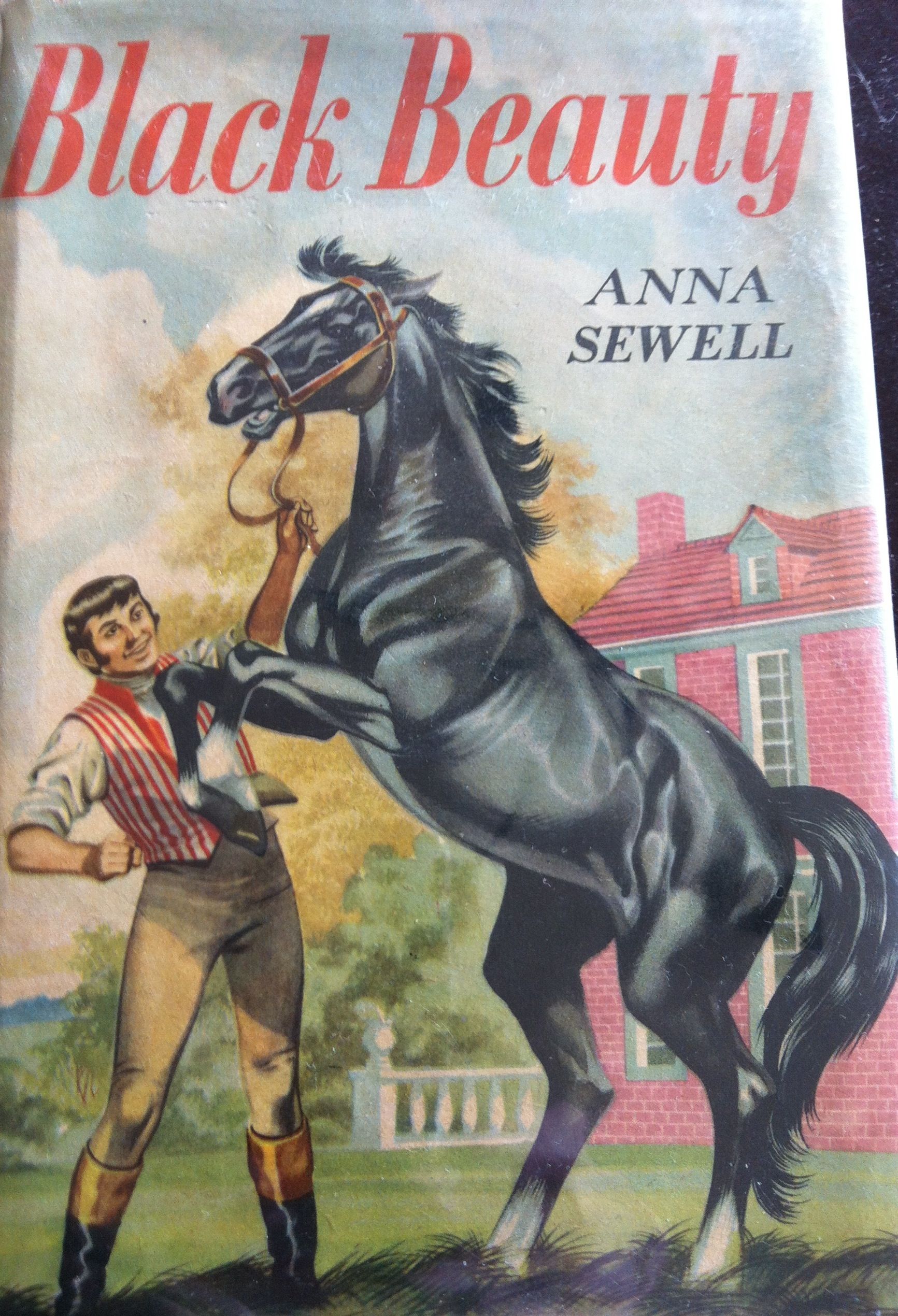
Anna Sewell’s Black Beauty is another case in point. Written as a first person narrative by the title character, it was originally conceived as a plea for compassion in the treatment of working horses (in much the same way as The Water Babies was a campaigning tract about the treatment of child chimney sweeps). Sewell wanted to bring the plight of working horses to public awareness and in particular to end the practice of unnaturally raising carriage horses’ heads with the “bearing rein”. Stripped of its social and historical context it is now a straightforward story about the life of a horse.
But I was struck on reading the novel how clearly it also reads as an anti-slavery tract. Forget for a minute that this is a book about horses, and read these lines from early in chapter one:
Our master was a good, kind man. He gave us good food, good lodging, and kind words; he spoke as kindly to us as he did to his little children. We were all fond of him, and my mother loved him very much….I was a dull black, so he called me Darkie.”
As long as Black Beauty is well cared for he accepts his enslavement with resignation. He describes how he is broken into wearing reins and a bridle:
I had of course long been used to a halter and a headstall, and to be led about in the fields and lanes quietly, but now I was to have a bit and bridle; my master gave me some oats as usual, and after a good deal of coaxing he got the bit into my mouth, and the bridle fixed, but it was a nasty thing! Those who have never had a bit in their mouths cannot think how bad it feels; a great piece of cold hard steel as thick as a man’s finger to be pushed into one’s mouth, between one’s teeth, and over one’s tongue, with the ends coming out at the corner of your mouth, and held fast there by straps over your head, under your throat, round your nose, and under your chin; so that no way in the world can you get rid of the nasty hard thing; it is very bad! yes, very bad!
There’s no attempt to disguise the distress Beauty experiences during his “breaking in” (a phrase also used to describe the brutal treatment of slaves until they came to accept their captivity). But however accepting of his condition, Beauty is aware that he is still a possession, vulnerable to being sold to a new, less kind master at any time:
I was quite happy in my new place, and if there was one thing that I missed it must not be thought I was discontented; all who had to do with me were good and I had a light airy stable and the best of food. What more could I want? Why, liberty! …Straps here and straps there, a bit in my mouth, and blinkers over my eyes. Now, I am not complaining, for I know it must be so. I only mean to say that for a young horse full of strength and spirits, who has been used to some large field or plain where he can fling up his head and toss up his tail and gallop away at full speed, then round and back again with a snort to his companions—I say it is hard never to have a bit more liberty to do as you like.
He also knows that if he breaks down physically and becomes no longer useful or wanted he is likely to be disposed of, either sold on to ever more difficult work, or sent to “the dogs” – that is to say slaughtered and sold as dog food. When his friend Merrylegs the pony is sold to a neighbour it is seen as a kindness that
“it was on the condition that he should never be sold, and that when he was past work he should be shot and buried. “
(This line of argument, that Black Beauty is a form of slave narrative, is developed by the wonderfully named Bonnie Blossom in this article.)
I am not arguing that Black Beauty is an anti-slavery tract, not least because slavery had been abolished in the USA a decade before it was published, and much earlier in the UK – the moral argument had been won. But awareness of the brutality of slavery was still very much in the public imagination, and viewing our treatment of domestic animals as being analogous to the way slaves were once treated, adopting some of the traditional narratives and characteristics of slave stories, gives a powerful emphasis to Sewell’s argument for kinder treatment of horses. Putting it simply, we feel for the mistreated horses in the novel because they are treated like slaves.
This is a progressive novel in other ways. Sewell argues forcefully for the retention of the Sabbath as a day of rest. Beauty’s driver, Jerry, is tempted to work on Sunday’s for a reliable customer, but turns down the work as he wants to preserve his time with his family:
“If working men don’t stick to their Sunday … they’ll soon have none left; it is every man’s right and every beast’s right. By God’s law we have a day of rest, and by the law of England we have a day of rest; and I say we ought to hold to the rights these laws give us and keep them for our children.”
This initial position of not working on the Sabbath for religious considerations is then generalised into a wider argument for the protection of working men’s conditions of employment, and their collective power through industrial action, specifically withholding their labour (a later chapter is called “A Strike for Liberty”):
“That may sound well enough, but it won’t do; every man must look after his own soul; you can’t lay it down at another man’s door like a foundling and expect him to take care of it; and don’t you see, if you are always sitting on your box waiting for a fare, they will say, ‘If we don’t take him some one else will, and he does not look for any Sunday.’ Of course, they don’t go to the bottom of it, or they would see if they never came for a cab it would be no use your standing there; but people don’t always like to go to the bottom of things; it may not be convenient to do it; but if you Sunday drivers would all strike for a day of rest the thing would be done.”
Elsewhere Sewell argues from a moral standpoint that:
“With cruelty and oppression it is everybody’s business to interfere when they see it”
This is typical of the muscular Christianity that informs much of the reforming literature of the Victorian era.
The novel also contains a striking portrait of the Charge of the Light Brigade in the Crimean War, told from the perspective of Captain, “An Old War Horse”. We are not told directly that his reminiscences are of this battle, but the descriptions are unmistakeable:
“I cannot tell all that happened on that day, but I will tell of the last charge that we made together; it was across a valley right in front of the enemy’s cannon. By this time we were well used to the roar of heavy guns, the rattle of musket fire, and the flying of shot near us; but never had I been under such a fire as we rode through on that day. From the right, from the left, and from the front, shot and shell poured in upon us. Many a brave man went down, many a horse fell, flinging his rider to the earth; many a horse without a rider ran wildly out of the ranks; then terrified at being alone, with no hand to guide him, came pressing in among his old companions, to gallop with them to the charge.
“Fearful as it was, no one stopped, no one turned back. Every moment the ranks were thinned, but as our comrades fell, we closed in to keep them together; and instead of being shaken or staggered in our pace our gallop became faster and faster as we neared the cannon…..
our gallant company was cruelly overpowered, and those who remained alive after the fierce fight for the guns came galloping back over the same ground. Some of the horses had been so badly wounded that they could scarcely move from the loss of blood; other noble creatures were trying on three legs to drag themselves along, and others were struggling to rise on their fore feet, when their hind legs had been shattered by shot. After the battle the wounded men were brought in and the dead were buried.”
I said, “I have heard people talk about war as if it was a very fine thing.”
“Ah!” said he, “I should think they never saw it. No doubt it is very fine when there is no enemy, when it is just exercise and parade and sham fight. Yes, it is very fine then; but when thousands of good brave men and horses are killed or crippled for life, it has a very different look.”
The enemy must have been awfully wicked people, if it was right to go all that way over the sea on purpose to kill them.”
This vivid description of the battle makes an interesting contrast to the jingoism of Tennyson’s better known account. Sewell uses the apparent naivety of the horses to point out the simplicity of seeing war as ourselves versus “awfully wicked people”.
There is also a fascinating description of Beauty’s reaction to his first encounter with a steam train, which captures much of the Victorian shock at the force of this new technology.
I shall never forget the first train that ran by. I was feeding quietly near the pales which separated the meadow from the railway, when I heard a strange sound at a distance, and before I knew whence it came—with a rush and a clatter, and a puffing out of smoke—a long black train of something flew by, and was gone almost before I could draw my breath. I turned and galloped to the further side of the meadow as fast as I could go, and there I stood snorting with astonishment and fear. In the course of the day many other trains went by, some more slowly; these drew up at the station close by, and sometimes made an awful shriek and groan before they stopped. I thought it very dreadful, but the cows went on eating very quietly, and hardly raised their heads as the black frightful thing came puffing and grinding past.
Reading the novel as a form of slave narrative, chapters on the Crimean War and the coming of the steam train – these are all points of interest. But the novel as a whole is repetitive. Beauty is sold to a new owner, he gets to know him and his new role, there is an encounter with another horse, and then an incident that leads to the next owner. Repeats over forty or more chapters. Events are described through the child-like innocent eyes of Beauty or his friends, with sufficient context for the reader to identify the wider commentary implicit and explicit in the narrative. All washed down with a gentle Christian sensibility (at one point a human watches a character leave and says to himself “Inasmuch as ye have done it to one of the least of these”, which as I am sure you know is from Matthew in the King James text of the Bible). There’s a banality to the repetition of the story arc over time which leaves the reader restless for the inevitable happy ever after.
Footnote
A while back I wrote about the use of the word “gammon” as a term of disrespect. There is another instance here where it is used as a euphemism for “hypocrite”. Beauty’s driver takes a fare for an urgent job having previously refused one. Asked how much he earned he replies:
“A good deal more than I generally get…..what he gave me will keep me in little comforts for several days.”
“Gammon!” said one.
“He’s a humbug,” said another; “preaching to us and then doing the same himself.”
 The Reading Bug
Pingback: Book review: Haroun and the Sea of Stories, by Salman Rushdie, 1990 – The Reading Bug
Pingback: Book review: The Man Who Would be King, by Rudyard Kipling, 1888 – The Reading Bug