I don’t often blog about blogging – it all gets a bit self referential – but the number of people dropping by this blog today (mainly it has to be said via the internet rather than WP reader) made this my best month ever in terms of visitors and views.
I know my readership is tiny by most standards, but the two or three people who swing by regularly to check out what I have been reading, and to sometimes say hello, make it worth doing. Yes it is sometimes a bit of a chore, and as I close in on 400 posts and I’d guess around 300 reviews (the rest are supplementary and comment pieces) I wonder how long I will keep going, but for now, and again, thank you.
My plans for the blog going forward are pretty relaxed – more of the same, with a focus on reading writers I haven’t read before – but if you have any suggestions on authors I should look into, please let me know.
“They may be called the Palace Guard, the City Guard, or the Patrol. Whatever the name, their purpose in any work of heroic fantasy is identical: it is, round about Chapter Three (or ten minutes into the film) to rush into the room, attack the hero one at a time, and be slaughtered. No one ever asks them if they want to. This book is dedicated to those fine men.”
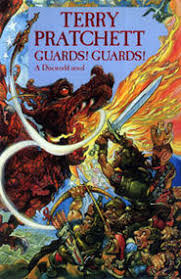
I was really looking forward to reaching Guards! Guards! in my Discworld reread. It is the novel in which Sam Vimes and the city’s night watch first appear, as well as featuring an extended role for the wonderful librarian.
A secret brotherhood, the Unique and Supreme Lodge of the Elucidated Brethren of the Ebon Night, plot to overthrow the Patrician Havelock Vetenari by using a dragon summoned from wherever it is that all the dragons went. As plans go this has some weaknesses, not least the dragon’s reluctance to return to its own realm once the people have been gulled into accepting a new puppet king. The fine men of the Night Watch, who at full strength are Captain Vimes, Sergeant Colon, Corporal Nobbs, and Lance Constable Carrot Ironfoundersson, set out restore order, aided by their new deputy, the Librarian.
Vimes is a drunk, fit only for the Watch, a small group of incompetents suited for bell ringing and running away. Newly appointed Constable Carrot is the exception to this rule. Brought up by a dwarf family (a great visual joke that Elf obviously borrowed) he is a strapping young man full of enthusiasm and youthful idealism for the rule of law – his first act on being sworn in is to arrest the head of the Thieves’ Guild.
Vimes begins investigating the dragon attacks, and in doing so meets Lady Sybil Ramkin, a magnificent swamp dragon breeder (That is, she is magnificent, not the swamp dragons, which are to royal dragons what chihuahuas are to great danes). She gives him a pet dragon, Errol, and offers help in the investigation. While the Brethren’s plan initially works and the Patriarch is deposed, the dragon returns unexpectedly during the coronation, eats the prospective king, and takes up residence in the palace. He seems to be able to control Vetinari’s chief minister Wones, clearly the Supreme Master of the brethren all along, through telepathy. A new order is imposed in which tributes are paid to the dragon in the form of gold, jewels, and a monthly human sacrifice. I won’t give away the finale because I am getting soft in my old age, but suffice to say fans of Shrek won’t be taken by surprise.
A commonly asked question about Discworld is where to start? At the beginning is always the best place, of course, but I would accept that it takes quite a bit of determination to face the prospect of the 40 or so novels in the series. If you are not convinced you have the stamina for the long haul, and want to sample Sir Terry when he had really hit his stride, then Guards! Guards! is a great starting place. You don’t need to have read any of the preceding novels as a precondition to enjoying Guards! – it works well as a stand alone narrative. It also introduces you to a range of characters who you will grow to love, if you have a heart. I’ve written before and often about my love for this series, and I would still argue that Granny Weatherwax is one of the greatest female characters in all literature (yes, I am well aware that sounds preposterously overstated – I stand by every word.) But Sam Vimes is the character with the most interesting story arc – he starts this novel as a broken wreck of a man, and by the end of the series he – well, things get a lot better for him. It’s a story of redemption through public service, and that may sounds pompous but it’s true nonetheless.
Rereading these novels is a joy, in part because you know what is to come and can spot all the small moments of foreshadowing. Vimes and Lady Ramkin’s relationship is that rare thing, a believable romance between two characters past their prime. The other source of pleasure in the novels is the “spot the pop culture reference” game STP loves to play – the text refers playfully to Sherlock Holmes, (“There was also the curious incident of the orangutan in the night-time”) Casablanca, Evelyn Waugh, Dirty Harry, and the Hobbit, to name just a few.
Guards! is written with an obvious love for books, bookshops, and libraries. This shines through in the many references to the importance of these in our lives and the special place in hell reserved for people who don’t respect them.
“The truth is that even big collections of ordinary books distort space, as can readily be proved by anyone who has been around a really old-fashioned secondhand bookshop, one that looks as though they were designed by M. Escher on a bad day and has more stairways than storeys and those rows of shelves which end in little doors that are surely too small for a full-sized human to enter. The relevant equation is: Knowledge = power = energy = matter = mass; a good bookshop is just a genteel Black Hole that knows how to read.”
Creating the beloved librarian to protect the Unseen University’s library was a great gift.
Last but not least I can never read Pratchett without being reminded yet again of his awesome ability to turn a phrase, comedic, philosophical or otherwise. Here are just a few random examples:
“They felt, in fact, tremendously bucked-up, which was how Lady Ramkin would almost certainly have put it and which was definitely several letters of the alphabet away from how they normally felt.”
“Someone out there was about to find that their worst nightmare was a maddened Librarian. With a badge.”
“A good bookshop is just a genteel Black Hole that knows how to read.”
“The three rules of the Librarians of Time and Space are: 1) Silence; 2) Books must be returned no later than the last date shown; and 3) Do not interfere with the nature of causality.”
“… a metaphor … is like lying but more decorative.”
“His sister had been sent down to the village to ask Mistress Garlick the witch how you stopped spelling recommendation.”
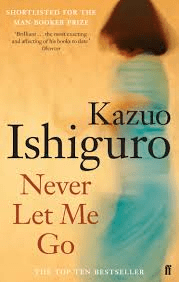
I am a bit embarrassed that I have only now just got round to reading what must be one of the most powerful novels written this century. I can completely see why Ishiguro was awarded the Nobel Prize for Literature in 2017. In terms of subtlety, control and lightness of touch this novel ranks with Nabokov at his best.
It’s also an extraordinarily difficult book to review without spoilers, and while my approach to spoilers in the past has been robust if not cavalier, here’s where I draw the line – because I can’t tell you (assuming you don’t know already of course) the central idea of this novel without undermining the long slow reveal which is a key part of the narrative structure.
I would hate you to think this all means that this is a ‘difficult’ novel. Part of Ishiguro’s genius is that it is deceptively simple. It is written in the form of the first person memoir by Kathy H, a ‘carer’. She describes a childhood spent at Hailsham, a boarding school somewhere in England. At first Kathy’s memories of school are unremarkable – this could easily be a traditional school story, all hockey sticks and midnight feasts, crushes on teachers and silly games. But the text is carefully sprinkled with suggestions that Hailsham is not your typical boarding school. Although the text opens with a stark sentence “England, 1990s” this is deceptive – and at the same time not, in that apart from the one key difference, this is a remarkably familiar, almost mundane world of bus shelters, offices, cassette tapes and cafes.
This is an incredibly thoughtful meditation on childhood and the mysteries of life. If that sounds pompous then I apologise because it is anything but. If you don’t want spoilers then stop here, because I find I can’t continue without commenting on the treatment of the novel’s major themes. The children at Hailsham and elsewhere are, we eventually discover, clones, bred for their organs, which are slowly harvested from them once they reach maturity. The moment when we find this out is a shocking moment of realisation – all of a sudden the references to caring, donating and ‘completing’ come into focus.
I doubt I am alone in wondering why the clones don’t reject the role in life set out for them as ‘donors’ and rebel, or just run away. The children’s pilgrimage to see a boat washes up on the Norfolk shoreline perhaps hints at their desire to escape their preordained fate. But I came to realise this would be missing the point. When the children are growing up at Hailsham they are gradually introduced to the concept that they will have their organs harvested and then eventually, after two, three or four operations, die. Dying is referred to as “completing”. They grow up understanding this is their fate and are taught not to question it. But don’t we all? We are all told about death, but we are also lied to about it. I don’t often quote the Daily Telegraph, but their reviewer put it really well – ”
‘Gradually, it dawns on the reader that Never Let Me Go is a parable about mortality. The horribly indoctrinated voices of the Hailsham students who tell each other pathetic little stories to ward off the grisly truth about the future – they belong to us; we’ve been told that we’re all going to die, but we’ve not really understood.”
Or as the narrator Kathy puts it
“What I’m not sure about, is if our lives have been so different from the lives of the people we save. We all complete. Maybe none of us really understand what we’ve lived through, or feel we’ve had enough time.”
We do indeed all ‘complete’, and few of us feel we have had enough time.
There’s obviously another perfectly valid reading of this novel which accepts this point – we all die – but goes on to make the point that we don’t all die by having our organs harvested and that society treats some people differently from others. The clones in the novel are treated by their non-clone guardians as little more than soulless meat. Hailsham, we are told, is a progressive school (farm) where the children (clones) are treated humanely, but we are also told that the movement to improve conditions for clones has declined and that they are now treated badly. One can only imagine what that means. This is surely a parable for the way people who we perceive as different, whether by race, gender, disability or religion are treated in some societies, dehumanised, ostracised, and even butchered. Or as Kathy puts it:
Maybe from as early as when you’re five or six, there’s been a whisper going at the back of your head, saying: “One day, maybe not so long from now, you’ll get to know how it feels.” So you’re waiting, even if you don’t quite know it, waiting for the moment when you realise that you really are different to them; that there are people out there, like Madame, who don’t hate you or wish you any harm, but who nevertheless shudder at the very thought of you – of how you were brought into this world and why – and who dread the idea of your hand brushing against theirs. The first time you glimpse yourself through the eyes of a person like that, it’s a cold moment. It’s like walking past a mirror you’ve walked past every day of your life, and suddenly it shows you something else, something troubling and strange.”
I feel I have only scratched the surface of this wonderful, powerful, heartbreaking novel, which I am sure I will return to one day. Like all great books it can only be read for the first time once – after you know Hailsham’s dark secret you can never un-know it – but this is so much more than a mystery novel. As a masterpiece of controlled writing and construction I can’t recall having read anything like it for a very long time.
As an experiment I tried crowd-sourcing this review. I joined a Terry Pratchett appreciation group on Facebook, and posted the following message:
Hi all. Quick question – what do people think of ‘Pyramids’? I am writing a review and my initial impression is that it is one of STP’s less successful books in the series, but struggling to pinpoint why. There’s some great lines and ideas, but it just doesn’t take off. What do people think?
I received over 100 replies (and counting) which was amazing – this is obviously a really vibrant online community. Given this was a group for fans of all-thing Discworld, it is hardly surprising that most of the comments were along the lines of “amazing” and “wonderful”. At the same time it’s hardly in the spirit of crowd-sourcing to only selection for quotation those comments I agreed with – I may have well just written my own review in the first place!
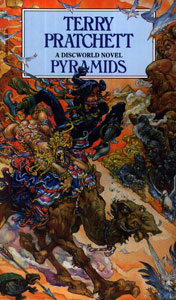
Quick plot summary for context – Pteppic, the crown prince of Djelibeybi (one of the better jokes in the book) is a trainee at the Assassins’ Guild in Ankh-Morpork. On the death of his father he returns home to become king, and oversee the construction of his father’s tomb, the biggest pyramid ever built. it’s not all fun as a living god however – the high priest Dios acts as voice of the king, and doesn’t allow Pteppic to make any decisions for himself.
The ancestral pyramids covering most of the country are used to control time in the kingdom, apparently, and in a scene that you just have to accept, the new pyramid, being built with magic, is so large that it causes some kind of space/time anomaly. Djelebeybi rotates out of alignment with the rest of the world by ninety degrees. Pteppic and his handmaiden Ptraci travel to neighbouring Ephebe to try and find a way of recovering the kingdom, while back in Djelibeybi the Old Gods and all the late kings come back to life, causing chaos. With the help of a mathematically advanced camel, Pteppic manages to put things back to right and all is well with the Disc.
So back to these readers’ comments. Positive comments first. There is a consensus here that the jokes really work, the ideas are great and the characters are believable and interesting. Lots of people tried to explain really engaged with the question I posed about my doubts about the novel (which was really kind actually) which mainly revolved around it being one of the few standalone novels, in a setting which STP didn’t return to. No-one said I was wrong – this isn’t that kind of community.
I really liked it. But I think the books with recurring characters will always have an edge as favourites
Love it. Sometimes it has to do with the mood you are in. Try again in a year.
It’s better on the second read through. Not his best, but not bad by any stretch.
I think as a stand alone discworld novel its great, like Reaper Man or Small Gods. However because the witches, the Watch (my personal favourite) or Rincewind appear in multiple books you have more time to get to know them and so you care more about them. Just a hypothesis based on opinion though
Love the book. Possible the reason it “less successful” is that there is not seque, As with Vimes or the witches books. As a stand allow or is as strong as any.
I love it. Its take on organized religion and the nature of belief is spot on.
I really loved it, one of my favourites. Teppic is a great characters and Dios is one of STP’s best written antagonists in my opinion, even if his name is a little on-the-nose.
I love it. That opening sequence (the assassin exam) is exquisite.
I really like it. One issue for me as a fan is that I like the relationship that develops as characters mature through the cannon. As a stand alone book it feels more superficial because of the need to establish the characters.
One of my favourites actually. Of course we all have different tastes and they often change over time.
It’s one of my favourites, possibly because it is one of the first times the theology of the disc becomes explicit.
One of if not my favourite. love the detail and so many jokes
One of my favourites, it was the second I read after small Gods. I think the standalones are a good entry point. And a bit of religion and mythic philosophy were very appealing to teenage me
Loved the school stuff! One of my favourite passages of any discworld books 👍
You Bastard (the camel) is one of my favourite characters.
These were the comments that were generally negative, and tried to explain why:
I agree, and I blame inferior characterization. Ptepppic is no Moist von Lipwick, Ptraci is no AdoraBelle, Dios is no Vorbis. Hence their verbal and dramatic interactions don’t stand up to comparison with later novels. Nonetheless, I re-read it … and my initial dislike lessened. A not-quite-so-good Pratchett novel is better than anything else.
I have just finished rereading this in my chronological reread, and I agree that it’s not his best. It has some good ideas, but for some reason the whole just doesn’t gel. It feels like he raced through it to meet a deadline. It especially suffers in comparison to Guards! Guards! which comes after it.
They don’t quite work together cohesively as a theme, I think. The assassins are great, the camels are great, Ephebe is great, all the Djelibeybi jokes are great… But nothing really ties them together thematically except the plot.
One of my least favourites. Didn’t find myself rooting for the characters. Didn’t understand what was going on a lot of the time.
Just rereading and think it’s the lack of familiar characters. It makes it hard to latch on to.
My “least favourites” tend to be the early ones where the plot and characters are mostly there to serve the jokes. I think Pyramids qualifies. At times, it’s like the really good pun or silly name is hard-elbowing its way past everything else.
It’s not one of my favourites but I do like it a fair bit. It’s one of the few of his books that doesn’t really flow as a whole story and feels a bit more like the storyline could have been created by another author.
Interesting that you asked. It was my 7th or 8th one from the series and I thought it was so boring and dumb I stopped reading his books for a few years. Would not recommend it.
For me, it is one of my least favourites. Although I do like Dios as a character, the book seems to be either a bit too stretched, as in thin in the middle, the beginning and the end are fun and go along at a decent pace, but the middle just loses something for me. I trend to have the same reaction to small gods and moving pictures however.
Not my favourite. I think it is because there isn’t a character I really care about.
There are some really good points here – even STP not at his best is still worth reading – but what is interesting is that people seemed to agree that the lack of familiar characters and settings – or characters that were to go on to become familiar – was an issue.
My sneaking suspicion is that Sir Terry would have happily accepted that this wasn’t his finest hour, which is why he never returned to these characters. It’s not that its a dud, it’s just not quite at the same standard as most of his other work. There are some jumps in the logic of the story where the reader just has to do a little too much work. But I would also agree with many commentators that the Assassins’ Guild examination chapter is worth the purchase price of the novel on its own.
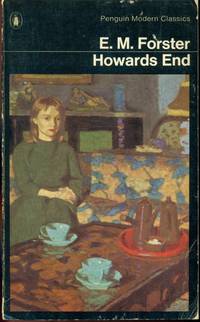
Set in Edwardian England at the beginning of the 20th century, during that brief but now seen as idyllic decade when the full horrors of the twentieth century were yet to emerge, ‘Howards End’ concerns three families: the Wilcoxes, the Anglo-German Schlegels, and the Basts. Each family is very precisely defined in terms of their class. The Wilcoxes are the more prosperous family, but their money derives from business rather than inheritance. Mrs Wilcox is differentiated from the rest of her family by her inheritance of the family home, the ‘Howards End’ of the novel’s title. The Wilcoxes are determinedly conservative and patriarchal, fiercely rejecting women’s suffrage and ordering their servants around brusquely. The Schlegels sisters, Margaret and Helen, are more urban and liberal, interested in the arts and living on inherited money without having to work for a living. The Basts are working class, and while Leonard is an insurance clerk he has aspirations for a life of culture. His wife appears only briefly in the novel, but plays a crucial part in one of its moment of melodrama.
After the Schlegels and Wilcoxes meet on holiday in Germany, Helen visits the Wilcoxes at their country home, (Howards End), where the novel opens. Impetuously she becomes engaged to the younger son, Paul, although they both almost immediately realise this has been a silly mistake, and call the whole thing off. The Wilcoxes move to London, abandoning Howards End until the end of the novel, into an apartment close to the Schlegels’ home. Margaret Schlegel and Ruth Wilcox become unlikely friends, but this friendship is cut short by Mrs Wilcox’s unexpected death. On her deathbed she bequeaths Howards End to Margaret but the bequest is informal and Margaret does not become aware of it until many years later. The Wilcox’s burn the note and agree never to speak of it, considering it a betrayal.
In a parallel plot line, the Schlegel sisters meet Leonard Bast at a concert. Leonard is an impoverished clerk about to marry a much older woman. Leonard yearns for a life of culture and the arts. Mr Wilcox warns the sisters that the insurance Leonard works for is likely to go bust – they in turn warn Leonard, who quits his job for something less well paid, only for that advice to turn out to be completely wrong.
Another time jump, and Henry Wilcox, the family patriarch and widower, and Margaret (the older Schlegel sister) become friends. Unsuited for the life of a bachelor, Henry proposes to Margaret. This is a marriage of opposites, and it is uncomfortable to a modern reader to see Margaret bullied into submission by her boorish husband, devoid as their relationship is of any outward sign of affection or compatibility. (In a horrible parody of affection, Henry refers to Margaret as “it” – “What a practical little woman it is! What’s it been reading” (chapter 31). Henry’s children are unhappy with this marriage – Margaret is an outsider, and their opposition is focussed on a suspicion that this is a long term plan to claim her rights to Howards End.
The melodrama really starts in earnest at the fateful wedding of one of Mr Wilcox’s children, Evie, in Shropshire. Distressed by finding the Bast’s living in poverty, and blaming Mr Wilcox for their situation, she bizarrely drags them to Shropshire to confront him. Unsurprisingly that doesn’t go well – in fact it goes horribly wrong, and from this point the events of the novel spiral badly out of control.
Forster is usually considered a liberal novelist, a defender of the arts and liberal values against the barbarism of the Wilcoxes and their ilk. Certainly the Schlegels are the more sympathetic personalities in the novel, but the whole thrust of the narrative is an attempt to reconcile the different aspects of the national character, bridging the gap between progressive and conservative, rich and poor, rural and urban – all of which is brought together in the novel’s central location, Howards End, and the very modern blended family that eventually comes to live there.
‘Howards End’ is usually considered a “state of the nation” novel, in which the central theme concerns how the country is emerging from the Victorian period to face the challenges of the twentieth century. In this reading the Wilcoxes can be seen as the confident, bullying imperialist, always ordering the working classes about. Mrs Wilcox represents the aristocracy, unifying the disparate elements of the novel through her house, ‘Howards End’. The Schlegels are the cultural life of the country, and Leonard Bast the apologetic and slightly pathetic representative of the working class. I’ve picked out a few quotes which illustrate this discussion of class:
“Dear Margaret, do come into the library and shut the door. Your maids are dusting the banisters”. (Chapter 2)
This is Mrs Munt, the sisters’ aunt, speaking. There are a number of things that jumped out at me when reading this sentence. First, they have a library. This is a novel in which lots of contrasting homes feature, and this is one of the central locations. The dimensions of the Schlegel’s London home in Wickham Place (a fleeting reference to Austen perhaps?) are never given. But it must be a decent size to have a library. Second – and this point is made several times elsewhere in the novel – it is not the done thing to speak of private or personal matters in front of staff. But third, and possibly most noticeably, the sisters have at least two, and possibly more, maids. Servants feature extensively in ‘Howards End’, although they are rarely given a voice (I think one of the chauffeurs might have a line or two) but essentially they are a servile underclass treated as disposable items of equipment. There is a passing indication that employing and retaining servants is something that is becoming increasingly hard in Edwardian England, and of course that situation was to get markedly worse during and after the Great War, but there is a strong line linking the maids, valets and butlers of Austen’s Regency novels and the Schlegel’s and Wilcox’s domestics nearly 100 years later.
“’Esprit de classe’…was strong in Mrs Munt. She sat quivering while a member of the lower orders deposited a metal funnel, a saucepan, and a garden squirt beside the roll of oilcloth.”
(Chapter 3)
Mrs Munt is essentially comic relief in this novel, and we are presumably intended to find her sense of outrage at the way she is being treated, her silent impotence, amusing. There certainly is something comic in the list of miscellaneous objects being loaded in to the car from the ironmongers – but class and class instincts are never far below the surface in ‘Howards End’. Here the shop-keeper is a representative of the lower orders, in front of whom class spirit dictates that emotions, particularly those of women, must be strictly checked.
“She (Mrs Wilcox) approached just as Helen’s letter had described her, trailing noiselessly over the lawn, and there was actually a wisp of hay in her hands. She seemed to belong not to the young people and their motor, but to the house, and to the tree that overshadowed it. One knew that she worshipped the past, and that the instinctive wisdom the past can alone bestow had descended upon her – that wisdom to which we give the clumsy name of aristocracy.” (Chapter 3).
Forster returns to the issue of class, claiming here that aristocracy is ‘the instinctive wisdom of the past’ – which is why the country and its assets should be left in the hands of the upper classes, not people with pretensions above their stations such as Leonard Bast. This is profoundly conservative perspective, and there is little reason to believe it is not the author’s as well as the narrator’s. incidentally, that wisp of hay in Mrs Wilcox’s hands makes a reappearance almost 300 pages later in chapter 43, as Margaret considers the aftermath of the confrontation at Howards End between Charles Wilcox and Leonard. “Life was a deep, deep river, death a blue sky; life was a house, death a wisp of hay”. This echo from the novel’s opening to its conclusion can’t be an accident (death is not, after all, a wisp of hay) and I suspect is Forster’s way of linking the opening scenes at Howards End with the novel’s conclusion.
At Mrs Wilcox’s funeral the narrator describes a woodcutter high in a tree, looking down at the ceremony. “With a grunt he descended, his thoughts no longer on death, but on love, for he was mating”. I can’t recall any ever reading about someone engaged in an ongoing sexual relationship – which is what Forster means – described in this way. It is coarse and animalistic – it implies that is all he is doing, copulating, rather than being in love. Without question he would not describe the relationships between the other characters in the novel in this way. The conception of Helen’s baby is virtually immaculate by comparison. Put simply, this is the language of class hatred. Is this the narrator who finds working class people no better than animals, or is it Forster? I could scour Forster’s diaries and correspondence to try and identify his personal opinions on class and sexual relationships, but that wouldn’t really answer the question. Certainly the perspective is consistent with the narrator’s other comments on class, such as the equally brutal and faintly ludicrous “We are not concerned with the very poor. They are unthinkable, and only to be approached by the statistician or the poet.” (Chapter 6)
There’s much to enjoy in ‘Howards End’. It is a thoughtful novel of ideas. At times the writing goes over the top, and the narrator becomes more of a preacher, such as here:
“Margaret realized the chaotic nature of our daily life, and its difference from the orderly sequence that has been fabricated by historians. Actual life is full of false clues and sign-posts that lead nowhere. With infinite effort we nerve ourselves for a crisis that never comes. The most successful career must show a waste of strength that might have removed mountains, and the most unsuccessful is not that of a man who is taken unprepared, but of him who has prepared and is never taken. On a tragedy of that kind our national morality is duly silent. It assumes that preparation against danger is in itself a good, and that men, like nations, are the better for staggering through life fully armed. The tragedy of preparedness has scarcely been handled, save by the Greeks. Life is indeed dangerous, but not in the way morality would have us believe. It is indeed unmanageable, but the essence of it is not a battle. It is unmanageable, but the essence of it is not a battle. It is unmanageable because it is a romance, and its essence is romantic beauty.”
I am afraid this means very little to me, and I don’t read novels for this level of patrician pomposity. But if you skim over these paragraphs, and I recognise you really shouldn’t have to, then what remains is an important novel that bridges the gap between the authors of the Victorian era and the modernist writers of the twentieth century.
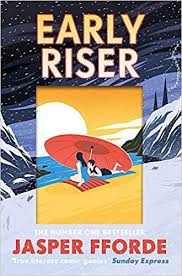
This is a really welcome return to writing ffor Fforde after a ffour year hiatus. (sorry).
I am guessing, but my suspicion is that his inspiration for this novel was the question “What if the last Ice Age had not finished when it did?” We know that human evolution – or probably more accurately the development of human civilisation – was profoundly affected by the most recent Ice Age. It can’t be a coincidence that the glaciers began to retreat around 11,700 years ago, and we can start to trace the rise of civilisation as we know it from around 10,000 years ago. But what if the ice had never gone away – what would human civilisation look like?
Fforde builds his world around this premise, or something very similar to it. In this chilly world humans hibernate, and it is part of his slow reveal technique that it is not until around 250 pages in that we discover what we should have probably already worked out, that humans have retained body hair more akin to our monkey cousins than our current-day down.
This world is shown through the eyes of Charlie Worthing, a trainee Night Consul. The Night Consuls are a police force who maintain order while 99% of the population sleep through the winter, protecting the sleeping from the Villains and others who choose not to hibernate. Charlie is very much the innocent abroad, who tries to do the right thing but is constantly stumbling into situations where his presence is at best a complicating factor.
In this alternative world, death during the winter is a frequent occurrence, not just for the Night Consuls. Go to sleep thin and you don’t wake up. The drugs people take to stop calorie sapping dreams can also take their toll, leaving some survivors as little more than brain dead and very hungry zombies. Charlie’s first job as a consul is to escort one such walker to a research facility, and when his companion is stolen, Charlie goes in pursuit, setting off a chain of events that cause mayhem in this sector of snow-bound Wales.
Fforde’s world building is wonderful – he has really given a huge amount of thought to what life in his world would be like. It is in many ways a quite sinister dystopia – fertility rights are traded down generations for example. He has also created a detailed vision of what dream manipulation might look like. As a detective story the novel is slightly less successful – Charlie is a hapless hero who is always on the spot when someone else is blown away by one of the freaky new percussive weapons people have, or predated by one of the WinterVolk – semi-mythological creatures who people the winters, along with the surviving mega-fauna such as mammoths. Somehow he always survives, and for me this pattern became a little predictable – Charlie and A.N.Other character set out to explore mysterious scenario a, b, or c, peril threatens and A.N.Other is blasted to kingdom-come with Charlie watching open-mouthed alongside them.
The novel is chock-full of in-jokes and contemporary references, (and not-so contemporary references – Rick Astley features, for example) and the winter-world is very recognisable, even if given a tweak. There is a Jane Bond film franchise, with one controversial male casting. References to the Welsh setting and the class war with the English give the novel a very specific set of cultural references that may not travel well – the novel is not yet published in the US, and it will be interesting to see how it is received there.
Quibbles aside, it is fantastic to have Fforde back. I don’t know if Charlie Worthing will be appearing in any sequels – I have a hunch not – but anything he writes is definitely worth reading. Highly recommended. If you haven’t read Fforde before then I also cannot recommend ‘The Eyre Affair’ highly enough – it is brilliant.
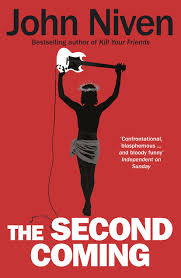
John Niven’s ‘The Second Coming’ is not for the easily offended. Yes, the second coming of the title is indeed the return of Jesus Christ to earth. God is appalled at the mess we are making of things down here and decides to send Jesus back down to have another go at sorting us out. This is not the millennial second coming of prophesy, but a rerun of the first attempt.
Niven’s satirical approach is raw and uncompromising – think Frankie Boyle or Bill Hicks. God is the CEO of Heaven, a charismatic leader who despises organised religion, doesn’t need to be worshipped (why would he?), and loves gays and cannabis. His message to mankind is “Be Nice”, not the monstrously clumsy ten commandments of the Old Testament. Satan is akin to the boss of an opposing company and hell is the nightmarish vision of Dante and Bosch combined, a place where the eternal anal rape of homophobes is just a little too gleefully described. Did I mention Niven doesn’t do subtlety?
Jesus returns to earth as a New York hippie, trying to help the dispossessed and the disadvantaged, at first making very little difference. “Be Nice” is not a message that gets much traction, so Jesus enters a musical talent competition – a very thinly disguised American X Factor – masterminded by a stunningly unpleasant boss. Niven’s publisher’s lawyers must have had some sleepless nights worrying about getting a call from Simon Cowell’s legal team. At one point it looks as if Niven is going to suggest that the Cowell figure is Satan’s representative on earth – he might as well be, such is the depth of his evil – but he backs away from that idea – on counsel’s advice perhaps? I enjoyed the anarchic road-trip across the States that Jesus and his assorted disciples take and the talent content was also fun, with Jesus each week wanting to perform an indy song a long way from the classic ballads favoured by the show’s producers.
I won’t spoil the plot for you, but the ending does not come as a shock. Niven is an atheist and certainly gives organised religion both barrels, but the portrait of heaven was surprisingly sympathetic and Christ’s faith in his resurrection is touchingly absolute and unquestioning, so much so that if you had told me Niven was an unorthodox Christian I would not have been surprised. I read this novel of almost 500 pages in less than 48 hours – it has great momentum, and you want to know how it all works out, even if you really know all along.
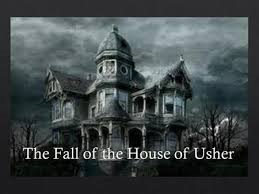
When I finish reading a text I will often consult the internet for some perspective – reviews, commentary, background, etc. My reading about ‘The Fall of the House of Usher‘ was largely un-illuminating – lots of people writing about how wonderful the story is – gothic, macabre, atmospheric are the terms most often used – but no-one able to clearly articulate why. It seems either you ‘get’ Poe or you don’t, and so far I don’t.
Here, for example, is some commentary in the journal of the Edgar Allan Poe Society of Baltimore (and let’s not pass too quickly over the fact that there is an Edgar Allan Poe Society of Baltimore) written by someone from the Tennessee Technological University (which sounds a really august centre of learning):
“Many readers consider Edgar Allan Poe’s ‘The Fall of the House of Usher’ to be one of the greatest short stories in all of world literature”.
Do they, really? I can’t find any evidence for that, and none is cited, which for an academic publication is disappointing. The writer continues:
“Few would disagree, at least, that it is one of Poe’s most popular and justifiably famous works.”
If this hyperbole were a one-off then I would be unjustified in quoting it, but that is far from the case – the reviewers on Goodreads, Amazon/com and Amazon.uk are near unanimous that Poe is a genius (which I am sure explains the whole marrying your 13 year old cousin thing) and that his story-telling and prose is outstanding. The editor of the Penguin Classics edition, David Galloway, describes ‘The Fall‘ as “one of Poe’s finest tales ….whose richness and totality of effect entitles it to unquestioned place among the short-fiction masterpieces of all time. Perhaps no other single short story has exerted such profound influences on other artists as Poe’s ‘Germanic’ tale“. Unquestioned place? Not ‘an unquestioned place’ – has the author’s gothic way of expressing himself transferred itself to the editor?
So what is it I am missing? I decided to give ‘The Fall‘ a further look following this research – surely the story has more to offer than I originally thought?
“During the whole of a dull, dark and soundless day in the autumn of the year, when the clouds hung oppressively low in the heavens, I had been passing alone, on horseback, through a singularly dreary tract of country, and at length found myself, as the shades of the evening drew on, within view of the melancholy House of Usher”.
Poe establishes his themes and techniques as soon as possible – he piles up the adjectives, alliteratively where possible, keeps on adding subordinate clauses one after the other, and is slow to tell the reader what is going on, even though the tale is told in the past tense (or more strictly the pluperfect – “I had been passing alone”). This is almost a prose poem, and makes it quite easy to copy and/or parody. Indeed, so over the top is Poe’s writing that it can easily be read as self-parody.
Poe also establishes early on that the phrase “The House of Usher” means both the family, and their home. Thus the term “fall” used in the story’s title tells us that both the house and the family are to meet their end in the course of the tale. The description of a “fissure, which, extending from the roof of the building in front, made its way down the wall in a zigzag fashion” together with a long description of the decayed fabric of the house, suggests a likely fate for both the house and the family. The additional suggestion a little later that the house has gained a form of sentience from the family, builds even closer links between the two.
Switching to the present tense, to give a more immediate sense to the narrative, the narrator describes his host, Roderick Usher, clearly suffering from a psychological illness of an undefined nature – he is pale and lethargic, suffering from nerves and ‘fear’. His sister, Madeline, has a mysterious sickness that doctors cannot treat. The narrator tries to cheer Roderick up – he listens to him play the guitar, and reads him stories, but without effect.
“I have just spoken of that morbid condition of the auditory nerve which rendered all music intolerable to the sufferer, with the exception of certain effects of stringed instruments. It was, perhaps, the narrow limits to which he thus confined himself upon the guitar which gave birth, in great measure, to the fantastic character of the performances. But the fervid facility of his impromptus could not be so accounted for. They must have been, and were, in the notes, as well as in the words of his wild fantasias (for he not unfrequently accompanied himself with rhymed verbal improvisations), the result of that intense mental collectedness and concentration to which I have previously alluded as observable only in particular moments of the highest artificial excitement.
It would be ridiculous to hold Poe to any normal standard of coherence or clarity in what is a tale of the supernatural, but his characters’ behaviour is still puzzling. The Lady Madeline passes away from her mysterious illness, and Roderick announces that he plans to inter her body in one of the vaults within the main family house, rather than the nearby burial grounds. The reasons given are, as always, ambiguous and vaguely sinister. The vault is lined with metal walls and a heavy iron door. Our last look at the corpse sees that she has “a faint blush upon the bosom and face, and that suspiciously lingering smile upon the lip which is so terrible in death.”
Any reader versed in the conventions of the gothic will be able to fill in the rest of the narrative without assistance from the author (or reviewer).
I could continue to delve into the depths of this narrative to try and find some additional value, but there comes a point when you just have to accept that certain styles of writing are just not to your taste. If you enjoy overblown, over the top, over-written gothic horror then this will be your cup of tea. But don’t be disappointed if you don’t find it the masterpiece that some believe it to be.
‘How not to be a Boy‘ was promoted as a feminist analysis of masculinity in the UK in the 21st century, how toxic it can be, and how it can be avoided (look at the front cover “Rules for Being a Man” if in doubt – confusingly man not boy). It does indeed contain this analysis, but this goes alongside a very traditional childhood to adulthood rags to riches autobiography. The book was also marketed as unblinkingly honest, one in which Webb confront his demons, looks them in the eye and names them. Again, this is only part of the story – there’s plenty of glossing over of difficult issues here alongside the franker discussions about early homosexual experiences, or his abusive father.
I am sure life wasn’t easy growing up in the Lincolnshire Badlands in the 1970’s and 80’s, fourth son of a forester who was physically abusive towards his mother and older brothers. His parents’ divorced when he was five and his step-dad seems to have been only a minor improvement. He always had the comfort of his grandparents to fall back on, but he grew up in the shadow of the death of an older brother before he was born, and for whom he was in some way a replacement. Webb records in detail a childhood that will seem familiar to a large part of the population, apart from a determination to one day achieve fame through acting or comedy. The death of his mother just before his A levels knocks him off course, although retakes see him securing the place at Cambridge that is principally a way of getting into the Footlights and on that well-trodden road to success. Webb skips over the difficult post-Cambridge years fast forwarding to marriage, Peep Show, Mitchell and Webb, and fatherhood, where the more interesting observations about ‘The Trick’ i.e. patriarchy can be found.
Has Webb got anything original or interesting to say about feminism? Everything he says is undoubtedly valid and supported by clear arguments and evidence. It’s an authentic record of his mistakes and opinions, and as far as it goes that would probably make a worthwhile Sunday supplement article or two. But no, it’s not original. And while the patriarchy made some of his childhood unhappy, he still managed to make it to Cambridge and beyond. I’m not criticising him using his platform for making some useful arguments in favour of men looking after themselves, seeking help, cultivating their friendship group and so on. Even if just one person is helped by this then it is worth doing.
The other, larger part of the narrative, the autobiography, sits (for me) uncomfortably with these observations. He has failed to avoid many of the mistakes he so clearly outlines. Why take advice from someone so skilled at being a traditional male – bad at relationships, bad at looking after himself, bad at even passing exams! While at Cambridge he was obnoxious – his seduction technique for example seems to have been “Get your coat” – and he is horrible, unfaithful and neglectful to the women he dates, all of which he cheerfully admits. None of this makes him easy to like.
My other issue with this book is its dishonesty. For a book that takes pride is being brutally honest, it isn’t. I can completely understand why he would want to avoid giving too much detail for example about his teenage homosexual relationships – the other people or person involved in still alive, now happily married – although the implication that this is in some way shameful or to be avoided is at odds with his claimed comfort with his sexuality and masculinity. Punches are pulled and the soul-searching only goes so far. Later at Cambridge he claims to have done literally no work – not attended any seminars, lectures or supervisions, devoting himself entirely to the Footlights and his romantic affairs – but he somehow emerges with a 2.2, which Cambridge University tends not to hand out for blank pieces of paper. This section of the book is a close copy of Stephen Fry’s account of his time at Cambridge – work heroically neglected, triumphs on stage, some last minute cramming and out pops a good degree. I don’t believe it for a minute. Webb at one point admits to humblebragging – well recognising that you are boasting while pretending to be humble (a chapter about having dinner with Carrie Fisher for example) doesn’t make you any less of a bull-shitter.


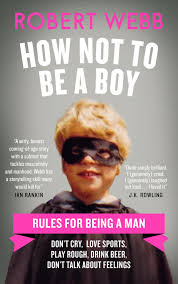 ‘How not to be a Boy‘ was promoted as a feminist analysis of masculinity in the UK in the 21st century, how toxic it can be, and how it can be avoided (look at the front cover “Rules for Being a Man” if in doubt – confusingly man not boy). It does indeed contain this analysis, but this goes alongside a very traditional childhood to adulthood rags to riches autobiography. The book was also marketed as unblinkingly honest, one in which Webb confront his demons, looks them in the eye and names them. Again, this is only part of the story – there’s plenty of glossing over of difficult issues here alongside the franker discussions about early homosexual experiences, or his abusive father.
