Book review

Klara and the Sun is narrated by the eponymous Klara, who is an ‘AF’ – an Artificial Friend, an advanced robot able to simulate and understand human emotions. Despite her intelligence Klara has a limited, child-like understanding of the world. The novel opens with Klara waiting patiently in her store to be bought. We learn that she is a specific type of robot intended as a child’s companion. She is solar powered, and therefore assumes that the sun has a significant role in all human affairs, a misunderstanding which would have been easily programmed away but which goes on to play an important part in the novel. Eventually she is purchased and taken to a remote family home, apparently somewhere in America. There are hints that American society is slowly breaking down, but this aspect of the novel, due to Klara’s very limited understanding, are never fully fleshed out. We also learn that in this dystopian future some children are genetically engineered (described here as “lifted”). This engineering seems to offer significant advantages in life, but comes at a serious risk of illness and death. Josie, the daughter of the family she has been bought to support, had an older sister Sal who died as a result of the lifting process, and Josie herself is seriously ill.
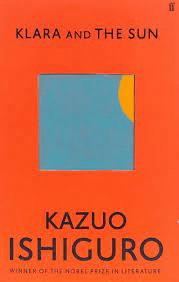
Through Klara we are introduced to Josie’s neighbour and childhood friend Rick. Rick has not been lifted and resents the impact this is likely to have on his career and life chances. This felt like fairly heavy handed social commentary – it’s not really much of a revelation that rich people have better prospects than the poor and that they can buy advantages for their children. The suggestion that any advantages come with a heavy price later in life is more subversive but it is not apparent how this translates to the real world – being rich and privileged doesn’t seem to have too many downsides!

Klara develops a theory about Josie’s illness which she is reluctant to explain in any detail, although it appears to have something to do with the sun. At first the reader believes this theory might have a grain of truth, but it quickly becomes clear that Klara has an essentially pagan understanding of the role of the sun in society and indeed of astronomy. She comes to believe that when the sun sets it ends up in a farmer’s barn on the horizon. She travels to the barn – it is suggested this is akin to an epic quest, although it is not clear why such a straightforward journey would represent a challenge to an advanced robot – and prays to the sun to save Josie. Klara offers a sacrifice in return for this favour – to destroy a machine which she believes in the sun’s enemy.

It slowly becomes apparent that Klara’s role is not just to be a friend to Josie. She is asked by Josie’s mother to imitate her daughter, and it is eventually revealed that if Josie dies, Klara is going to take her place as a disturbing if convincing substitute. I think you will by now have got the idea – this is not a science fiction novel, nor a traditional dystopian novel. Klara’s world is in some respects convincing, but in others very much the opposite. I particularly struggled with the idea of a robot being so powerful as to accurately understand and replicate human emotions, but not understand very simple concepts of astrology (as an example – Klara understands very little about the world apart from what she has observed from her shop window. Why robots would be solar powered was also puzzling! The mistakes she makes about the physical world, and the false conclusions she draws from her observations, make Klara a highly misleading narrator. Showing the reader the events of the novel and the world in which it is set through the eyes of someone – Klara in this case – who doesn’t really understand what’s going on and who makes some serious errors of understanding, is a very well established technique for encouraging the reader to see the world from a fresh perspective. The reader slowly across the course of the novel learns to decode Klara’s descriptions and work out when and how she gets things wrong, and when things are being carefully hidden from us.

The more I think about it, (and I finished the novel several weeks ago and have been turning it over in my mind ever since) the more I think the only way to read Klara and the Sun is as a parable, a modern Gulliver’s Travels. All the inconsistencies in the plot and the strange mistakes Klara makes about the world are unimportant when the novel is read that way. The anachronism of the steam-punk science is less obtrusive: we don’t need to understand why Klara’s parents would bafflingly expose her to a life-threatening treatment which had already claimed the life of her sister for little apparent benefit. But as a parable the novel is elusive – life is short and mysterious, and sometimes things happen for no particular reason. Klara is a thought-provoking novel, but I am not sure whether it works as a whole rather than as a collection of ideas that don’t cohere together as a whole. Perhaps it is one of those ‘go back and read it in a few years and see what you think’ novels?
Klara and the Sun by Kazuo Ishiguro, 2021

Aside
Book review

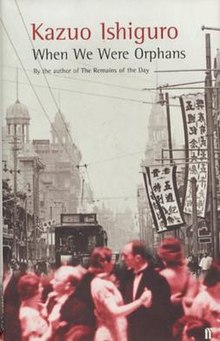
When We Were Orphans is very nearly a great novel. I am probably going to spend most of this post explaining why it is nearly great, and how it just falls short. But first, a quick plot summary. It’s important as always to understand that these summarises iron out the plot in a very unrepresentative way, particularly so in a novel such as this where the time structure is so complex. The narrator is Christopher Banks, who when we first meet him is an aspirational detective having recently graduated from

When We Were Orphans.jpg

Cambridge, ‘setting himself up in the world’ in London. Over the course of several chapters Christopher slowly tells the reader the story of his childhood in Shanghai. When he was ten his father, a businessman involved in the opium trade, went missing. Christopher was convinced (at the time, and remains so) that he was kidnapped. A few weeks later his mother, who had been vocally active in opposition to the opium trade, also disappeared. After weeks without any sign of them, he was eventually sent back to live with a maiden aunt in Shropshire, and from there on to public school. In the present, Christopher recounts several meetings with former school-friends as well as an attractive and ambitious young woman, Sarah Hemmings, who incidentally is an orphan, and comes to play an important role in his life.

Time passes, and we are told that Christopher has become a successful detective. His detection skills are such that he can visit the scene of a crime several months after the event, and still discern sufficient evidence to solve the crime. While are always told about these abilities by Christopher they are never demonstrated or explained in any detail – the crime are just solved. Despite any natural scepticism – is he really as good at solving crime as he thinks he is – his skills are widely recognised and lauded. This work is in preparation for his most important case, a return to China to solve the mystery of the disappearance of his parents. This return is much delayed, and matters are complicated when he – seemingly spontaneously – adopts a young Canadian orphan, but finally after several years he returns to Shanghai and begins to try to solve his parents’ case. His work is a matter of much public interest and his success is so much taken for granted that he is asked to confirm details of the arrangements for the ceremony when his successfully located parents are returned to freedom. However the deepening conflict between China and Japan makes the investigation even more complex than it would otherwise have been, and it is only at the last moment that the secret of what happened to his parents is revealed.

While reading When We Were Orphans – and I read it in one compelling sitting – two authors came to mind as comparators to help me make sense of what was going on (because at times, what was going on made no sense!). One obvious influence seemed to be Kafka. Christopher is disorientated, struggling through a world that increasingly no longer complies with the ordinary rules of behaviour, where strangers know more about him that he expects, and where the landscape becomes strangely fluid and confusing. Christopher is unable to satisfactorily explain what happens to him in the novel. Frequently his view of the world seems dramatically at odds with the people he meets. His memories of school vary wildly from former schoolfriends (to emphasise the point Ishiguro has this happen twice). People look at him strangely when he makes everyday comments. He gets angry when people misrepresent events from his past:

For gradually, from behind his cheerful anecdotes, there was emerging a picture of myself on that voyage to which I took exception. His repeated insinuation was that I had gone about the ship withdrawn and moody, liable to burst into tears at the slightest thing. No doubt the colonel had an investment in giving himself the role of an heroic guardian, and after all this time, I saw it was as pointless as it was unkind to contradict him. But as I say, I began to grow steadily more irritated.

There is a common perception among the people he meets that his investigation will in some unspoken way do more than locate his parents (who he unquestioningly believes are still alive) but also resolve the growing military and political tension between Japan and China which threatens to spill over into an international conflict.

The Kafkaesque atmosphere of the novel intensifies when the search for his parents reaches its climax. Working his way on foot through the ruins of a slum on the frontline between the Japanese and Chinese forces, he meets a badly wounded Japanese soldier who may or may not be his childhood friend Akira. They finally reach the building Christopher has become convinced is the place where his parents are being held, but inevitably he is wrong. He is whisked away by the Japanese forces and safely returned to the British consulate where he finds out the real fate of his parents.

Another type of unreliable narrator, where the author slowly and deliberately exposes the narrator’s delusions, and a more convincing ‘reality’ is shown, is more closely associated in my mind with Nabokov, and in particular with his extraordinary Pale Fire. For a long time I expected to find out that Christopher’s descriptions of his prowess as a detective, his childhood memories of his life in Shanghai, and his status within the ex-patriate community, were going to be revealed as delusional, (possibly as a result of an addiction to opium, which would have been ironic!). But while his account of his story is clearly flawed, the essential elements are apparently reliably narrated. He is, everyone agrees, an extremely successful detective, his prowess is widely recognised and appreciated, and he does survive the arduous journey along the front-line of the battle of Shanghai. Which leaves the many instances in which he is baffled by the behaviour of others around him, and they by him, unexplained. Ian McEwan does something similar in Enduring Love where the hints throughout the novel that the narrator’s account of the ballooning accident is flawed come to nothing, and the final chapters confirm that everything we have been told is true despite the many improbabilities and suggestions that ‘something’ is wrong with the account.

Why include scene after scene emphasising the unreliable nature of Christopher’s narration only to finally confirm its essential accuracy?

There are a couple of other issues I wanted to mention before closing. In a Guardian review of the novel, Philip Hensher focussed on the slightly awkward phrasing of much of Christopher’s narration:

“Ishiguro’s avoidance of phrasal verbs is a major problem here – it gives his narrator a circumlocutious, cautious air which isn’t really very helpful. More than that, it gives him a particular tone of voice which is not that of his social setting. It is bizarrely unconvincing as an idea of upper-middle-class London in the 1930s – I think Ishiguro will find that society beauties did not say ‘pardon’ then and do not now – and the inadequacy can be pinned down to the narrator’s voice, and his choice of verbs, as much as the details. “

This comment breaks a fundamental rule of reading, which is that if you notice something ‘off’ about a novel don’t just assume that it is a weakness in the author’s abilities as a writer (especially as we are talking about someone who had already won the Booker in 1989 with Remains of the Day). Instead ask the question – why? Why does it sound as if English is not the speaker’s first language? Could it be that Ishiguro is trying to convey the fact that Christopher lived for the first ten years of his life in China and is not convincingly part of the upper-middle-class world he circulates in? Is his fractured relationship with reality being conveyed here with his ‘circumlocutious, cautious air’? Giving a character a specific voice to illustrate their character wouldn’t be that revolutionary a technique would it?

Not wanting to end on too negative a note, but the novel’s description of the ‘fate’ of Christopher’s mother is grotesque and plays to very out-dated cliches about the Chinese. I’m not going to dwell on this or be more specific, and I am sure such things did happen occasionally, but it’s needlessly distressing.

So why ‘nearly great’? Even Ishiguro himself accepted that ‘it’s not my best book’. If he had been able to conclude the novel with an explanation that allowed the reader to make sense of Christopher’s confusion, his apparent ability to solve long-past crimes with the aid of just his slightly ridiculous, sub-Holmesian magnifying glass, and the many conversations where there is obviously a big gap between what he tells us and what is ‘actually’ perceived by the other characters, then the novel would have been an exciting mystery. I still enjoyed reading the novel, but I was so disappointed in the lacklustre ending where everything that had been promised failed to materialise.

When We Were Orphans, by Kazuo Ishiguro, 2000

Aside
Book review

The Buried Giant, by Kazuo Ishiguro, 2015

The Buried Giant is an enigmatic, allegorical novel. Do those two features work well together – can an allegory actually be enigmatic, because if it is then is it really an allegory (and if so of what?). These are the questions that I am grappling with in shaping this review, whereas I suspect they may actually be a distraction, because The Buried Giant is first and foremost an enjoyable story.

Set in Britain in what became known as the Dark Ages, the period in history roughly between the departure of the Roman occupation and the Norman Conquest, this novel tells the story of two Britons, Axl and Beatrice, as they journey from their village to visit their son. Journeys of this nature were at the best of times dangerous and challenging, here all the more so because Axl and Beatrice are old. Although peace has descended on the countryside following years of conflict between Britons and Anglo-Saxons, this is still a world full of danger and menace, so of it very practical – a fall or an infection could easily prove fatal – and some of it fantastical, such as the unspoken threat that lurks on the Great Plains, or the ogres that steal children away from villages.

The fantasy element of the novel sits a little uncomfortably alongside the highly realistic portrait of Dark Ages life, in all its primitive, brutish and short nastiness. It becomes slowly apparent that the people are being affected by a form of collective amnesia – Axl and Beatrice refer to it as ‘the mist’ meaning that they quickly forget even recent events, and lives their lives in a fog of the very recent past. Axl sometimes wonders if this is a blessing, allowing them to forget upsetting incidents in their past, whether it be the conflicts that have swept across the land between Britons and Anglo-Saxons, or the personal problems the couple have faced, despite appearing the model of old-age devotion.

An adventure element to the novel is introduced with the character of Wistan, an Anglo-Saxon warrior sent by his king in the fens to travel west on an unspecified quest. Wistan rescues a boy from some ogres and agrees to share Axl and Beatrice’s journey for some of the way. They meet an aging Sir Gawain, knight of the Round Table, who is also on a quest. Slowly the truth about the amnesia causing fog and the characters’ back story emerges, and while I don’t think I would be spoiling the plot for you if I said more, I won’t in case it might. The adventure element of the novel keeps the pages turning, even if the allegorical nature of the plot (nothing is ever just itself – it always represents or stands for something, and after a while this gets a little distracting) is really what we are here for, with the sword fights and escapes through mysterious tunnels just a bit of a distraction.

This is very much an aside, but I would have liked it if Ishiguro had avoided some of the cliches about the Dark Ages. Of course they were difficult dangerous times, but the savagery and lawlessness that is suggested is probably wrong. There is evidence, principally archaeological, that travel and trading between Britain and the continent continued after the Romans left, and that society continued in many ways unchanged, with cooperation and inter-marriage between Britons and Anglo-Saxons. But of course it suits the narrative here to have these as savage times.

So what’s the novel an allegory of? It’s a meditation on relationship, naturally, but however touching the relationship of Axl and Beatrice is this is not more than a portrait of a couple growing old together and coming to terms with the challenges their marriage has faced over the years. In the end Axl faces the loss of his wife with stoicism. Their journey through the country can be seen as Bunyanesque, with the challenges they face as metaphorical manifestations – ogres, dragons, dog-beasts – of child-rearing, infidelity and old-age. You have to work hard at these allegorical associations – Ishiguro doesn’t join any dots for the reader – and I am not convinced that they really work. Everyone will have their own personal interpretation of these symbols. The Buried Giant itself only appears in passing, and is a slightly easier puzzle – conflict in the land has been buried by the collective amnesia caused by Merlin’s spell, and when it awakes there will be a heavy price to pay.

I’ve read a few negative reviews of this novel, both when it was published and subsequently in preparing for this post. Some of the objections are relatively trivial – if the identity of the narrator in some chapters is unclear, does it really matter? (I did notice, and it niggled slightly, but I got over it). The concerns about Ishiguro appropriating the tropes of fantasy fiction – which when it boils down to it that just  means dragons – seem a bit ridiculous in hindsight. Of course you can put dragons into your novels if you want to, who says you can’t? That doesn’t mean you are showing disrespect to the authors who were writing about dragons before you came along with your Nobel prize and your realism. I think this is one of those novels that unsettle readers and reviewers when it first comes out, but over time comes to be appreciated for what it is.

Despite my minor reservations, this was a genuinely enjoyable read. The characters are interesting, and you come to care about them as more than just cyphers for the values they represent. Post-Roman England is realistically portrayed. What I really like about Ishiguro’s work is that he refuses to be pigeon-holed by genre – novels as varied as this work, Never Let Me Go and The Remains of the Day are all worth reading. Although it was published in 2015 this is his most recent novel – let’s hope the fuss about the use of fantasy tropes when it come out haven’t put Ishiguro off taking risks in his fiction.


Standard
Book review

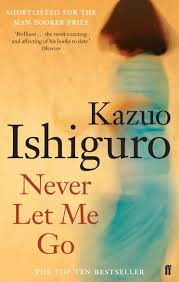
Never Let Me Go by Kazuo Ishiguro, 2005

Wow. Just wow.

I am a bit embarrassed that I have only now just got round to reading what must be one of the most powerful novels written this century. I can completely see why Ishiguro was awarded the Nobel Prize for Literature in 2017. In terms of subtlety, control and lightness of touch this novel ranks with Nabokov at his best.never

It’s also an extraordinarily difficult book to review without spoilers, and while my approach to spoilers in the past has been robust if not cavalier, here’s where I draw the line – because I can’t tell you (assuming you don’t know already of course) the central idea of this novel without undermining the long slow reveal which is a key part of the narrative structure.

I would hate you to think this all means that this is a ‘difficult’ novel. Part of Ishiguro’s genius is that it is deceptively simple. It is written in the form of the first person memoir by Kathy H, a ‘carer’. She describes a childhood spent at Hailsham, a boarding school somewhere in England. At first Kathy’s memories of school are unremarkable – this could easily be a traditional school story, all hockey sticks and midnight feasts, crushes on teachers and silly games. But the text is carefully sprinkled with suggestions that Hailsham is not your typical boarding school. Although the text opens with a stark sentence “England, 1990s” this is deceptive – and at the same time not, in that apart from the one key difference, this is a remarkably familiar, almost mundane world of bus shelters, offices, cassette tapes and cafes.

This is an incredibly thoughtful meditation on childhood and the mysteries of life. If that sounds pompous then I apologise because it is anything but. If you don’t want spoilers then stop here, because I find I can’t continue without commenting on the treatment of the novel’s major themes. The children at Hailsham and elsewhere are, we eventually discover, clones, bred for their organs, which are slowly harvested from them once they reach maturity. The moment when we find this out is a shocking moment of realisation – all of a sudden the references to caring, donating and ‘completing’ come into focus.

I doubt I am alone in wondering why the clones don’t reject the role in life set out for them as ‘donors’ and rebel, or just run away. The children’s pilgrimage to see a boat washes up on the Norfolk shoreline perhaps hints at their desire to escape their preordained fate. But I came to realise this would be missing the point. When the children are growing up at Hailsham they are gradually introduced to the concept that they will have their organs harvested and then eventually, after two, three or four operations, die. Dying is referred to as “completing”. They grow up understanding this is their fate and are taught not to question it. But don’t we all? We are all told about death, but we are also lied to about it. I don’t often quote the Daily Telegraph, but their reviewer put it really well – ”

‘Gradually, it dawns on the reader that Never Let Me Go is a parable about mortality. The horribly indoctrinated voices of the Hailsham students who tell each other pathetic little stories to ward off the grisly truth about the future – they belong to us; we’ve been told that we’re all going to die, but we’ve not really understood.”

Or as the narrator Kathy puts it

“What I’m not sure about, is if our lives have been so different from the lives of the people we save. We all complete. Maybe none of us really understand what we’ve lived through, or feel we’ve had enough time.”

We do indeed all ‘complete’, and few of us feel we have had enough time.

There’s obviously another perfectly valid reading of this novel which accepts this point – we all die – but goes on to make the point that we don’t all die by having our organs harvested and that society treats some people differently from others. The clones in the novel are treated by their non-clone guardians as little more than soulless meat. Hailsham, we are told, is a progressive school (farm) where the children (clones) are treated humanely, but we are also told that the movement to improve conditions for clones has declined and that they are now treated badly. One can only imagine what that means. This is surely a parable for the way people who we perceive as different, whether by race, gender, disability or religion are treated in some societies, dehumanised, ostracised, and even butchered. Or as Kathy puts it:

Maybe from as early as when you’re five or six, there’s been a whisper going at the back of your head, saying: “One day, maybe not so long from now, you’ll get to know how it feels.” So you’re waiting, even if you don’t quite know it, waiting for the moment when you realise that you really are different to them; that there are people out there, like Madame, who don’t hate you or wish you any harm, but who nevertheless shudder at the very thought of you – of how you were brought into this world and why – and who dread the idea of your hand brushing against theirs. The first time you glimpse yourself through the eyes of a person like that, it’s a cold moment. It’s like walking past a mirror you’ve walked past every day of your life, and suddenly it shows you something else, something troubling and strange.” 

I feel I have only scratched the surface of this wonderful, powerful, heartbreaking novel, which I am sure I will return to one day. Like all great books it can only be read for the first time once – after you know Hailsham’s dark secret you can never un-know it – but this is so much more than a mystery novel. As a masterpiece of controlled writing and construction I can’t recall having read anything like it for a very long time.

Standard
Book review

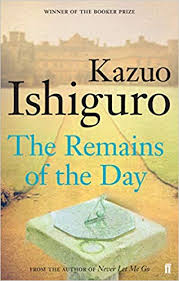
The Remains of the Day, Kazuo Ishiguro, 1989

The Remains of the Day is a subtle, detailed portrait of a life of self-control, restraint and sacrifice. It is narrated by Mr Stevens, an ageing butler, who in 1956 takes a road trip to the West Country, to visit a former colleague, Mrs Dean, formerly Miss Kenton. In the course of his largely uneventful trip he reminisces freely about his long career of service. It has been a prestigious career at the height of his profession, or at least so he claims, but there has been a price to pay for this commitment to the demands of his role.

We are used to flawed narrators in modern literature, in which the detRemainsails of the story emerge in the gaps between what the narrator tells us, and what we can perceive is actually happening. Here Ishiguro pushes the flawed narrator concept even further – Stevens’s memories are carefully layered to reveal a portrait of a man profoundly reserved and out of touch with his feelings, who comes to fear that he has wasted his life, and worse still will waste what remains to him. Several memories are revisited more than once in the course of the novel, with Stevens’s revisions and corrections revealing each time further insights into his decisions and thought processes.
The ostensible purpose of his road trip emerges over the course of the novel. Initially we are told that Stevens is planning to ask Miss Kenton to return to Darlington Hall, the scene of his long years of service to Lord Darlington, and more recently to an American employer, Mr Farraday. Darlington Hall was once a large prestigious establishment, but is now sadly reduced with large areas of the hall closed up, and only a skeleton staff. Stevens has received a letter from Miss Kenton which he chooses to interpret as indicating that she wants to return to her post as housekeeper. At this time we know little about their relationship, and Stevens only gives us unreliable glimpses of the past, but he slowly builds a picture of a warm friendship which could easily have become something more. Later he confesses that he may have read too much into her letter, and that his visit has more a more personal agenda. He mentions several other former acquaintances that he has lost touch with over the course of the years, and it becomes apparent that this trip is, for Stevens, (although he would never admit it) a last attempt to rekindle an old flame and recapture some of the former glories of his past. Stevens is an expert at self deception, and his explanations for his conduct – for example when he pretends to the villagers he meets when his car breaks down that he is a gentleman, rather than a servant – are always plausible but ultimately unconvincing.

In parallel with this personal account of his life, Stevens reveals the story of his former employer, Lord Darlington. Lord Darlington, it slowly becomes apparent, was a Nazi-sympathiser and supporter of appeasement, and after the outbreak of the second world war was publicly disgraced. Stevens avoids admitting that he was butler to Lord Darlington in the post-war present, even though privately in the confines of his personal narrative he defends his former employer as having been well-intentioned if ultimately misled by those he trusted. In one scene he recounts the story of his being asked by Lord Darlington to fire two servants because they are Jewish. He does so despite the passionate protests of Miss Kenton, taking the approach that it is not his role to question his employer’s decision.

The pace of the novel and the lack of incident in the present have led to some reviewers expressing frustration with this novel. Stevens’s buttoned-up, restrained personality, and his habit of expressing himself with precise, non-committal language that never expresses his true feelings. When his father dies for example, we can only tell he is upset because someone notices he is crying, something he would never admit to doing himself.

Certainly there are no car-crashes, chases or fist-fights in ‘The Remains of the Day’. If you are looking for dramatic incident, look elsewhere. This is a novel of subtle details, precisely chosen words, and delicate portraits. The reader needs to invest in the narrative – if they do so the rewards are worth it.

Did you enjoy ‘Remains’? Did you prefer the film, which was undoubtedly brilliant, but arguably placed too much emphasis on the romantic aspects of the novel? Or was the lack of incident a problem for you? Would really like to know what you thought.


Standard
Book review

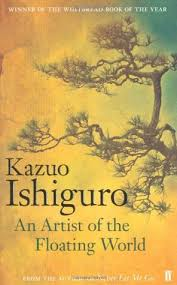
An Artist of the Floating World – Kazuo Ishiguro – 1986

This novel addresses what most be one of the most difficult issues a country has to ever face – how to come to terms with overwhelming military defeat. For Japan, that defeat was all the more painful because its involvement in World War 2 was completely avoidable; and the end of the war, at Hiroshima and Nagasaki was so shocking and final. Ishiguro’s approach to this subject is to walk slowly round it, quietly approaching and then stepping quickly away as soon as the subject becomes too raw.

I am being oblique myself, so let’s explain. The narrator is a painter, Masuji Ono. He has lost a son and a wife in the war, but his two daughters survived. One is married, one going through the complex engagement process used by some Japanese families at the time (and for all I know is still in use). The time structure used in the novel is complex; although each section is dated, giving the reader a misleading reassurance as to the date of the events of that part of the novel, Ono’s account wanders across time, gradually revealing details of his career as a painter. Discouraged by his father from becoming a painter, he runs away from home, and becomes an artist of the floating world – a particular genre of art in Japanese culture. Very slowly Ono reveals his involvement in the rise of Japanese nationalism, and his subsequent disgrace and the rejection of his values by the new, post-war generation. This reveal takes the whole of the story arc, and even then one is left with the distinct impression that we have only been shown a small part of the story.

Ono is a reflective character – he is certainly a deeply flawed narrator, as one would expect, but he is not delusional – he knows that his involvement in Japanese nationalism, painting pictures encouraging the expansion of the empire, was wrong, although the extent of that recognition is unclear: at one point he admits “There is certainly a satisfaction and dignity to be gained in coming to terms with the mistakes one has made in the course of one’s life”, although this is more of a tactical admission than a confession. Ono’s grandson plays an important part in the narrative – he is a really brattish, unpleasant little eight year old, who is encouraged (by his grandfather) to believe that his gender gives him authority over his mother.

There is a profoundly hesitant, tentative feel to the novel. Ono tiptoes around his story, rarely revealing much, and constantly admitting that his recollection may be flawed, The reader is given enough information to piece together the outlines of his story, but only through hints and only rarely through actual events – at one point we are shown him visiting the house of one of his students, who he has reported for anti-nationalist feeling, and it is clear that the authorities reaction has been extreme – we found out earlier that the student was imprisoned for a long time, and apparently tortured. Ono doesn’t understand, or refuses to understand, his responsibility for this situation.

Ishiguro is clearly a writer of some considerable skill – the novel is quite deliberately like a delicate Japanese watercolour, done with great finesse. But the characters – other than Ono himself – are only tentatively drawn – we only see them through Ono’s eyes, and he doesn’t trouble to sketch them in any detail. The language is equally delicate and riven with hesitation, again quite deliberately, giving a very authentic flavour to the narrative, but leaving the reader a little bit detached and remote – the speeches are overly polite, and you need to listen carefully to the subtext to understand what the speakers are really saying, even if the narrator usually misses the point.

Japan clearly went through a huge, if self-imposed trauma before, during and after the Second World War. The price paid was enormous, and understanding how that come to happen is important. Ishiguro gives us one witness’s flawed account, but it is very much that of someone who had only a small, marginal involvement in the tragedy, and I am not sure that it tells enough of the story to be of any value. The book ends without any big reveal, and so does this review.

Standard