
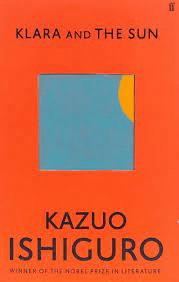
Klara and the Sun is narrated by the eponymous Klara, who is an ‘AF’ – an Artificial Friend, an advanced robot able to simulate and understand human emotions. Despite her intelligence Klara has a limited, child-like understanding of the world. The novel opens with Klara waiting patiently in her store to be bought. We learn that she is a specific type of robot intended as a child’s companion. She is solar powered, and therefore assumes that the sun has a significant role in all human affairs, a misunderstanding which would have been easily programmed away but which goes on to play an important part in the novel. Eventually she is purchased and taken to a remote family home, apparently somewhere in America. There are hints that American society is slowly breaking down, but this aspect of the novel, due to Klara’s very limited understanding, are never fully fleshed out. We also learn that in this dystopian future some children are genetically engineered (described here as “lifted”). This engineering seems to offer significant advantages in life, but comes at a serious risk of illness and death. Josie, the daughter of the family she has been bought to support, had an older sister Sal who died as a result of the lifting process, and Josie herself is seriously ill.
Through Klara we are introduced to Josie’s neighbour and childhood friend Rick. Rick has not been lifted and resents the impact this is likely to have on his career and life chances. This felt like fairly heavy handed social commentary – it’s not really much of a revelation that rich people have better prospects than the poor and that they can buy advantages for their children. The suggestion that any advantages come with a heavy price later in life is more subversive but it is not apparent how this translates to the real world – being rich and privileged doesn’t seem to have too many downsides!
Klara develops a theory about Josie’s illness which she is reluctant to explain in any detail, although it appears to have something to do with the sun. At first the reader believes this theory might have a grain of truth, but it quickly becomes clear that Klara has an essentially pagan understanding of the role of the sun in society and indeed of astronomy. She comes to believe that when the sun sets it ends up in a farmer’s barn on the horizon. She travels to the barn – it is suggested this is akin to an epic quest, although it is not clear why such a straightforward journey would represent a challenge to an advanced robot – and prays to the sun to save Josie. Klara offers a sacrifice in return for this favour – to destroy a machine which she believes in the sun’s enemy.
It slowly becomes apparent that Klara’s role is not just to be a friend to Josie. She is asked by Josie’s mother to imitate her daughter, and it is eventually revealed that if Josie dies, Klara is going to take her place as a disturbing if convincing substitute. I think you will by now have got the idea – this is not a science fiction novel, nor a traditional dystopian novel. Klara’s world is in some respects convincing, but in others very much the opposite. I particularly struggled with the idea of a robot being so powerful as to accurately understand and replicate human emotions, but not understand very simple concepts of astrology (as an example – Klara understands very little about the world apart from what she has observed from her shop window. Why robots would be solar powered was also puzzling! The mistakes she makes about the physical world, and the false conclusions she draws from her observations, make Klara a highly misleading narrator. Showing the reader the events of the novel and the world in which it is set through the eyes of someone – Klara in this case – who doesn’t really understand what’s going on and who makes some serious errors of understanding, is a very well established technique for encouraging the reader to see the world from a fresh perspective. The reader slowly across the course of the novel learns to decode Klara’s descriptions and work out when and how she gets things wrong, and when things are being carefully hidden from us.
The more I think about it, (and I finished the novel several weeks ago and have been turning it over in my mind ever since) the more I think the only way to read Klara and the Sun is as a parable, a modern Gulliver’s Travels. All the inconsistencies in the plot and the strange mistakes Klara makes about the world are unimportant when the novel is read that way. The anachronism of the steam-punk science is less obtrusive: we don’t need to understand why Klara’s parents would bafflingly expose her to a life-threatening treatment which had already claimed the life of her sister for little apparent benefit. But as a parable the novel is elusive – life is short and mysterious, and sometimes things happen for no particular reason. Klara is a thought-provoking novel, but I am not sure whether it works as a whole rather than as a collection of ideas that don’t cohere together as a whole. Perhaps it is one of those ‘go back and read it in a few years and see what you think’ novels?

