
Yes, you read that correctly – the Tuesday Club Murders, by Agatha Christie, not The Thursday Murder Club by Richard Osman. The similarities in name are striking though aren’t they? Although in interviews about his novels Richard Osman has regularly acknowledged his debt to Christie, I don’t (so far as I know) think he has ever mentioned this collection of stories. I can’t surely be a coincidence though.
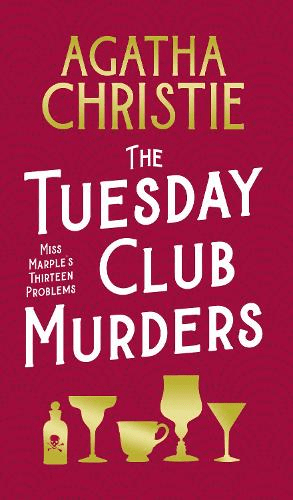
To be fair, this collection of stories is usually published as ‘The Thirteen Problems’. It was first published under that title in the UK in 1932 and it wasn’t until the stories were published in the US the following year that the title The Tuesday Club Murders was adopted. Obviously the publishers have reissued the collection under the US name to capitalise on the popularity of Osman’s novels, even going so far as to describe the stories in the blurb as ‘the original weekday murder club’! To be fair they haven’t mimicked the distinctive cover design used for The Thursday Murder Club and its sequel, The Man Who Died Twice, unlike other recent murder mysteries, but they must have been sorely tempted to do so.
The introduction to the club does seem very similar to Osman’s version:
‘Well,’ said Joyce, ‘it seems to me we are a pretty representative gathering. How would it be if we formed a Club? What is today? Tuesday? We will call it The Tuesday Night Club. It is to meet every week, and each member in turn has to propound a problem. Some mystery of which they have personal knowledge, and to which, of course, they know the answer.’
But this is almost where the structural similarities end. This is a collection of short stories not a novel, and the ‘club’ structure is a weak framing device that isn’t really necessary. Apart from the title, the points of similarity between these stories and Osman’s novels are actually few and far between. They have a similar setting, and the Miss Marple would probably fit in quite well into the group of crime-solving pensioners in The Thursday Murder Club. But the Tuesday ‘Club’ isn’t really a club at all, nothing more than a story telling group of friends, who seem to only meet the once (despite the initial set up) , even if they were probably quite capable of taking on a ‘real’ case or two.
All thirteen stories feature Miss Marple, and all follow the same pattern quite rigidly – some friends gather and share stories about a crime, Miss Marple chuckles to herself and indirectly reveals she has worked out ‘whodunnit’, followed swiftly by the reveal of the criminal’s identity. Invariably she is knitting throughout the story, and almost always drops a stitch or two as a way of emphasising her powers of concentration. There’s little by way of characterisation – you will find more varied personalities in a game of Cluedo (Clue) – descriptive writing is kept to the minimum, and any deviation from the structure comes as a welcome but rare relief. Perhaps that is no surprise – these are some of Christie’s earliest published works, and the first time that Miss Marple appears in print. There is a brief attempt to bring Miss Marple to life in the opening story. She is described in more detail than any other character in the collection:
“She sat erect in the big grandfather chair, Miss Marple wore a black brocade dress, very much pinched in round the waist. Mechlin lace was arranged in a cascade down the front of the bodice. She had on black lace mittens, and a black lace cap surmounted the piled-up masses of her snowy hair. She was knitting, something white and soft and fleecy.”
That’s an interesting portrait that’s worth unpicking a little. Firstly she is sitting in a grandfather chair. The internet is probably the world’s most useful information tool ever developed, but it can’t tell me precisely what a grandfather’s chair looks like – the best description is ‘an easy chair, usually with wings’. I think we can infer from the context that this is a significant, perhaps even dominant chair which allows Miss Marple a place of prominence in the gathering. The black brocade dress – brocade being defined as
“heavy cloth with a raised design often of gold or silver threads” – suggests she is formally if not over-dressed to receive her guests. Mechlin lace is interesting. Christie could easily have just dressed her character in ‘old’ or ‘ornate’ lace, but she specifically chose Mechlin, which is a relic from the nineteenth century and before. Wikipedia as always a mine of information, tells us that:
“In 1755 Mechlin lace went into decline in England….Mechlin lace was also very popular with the English royalty. Queen Mary II, in spite of the prohibition against imported laces, purchased two yards of knotted fringe for her Mechlin ruffles in 1694…George I had a Mechlin cravat, and it was a favourite of Queen Charlotte and Princess Amelia.”
In other words it was a bit old-fashioned even when Queen Victoria came to the throne, and almost a hundred years later I think we can safely say was not the height of fashion! The bodice over which this lace ‘cascades’ is out of date as well, She is dressed almost entirely in black, including black mittens and cap, which strongly suggests someone in mourning. There was no national mourning at this period, and there is no suggestion that she ever married or suffered a family loss. She is just one of those old ladies who prefers to wear black. The constant knitting might suggest a tricoteuse in the shadow of the guillotine, which is apt as Miss Marple’s detective skills would almost certainly have sent many men and a few women to the deaths. In A Christmas Tragedy, one of Miss Marple’s own contributions to the collection, she says of the story’s villain:
“Saunders was hanged .. and a good job too. I have never regretted my part on bringing that man to justice. I’ve no patience with modern humanitarian scruples about capital punishment”.
Clearly Miss Marple isn’t just the sweet little old lady she likes to present herself as.
In detective stories the principal interest is in the challenge – can the reader work out the solution to the mystery before it is revealed? Christie is adept, even in these very early stories, of giving the impression that the mystery can be solved – after all, Miss Marple can work them out with only the information we the reader are given – but really the solutions are almost impossible, and in some cases quite random. The use of mystery poisons features in several of the stories, as do several other mystery story stand-bys – invisible ink, swopped identities, even Cornish smugglers.
I’ve been determined to add Christie to my list of reviewed novels – her absence seemed a real gap, but I don’t think I chose a very sensible starting point. These stories are static and repetitive, and I quickly lost interest in the crimes and their inevitable solution. Of course Christie went on to be a much more mature writer, and to judge her on the strength of this collection alone would be unfair. So she remains, for now, on my non-existent ‘to be read’ list.
 The Reading Bug