Book review

Going Postal (Discworld 33) by Sir Terry Pratchett, 2004

I have to warn you now that this is going to be one of those posts in which I blather on about how many different types of wonderful Terry Pratchett’s novels are. Going Postal is Pratchett at the peak of his powers. Incidentally it also made by far the best television adaptation, which I think successfully captures the spirit of the novel and retains almost all the central ingredients.
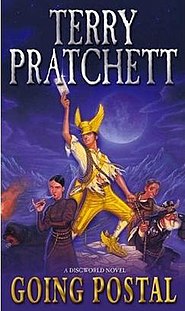
Discworld Postal.jpg

Going Postal is a devastating attack on the rapacious form of asset stripping capitalism. In the novel the clacks, the Discworld telegraph system, has been taken over by an aggressive consortium of bankers interested only in squeezing profit from their new enterprise. To this end they refuse to invest in maintenance of the system, cut corners, and put the safety of their staff at risk. The chief engineer Mr Pony, who stays with the company, knows the lives of his workers are being put at risk but protects himself with copies of warning memos. He is a deeply sad figure, but all too recognisable in late-stage early 20th century capitalism. Pratchett dismantles surgically the smoke and mirrors behind high-finance:

“But, in truth, it had not exactly been gold, or even the promise of gold, but more like the fantasy of gold, the fairy dream that the gold is there, at the end of the rainbow, and will continue to be there forever – provided, naturally, that you don’t go and look. This is known as finance.

So what happens? Moist von Lipwig, a consummate swindler, is hanged for his crimes. His still living body is recovered from the scaffold, resuscitated and taken before the Patrician. Vetinari presents him with a choice: become Postmaster General of the city’s postal service or death. Moist takes the job, intending to run away at the earliest possible opportunity. However, his probation officer, a golem named Mr Pump (after his former occupation), brings him back to Ankh-Morpork, where Vetinari explains escape from a golem is impossible. So the Post Office it is.

The scale of the challenge is soon revealed. The Post Office has not operated for many years, and the building is full of undelivered mail and pigeon dung. Four previous recently appointed Postmasters have died in suspicious circumstances. Of the many portraits in Going Postal one of the most relevant (although I think they are all relevant) is of Reacher Gilt, the chair of the Grand Trunk Company which runs the clacks. Gilt is a financial pirate who operates in plain sight – he even has a parrot that squawks “twelve and a half per cent” (= pieces of eight, not the worst joke in the novel). Gilt has a penthouse office in Tump Tower and has ambitions to become Patrician one day – see what Pratchett was hinting at there? It is quickly apparent that Gilt is the villain of the piece, is behind the deaths of the previous Postmasters, and plans to remove Moist as soon as possible.

This is just the beginning of an extraordinarily action-packed novel – there’s a wonderfully rich cast of junior characters such as pin-collector Stanley Howler; Sachrissa Cripslock, reporter for the Ankh-Morpork Times (first introduced in The Truth); and Anghammarad, a nineteen thousand year-old golem waiting for the end of the world. There’s a fire, a visit to the Mended Drum, a race to Genua, and guest appearances from the Watch and the wizards of the Unseen University, to mention just a few highlights. Romance is provided by another of Pratchett’s amazing strong women: golem-rights activist and chain smoker Adora Belle Dearheart. It’s all utterly wonderful. Moist is another brilliantly realised creation in all his complexity and carries the weight of the narrative effortlessly. The moment he realises his responsibility for Adora’s loss of her job (which the television adaptation made even more dramatic in a very effective edit) is extraordinary.

This is also the Discworld novel where the GNU tradition originates. John Dearheart, murdered brother of Adora, is remembered by his colleagues on the clacks by a piece of code – “GNU John Dearheart” – which echoes his name up and down the lines. “G” means that the message must be passed on, “N” means “not logged”, and “U” means the message should be turned around at the end of a line. (This is of course a tech joke: GNU is a free operating system, “GNU’s not Unix”.) The code causes John’s name to be repeated indefinitely throughout the system, because: “A man is not dead while his name is still spoken“, a phrase with so much more resonance since Sir Terry’s passing.

I know I have said this many times before, but Pratchett is a profound moral philosopher and this novel is over-flowing with insights into the human condition:

“There was no safety. There was no pride. All there was, was money. Everything became money, and money became everything. Money treated us as if we were things, and we died.

In fact, I am giving serious consideration to starting my own minor religion based on the words of wisdom found in Going Postal alone. If you read a sentence like this in a book of philosophy you would almost certainly nod your head in agreement and appreciate the author’s wisdom and sagacity;

“all freedom is limited, artificial, and therefore illusory, a shared hallucination at best. No sane mortal is truly free, because true freedom is so terrible that only the mad or the divine can face it with open eyes.

I used to always say Night Watch was Pratchett’s finest novel – having re-read Going Postal I am no longer quite so sure.
Standard
Book review

Surfacing, by Margaret Atwood, 1972

Surfacing, Atwood’s second novel, is an elusive narrative. Ostensibly it is a simple story – after a long absence an unnamed narrator returns to her childhood home in the remote Canadian countryside to try and find her missing father. Her boyfriend, Joe, and a married couple, Anna and David, complete the group. The homecoming is uneasy – despite being familiar the setting feels alien and disturbing. On arrival at the family home there is no obvious sign of her father. The group agrees to stay for a week and turn the visit into a short, back to nature holiday. Tensions between each couple slowly emerge – David belittles Anna, who tells the narrator that he is a philanderer who objectifies women – for example he insists that she always wears makeup. The narrators relationship with Joe is equally strained.

Time is whiled away in fairly banal tasks – they go blueberry-picking, fishing and swimming, weed the vegetable patch and play board games. The women do the bulk of the domestic tasks. The narrator’s mental state slowly deteriorates and the narrative begins to fragmented. Sentences become short and disjointed, and eventually incoherent. The narrator is haunted by memories of her marriage, her child, and the abortion she was pushed into having. Her increasing sense of paranoia is fuelled by David’s constant references to an impending American invasion of Canada, which she treats entirely seriously. She sees hidden messages from her parents in every day objects around the house, and cannot decide if he is really alive or dead. Meanwhile David and Joe are making a modernist film, Random Samples, which is really just a collage of miscellaneous scenes. This again emphasises the narrator’s sense of alienation, making her feel like a performer rather than a real person with her own identity.

The novel draws to a climax when both men attempt unsuccessfully to pressurise the narrator into having sex with them – when rebuffed they sulk. This may have been the final trigger for the narrator’s descent into a full blown psychotic episode. She destroys David’s film and escapes in a canoe, hiding in the forest until the others leave the island. She trashes everything in the cabin, and runs around naked, eating unwashed plants, and living outside. I found these quite disturbing scenes, and although the end of the novel suggests a return to some form of normality it was something of a relief. This will probably sound patronising, but this felt like an early sketch for a novel – lots of themes and ideas are laid out for consideration, but the narrative was erratic and very difficult to engage with. There’s little here to suggest the impressive prose and strong ideas that Atwood was to develop in her later work.

Standard
Book review

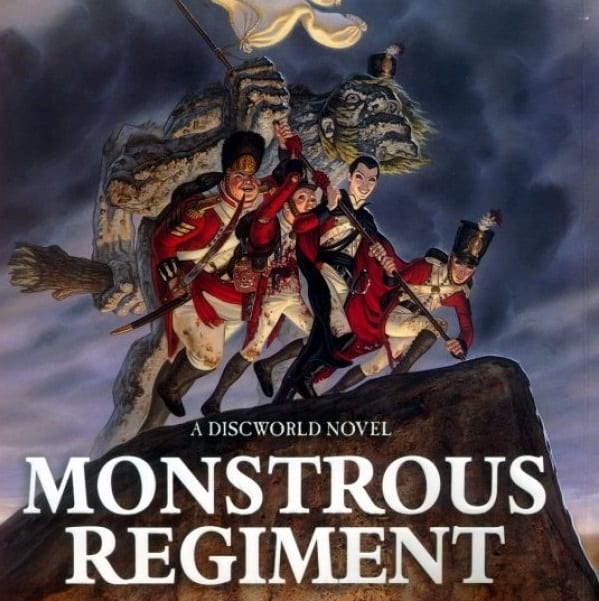
Monstrous Regiment (Discworld 31) by Sir Terry Pratchett, 2003

Did I mention that Terry Pratchett was, amongst many other things, a brave writer? In his novels he tackles some of the most difficult subjects, and the fantasy settings can only provide so much “it’s only a story about vampires and trolls” cover. In Monstrous Regiment he addresses some seriously weighty issues – war, the status of women in the military and wider society, and fundamentalist religion.

Dueling Book Clubs Review Monstrous Regiment - The Fandomentals

For much of the time he is on a tightrope, balanced finely between being preachy while also avoiding being insensitive – these are not laughing matters. Amazingly he pulls it off – there’s never a point in this novel where I felt spoken down to or where the material wasn’t treated with the respect it deserved, while all the time making a series of serious points about the issues discussed. It’s mature writing of the highest order, Pratchett at the peak of his powers.

Which begs the question – what’s the novel about? Monstrous Regiment is set in Borogravia, a deeply traditional country not far from Uberwald, and therefore a long way from anywhere else. Its people are followers of Nuggan, a weirdly strict deity who rules through his representative on earth, or in the part of it that is Borogravia, the Duchess, the country’s monarch, who is almost certainly long-dead. There is strong middle-European feel to this country, not least to its constant border disputes with its neighbours over who owes a particular field or tree.

The current war with Zlobenia is going badly for Borogravia, and we join the novel with recruiters scouring the countryside for anyone who can hold a gun. The narrator follows Polly Perks, who joins up to try and find her missing in action brother Paul. (This is not just sisterly love – if Paul cannot be traced the family pub will pass to her drunken cousin when her father dies. It is one thing to recognise the unfairness to women of inheritance law, and another to include such reference in a fantasy novel). Joining a long tradition of women in the military, Polly disguises herself as a man. Much fun is had with her attempts to adopt a male swagger, to occupy space, and to fart and belch convincingly. Other recruits sign up – Maladict, a vampire, a troll called Carborundum, an Igor, and Tonker, Shufti, Wazzer and Lofty. Without wanting to spoil the reveal, this unlikely bunch of recruits are not what you might expect of a group of young men and persons joining the army.

They set off for the front, led by Sergeant Jackrum, a corpulent and highly experienced recruiting officer and their commanding officer, Lieutenant Blouse. Their first encounter with an arrogant troupe of Zlobenian cavalry is surprisingly successful. even more so when their unlikely victory is reported on by war correspondent William de Worde, he of The Truth. They quickly become popular figures of interest followed back home, and elsewhere by Commander Vimes, sent from Ankh-Morpork to try to broker a peace and protect Ankh-Morpork interests. Vimes sees that a straightforward Zlobenian victory will lead to an imbalance of power in the area, so he wonders whether the small band of plucky recruits working their way to the war might prove more useful than just cannon fodder. Sergeant Angua keeps track of the recruits as they make their way to the front, occasionally providing help, such as an unexpected package of coffee when Maladict, a black ribboner, (a vampire who has foresworn blood) begins to suffer withdrawal symptoms. On their journey the links between the unlikely recruits grow stronger, and their various backstories and secrets slowly emerge.

When they reach the front the recruits realise that the war is at a stalemate – Borogravian troops are pinned down and unable to break out of a small area of land; Zlobenian and alliance troops holding the area’s principal fortress but are unable to press their advantage. Control of the castle is key, and in a highly risky plan (which is therefore guaranteed success) they decide to infiltrate the Keep disguised (of course) as washerwomen, free the prisoners, and end the war.

I can’t tell you much more without revealing some important plot points, and for once I don’t intend to do so. As always with Pratchett the plot is really secondary to the character development anyway, and the outcome is not really that much of a surprise.

This is one of my favourite later Discworld novels – it’s set in largely new territory with only a brief appearance of regular characters, but remains unquestionably Discworld in feel throughout. The sensitivity with which the material and issues are handled is impressive, and although the jokes as always are pretty basic, the central characters are fully rounded and utterly believable. There are no bad starting places in the series, but if you have preconceptions about fantasy novels as being full of dwarves and dragons, there are worse places to put you straight than this.

P.S. I am sure you will have spotted it, but just in case, the title is an ironic reference to this 16th century misogynist pamphlet against women in positions of authority.

P.P.S. Towards the end of the novel, Pratchett uses the haunting refrain “the world turned upside down” several times. You might recognise this phrase from the musical ‘Hamilton‘. But Wikipedia tells me that the phrase derives from a pamphlet published in the 1640s “as a protest against the policies of Parliament relating to the celebration of Christmas” and has an even earlier origin in Scripture:

These that have turned the world upside down are come hither also; Whom Jason hath received: and these all do contrary to the decrees of Caesar, saying that there is another king, one Jesus‘.” Acts 17:5-7

The Hamilton reference derives from a legend that the British army marched to this tune when they surrendered after the Siege of Yorktown. The British army would apparently have played an American or French tune in tribute to the victors, but General Washington refused them the honours of war and insisted that they play “a British or German march.” Like most good stories of this kind it is probably apocryphal – it first appears in the historical record a century after the surrender!

Standard
Book review

The Wee Free Men (Discworld 30) by Sir Terry Pratchett, 2003

Some books are harder to review than others. Sometimes it’s just difficult to find something interesting or original to say, and you don’t want to just summarise the plot and wrap it up with some platitudes about the author’s writing style. But this isn’t that kind of difficult. The Wee Free Men is so full of wonderfulness that it is impossible to capture it all – and to fail would be a disservice to the breadth of Pratchett’s skill as an author. It’s not perfect of course but it’s pretty damn close. For younger readers it is an ideal entry point into Discworld.

Nac Mac Feegle.jpg

The Wee Free Men features the magnificent nine-year old Tiffany Aching. She lives with her farming family, helps out around the farm, and looks after her irritating younger brother Wentworth. Tiffany is special – ferociously intelligent and with a thirst for knowledge and understanding.

I am careful and logical and I look up things I don’t understand! When I hear people use the wrong words, I get edgy! I am good with cheese. I read books fast! I think! And I always have a piece of string! That’s the kind of person I am!

Pratchett’s ability to create fully-rounded female characters always astounds me, and here he does it again, entering imaginatively into the mind of a precocious young girl and getting it pitch perfect. I can’t think of another author of his generation who writes such brilliantly fierce, independent and strong women as Pratchett. They are not just adornments to his novels, they are centralised and given distinctive voices which articulate the reality of their lives. Of course a man can never fully understand what it is to live the life of a woman, but Pratchett does an amazing job of trying. And he defies stereotypes at each turn, not in a self-conscious “I am going to create a gender-fluid character to show how progressive I am” way, but because such characters genuinely interest him.

Although this is a younger reader’s novel, there’s nothing patronising or simplified about the story – it is nuanced, layered, and contains several moments of genuine peril. The bad guys have grim-hounds, dream-stealers and things too scary to describe, and are led by a witch several times scarier than anything in Narnia.

Zoology, eh? That’s a big word, isn’t it?”
“No, actually it isn’t,” said Tiffany. “Patronising is a big word. Zoology is really quite short.

In the previous novels in the series Pratchett created many vividly imagined settings: the sprawling chaos that is Ankh-Morpork; the mountain kingdom of Lancre, the Unseen University, and so on. The Wee Free Men is set in the countryside, a sheep-farming area of grassland known as The Chalk. This small patch of Discworld is vividly evoked and drawn with so much reverence and respect – you have to wonder if Sir Terry grew up somewhere similar to The Chalk.

Anyway, back to the novel. One day while out for a walk with Wentworth, Tiffany sees what the reader knows are Nac Mac feegles, tiny blue kilted men speaking a chaotic and hugely entertaining form of Glaswegian. They warn her of a monster lurking in the river. Using Wentworth as bait, Tiffany bashes the creature with a frying pan. Without mentioning this supernatural experience to any other adult, all of whom are too busy to listen anyway, she seeks out Miss Tick, a visiting witch, who teaches Tiffany some important lessons:

“If you trust in yourself. . .and believe in your dreams. . .and follow your star. . . you’ll still get beaten by people who spent their time working hard and learning things and weren’t so lazy.”

She also tells her all about the Nac Mac Feegle. These riotous pictsies are at the heart of the novel, and are an inspired, vibrant creation. I particularly enjoyed their fear of lawyers – “We’ve got a cheap lawyer an’ we’re not afraid to use him!” In a nod to Tolkien, the Feegles’ swords glow blue in the presence of lawyers. The Feegles believe they are dead – this world is so full of wonders that it must be heaven. When they die therefore there is no cause for grief – you can’t die if you are already dead. That feels seriously profound to me – comforting and at the same time reminding one to appreciate the world as it is.

All of which is a prelude to Wentworth being kidnapped by the Queen of the Fairies, and Tiffany’s rescue mission. She is aided by the Nac Mac Feegles, including Rob Anybody (I confess I only got that joke (that he will steal from anyone) when I read the name out loud; before that I just thought it was a silly name. This might suggest that the novel was written to be read to younger children perhaps?) Big Yan, Daft Wullie, Hamish, the Feegle’s Gonnagle William. The Gonnagle is the Feegle’s battle poet, reciting poetry of Vogon severity that causes enemies to flee. Well I never said the jokes were going to be sophisticated did I?

Tiffany and the Feegles’ adventures in fairyland are scary enough. All through the novel Tiffany remembers her Granny, Granny Aching, an iconic figure of the Chalk who died a few years earlier but remains a crucial figure in her life. This is a touching tribute to the importance of grandparents in children’s lives, and I am sure would be a comfort to any younger reader going through a similar loss.

The novel ends with what is in effect a guest appearance by Granny Weatherwax and Nanny Ogg. In true fairy godmother style, Granny gives Tiffany an imaginary witch’s hat. Tiffany asks

Is it really there?”

“Who knows….It’s virtually a pointy hat. No-one else will know it’s there. It might be a comfort.”

“You mean it just exists in my head?” said Tiffany.

“You’ve got lots of things in your head. That doesn’t mean they aren’t real”.

The Wee Free Men, page 307

Surely it’s not just me who sees this line reappear in Harry Potter and the Deathly Hallows, when Dumbledore says to Harry:

“Of course it is happening inside your head, Harry. But why should that mean that it is not real?”

I’ve only scratched the surface of the wonders of this novel. If you haven’t read it before I am so jealous.

Standard