Book review

I don’t enjoy writing negative reviews, I really don’t, and sometimes it’s better to just not review a book that to take it apart. But at the same time I don’t want to self censor. So here goes: The Heart Goes Last is dreadful. It’s a hot mess. I can’t imagine if it had been written by anyone less famous than Atwood it would have been considered for a second by any publisher. That’s not to say it doesn’t have any redeeming features, but you will struggle to find them. It doesn’t make Atwood any less of a writer (well it does a bit) – The Handmaid’s Tale will always be a great book – but The Heart Goes Last is almost from a different author, it’s so casually, carelessly bad.
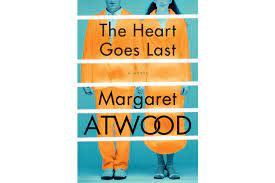
So what’s wrong with it? It opens promisingly enough. The setting is a very similar world to that described in Octavia Butler’s Parable of the Sower, the USA of the near future in which the economy has collapsed and social order is breaking down. (Towards the end of the novel this economic collapse is forgotten and we are back to a very recognisable consumer economy. By then the idea of disorder has done its job). Charmaine and Stan are a young under-employed couple living in their car, surviving on Charmaine’s wage and tips from her bar job. Both have been recently lost better paying jobs, and both will eventually find their way back to their previous employers in very different circumstances. They are under threat from the dangerous criminal elements that seem to roam unchecked in the streets. Stan’s brother, Conor, is a small-time criminal who helps him out from time to time. It’s clear that Stan and Charmaine’s way of life won’t last for long – they are getting desperate.

One day Charmaine sees an advertisement for Conscilience, a community in which jobs and housing are available. What’s the catch? Something very similar happens in Octavia Butler’s Parable of the Sower, where a family trades their home in their vulnerable walled community for an apartment in a company run town. Butler doesn’t follow this thread of her story through (in the original novel at least – I have yet to read the sequel) but this very similar community becomes the focus for Atwood’s story. In Conscilience (motto – “Do Time Now, Buy Time for Our Future”) everyone spends one month working in the community and alternate months in prison. Yes, I know, that makes no sense at all. Being in prison seems virtually the same as being outside it – in both cases they can’t leave the overall community – and the economic model underpinning the enterprise just doesn’t add up. Of course I understand this is not to be read literally – this is a parable about Americans trading their freedom for economic security, and at the same time a satire on the for-profit prison system in the USA – but even parables need to make some kind of sense don’t they? Inside Conscilience Charmaine and Stan have mundane jobs on their ‘freedom’ months and when they are in prison Stan looks after the chicken farm, and Charmaine dispenses lethal injections to prisoners who have proven troublesome. That’s just one of Conscilience’s dark secrets – it practices widespread murder of the difficult and economically inefficient. The management of the community, a company called Positron, is a Big-Brother-like elite using surveillance cameras across the whole community to monitor the inmates. Other sinister secrets are obviously lurking behind the fake smiles of Positron employees. As someone observes “Once you’ve got a controlled population with a wall around it and no oversight, you can do anything you want.” The wholesale murder of prisoners is not something they are particularly keen on getting out, but it is suggested that Positron has stumbled across a new social order for the USA which is better than all the other alternatives, and that a few dead prisoners here and there might be a price worth paying.

It seemed to me as if Atwood lost interest in the novel at around this point. Having established the pieces on the board she wasn’t sure what to do with them. All the major satirical points have been made. So she took the strange decision to write the rest of the novel as a ‘madcap’ sex comedy (and whose heart doesn’t drop at those words?) Charmaine begins a passionate, sordid and erotically adventurous affair with the husband of the couple who live in their apartment on alternate months. When this relationship is discovered Stan is forced to re-enact the affair – literally and physically, but for reasons that are never really made clear – with the alternate wife, sordid sex on video and all. The wife turns out to be a disaffected senior figure within Positron who is working to expose the company’s excesses and crimes, but can’t simply email the dossier of incriminating data to a journalist because – well, just because – so has to come up with an elaborate scheme to smuggle Stan out of Conscilience with a memory stick hidden in his belt. This overly elaborate scheme, which dominates the latter part of the novel, involves sex robots, Elvis and Marilyn impersonators, and a clumsy reference to the Blue Man Group. There’s also a sub-plot involving pioneering surgery which causes the recipient to fall in love with the first person they see when they come around from the anaesthetic, which I assume is a commentary on free-will but by this point I had long lost interest.

You will either read this element of the novel – the sex comedy – as either a Swiftian romp (as one extremely generous reviewer described it) or find it pretty unbearable. Whatever your thoughts on these chaotic chapters, the clash in tone with the realism of the first half of the novel is jarring. There are lots of other problems with this novel. The subject of paedophilia sex-bots is raised and quickly dropped. At one point it is hinted that Positron is planning to sell the blood of babies. Again, mentioned then quickly dropped. The casual homophobia – the Elvis impersonators all pretend to be gay to avoid having to sleep with their escorts when working in this area – was ugly. All of these elements shouldn’t have survived a careful editing of the novel, but I am not sure what would have been left.

Goodreads is normally relentlessly positive about the novels reviewed on the site – I think this is because the people who take the trouble to write reviews are usually ones who have enjoyed the books. But the Goodreads scores for The Heart Goes Last are awful – 23k three star reviews compared to a generous 8k five star.

All authors have misfires, but this one should have stayed in the draft folder.
The Heart Goes Last by Margaret Atwood, 2015

Aside
Book review

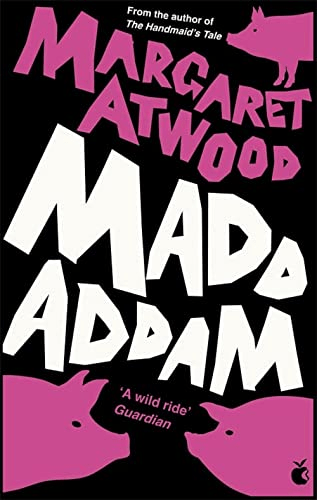
MaddAddam is the third and final novel in (and also gives its name to) the MaddAddam trilogy. It continues the story of the characters introduced in Oryx and Crake and The Year of the Flood, and opens in traditional manner of sequels: two survivors of the apocalypse, Ren and Toby, (the principal characters of The Year of the Flood), set out to rescue their friend Amanda, another of God’s Gardeners, the survivalist millennial cult who has been kidnapped. During their search they met up with other survivors including several former members of the God’s Gardeners, who were either all extremely lucky or somehow developed an immunity to the man-made virus that triggered the pandemic. They also meet Snowman Jimmy (principal narrator of Oryx and Crake) and his ‘Crakers’, modified humanoids genetically designed to survive the apocalypse and prosper in the new, post-human world. Together they form a small defensive compound, pooling their resources and skills and protecting themselves against the hostile wildlife, as well as the two ‘painball’ (a form of gladiatorial combat) kidnappers.

As with the previous books in the trilogy, Atwood combines present tense narratives with long, detailed flashbacks. In this novel we learn a lot more – possibly a shade too much – about Zeb’s background. He and his brother, Adam, who we later find out is the founder of the God’s Gardeners, escape from an abusive father and step-mother, and go on the run. Zeb adopts a bewildering series of different identities, at each stage crossing the paths of other characters already featured. Or as the New Stateman’s reviewer put it:

A penchant for coincidence began to emerge in The Year of the Flood and by this instalment it’s running as amok as the pigoons. All the survivors have known each other for years and keep bumping into each other in the post-apocalyptic landscape, while rarely encountering anyone who didn’t appear in the first two books.

The improbable coincidences pile up as Zeb moves from job to job, all of them ‘manly’ roles such as pilot and bouncer for a sex club (the one Ren and Amanda work at, of course). Zeb has adventure after adventure (at one point he is mistaken for Bigfoot, which I think was intended as comedic relief?). I had the impression Atwood was writing these asides as a form of therapy, an escape from ‘serious’ writing and that she could have gone on almost indefinitely.

Humour is also provided by the naivety of the blue-skinned, penis-waving Crakers. They are like toddlers constantly asking “why?” insisting on being told stories, and then interrupting them. This joke is quite amusing the first time it is used, but it doesn’t bear that many repetitions.

When it was originally published MaddAddam was met with some confusion. Why was Atwood still writing about this society which had already been explored in considerable depth? Was there anything particularly new to say about the apocalypse? There’s a degree of condescension in this attitude – as if science fiction is not worthy of the attention of an author of Atwood’s status – but this is nevertheless quite derivative stuff. The lack of originality in the novel’s core concept – ‘the end of the world, and what happens to the plucky group of survivors’ – is certainly a weakness which becomes all the more apparent by this stage of the series. There’s no sense of peril in the conflict with the Painballers – the novel’s bad guys – and the final showdown is told almost entirely ‘off-screen’ through the confused eyes of one of the Crakers, who doesn’t really understand what is going on.

Atwood hints that the Crakers may not be the primitive creatures we have been led to believe. One of the younger humanoids learns how to write and gains an understanding of some of the simpler human concepts. Is this a sign of the Crakers’ beginning to evolve and throw of their genetic limitations, or not? We don’t find out because this element of the story remains unresolved.

In the novel’s acknowledgements, Atwood wrote: “Although MaddAddam is a work of fiction, it does not include any technologies or biobeings that do not already exist, are not under construction, or are not possible in theory. (my emphasis). The final clause in this sentence is doing a lot of the heavy lifting. A lot of things are theoretically possible but still thousands of years away from being developed. To imply that the technology in MaddAddam is in some way imminent is misleading: psychic pig/human hybrids are not going to happen any time soon. Of course what Atwood is doing quite deliberately is referencing a similar point she made about The Handmaid’s Tale – that everything described there had happened to women at some point in human history. This is an attempt to make the text more vivid and real, a warning rather than speculative fiction. Whether she needed to do that or not is a moot point – without it does the text stands on its own well enough as fiction? Most dystopian fiction doesn’t need the protective cover of an ‘it could happen, really’ justification.

Atwood prescience happens where I suspect she least expected it – not in the development of genetic engineering, but in an aside on one of Zeb’s early jobs:

“His first employer was Ristbones, an outfit that specialised in the hacking of electronic voting machines. That had been easy in the first decade of the century, and also profitable – if you controlled the machines you could slip in whichever candidate you wanted”.

I detected some conservative themes in the previous novels in this series – opposition to gun control, and a suggestion that the apocalypse could in some way be an opportunity for a new start for humanity – but I didn’t expect to see Trumpian lines about electoral fraud being anticipated so accurately.

MaddAdam by Margaret Atwood, 2013

Aside
Book review

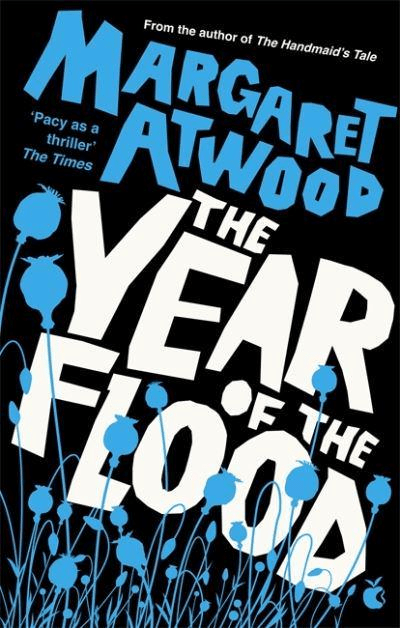
The Year of the Flood is the sequel to Atwood’s 2003 novel Oryx and Crake. It was a long wait to find out about the mysterious people that Snowman/Jimmy saw on the beach at the end of his hazardous supply-run to his former compound, but one of the obvious advantages of reading these novels ‘in arrears’ so to speak is that they can be read without the long delays in between publication, keeping the details of the preceding books fresh in the mind.

However, the enigmatic end of O&C is not immediately resolved – the wait continues until near the end of this sequel. The Year of the Flood follows the story of two of ‘God’s Gardeners’, the millennial cult mentioned in O&C. God’s Gardeners believe that a biblical ‘waterless flood’ is coming, in which the world will be cleansed of the damage done by man. and of mankind itself, leaving only a small number of survivors who have prepared for the ‘flood’.

Prepping – ‘the practice of making active preparations for a possible catastrophic disaster or emergency, typically by stockpiling food, ammunition, and other supplies‘ – is now a fairly common concept if not practice, particularly after Covid, but I am not sure when it became mainstream. Regardless, God’s Gardeners are preppers, stashing away supplies in ‘arks’ in preparation for the coming imminent catastrophe. And they are as it turns out absolutely right to do so. Atwood’s sympathies seem clearly with those warning of the impending ecological disaster, even if it is probably too late to do anything to avoid it.

As the narrative develops we learn more about the God’s Gardeners’ beliefs – they are strict vegetarians and aim to live entirely self sufficiently while they await the expected end of the world, even though their origins are not fully explained until the third novel is the trilogy, MaddAddam. Sections of the novel are regularly interspersed with copies of sermons preached by Adam One, the God’s Gardeners leader and founder, and hymns which celebrate their endless round of festivals. The cult’s leadership council are all called Adam and Eve One, two, Three etc. We also learn that the group’s ideology is perhaps not as outlandish as we had originally been led to believe – their understanding of the likely coming apocalypse proves almost exactly right, and they develop an impressive range of survival skills. The community steadily grows as more people come to realise that the modern way of life is unsustainable.

Much of The Year of the Flood follows a similar time period and structure to Oryx and Crake, with a fresh perspective of the events leading up to the apocalypse and its aftermath from the point of view of the God’s Gardeners and in particular two of their surviving members, Toby and Ren. As with O&C much of the novel is told in flashback. Toby (confusingly, a young woman) works as a ‘meat barista’ in a burger bar, enticingly named SecretBurgers. As we know from O&C law and order has largely broken down in the world outside the corporation compounds, so when Toby is assaulted by her manager, the psychotic Blanco, she is unable to do much about it until the God’s Gardeners rescue her and take her to their commune.

The other parallel thread of the story is told by Ren, a child member of the group, whose mother Lucerne is an escapee from one of the corporation compounds. At first Lucerne is in a relationship with Zeb, one of the Group leaders (while the focus of this novel is on the female characters, Zeb is a charismatic figure and it is no surprise that he comes to the fore in final novel of the trilogy). When that relationship breaks down and Lucerne and Ren return to their compound, (Lucerne claiming to have been kidnapped, a not entirely unknown experience), Ren goes to a conventional compound school where she meets Jimmy (Snowman) and Glenn (Crake). This is the starting point for the timelines of the two novels to merge.

Atwood carefully creates a very convincing portrait of a world where science is unchecked and is taking us to the brink of catastrophe. Her warnings about gene editing technology, global warming, and climate change could not be clearer. This isn’t a ‘we are all doomed’ rant, but it tiptoes close to it: if a full-scale global apocalypse does ever happen I can imagine Atwood standing in the wings, tweeting ‘well I did tell you so’. Unlike with most other dystopias there is no real attempt to suggest a way out of this mess – we are probably past the point of no return, and all we can do (it is implies) is stock up on tinned goods and hide our guns.

There are a few other weaknesses in the narrative. The days of the apocalypse themselves remain strangely unexplored – we know in detail how it happened, and how the handful of survivors come together, but almost nothing about the event itself. Atwood is careful to provide elaborate reasons why Ren and Toby survive the pandemic (Ren is locked in a bio-secure environment when it happens – it’s not entirely clear why but it appears to be some sort of quarantine required as part of her role as a sex-worker; Toby locks herself in the high-end spa where she works, also ensuring her survival) but other survivors emerge without such clear reasons for their survival, and the novel’s plausibility wobbles alarmingly when they all end up being known to one another, including several of Jimmy’s previous girlfriends. This makes for moments of recognition when incidents in the first novel are called back, such as when Jimmy’s college girlfriend burnt his shoes because they were made of faux leather, but this doesn’t make them any more plausible.

As a dystopia The Year of the Flood doesn’t have a lot more to say than Oryx and Crake. But as an adventure story it is entertaining, even exciting at point, and the reader is always rooting for the God’s Gardeners, unlikely good guys in the apocalypse if ever there were any, to come out on top, The strange Crakers make a return appearance at the end of the novel when the action catches up with where we left it at the end of Oryx and Crake, setting things up for the exciting finale, MaddAddam.

The Year of the Flood by Margaret Atwood, 2009

Aside
Book review

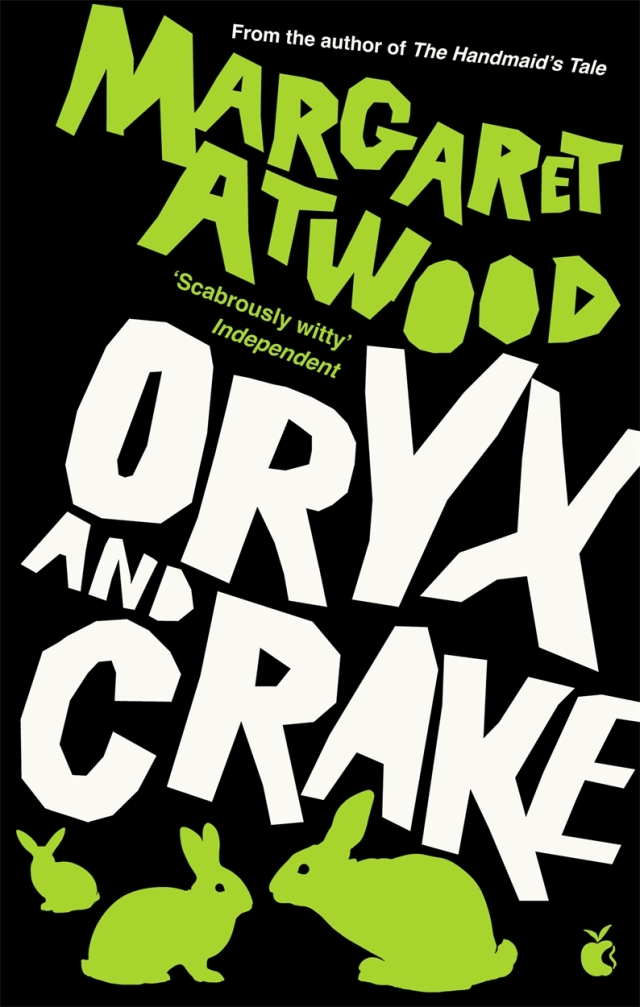
O&C was shortlisted for the 2003 Booker Prize (losing out the the excellent Vernon God Little) and the 2004 Orange Prize for Fiction. It is the first novel in the MaddAddam trilogy, followed by The Year of the Flood (2009) and MaddAddam (2013).

“Snowman”, short for ‘Abominable Snowman’, is a lonely survivor of a global pandemic that has seen virtually all mankind wiped out. He lives a precarious existence surviving off scraps and is threatened by the many bio-engineered creatures that now roam freely in a decaying landscape devoid of mankind. The novel opens with him waking up in a tree where he hides each night for safety. When I first attempted to read Oryx and Crake for some reason I never got past this very early point. This vivid image – a slightly mad-man in a tree – stayed with me, along with the entirely incorrect impression that this was a very experimental novel.

Snowman has an uneasy relationship with a mysterious group of primitive human-like creatures living nearby who he calls ‘Crakers’. The remainder of the novel tells us how the Crakers came into existence, how Snowman got his name, and how the world almost came to an end.

Much of Oryx and Crake is told in the form of Snowman’s memories as he decides how to track down the food, drink, shelter and weapons he needs to survive in this hostile environment. These are the very early years – if not months – of the post-apocalypse world. Snowman, once called Jimmy, grew up in a world recognisably similar to our own. This society was dominated by megacorps that replaced most forms of government. People working for these corporations were an elite who lived and worked in compounds, isolated from the world outside in which society was slowly breaking down. The government and the police appear to have withered away, with law and order being provided to the highest bidder by private police, the CorpSeCorps. (Atwood makes a subtle pro-gun lobby point here – the citizens of this dystopia are unable to resist the loss of their civil liberties because strict anti-gun laws have been introduced and enforced). You will not be surprised to hear that the climate was also damaged beyond repair, and that many different species of animal had become extinct. This pre-apocalypse future in other words was highly unpleasant, but entirely recognisable.

Science in our world has led society down some very dark paths, and Atwood simply follows them to their logical conclusion. For example, genetic engineering in Oryx and Crake’s pre-apocalypse society has created hybrid animals which are usually more dangerous than originally intended, and all of which survive the human-only pandemic. Some of these hybrids would be more at home on the Island of Dr Moreau than on a farm or in a laboratory – there are lion and lamb hybrids, and pig and human creatures, pigoons, designed to act as carriers of spare transplant organs.

At first the nature of the apocalypse that has wiped out humanity is unclear, but as Snowman’s story is slowly revealed we learn that the unchecked bioengineering created a super-virus that was spread through a version of Viagra. This it transpires was a deliberate attempt to wipe out mankind engineered by Jimmy’s brilliant if unstable friend Glenn, also known as Crake. It was also Crake who bioengineered the Crakers as an attempt to restart humanity with all our bad traits genetically removed.

Running short on supplies, Snowman/Jimmy decides to return to his compound, leaving behind the Crakers who look to him as some kind of spiritual leader. This is the prompt for more reminiscing by Jimmy. At school he met Glenn, who was already clearly a dangerous genius. Atwood describes the damage unrestricted exposure to the worst of the internet would have had on these young minds, another element of the socially conservative under-current to the novel. Jimmy and Glenn, now known as Crake, his identity in an online game, play violent online games and watch extreme content including live executions and child pornography.

On leaving school Crake and Jimmy part ways. Crake goes to the prestigious Watson–Crick Institute to study bioengineering; the far less gifted Jimmy follows a different path and goes to the arts and humanities based ‘Martha Graham Academy’. Jimmy has a number of relationships (which are called back in the later sequels, but which at the time seem inconsequential). A counter-culture lead by a group called God’s Gardeners is mentioned, but these seem a harmless millennial cult rather than serious opposition within society. After graduation Jimmy works in advertising until he is offered a job by Crake promoting a new drug he has developed.

All the pieces are now in place for the pandemic to break out, and it duly follows. The author doesn’t dwell on the end of the world – we have been shown the build up and the aftermath, but the event itself is passed over quickly. This is a novel of ideas rather than an adventure story after all. But the novel does end on a cliff-hanger (readers had to wait six years before finding out what happens next) when Jimmy discovers he is not alone in this world.

Dystopian fiction is a fairly crowded field, particularly of late, and the global pandemic that wipes out mankind was of course chillingly prescient. But the novel that Oryx and Crake reminded me most of was, strangely, Brave New World, In both novels mankind has become subservient to technology, which dominates everyday lives including the messy business of sex. Some people live outside the highly stratified modern society and have ‘primitive’ attitudes towards reproduction, which are presented as being more ‘natural’. Soma, the drug taken to dull the pain of everyday life in BNW, a form of anti-depressant taken like sugar or caffeine, has its equivalent in Oryx and Crake’s BlyssPluss. Huxley;s view of the prospects of mankind is fairly pessimistic, but Atwood goes a step further by seeming to welcome Crake’s apocalypse, even if the Mark 2 humanity that emerges, the Crakers, are stripped of all the positive qualities we associate with man – creativity, appreciation of music, spirituality – leaving them as mere dumb beasts.

Atwood’s themes – globalisation, the power of corporations, the climate crisis and the risks inherent in bio-engineering – are all as relevant today, if not more so, than when the novel was first published almost twenty years ago. The novel at times tiptoes close to being moralistic, and the enigmatic character of Oryx is never fully developed, but this is in many ways a traditional ‘what-if’ dystopia that suggests the end of the world wouldn’t be all bad, and it might well be what we deserve. That’s a worrying interpretation which the sequels (reviews to follow) do little to dispel. I was however glad to be wrong about the readability of this novel – it is at heart an entertaining adventure story, albeit a fairly morbid one,

Oryx and Crake, by Margaret Atwood, 2003

Aside
Book review

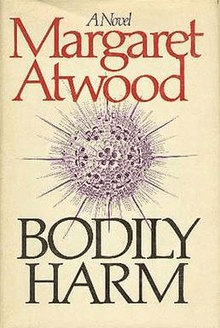
Bodily Harm felt strangely familiar: the premise of the novel echoed strongly with me, but I am struggling to pin down from where. In the novel Rennie Wilford, a Canadian ‘lifestyle writer and journalist’, suffers an upsetting relationship breakdown following surgery for breast cancer. In an attempt to escape she engineers an opportunity to travel to the small Caribbean island nation of St. Antoine to write a travel/holiday piece. Here she finds the island uncomfortable and alien, but slowly becomes embroiled in the febrile local politics. An attempted coup or insurrection goes badly wrong, and Rennie is caught up in the aftermath.

Frustratingly I can’t identify what book or books this reminds me of. It is possible that the cumulative effect of so many tropes is what is causing this ‘deja lire’ phenomenon.

The contrast between Rennie’s life in Toronto and her experience on the islands is striking. At home she was originally a political journalist specializing in unspecified ‘abuses’ but now writes about ‘lifestyles’:

“You write about something until people become tired of reading about it or you become tired of writing about it, and if you’re good or lucky enough it’s the same thing. Then you write about something else.”

Rennie lives with Jake, an unpleasant sexually aggressive and frankly abusive young man. He has a vacuous job as a label designer

“not just labels but the total package: the label, the container, the visuals for advertising. He was a packager. He decided how things would look and what contexts they would be placed in, which meant what people would feel about them”,

Canadian culture is portrayed as synthetic and superficial, and Rennie is profoundly unhappy without really realising it. Her breast cancer diagnosis brings this unhappiness to the fore, and shortly after Jake moves out Rennie comes home one day to find two policemen waiting for her, inspecting a sinister coil of rope left on her bed by an intruder. This is the catalyst for her getting out of Toronto, albeit temporarily. The Caribbean island state of St. Antoine is undeveloped and unwelcoming, and Rennie never takes her purported mission, to write a travel piece about the island, very seriously. She meets a number of ex-patriates including Paul, a drug smuggler who may or may not also work for the CIA and Lora, a fellow Canadian who has ended up in St Antoine with no real idea as to why. She also meets some locals including Dr. Minnow who is a candidate in St. Antoine’s elections, the first since independence from the British. What starts as a travelogue degenerates into a nightmarish experience as St. Antoine’s political factions go to war, and outsiders are all suspects.

Bodily Harm is not a comfortable read. St Antoine becomes a metaphor for Rennie herself, almost as if her vacation is a dream in which her various traumas are worked through and the characters represent aspects of her life back in Toronto. Her cancer is echoed in the rottenness of the island’s political corruption; the sado-masochism of her relationship with Jake is paralleled in the violence she encounters, and the novel’s conclusion in which she is imprisoned while her involvement with the island’s insurrectionists is investigated is (arguably) a metaphorical representation of her illness and slow recovery. Read this way Bodily Harm is a disquieting portrait of contemporary life rather than the superficial story of a journalist taking a vacation in the Caribbean that it initially promises to be.

Bodily Harm was the novel Atwood wrote immediately before The Handmaid’s Tale which was published four years later. Atwood is not a genre writer, and all of her novels that I have read thus far are significantly different, so it is difficult to find any trace of Handmaid’s in this novel. Having said that the theme of sexual violence being part of everyday life for women does indicate the lines the author was thinking on at the time and which were much more fully developed in the later novel.

Bodily Harm by Margaret Atwood, 1981

Aside
Book review

Alias Grace, by Margaret Atwood, 1996

Alias Grace is a fictionalised account of the mid-nineteenth century murder of Thomas Kinnear, a Canadian farmer, and his housekeeper, Nancy Montgomery. Two servants, Grace Marks and James McDermott, were convicted of the murder of Kinnear, and while McDermott was executed, Marks was sentenced to life in prison. This is Grace’s story.

AliasGrace.jpg

The novel opens several years after the date of the murders. Grace is being interviewed by Dr Simon Jordan, a researcher into mental illness who is investigating her case. Jordan has a vague idea of opening an asylum, and thinks that a breakthrough in Grace’s treatment will attract the investment he needs. He has been engaged by a group of local well-wishers who have been petitioning unsuccessfully for Grace’s release for some time. Grace has no clear memory of the murders and is unable to say clearly whether (as McDermott claimed) she helped strangle the housekeeper. There is some doubt as to her mental capacity – she has served some of her sentence in an asylum, although at the time the novel opens she works as a trusted servant in the home of the prison governor.

Jordan’s treatment consists of bringing an everyday item – a piece of fruit for example – to each interview, and encouraging Grace to tell her story. This is an effective approach for the purposes of the novel – these interviews are the heart of the narrative – but as treatment they have no effect whatsoever. Grace’s story remains consistent throughout, and there is no breakthrough of any kind. Her memories range back to her family’s migration to Canada from Ireland, her going into service (that is, getting her first job as a servant) and the time she became close friends with Mary Whitney, a slightly older and more experienced fellow servant. We know Mary is significant in Grace’s story because she used her name when briefly on the run following the murders. Mary is one of many women in the novel who suffer at the hands of men, in her case becoming pregnant outside of marriage and having to seek out a brutal illegal abortionist.

Grace enjoys her time with Jordan, and her inner monologue confirms she constructs her story to keep him engaged and interested. His story is very different from Grace’s, but it eventually shares a strange similarity when his landlady seduces him and then tries to persuade him to murder her drunken and abusive husband. Jordan has choices Grace did not, and he abruptly leaves both Toronto and the narrative. With him leaves any hope of a pardon for Grace. After almost thirty years she is however eventually released, begins a new life in the United States and marries in fulfilment of a prophesy made by Mary Whitney many years earlier.

This is not a mystery novel. There is no denouement, no final reveal of ‘what really happened’. The ambiguity as to Grace’s involvement in the murders is never clarified. I never really expected it to be but I’d be lying if I didn’t admit to a slight sense of disappointment – the urge to discover ‘the truth’ is a powerful one. Using a real-life incident as the skeleton of a narrative is not a new idea of course, and there was little overall about Alias Grace that felt particularly original. If you had asked me before reading the novel how I thought it might be constructed, given the premise, I would have anticipated multiple points of view, unreliable narrators, a combination of different forms – letters, diary entries etc – and an ambiguous ending. There are plenty of texts constructed on similar lines, such as A S Byatt’s 1990 Booker winner Possession and Graeme McRae Burnett’s much later (and shortlisted) His Bloody Project. There was an obvious sense of the novel’s artificiality. Sometimes that’s fine; here it was disappointing, as the immersive narrative, the story of the murders, was constantly interrupted by yet another reminder that this is all a construct.

If a novel is going to be self-consciously crafted, then the author has to be highly skilled at the craftwork to avoid the artificiality being off-putting. And of course Atwood is without question a fine writer. While avoiding being overly didactic this novel has a lot to say about the role of women in nineteenth century society, where frequently the choice was between domestic servitude, an unhappy marriage, or the streets. (Jeremiah the peddler, (alias Geraldo Ponti, magician, alias Dr. Jerome DuPont, “Neuro-Hypnotist”,) represents a glimpse of an alternative life for Grace, an exotic life of adventure, but it is one she never seriously considers). At times she almost enjoys life as a household servant – it is better than starving with the rest of her family – but there don’t seem to be many positive choices elsewhere. Dr Jordan summarises the options as follows:

“In his student days, he used to argue that if a woman has no other course open to her but starvation, prostitution, or throwing herself from a bridge, then surely the prostitute, who has shown the most tenacious instinct for self-preservation, should be considered stronger and saner than her frailer and no longer living sisters. One couldn’t have it both ways, he’d pointed out: if women are seduced and abandoned they’re supposed to go mad, but if they survive, and seduce in their turn, then they were mad to begin with.”

We are led to believe that his views have not materially changed since this time, and this is presented as a progressive view compared to those who would dismiss ‘fallen women’ without compassion. But it is still not much of a choice for the women in the novel.

There is without question much fine poetic writing in Alias Grace.

“When you are in the middle of a story it isn’t a story at all, but only a confusion; a dark roaring, a blindness, a wreckage of shattered glass and splintered wood; like a house in a whirlwind, or else a boat crushed by the icebergs or swept over the rapids, and all aboard powerless to stop it. It’s only afterwards that it becomes anything like a story at all. When you are telling it, to yourself or to someone else.”

At times Grace’s narrative voice comes close to overlapping with that of the omniscient narrator – she uses language and expressions that don’t seem authentic for a young Irish emigre:

“Murderess is a strong word to have attached to you. It has a smell to it, that word – musky and oppressive, like dead flowers in a vase. Sometimes at night I whisper it over to myself: Murderess, Murderess. It rustles, like a taffeta skirt across the floor.”

But that is nit-picking – overall this is a strong exploration of the role of women in the nineteenth century. It’s not in any way sentimental – yes Grace is a victim but she is also quite possibly a murderer as well. (The supernatural explanation for the murders that we are given at one point towards the end of the novel is a red herring in my opinion – I don’t think we are intended to consider it the revelation that some readers/reviewers have treated it as.) I am not sure if I am being overly harsh in reflecting my disappointment with the lack of originality in Alias Grace, despite the many deft touches such as the use of the quilting motif through the novel. But I think The Handmaid’s Tale made many of the same points much more powerfully because of the originality of the novel’s premise.

Standard
Book review

The Testaments, by Margaret Atwood, 2019

This review is going to get me into trouble, at home if nowhere else. Because The Testaments was such a disappointment! While living up to the standards of her earlier works was always going to be difficult, some elements of the novel were reminiscent of fan-fic – based in the world so chillingly described in The Handmaid’s Tale, but unevenly written with poorly conceived characters and an implausible plot.

Of course I could self-censor, write about the things in the novel that I did like – Gilead is no less a scary dystopia than it was before, and of course Atwood hasn’t become a bad writer overnight – but what would be the point of that? If this blog has any purpose at all it is to act as a place where I record my authentic impressions of what I read, not what I am supposed to think. Having said that, I also owe any author, let alone one of such distinguished status as Margaret Atwood, the effort of trying to recognise the strengths in their work. So let’s start there.

Atwood’s political analysis of the oppression of women hasn’t fundamentally changed from Handmaid’s, but it remains as sharp as ever. For example, where she identifies what made women particularly vulnerable when Gilead first took over:

“All that was necessary was a law degree and a uterus: a lethal combination.”

Young women growing up in Gilead are brain-washed into thinking their bodies are the source of all sin:

“We were precious flowers that had to be kept safely inside glass houses, or else we would be ambushed and our petals would be torn off and our treasure would be stolen and we would be ripped apart and trampled by the ravenous men who might lurk around any corner, out there in the wide sharp-edged sin-ridden world.”

What has changed from Handmaid’s is that Atwood identifies the role of women as instruments of their own oppression. Some women are zealots who seem to genuinely believe men are the stronger sex who have the right to control women’s bodies; others simply do what they have to do to survive. As Aunt Lydia tells us:

Two roads diverged in a yellow wood, and I took the one most travelled by. It was littered with corpses, as such roads are. But as you will have noticed, my own corpse is not among them.”

The threats to women’s autonomy remain as significant as they were when Handmaid’s was written – but arguably that just makes the original novel all the more pertinent rather than requiring a sequel. Atwood’s reasons for writing this follow-up may well be as much to do with the success of the television adaptation as a burning desire to explore further the complexities of Gilead. I can’t blame her for that, and to be fair she doesn’t just write Handmaid’s Tale 2.

The original novel has an ambiguous ending. We know, due to the appendix, that Gilead doesn’t survive, but we don’t know how the regime ends, and we know nothing about the fate of the central character, Offred. We don’t even know her real name. Atwood has returned to Gilead to answer some of these questions. The novel uses the always popular multi-narrator approach, threading the testimonies of three key women. We hear more from Aunt Lydia about the circumstances in which Gilead and its institutions were founded, how it survived despite conflict on all its borders, and how eventually it fell. I haven’t worked out a clear timeline for the events of the novel, but the whole period seems little more than a few decades from creation to fall.

We also learn about life outside Gilead, in Canada and elsewhere, and the efforts of Mayday, an underground organisation, to rescue women from Gilead. Their work is consciously modelled on the Underground Railroad.

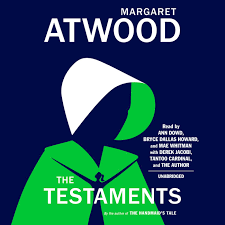
The Testaments by Margaret Atwood | Penguin Random House Audio

As well as Aunt Lydia’s narrative the novel interweaves testimonies – testaments – by two teenage girls, Agnes, the adopted daughter of Commander Kyle and his wife Tabitha, and Daisy, growing up in Toronto with her adoptive parents, Neil and Melanie, who run a second-hand clothes store. The three narrators alternate in short chapters which gave considerable pace to the narrative. It was obvious early on that the secrets about Daisy and Agnes’s parentage would be revealed, and how the threads of the narrative would eventually join.

Aunt Lydia is the dominant character in the novel – shrewd, knowledgeable, and a survivor. She is not above suspicion, but is able to manipulate (a little too easily) the characters around her to protect herself, while all the time working to undermine Gilead. The teenage girls show two completely different views of Gilead – Agnes has been born and raised in the country and has adopted its worldview unquestioningly. She has been taught that women must cover up to avoid inflaming male passions, and that reading is a source of sin. Her body is dangerous and she must be married at an early age to fulfil her purpose of having children. She is profoundly religious and keeps her faith even when her belief in the ideals of Gilead are shaken. Daisy on the other hand, having been raised in Canada, is an atheist and is opposed to everything Gilead stands for. She happily volunteers to go undercover into Gilead to recover some damning information about the regime, despite the obvious dangers.

Despite its status as a feminist novel of ideas, The Testaments works most effectively as an action novel. The climax of the narrative features a breathless escape from Gilead, with speedboats and helicopters thrown in for good measure, secret information hidden in a micro-dot (how very 1970’s!) hidden under one of the girl’s skin, disguised by a GOD/LOVE tattoo.

Atwood’s skill as a writer is without question, but her ability to craft a phrase stands out:

“The truth can cause a lot of trouble for those who are not supposed to know it.”
“how easily a hand becomes a fist.”
“No one wants to die…but some people don’t want to live in any of the ways that are allowed.”

That skill falters slightly when she writes as a teenage girl, where an element of inauthenticity appears. Would a teenage girl, even when writing in later life, write “Nobody is any authority on the fucks other people give“? Much quoted (in reviews) phrases such as “You don’t believe the sky is falling until a chunk of it falls on you” or “As they say, history does not repeat itself, but it rhymes” sound quite impressive on a first reading but I am not sure they actually mean anything.

So what’s the problem with The Testaments? I’ve touched on some of the issues above. But my main concern was with the action elements of the novel. Perhaps they would work better on television, but on the page they came across as a parody of a spy novel. What is more they didn’t really make any sense. I found Daisy’s decision to return to Gilead disguised as a Pearl Girl (a missionary) completely unconvincing, and Commander Judd’s decision to keep quiet about her return was baffling. Of all the people you would send back to Gilead to recover some vital intelligence, Daisy would be the very last choice. And once her return to Gilead was known why the Commander would keep it quiet and allow her to escape back to Canada I have no idea.

Other elements such as the casually announced death of one of the minor characters suggested a rush to end the novel and tie up loose ends without thinking through the detail. There were other signs of this, such as how trainee aunts, totally illiterate when they arrive at Ardua Hall in their mid teens, are fluent readers in a few months despite starting with modestly coloured-in Dick and Jane books.

Despite all this I enjoyed reading this novel. I recognise I should probably consider it on its own merits rather than as the sequel to an iconic classic. It’s ironic that this won the Booker rather than the original, which is probably the judges’ way of correcting history. I am pretty sure that Handmaid’s will be read in decades if not centuries to come as an important statement of protest at society’s treatment of women, while The Testaments will be remembered as a less interesting addendum.

Standard
Book review

The Blind Assassin, by Margaret Atwood, 2000

Novel the blind assassin cover.jpg

The structure of this novel is fascinating. The principal thread holding it together is a first person narration by the novel’s central character, Iris Chase. In her old age she writes a memoir for her grand-daughter. Her narrative recalls memories of her childhood and the early years of her unhappy marriage to a Toronto businessman, Richard Griffen. She also describes her present-day life in Port Ticonderoga, her Canadian home-town, dependent on the goodwill of her friend Myra for her everyday needs. Interspersed with this narrative is the text of a novel, The Blind Assassin, apparently written by Iris’s sister Laura, and published posthumously just after the end of the second world war. The Blind Assassin itself contains a third narrative, a pulp science fantasy story – and it is this story which is the tale of the eponymous blind assassin. This might sound an overly complex structure, but it is easy to follow once you understand the conventions Atwood uses to signal which of the stories we are being told.

Intertwined narratives of this kind are not that new or innovative – A S Byatt’s 1990 Possession does something quite similar. What is so striking about this novel is the way Atwood draws together the threads of her stories and step by step reveals the truth underlying the initial presentation. It will come as no surprise to hear that Iris is an unreliable narrator and it is the contrast between her account and her sister’s novel, slowly revealed to be based on real life, which allows a truth to emerge. Again, this concept of there being a ‘true’ narrative hiding behind the lies and misrepresentations offered by the narrator is not entirely new, but it is done with considerable skill here.

Atwood uses one other device to drive the narrative. Key moments of the story are revealed through newspaper stories. We are told about the premature deaths of central characters. The novel therefore becomes a mystery story – we are less interested in what happens, but why, and how the events are related to one another.

The temptation in reviews of this kind is to take a retrospective view of the events of the novel and to flatten them out – to present them in a linear chronological fashion, whereas the presentation within the novel is complex and at times even chaotic. So if I were to tell you the story of the Chase sisters, their wealthy manufacturing family, Iris’s unhappy marriage to Toronto manufacturing tycoon Richard Griffen, etc, it would all be true, but it would give a distorted version of the novel. Sometimes such summaries are useful, when it is hard to follow the plot or where there is uncertainty about some of the detail (this is particularly true of those novels spanning generations where everyone seems to have at least three different interchangeable names!). But here I think I will pass – plot summaries are easy to find online if required, but would reduce this novel to a story, which would be reductive and misleading.

I found it interesting to compare this novel in all its complexity to Atwood’s 1972 novel Surfacing, It clearly demonstrates her growth as a novelist – while Surfacing is a convincing portrait of one woman’s mental deterioration, the contrast with The Blind Assassin makes it look superficial and incomplete.

I have disagreed with the choices of the Booker judges many times over the years, but this must have been one of the simpler choices they ever had to make.

Standard
Book review

Surfacing, by Margaret Atwood, 1972

Surfacing, Atwood’s second novel, is an elusive narrative. Ostensibly it is a simple story – after a long absence an unnamed narrator returns to her childhood home in the remote Canadian countryside to try and find her missing father. Her boyfriend, Joe, and a married couple, Anna and David, complete the group. The homecoming is uneasy – despite being familiar the setting feels alien and disturbing. On arrival at the family home there is no obvious sign of her father. The group agrees to stay for a week and turn the visit into a short, back to nature holiday. Tensions between each couple slowly emerge – David belittles Anna, who tells the narrator that he is a philanderer who objectifies women – for example he insists that she always wears makeup. The narrators relationship with Joe is equally strained.

Time is whiled away in fairly banal tasks – they go blueberry-picking, fishing and swimming, weed the vegetable patch and play board games. The women do the bulk of the domestic tasks. The narrator’s mental state slowly deteriorates and the narrative begins to fragmented. Sentences become short and disjointed, and eventually incoherent. The narrator is haunted by memories of her marriage, her child, and the abortion she was pushed into having. Her increasing sense of paranoia is fuelled by David’s constant references to an impending American invasion of Canada, which she treats entirely seriously. She sees hidden messages from her parents in every day objects around the house, and cannot decide if he is really alive or dead. Meanwhile David and Joe are making a modernist film, Random Samples, which is really just a collage of miscellaneous scenes. This again emphasises the narrator’s sense of alienation, making her feel like a performer rather than a real person with her own identity.

The novel draws to a climax when both men attempt unsuccessfully to pressurise the narrator into having sex with them – when rebuffed they sulk. This may have been the final trigger for the narrator’s descent into a full blown psychotic episode. She destroys David’s film and escapes in a canoe, hiding in the forest until the others leave the island. She trashes everything in the cabin, and runs around naked, eating unwashed plants, and living outside. I found these quite disturbing scenes, and although the end of the novel suggests a return to some form of normality it was something of a relief. This will probably sound patronising, but this felt like an early sketch for a novel – lots of themes and ideas are laid out for consideration, but the narrative was erratic and very difficult to engage with. There’s little here to suggest the impressive prose and strong ideas that Atwood was to develop in her later work.

Standard
Book review

The Handmaid’s Tale, by Margaret Atwood, 1985

The popularity of the television adaptation of The Handmaid’s Tale may have been what inspired Margaret Atwood to return to Gilead and the story of the eponymous handmaid Offred. (In the TV adaptation this character is called June, but so far as I can tell this name is not used in the book). It was certainly a factor in my decision to finally getting round to picking up this much-admired classic.

The Handmaid’s Tale is set the near future. A radical religious group, the “Sons of Jacob”, has captured power in the United States. The president has been assassinated, congress murdered, the constitution suspended, and the possession of jobs and separate bank accounts is forbidden to women. This is only the beginning of a dramatic overhaul of society in which all other religious groups are banned and a Talibanesque Old Testament-inspired model of society is imposed.

Declining birth rates caused by pollution and radiation mean that now only a few women are able to have children. These women are taken into slavery and forced to produce children for the ruling class of men, the “Commanders”. They are known as handmaids, a title derived from the story in Genesis of Rachel and her slave Bilhah. Women (and their children) are commonly treated as possessions in the Old Testament, and this inspires many of the new social structures and traditions in Gilead. All women have rigidly defined roles and and must follow a strict dress code: Commanders’ wives wear blue, handmaids red, and Marthas (servants) green.

The story is narrated by Offred, a 33 year old woman who records several months of her life as handmaid to a Commander and his embittered wife. As well as telling the reader about her imprisonment and the daily tortures she faces, she includes memories of her life before and during the revolution, which she describes as “The other time, the time before”. Life is brutal for almost everyone in Gilead, but the enslavement of women and the ritualised assaults for the purpose of breeding is particularly horrifying, even if Offred has slow begun to come to terms with her captivity. Her fond memories of times past provide some slight relief from the brutality of her new life.

Things improves marginally when the Commander begins to meet her secretly at night, not for sex, but to play Scrabble. This surprising development lightens the mood slightly and allows them to develop a less formal relationship. This is rule-breaking that could easily end badly for Offred, but she welcomes the hint of freedom it offers. She also agrees when the Commander’s wife, Serena, proposes that she tries to get pregnant by Nick, the family chauffeur, the implication being that the Commander may be sterile. At the same time Offred learns from her shopping partner, Ofglen, that there may be an underground resistance working to overthrow Gilead.

Offred’s narrative ends abruptly, leaving it unclear whether she has been taken into custody for her small acts of resistance, or whether she escapes Gilead. A mis-judged epilogue set in 2195 explains the events of the novel were recorded onto cassette tapes and are now considered an historic document charting the early years of the Republic of Gilead. While it appears a more equal society has now been restored, the lecturer is insensitive, treating the victims of the regime as a source for clumsy jokes. 

There are several disturbing aspects to this novel. It is utterly convincing in its demonstration how the injustices towards women in today’s society came to be the first step towards their enslavement in Gilead. Offred describes her life before the collapse of society as largely happy, but

“I never ran at night, and in the daytime only beside well-frequented roads. Women were not protected then. I remember the rules, rules that were never spelled out, but that every woman knew: don’t open your door to a stranger, even if he says he is the police. Make him slide his ID under the door. Don’t stop on the road to help a motorist pretending to be in trouble. Keep the locks on and keep going. If anyone whistles don’t turn to look. Don’t go into a laundromat, by yourself, or at night.”

In other words the seeds of Gilead and its oppression of women are inherent in today’s society. Another incident recounted in the novel emphasised this point. Offred describes a book-burning scene. But these are not nazis burning books about Marxism, but women burning hard core porn.

You see what things used to be like? That’s what they thought of women then!”

I think the author may be suggesting here that freedom of speech extends to even content we find offensive, and that once we start burning books or magazines because they are upsetting, we are on the path that lead to censorship. Atwood in other words is out to challenge the reader rather than present a scary story which we can walk away from knowing we are lucky not to live there.

There are some obvious parallels between The Handmaid’s Tale and George Orwell’s 1984. Both are set in a relatively near future in which people can remember and contrast life under the previous regime. Both envisage totalitarian control of society in which thought crime can be punished by death. Sex is strictly controlled by society and is used as an act of rebellion by the protagonists. War dominates daily life in both Gilead and Eurasia. The state spies on and tortures its opponents and punishes any deviation from the rules, and uses collective gathering, such as the daily hate or the Salvagings to keep the people in check. The novels even share the same feature of an epilogue or postscript looking back at the society from a more liberal future. The other characteristic the novels share is their approach to language. In 1984 language is under attack through the introduction of Newspeak, constantly being diminished to reduce the risk of thoughtcrime. In Gilead they take this further, so all writing and reading is forbidden to women (which is why seemingly mundane invitation to play Scrabble is so dangerous thrilling to Offred).

Doing a small amount of background reading I came across the shocking fact that this novel was short-listed but did not win the 1986 Booker prize, which was instead awarded to Kingsley Amis’s The Old Devils. Time has not been kind to that decision. I know hindsight is a wonderful thing but the judges of that award must look back with some shame. Instead of the Booker the Handmaid’s Tale won the inaugural Arthur C Clarke award in 1987, even though the novel is clearly not science fiction. My other brief attempt at research also threw up (choice of words intentional) this classic example of missing the point. Writing in the Spectator, the writer Allison Pearson claimed

“I only wish that Atwood would tell her fans that she is not writing, primarily at least, about the way that Trump’s America could go in the future, but about how things are right now for females in repressive Islamic societies. We are so blessed compared to them. To don a red dress and white bonnet, to pretend their suffering is ours, to talk of tyranny, is the most appalling moral vanity.”

Yes and no. Surely Atwood is writing about how women are treated in patriarchal society, not just one country or set of social conditions. She is unlikely to have been writing about Trump’s presidency in 1985 anyway! It’s easy to scan round the world, find a society you don’t like (the Spectator isn’t a fan of Islam) and identify ways in which women in that society are treated similar to those in Gilead. You can if you wish do the same for women in America denied the right to have an abortion. It’s not a competition – which society is the most repressive towards women – the problem is that they all are. And they all use the same reasons – that women are not safe when they are free. I think this slowly dawns on Pearson, because she ends on this peroration

Imagine a country where women have no jobs, no rights and are valued only for their reproductive success. Imagine a country where girls aren’t taught to read in case they get ideas. Imagine a country where boys eat lunch while girls have to wait. Imagine women having to cover themselves head to toe in case men get ideas. Sadly, we don’t have to imagine. There are millions of handmaids. The nightmare of Gilead is right here.

Her dislike of Islam overrides her need for consistency, because women wear head to toe clothing in many societies including the UK, women earn less than men, women face everyday sexism in the workplace, and the example of boys eating their lunch first is drawn for a reference earlier in the article to a school in the UK.

I am glad Atwood has returned to Gilead in The Testaments, which I look forward to reading. The Chaucerian echo in this novel’s title always suggested there were more tales to be told.


Standard