
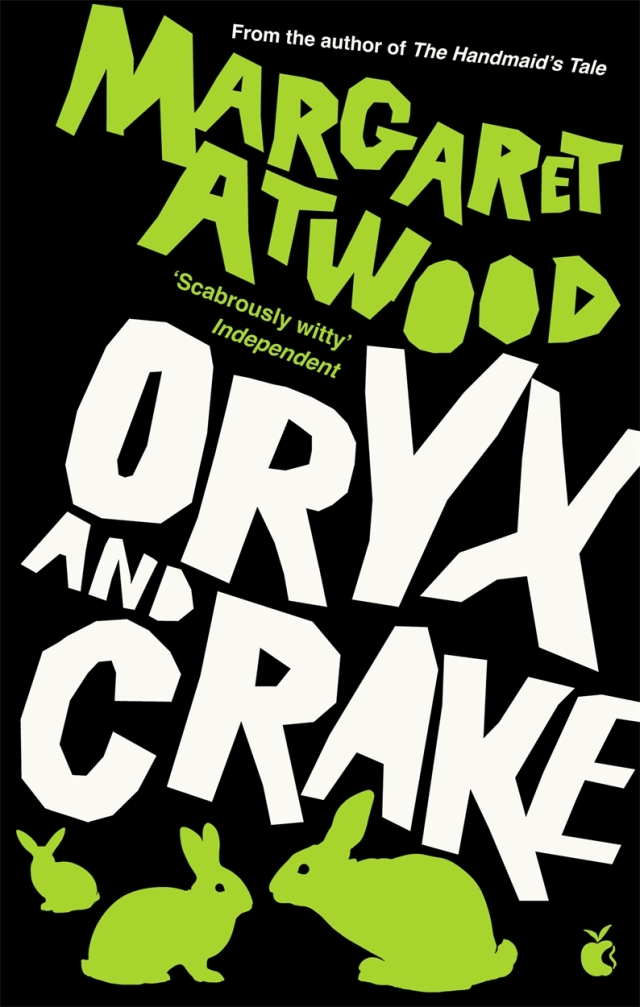
O&C was shortlisted for the 2003 Booker Prize (losing out the the excellent Vernon God Little) and the 2004 Orange Prize for Fiction. It is the first novel in the MaddAddam trilogy, followed by The Year of the Flood (2009) and MaddAddam (2013).
“Snowman”, short for ‘Abominable Snowman’, is a lonely survivor of a global pandemic that has seen virtually all mankind wiped out. He lives a precarious existence surviving off scraps and is threatened by the many bio-engineered creatures that now roam freely in a decaying landscape devoid of mankind. The novel opens with him waking up in a tree where he hides each night for safety. When I first attempted to read Oryx and Crake for some reason I never got past this very early point. This vivid image – a slightly mad-man in a tree – stayed with me, along with the entirely incorrect impression that this was a very experimental novel.
Snowman has an uneasy relationship with a mysterious group of primitive human-like creatures living nearby who he calls ‘Crakers’. The remainder of the novel tells us how the Crakers came into existence, how Snowman got his name, and how the world almost came to an end.
Much of Oryx and Crake is told in the form of Snowman’s memories as he decides how to track down the food, drink, shelter and weapons he needs to survive in this hostile environment. These are the very early years – if not months – of the post-apocalypse world. Snowman, once called Jimmy, grew up in a world recognisably similar to our own. This society was dominated by megacorps that replaced most forms of government. People working for these corporations were an elite who lived and worked in compounds, isolated from the world outside in which society was slowly breaking down. The government and the police appear to have withered away, with law and order being provided to the highest bidder by private police, the CorpSeCorps. (Atwood makes a subtle pro-gun lobby point here – the citizens of this dystopia are unable to resist the loss of their civil liberties because strict anti-gun laws have been introduced and enforced). You will not be surprised to hear that the climate was also damaged beyond repair, and that many different species of animal had become extinct. This pre-apocalypse future in other words was highly unpleasant, but entirely recognisable.
Science in our world has led society down some very dark paths, and Atwood simply follows them to their logical conclusion. For example, genetic engineering in Oryx and Crake’s pre-apocalypse society has created hybrid animals which are usually more dangerous than originally intended, and all of which survive the human-only pandemic. Some of these hybrids would be more at home on the Island of Dr Moreau than on a farm or in a laboratory – there are lion and lamb hybrids, and pig and human creatures, pigoons, designed to act as carriers of spare transplant organs.
At first the nature of the apocalypse that has wiped out humanity is unclear, but as Snowman’s story is slowly revealed we learn that the unchecked bioengineering created a super-virus that was spread through a version of Viagra. This it transpires was a deliberate attempt to wipe out mankind engineered by Jimmy’s brilliant if unstable friend Glenn, also known as Crake. It was also Crake who bioengineered the Crakers as an attempt to restart humanity with all our bad traits genetically removed.
Running short on supplies, Snowman/Jimmy decides to return to his compound, leaving behind the Crakers who look to him as some kind of spiritual leader. This is the prompt for more reminiscing by Jimmy. At school he met Glenn, who was already clearly a dangerous genius. Atwood describes the damage unrestricted exposure to the worst of the internet would have had on these young minds, another element of the socially conservative under-current to the novel. Jimmy and Glenn, now known as Crake, his identity in an online game, play violent online games and watch extreme content including live executions and child pornography.
On leaving school Crake and Jimmy part ways. Crake goes to the prestigious Watson–Crick Institute to study bioengineering; the far less gifted Jimmy follows a different path and goes to the arts and humanities based ‘Martha Graham Academy’. Jimmy has a number of relationships (which are called back in the later sequels, but which at the time seem inconsequential). A counter-culture lead by a group called God’s Gardeners is mentioned, but these seem a harmless millennial cult rather than serious opposition within society. After graduation Jimmy works in advertising until he is offered a job by Crake promoting a new drug he has developed.
All the pieces are now in place for the pandemic to break out, and it duly follows. The author doesn’t dwell on the end of the world – we have been shown the build up and the aftermath, but the event itself is passed over quickly. This is a novel of ideas rather than an adventure story after all. But the novel does end on a cliff-hanger (readers had to wait six years before finding out what happens next) when Jimmy discovers he is not alone in this world.
Dystopian fiction is a fairly crowded field, particularly of late, and the global pandemic that wipes out mankind was of course chillingly prescient. But the novel that Oryx and Crake reminded me most of was, strangely, Brave New World, In both novels mankind has become subservient to technology, which dominates everyday lives including the messy business of sex. Some people live outside the highly stratified modern society and have ‘primitive’ attitudes towards reproduction, which are presented as being more ‘natural’. Soma, the drug taken to dull the pain of everyday life in BNW, a form of anti-depressant taken like sugar or caffeine, has its equivalent in Oryx and Crake’s BlyssPluss. Huxley;s view of the prospects of mankind is fairly pessimistic, but Atwood goes a step further by seeming to welcome Crake’s apocalypse, even if the Mark 2 humanity that emerges, the Crakers, are stripped of all the positive qualities we associate with man – creativity, appreciation of music, spirituality – leaving them as mere dumb beasts.
Atwood’s themes – globalisation, the power of corporations, the climate crisis and the risks inherent in bio-engineering – are all as relevant today, if not more so, than when the novel was first published almost twenty years ago. The novel at times tiptoes close to being moralistic, and the enigmatic character of Oryx is never fully developed, but this is in many ways a traditional ‘what-if’ dystopia that suggests the end of the world wouldn’t be all bad, and it might well be what we deserve. That’s a worrying interpretation which the sequels (reviews to follow) do little to dispel. I was however glad to be wrong about the readability of this novel – it is at heart an entertaining adventure story, albeit a fairly morbid one,

