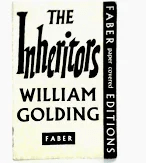
The Inheritors by William Golding, 1955
The Inheritors is a fascinating, challenging novel by the author of Lord of the Flies, with which it shares some points of similarity. It is set in prehistoric times and follows a community of stone-age people moving from their winter quarters to their summer base. The novel is prefaced by a quote from H G Wells’s Outline of History explaining how little is known about Neandethal man. Although this is presented as a key to interpreting the text that follows, it is somewhat misleading, as the reader comes to learn.
The Inheritors is told largely from the perspective of Lok, one of ‘the people’, a term they use to describe their small group. It is not clear if the people have had contact with other communities before. It is quickly clear however that they are a very primitive tribe. One way Golding illustrates this is that they struggle with most kinds of abstract or conceptual thought. We see this early in the novel, when Lok finds that the log the group has habitually used to cross a river has been removed:
“He shut his eyes and frowned at the picture of the log. It had lain in the water from this side to that, grey and rotting. When you trod the centre you could feel the water that washed beneath you, horrible water, as deep in places as a man’s shoulder. The water was not awake like the river or the fall but asleep, spreading there to the river and waking up, stretching on the right into wilderness of impassable swamp and thicket and bog. So sure was he of this log the people always used that e opened his eyes again, beginning to smile as if he were waking out a a dream; but the log was gone. “
You will note that the author uses the phrase ‘as deep in places as a man’s shoulder’. Elsewhere the term ‘old woman’ is used. So we are subtlety led to understand that these people are men and women, or consider themselves as such. But they have virtually no tools, no clothing, a very limited understanding of the world around them, and are almost completely unable to use abstract ideas (although they are able to control fire). Which prompts the reader to ask – just how primitive are they? – and critically, are they homo-sapiens, the species that went on to inherit the earth (in the terms of the novel’s title), or are they another species entirely? We are initially encouraged – by the novel’s title, the focus on the group, the first person narration and the use of the terms man and woman – to think they are the inheritors, our ancestors, but we come to realise that assumption might not be right. That doubt accelerates or is confirmed when the group comes into contact with the Others. This new group wear clothes, use tools including weapons and boats, and kill the people casually immediately on contact. The people are quickly reduced to two adults – Lok, Fa, a female, and two children, Liku and an unnamed baby. The newcomers kidnap the children and shoot arrows across the river at Lok, who doesn’t understand what is happening:
Suddenly Lok understood that the man was holding the stick out to him but neither he nor Lok could reach across the river. He would have laughed if it were not for the echo of the screaming in his head. The stick began to grow shorter at both ends. Then it shot out to full length again. The dead tree by Lok’s ear acquired a voice. “Clop!” His ears twitched and he turned to the tree. By his face there had grown a twig: a twig that smelt of other, and of goose, and of the bitter berries that Lok’s stomach told him he must not eat. This twig had a white bone at the end. There were hooks in the bone and sticky brown stuff hung in the crooks. His nose examined this stuff and did not like it.
Despite his understanding that the sticky brown stuff at the end of the arrow is unpleasant, (he has a highly advanced sense of smell) Lok is simply unable to conceive of the fact that he is being attacked. Later he again has arrows fired at him and crucially he has learnt nothing from his original encounters with the Others and reacts in a bemused way. The people are so isolated that they are unable to comprehend the danger that the Others represent – without this instinct for self-preservation they are doomed. Although wary of the Others once they have killed four of his group, Lok is also fascinated by them – running away doesn’t occur to him. Fa, more perceptive than Lok, tries to persuade him to flee, but he is focussed on rescuing the children. When Liku, the older child, is apparently killed and possibly eaten by the Others, Fa sensitively protects Lok from this fact. As we see the events of the novel from Lok’s perspective it is some time before we (and he) realise what has happened to Liku. More generally, his limited vocabulary and understanding of the world at times makes the novel hard to follow. The reader has to decode everything – the example given above of the arrow being fired at Lok is straightforward enough, but much of the time things are confused and unclear. This means that The Inheritors is a novel that demands to be read carefully. Ben Okri’s introduction to the Faber and Faber edition puts it this way:
“It is the kind of novel in which the real reading starts with the second reading. Then the work becomes clearer with every sentence and yet not so clear. In the second half, much has to be pieced together in the highly suggestive writing. Readers have to discover for themselves what is meticulously described. This makes us inhabit the restricted comprehension of ‘the people’, sometimes understanding and sometimes not.”
The novel is redolent with symbolism and particularly Biblical imagery. The group are described as the people of the Fall. In one sense this is literal, as their summer camp is next to a waterfall, but the analogy with the Adam and Eve story, with the people embodying an innocence that has no concept of sin or violence, and the Others representing the violence of Cain. It is relevant that the people have a cultural taboo against killing animals, although they will eat the abandoned or stolen prey of wild animals. The Others have developed an alcoholic drink and the scene where Lok and Fa accidentally get drunk and are completely disorientated by the experience is analogous to Adam and Eve being tempted to eat the fruit of the tree of knowledge of good and evil. If this sounds a somewhat heavy-handed use of symbolism that is more down to my summary than Golding’s writing which is done with much more sensitivity and lightness of touch.
The novel ends, famously, with two sudden changes of perspective. From the moment Fa is swept away over the waterfall, the narrator steps back, and instead of showing us the world and its events from Lok’s perspective, looks at him dispassionately. He suddenly – mid-chapter – becomes “it” and “the red creature”. We have seen this description used once before, when in Chapter 11 we see Fa from Lok’s eyes and she is described as “red as a squirrel, running mostly on all fours“, but this is the first detailed description of the people’s appearance:
“It was a strange creature, smallish and bowed. The legs and thighs were bent and there was a whole thatch of curls on the outside of the legs and arms. The back was high and covered over the shoulders with curly hair. Its feet and hands were broad, and flat, the great toe projecting inwards to grip. The square hands swung down to the knee. “
The novel’s final chapter sees another switch in perspective, almost as shocking. It is written from the viewpoint of Tuami, one of the homo sapiens group that has brought such destruction into the simple lives of the people. This group are scared – terrified – of the people and are running away from them. Tuami is plotting to kill the group’s leader and replace him. But for now they are fleeing from the strange and dangerous people who they think of as devils. They have with them the Neanderthal baby, adopted as a pet. The Others have been scarred and damaged by their encounter with the people and will carry traces of this meeting for a long time, choosing to avoid the forest where they think they live. These are the real inheritors – and they are us. As he does in Lord of the Flies, Golding exposes man’s true nature. I wouldn’t want to reduce this complex narrative to a simple parable – ‘we are the real monsters’ – but there’s no doubt that is a significant part of the overall theme of the novel.
As Golding’s second novel this is a powerful follow up to Lord of the Flies and a novel that is perhaps not read as widely as it should be. That might in part be because of its perceived difficulty and partly because (slightly surprisingly) it has never been filmed. It is thoughtful and thought-provoking. Highly recommended.