
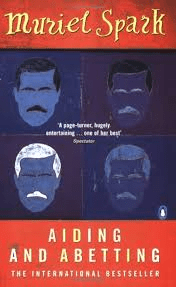
Aiding and Abetting, by Muriel Spark, 2000
Aiding and Abetting was Muriel Spark’s penultimate novel. It is a retelling of the notorious case of ‘Lucky’ Lucan, a British aristocrat who in the 1970’s murdered his children’s nanny, battered his wife almost to death (she having been his original target) and then went on the run, never to face justice. He is the recurring subject of tabloid stories, being ‘discovered’ living in the Australian outback or South Africa every few years.
Spark tells this story through the unusual lens of Dr Hildegard Wolf, a fake-psychiatrist ‘practising’ in Paris, who is consulted by two men, both of whom claim to be Lucan. They have discovered that she, like them, has a secret – in a previous incarnation she was Beate Pappenheim, a ‘fake stigmatic’ – someone who claimed to experience the wounds Christ suffered on the cross, wounds which mysteriously heal and reappear periodically. Using this story Beate/Hildegard took charitable donations from the faithful and the gullible, and when her fraud (she used period blood to simulate her wounds) was uncovered, fled the country. assuming a new identity.
It’s never clear whether the Lucan claimants are intending to blackmail Wolf – they need the money, their supporters who have kept them secure from the law for decades finally beginning to run out – or whether they enjoy the experience of being able to tell their story free from any risk of exposure. Wolf quickly works out that the men are working together, one being the real Lucan and the other a decoy, helping collect donations of support while leading the police and others astray. But this is all largely a framework within to tell or retell the notorious story of Lucan’s murder of Sandra Rivett, the Lucans’ nanny, and attempted murder of his wife. Lucan sees this as a Shakespearean tragedy instigated by his wife’s legal battle for custody of their children (they were divorcing), made worse by his constant gambling losses. He is the victim in his version of the story. The protection he is offered by friends in escaping justice is his god-given right.
When reading Aiding and Abetting I was left with the impression that it was poorly written, with a lot of repetition and sub-plots that peter out. Poorly written by Spark’s standards that is – she is normally a very intelligent writer with intricate plots, well developed characters and deft control of her material, none of which could be found here. I went back to the text several times to try and find evidence for this impression, but came up empty-handed. Perhaps I was looking for something that wasn’t there? As a reader you have to both trust and challenge your instincts – trust them as first impressions, but nevertheless check them just in case they are prejudices bobbing to the surface. Always give the author the benefit of the doubt (OK- not always; there are some authors who just don’t deserve the benefit of the doubt. E L James comes to mind, as do Jeffrey Archer and Dan Brown. But that’s just about it). If you are left with an impression, try and work out why. Well, for a start in Aiding and Abetting Spark doesn’t really have anything new or interesting to say about the Lucan case. She uses it as the structure for her story, but ends up leaning against it lazily. Spark claimed the novel’s theme was ‘blood’ and while there is plenty of blood in the novel, multiple references don’t add up to a theme. None of the novel’s characters are engaging – some are pretty forgettable – and the story doesn’t do justice to the real victim, the children’s nanny, who remains a largely one-dimensional and voiceless figure. (As part of my background reading for this review I was pleased to note that more recently, in 2019, Jill Dawson wrote The Language of Birds which tells the events of the Lucan murder from the point of view of the victim). If I felt ambivalent about the novel, the appallingly predictable and unfunny ending, a tribute of sorts to Evelyn Waugh but with none of the wit and about seventy years too late, left me in no doubt that this was a bit of a dud.
I really hesitate to suggest that Spark, in her early 80’s when this was written, was running out of steam, but I can’t find any other reason why an author usually so careful in her construction and characterisation would not live up to those standards. Perhaps I should read her final novel, The Finishing School, to see if that hypothesis stands up?

