
Jack Maggs, by Peter Carey, 1997
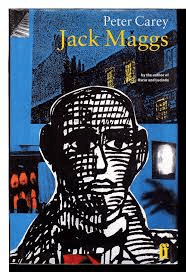
I can’t tell you precisely how long Peter Carey’s Jack Maggs has sat on my bookshelves waiting to be read, but it is a long time – I was seriously considering abandoning any intent of reading it and regifting it to the charity shop from whence it came. I am so glad that I did not and instead on a whim started this original and entertaining novel.
When I first started it I wasn’t aware that Jacks Maggs was based on Dickens’ Great Expectations and was feeling rather smug when I identified the character Tobias Oates as being a portrait of the young Dickens. Oates is 24 and has had one successful novel published (Captain Crumley, a version of the Pickwick Papers). Oates is married but is already getting bored with his wife and is having a passionate affair with his eighteen-year old sister-in-law. There are close parallels with Dickens’ life here and he doesn’t come out of the novel well at all. Dickens did eventually separate from his wife after she had borne his many children and his relationships with his sisters-in-law don’t stand up to too much scrutiny. This speculative portrait of the early years of his marriage suggest that his affections for his wife were waning even at this stage.
The novel opens with the titular character returning from a life-sentence of transportation to Australia. Whilst imprisoned as a convict his life in Australia was brutally hard, but eventually he was freed and went on to earn a comfortable living and a place in respectable society by becoming a brickmaker. He uses some of this money to trace his young son, abandoned back in England, and provide him with a good education. This of course is essentially the storyline of Great Expectations, but seen from Magwitch/Maggs’s point of view. On returning to England to find his son, leaving a young family back in Australia, Maggs risks the death penalty which faced all those who left Australia after a life sentence. He finds his son’s house empty – he has fled to his club after being forewarned of his father’s intention to come calling – and takes a job as a footman in the household of Mr Percy Buckle, the next door neighbour. His predecessor in the role has recently died by suicide and one of the novel’s mysteries and sub-plots is the background to this death. Maggs is a brutal man, vividly realised by the author, and quite unsuited to the subservient role of footman. In this role he encounters Oates, a dinner guest in the Buckle household, who is intrigued by the rough character who is attending table. Oates offers to hypnotise Maggs to help him with a painful tic that has developed in his face, a result of his being brutally whipped. Oates real intention is to discover Maggs’ backstory, which he quickly does, much to Maggs’s anger when he finds out his identity has been revealed. Maggs only agrees to be hypnotised if Oates will tell him how to find a notorious thief-taker who he believes will help him track down his son.
The novel slightly stalls at this point. The Great Expectations storyline has been left some way behind, and the characters and events repeat themselves while waiting for the deadline by which Oates has agreed to reveal the identity of the thief taker to come around. Maggs discovers his identity has been revealed, and reacts with anger, effectively taking Buckle’s household and Oates along with it hostage. Maggs doesn’t follow a plan or behave in any way strategically – he just uses cunning and the threat of violence to get his way. A trip to Gloucester to find the thief-taker is a wild-goose-chase which doesn’t seem to serve any particular purpose in the narrative (unless it was following a story-line in GE that I have managed to forget!) and puts off the climax in which all the characters come together in a dangerous and potentially violent end to the novel. Dickens was always careful to give his villains an ending that Victorian civic society would approve of, however charismatic they might be, but Carey is less anxious to comply with Victorian morality and (spoiler alert) allows Maggs a happy ending that for much of the novel appears deeply unlikely. Oates on the other hand suffers a painful loss that runs parallel with a similar loss in Dickens’ life, showing that not all immoral behaviour escapes judgment, even if the judgment is delivered on a young woman rather than Dickens/Oates himself.
I thought it would be an interesting to compare this novel with a more recent reimagining of Dickens, Barbara Kingsolver’s Demon Copperhead. Google’s AI tells me that the latter novel is the more radical reinterpretation of the two, set as it is in the Appalachians in modern times, and focussing on the opoid epidemic. But it was also in other ways a traditional and fairly close retelling of the Dickens novel, albeit updated, whereas I thought Carey’s novel, while retaining the original setting, was a more imaginative narrative. It uses the Dickens text as a jumping off point but also blends the events of Great Expectations with episodes from Dickens’ life itself. It also uses what I think of as the ‘Rosencrantz and Guildenstern’ technique of showing the events of the novel from an entirely new perspective, revealing depths to the original that were previously unexplored. I think on balance I found the Carey text the more impressive of the two (compared that is with the Kingsolver novel, not the Dickens!) although in terms of critical and popular reaction Demon Copperhead has been far more successful. It is interesting that two very well established authors chose to turn to Dickens for inspiration (of course there are many others doing the same thing) rather than crafting entirely new narratives.

