Book review

Men at Arms (Discworld 15) by Sir Terry Pratchett, 1993

It is incredibly hard to choose a favourite Discworld novel. It’s like choosing a favourite ice-cream (what, only one?!). But if forced to choose it might well be Men at Arms. I have a suspicion I have said the same thing about previous novels in the Discworld series, but I am too lazy to go back and check, and it wouldn’t invalidate the choice in any event.
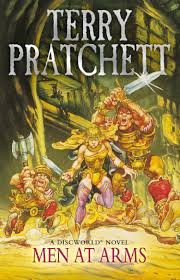
Men at Arms

Men at Arms opens with Edward D’Eath, an assassin becoming convinced that the restoration of the monarchy will cure Ankh-Morpork of its various problems, and restore his family to their rightful place in its heirarchy. He discovers after a suspiciously brief and cursory amount of research that Corporal Carrot Ironfoundersson, recent recruit to the City Watch, is the rightful heir to the AM throne. He charts a course for the restoration of the monarchy by plotting to make the Patriarch deeply unpopular, assuming that the populace will want the intervention of a fairy-tale king to right all the wrongs.

You might reasonably expect this plot line to be central to the novel, but it dwindles away rather quickly, or rather fades into the background, and only comes back when ends need tidying away. I think this is because Pratchett’s real interest is in the men and women of the Watch. Sam Vimes is preparing for his marriage to Sybil and his subsequent retirement from police work, while at the same time dealing with the new recruits to the Watch: Cuddy (dwarf), Detritus (troll), and Angua (female, and we soon discover, also a werewolf). Several murders follow swiftly on the back of D’Eath’s discovery of Carrot’s ancestry, and a standard police procedural begins to unfold, albeit in the bizarre and dangerous setting of Ankh-Morpork. Vimes eventually works out from a trail of clues that D‘Eath has stolen a gun (‘gonne’), Discworld’s first firearm, from the Assassins’ Guild. This being Discworld, this is no ordinary gun – it seems to have a personality all of its own. The investigation’s conclusion is revealed with a flair that suggests Pratchett could have made a lively writing detective novels had he ever tired of Discworld.

So while Vimes and Sybil are eventually married, Vimes’ reluctant plans to retire are foiled as he is appointed Commander of the Watch, to all intents and purposes his old job with a new rank. The temporary changes to the Watch that Vimes and Carrot have improvised during the course of the investigation are made permanent, and by the end of the novel it is on the path to becoming the formidable force that keeps the peace in the world’s most anarchic city.

The debate about the best segment of Discworld novels and the best place to start will always crop up whenever Pratchett fans convene, and of course it doesn’t have a right answer, but if you haven’t read Pratchett before and are worried that the novels might be a little childish (they are, but in the best possible way) then Men at Arms might be the key to a lifetime of wonderful novels.
Standard
Book review

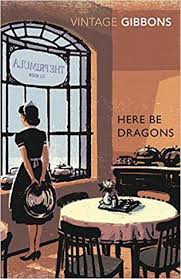
Here be Dragons, by Stella Gibbons,1956

Long-term readers of this blog, if there is such a thing, will know of my futile quest to find a novel by Stella Gibbons that contains a scintilla of the wit and wisdom of Cold Comfort Farm. I keep buying the lovely Vintage reprints, knowing that it’s not going to happen, but each time hoping to be wrong.Here be dragos

But I’m not. This novel, like all the rest, shows glimpses of promise but would probably not have been printed without the huge affection everyone feels for CCF.

This is standard-fare Gibbons. A sensible, down-to-earth heroine in her late teens or early twenties, in the Flora Poste mould, comes into contact with a group of rather louche bohemians, who are gently poked fun at, with a lot less if any of the suppressed anger and contempt that characterises “Conference at Cold Comfort Farm”.

(‘Has Benedict a beard?’

‘Not so far,’ said Nell cautiously, ‘but they do tend to grow them suddenly, you know.’)

Our heroine, Nell Sely, is uprooted from her comfortable family life when her father, a Church of England vicar, loses his faith. The family moves to a flat in Hampstead provided free of charge by her generous but unappreciated aunt, a nascent radio personality. Said aunt gets her a job as a typist but Nell gives it all up for her remarkably modest dream, a waitress job at The Primula tea rooms. At the same time she falls inexplicably for her cousin John, a scruffy and mildly comic figure who thinks of himself as an artist, but is (depending on how you react to men of this ilk) a privileged, patronising fool or a charming free-spirit. After a lot of tea being drunk and minor incidents to keep the pages turning, the novel fizzles out inconclusively. Nell gets her teashop but not her man, John being called up for National Service after rather pathetically trying to avoid it by hiding from the police (who were sent out to enforce call-ups) in a little old lady’s cottage next door to the family apartment.

This is gentle observational comedy where the interest level never really ticks above medium. We don’t really care what happens to these people – they aren’t engaging or interesting enough. Although Gibbons evokes the grimness and griminess of 1950’s London wonderfully, the plot is paper thin, little happens, and an attempt to inject a little drama as the novel wanders to an ending falls flat. The humour can at times be diverting, even though this world seems very alien from the other side of the millennium, where the worst thing that can happen is for someone to lose their faith or be called up into the Army and where sex is only hinted at as something that only bad girls do.

I won’t stop reading Gibbons, but I will continue to do so with a sense of melancholy that each novel isn’t Cold Comfort Farm, and a sense of delight that at least Cold Comfort is!


Standard
Book review

How to be Right by James O’Brien, 2019

James O’Brien is that rarity, a progressive talk radio host. While most of his fellow talkshow hosts seem to actively encourage people to spill their prejudices, O’Brien confronts them. His technique and reasons for doing so are the heart of this book – it’s not really a handbook for being right (I think the structure of the title is self-consciously copying Caitlin Moran’s ‘How to be a Woman‘ and similar works) more a series of essays about current affairs and controversial issues, illustrated by extensive extracts from O’Brien’s many conversations with right-wing callers.

As you would expect, Brexit is front and centre of the book, together with the closely related issue of immigration to the UK. O’Brien cleverly unpicks the prejudices of his callers, exposing their logical fallacies, lack of understanding of the issues, and his command of the facts. Whether he is ever bested in argument – it is what he does for a living after all, and has plenty of time to choose and prepare his field of battle – we don’t learn, I doubt it.

How to be Right is both the Waterstones and WH Smith’s non-fiction book of the month for June (2019), and not surprisingly is selling very well. How to explain the popularity of this book? The sub-title provides a clue – How to be Right – in a World gone Wrong. There is unquestionably an appetite for answers to the question of why the world feels to many people as if it is going wrong, and specifically as if years of progress in which civil and human rights have been taken forward have all of a sudden started to go backwards. We see this most vividly in the USA where women’s productive rights are under open attack, although best not to forget that one of the allegedly moderate candidates in the campaign for the leadership of the Conservative Party underway right now is in favour of more than halving the period within which abortions can be performed.

So the world feels as if it has gone wrong, and people are hungry for answers as to why, and what can be done about it. Which is where O’Brien’s book falls short. Because while it is excellent at pointing out, often using their own words, the weaknesses in the arguments of racists, homophobes and Brexiteers, O’Brien hasn’t any constructive alternative, other than not being racist, homophobic, and staying in the EU. I am aware I am being very unfair here. First, there’s nothing whatsoever wrong with arguing that the best reaction to racism is not being racist, and so on. Although I suspect that few people listening to his programme or reading his book will have said “you know what, I am being a bit of an idiot, James is right, and I will renounce my former unpleasant and regressive attitudes”. It would be nice if they did of course. The other reason for considering this argument as unfair is that O’Brien makes no claims about his ability to articulate a vision for a better world. His book is simply a handbook for winning arguments with idiots, not a manifesto.

O’Brien has done his homework. He has taken time to read all the relevant background issues and understand the difference (for example) between the Council of Ministers and the European Parliament. He knows his stuff, and is able to deploy lots of facts and figures to win his case. Would I have enjoyed this book a fraction as much if O’Brien had been a persuasive, charming, well-informed conservative? I doubt it, which means I am still stuck in the progressive Remain echo-chamber. But at least I am better informed than I was before I learned how to be right.

This is an entertaining and straightforward read. O’Brien seems a nice bloke, and he is on the side of the angels. If you want to see how he does it, recommended.

Standard