Book review

All books are themselves the product of earlier books, however original they may be. I’m not suggesting that all books are copies of earlier works, but they all have dna, texts which have influenced them and without which they couldn’t exist. Some reveal their origins more obviously than others. Unruly makes very little attempt to disguise its sources and influences, which are a fairly straightforward combination of Horrible Histories and the ladybird books that gave you one king per page, with an illustration summarising the one thing you needed to remember about him or her. Add in a little 1066 and All That and a lot of swearing (and I will come back to the swearing), and there you have it.
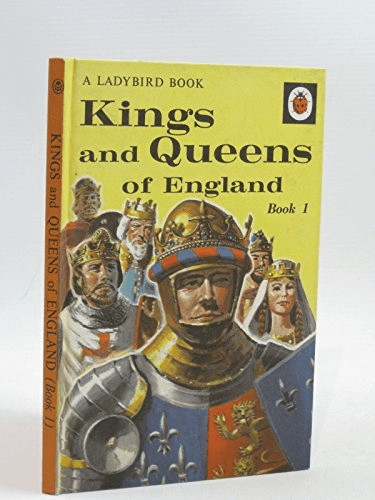
Which as always begs the inevitable question – why? What made David Mitchell think that writing a book about the queens of England from Anglo-Saxon days to the end of the Tudor period, a pretty long span of history in anyone’s books, was a good idea? Certainly there is a very well established tradition of celebrities writing books. And Mitchell studied history at Cambridge, albeit quite a while ago. My hunch is that this is a lockdown book, something the author filled his hours with when going out or recording game shows wasn’t an option.

There’s not much original research here – none in fact – and anyone with a reasonable grasp of English royal history won’t learn a great deal. A canter through six hundred years of royal history was always going to be somewhat superficial. Even if Mitchell’s reasons for writing the book can be surmised, that in itself doesn’t explain why anyone should read it. There are a few reasons, although whether these justify the whole exercise I am not so sure.

Firstly, there’s the swearing. For someone who has developed a whole comedic persona around being posh, here Mitchell swears freely and extensively. For example, writing about King Stephen and Queen Matilda, he says: “They were both twats. They may not have been able to help being twats – the mores and values of their times and of their class may have made them twats. But they were twats and terrible things happened as a result.” (This is a more family-friendly example). The comedy here derives from the repetition of the word twat rather than its shock value – just in case you hadn’t spotted that. Despite his best efforts not much comedy is wrung from the humour of King Cnut’s name sounding a little like a spelling mistake. But it lightens the tone and makes it clear that Mitchell isn’t taking the exercise all that seriously.

The main interest and where the text really comes alive is in Mitchell’s observations about the nature of monarchy. He argues compellingly that monarchs aren’t in any way special people:

“Ultimately the reverence shown to monarchs is a mockery, a joke. It’s pretending they’re something they are not. This is a bitter and clear reduction of kingship to its essentials: an office accepted only because an unjust hierarchy is preferable to anarchy. Out of the gangsterism of the lawless post-Roman land of Britannia, a few local bigshots emerged, their power gradually coalescing into kingship.” (396).

That’s the book’s thesis in a nutshell – once the Romans left Britain there was a period of lawlessness, local thugs took control of small areas, slowly killed one another and grew in power and influence until the concept of ‘king’ was invented. That power was then cemented with “ceremonial and religious elements giving kingship an aura of legitimacy and sanctity. But it was just made up. At some point someone with a sociopathic dislocation from the truth had to start asserting it, like the first conspiracy theorist who said that 5G masts spread Covid”. All of this is rather brilliantly summarised in the book’s final chapter, Bookends. This final chapter also contains a rather remarkable few paragraphs about Shakespeare. Mitchell writes with passion about Shakespeare’s brilliance, and concludes “He’s where this book has been heading, it turns out…Shakespeare is a good reason to stop writing about kings, because his brilliance makes them seem silly.” I wish he had come to that realisation a few hundred pages earlier and turned his intelligence and learning towards a subject that obviously interests him far more than kings and queens, and one on which has some valuable insights.

The book ends by making it clear that although the exercise could be repeated for the Stuarts, Hanoverians etc, it won’t be. The excuse offered is that kingship had by the end of Elizabeth’s reign become less important and therefore less interesting (tell that to Cromwell). I’m not buying it for an instant. I hope Mitchell’s next book is about a subject he obviously has a real passion for and which according to this book he shares with his wife – if she were to help him out with it all the better!
Unruly, a History of England’s Kings and Queens, by David Mitchell, 2023

Aside
Book review

Orwell, A Man of our Time, by Richard Bradford, 2020

I can’t remember ever having so passionately agreed with the central premise of a book before – yet also found myself profoundly disagreeing with many of the conclusions the author draws. I know that might sound like a slightly artificial opinion adopted to make a good opening line to a blog post, but I mean it. (I’d rather be honest than interesting, although ideally I’d like to be both of course!).

Bradford’s thesis is summed up in the book’s subtitle – Orwell is a Man of Our Time. In other words his work has an immediate relevance to the 2020’s – to the era of Trump, Brexit, social media and the ever intrusive state. And that’s utterly unarguable – of course he does. Orwell has in many ways shaped the way we see the world. That’s why the media manages to find a dozen things a day ‘Orwellian’, from facial recognition software to social media cancel culture. So here’s the first problem – this thesis has already been written. In 2002 Christopher Hitchens wrote Why Orwell Matters adopting the same format as Bradford, or rather anticipating it, demonstrating vividly Orwell’s continuing relevance. Although Bradford has written in more detail than Hitchens, and obviously included more recent material, fundamentally the point has already been made, far more convincingly. (If you prefer there is a short YouTube video of a speech Hitchens made that covers his key points. I disagree with much of what he says – he argues that Orwell died of poverty, which is simply nonsense, and he has nothing to say about Orwell’s defining characteristic, his Englishness, but he is entertaining and persuasive).

There’s a second equally obvious problem with the biographical structure that Bradford adopts. He goes through Orwell’s life in the manner of a traditional biography and gives equal space to his childhood and early novels compared to for example his final great works. If you are trying to trace the origins of (say) Animal Farm in Orwell’s time at the village store in Wallington, fair enough, but that immediately begins to stray from the declared intention of the book, to demonstrate Orwell’s continuing relevance. I would argue (as Orwell himself does, in Why I Write) that his work really only begins to be distinctively in his voice after the Spanish Civil War. Almost everything before that is of minor interest only (I would exclude the Down a Mine section of Wigan Pier). Putting it another way, if that sniper’s bullet that bisected his throat in 1937 had been centimetres to the left or right, we would never have heard the term “Orwellian”. The biographical structure of this book therefore means that we spend a long time waiting for the main event, the major two novels and the classic political essays of the 1940’s, and that some earlier parts of the text feel like ‘filler’.

(Just a quick aside on the term Orwellian. It seems to me it is used in three distinct ways nowadays. Increasingly the first application has come to predominate – to describe totalitarian behaviour by the state or the agents of the state, particularly through the use of technology. Facebook’s algorithms are Orwellian, automatic number plate recognition is Orwellian, etc. The second use is in the ironic commentary on official language, referencing the slogans of Oceania – appointing a Minister for Brexit Benefits was quintessentially Orwellian. Finally, and this is more rare nowadays, is the use of the term to describe writing in Orwell’s distinctive style – as he famously put it in the essay just referenced, “Good prose is like a windowpane”. )

Bradford often strays from his original concept. Instead of demonstrating Orwell’s relevance to contemporary events, (‘our time’) he instead finds parallels between incidents in Orwell’s life and things that happened later. Oswald Mosley is compared to Nigel Farage, for example, a perfectly fair comparison but nothing to do with Orwell. Conditions in mines in the 1930’s were hard, as recorded in The Road to Wigan Pier, but in the 1980’s miners in the UK went on strike to save their jobs – again hard to argue with, although the two things are barely connected with one another let alone Orwell. Where Bradford’s argument nears breaking point is in his apparently preposterous claim that Orwell’s ‘foresaw Brexit‘. That might seem ridiculous given that the EU didn’t exist before Orwell died in 1950, but surprisingly Bradford does a good job of defending this point. Orwell thought a lot about what the world would look like after the end of the second world war and in a world dominated by nuclear weapons. He lived just long enough to see the beginning of the end of Empire and new post-war political and military structures emerge, one of which was likely to be a form of united Europe. IN the event such a body was created, Britain’s role in it would be uncertain. It is not much of a leap to imagine Orwell’s understanding of colonialism, imperialism and nationalism all coming together to predict Brexit. In England Your England (1941) for example, Orwell wrote about “the famous ‘insularity’ and ‘xenophobia’ of the English, and in 1947 recorded anti-Polish sentiment very similar to the prejudices that drove Brexit. Orwell also foresaw that it would be in America’s commercial interests to weaken a centralised United States of Europe.

Unfortunately, for every worthwhile observation there are far too many misses, irrelevancies or demonstrations of the author’s own prejudices. The television cook Hugh Fearnley Whittingstall is bizarrely attacked for no apparent reason than he went to Eton. Anti-Semitism within the Labour Party is bafflingly compared to the two-minute hate in 1984. Jacques Derrida’s syntax is attacked as overly complex, and claimed to be an example of something Orwellian, I am not quite sure what given that Newspeak was defined by its lack of complexity. The book’s analysis ends with a scattergun critique of Boris Johnson, Trump, Jeremy Corbyn’s Labour, political correctness, wokeism, cancel culture in universities, deconstructionism, and last but not least Islam.

There are some errors in this text, or at least things that I found debateable, although I make no pretence of authority on the issue. First, Bradford says that Orwell spent a year at Wellington college before going on to Eton (page 17) – Taylor’s far more authoritative work says he was there for just nine weeks (page 60). In his discussion on homelessness as presented in Orwell’s work Bradford appears to believe that anyone using the ‘tuppenny hangovers’ (the cheapest place to sleep, resting over a rope) were at risk from arrest under the Vagrancy Act because they were outside, which is simply incorrect. He later describes Orwell’s voice as indicating “irredeemable boredom and monotony” without acknowledging that no recordings of Orwell’s voice can be found. To give one final example Bradford criticises China’s one-child policy, citing it as an unexplained example of the state attempting to control the private lives of the citizenry (and being therefore Orwellian) without giving a moment’s thought to the famine in China less than a decade earlier which lead to the deaths by starvation of millions of people (https://en.wikipedia.org/wiki/Great_Chinese_Famine).

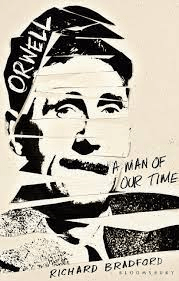
This might be a bit clumsy, but I found this edition’s front cover strangely apposite. It is illustrated (see above) with a print of Orwell’s head and shoulders, cut into segments then partially reassembled, leaving his face crooked and askew. In a way that is what Bradford has done with Orwell’s life work – he has broken them down into different constituent parts and then poorly reassembled them.

Orwell, A Man of Our Time, by Richard Bradford, 2020

Aside