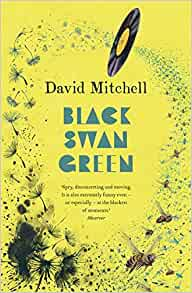
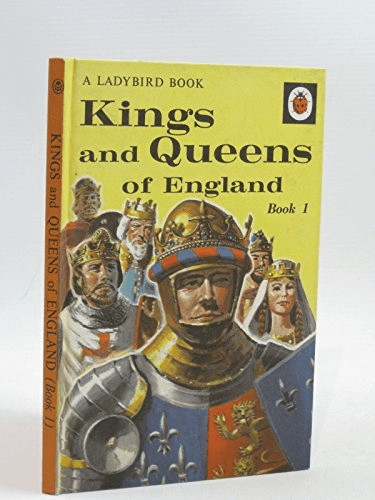
All books are themselves the product of earlier books, however original they may be. I’m not suggesting that all books are copies of earlier works, but they all have dna, texts which have influenced them and without which they couldn’t exist. Some reveal their origins more obviously than others. Unruly makes very little attempt to disguise its sources and influences, which are a fairly straightforward combination of Horrible Histories and the ladybird books that gave you one king per page, with an illustration summarising the one thing you needed to remember about him or her. Add in a little 1066 and All That and a lot of swearing (and I will come back to the swearing), and there you have it.
Which as always begs the inevitable question – why? What made David Mitchell think that writing a book about the queens of England from Anglo-Saxon days to the end of the Tudor period, a pretty long span of history in anyone’s books, was a good idea? Certainly there is a very well established tradition of celebrities writing books. And Mitchell studied history at Cambridge, albeit quite a while ago. My hunch is that this is a lockdown book, something the author filled his hours with when going out or recording game shows wasn’t an option.
There’s not much original research here – none in fact – and anyone with a reasonable grasp of English royal history won’t learn a great deal. A canter through six hundred years of royal history was always going to be somewhat superficial. Even if Mitchell’s reasons for writing the book can be surmised, that in itself doesn’t explain why anyone should read it. There are a few reasons, although whether these justify the whole exercise I am not so sure.
Firstly, there’s the swearing. For someone who has developed a whole comedic persona around being posh, here Mitchell swears freely and extensively. For example, writing about King Stephen and Queen Matilda, he says: “They were both twats. They may not have been able to help being twats – the mores and values of their times and of their class may have made them twats. But they were twats and terrible things happened as a result.” (This is a more family-friendly example). The comedy here derives from the repetition of the word twat rather than its shock value – just in case you hadn’t spotted that. Despite his best efforts not much comedy is wrung from the humour of King Cnut’s name sounding a little like a spelling mistake. But it lightens the tone and makes it clear that Mitchell isn’t taking the exercise all that seriously.
The main interest and where the text really comes alive is in Mitchell’s observations about the nature of monarchy. He argues compellingly that monarchs aren’t in any way special people:
“Ultimately the reverence shown to monarchs is a mockery, a joke. It’s pretending they’re something they are not. This is a bitter and clear reduction of kingship to its essentials: an office accepted only because an unjust hierarchy is preferable to anarchy. Out of the gangsterism of the lawless post-Roman land of Britannia, a few local bigshots emerged, their power gradually coalescing into kingship.” (396).
That’s the book’s thesis in a nutshell – once the Romans left Britain there was a period of lawlessness, local thugs took control of small areas, slowly killed one another and grew in power and influence until the concept of ‘king’ was invented. That power was then cemented with “ceremonial and religious elements giving kingship an aura of legitimacy and sanctity. But it was just made up. At some point someone with a sociopathic dislocation from the truth had to start asserting it, like the first conspiracy theorist who said that 5G masts spread Covid”. All of this is rather brilliantly summarised in the book’s final chapter, Bookends. This final chapter also contains a rather remarkable few paragraphs about Shakespeare. Mitchell writes with passion about Shakespeare’s brilliance, and concludes “He’s where this book has been heading, it turns out…Shakespeare is a good reason to stop writing about kings, because his brilliance makes them seem silly.” I wish he had come to that realisation a few hundred pages earlier and turned his intelligence and learning towards a subject that obviously interests him far more than kings and queens, and one on which has some valuable insights.
The book ends by making it clear that although the exercise could be repeated for the Stuarts, Hanoverians etc, it won’t be. The excuse offered is that kingship had by the end of Elizabeth’s reign become less important and therefore less interesting (tell that to Cromwell). I’m not buying it for an instant. I hope Mitchell’s next book is about a subject he obviously has a real passion for and which according to this book he shares with his wife – if she were to help him out with it all the better!