
The trouble began long before June 9, 1976, when I became aware of it, but June 9 is the day I remember. It was my twenty-sixth birthday. It was also the day I met Rufus – the day he called me to him for the first time.
Dana and Kevin have just moved into their new apartment in Los Angeles, California. Out of nowhere, Dana starts to feel dizzy and faint, and before she knows it…
“The house, the books, everything vanished. Suddenly I was outdoors kneeling on the ground beneath trees. I was in a green place. I was at the edge of a woods. Before me a was a wide tranquil river, and near the middle of that river was a child, splashing, screaming….Drowning!”
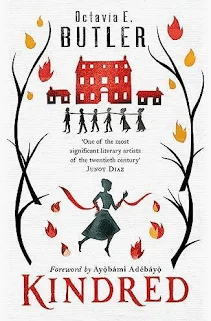
Dana has been transported to somewhere where she is needed, where she can save the life of the drowning child, whose name we later find out is Rufus. But the boy’s parents are not grateful – far from it, they seem to think Dana is responsible for his accident – the father aims a shotgun at her and angrily confronts her. She fears for her life, and in that moment she is transported back to her apartment, where a puzzled Kevin tells her that only moments have passed.
At first the reader thinks they are in a simple time travel novel, where the principal character is summoned into another time and place to intervene in the life of someone with whom they have some kind of connection. Yes and no, because in a moment of dreadful realisation Dana finds out something terrible about the challenge fate has presented her with – the time she is travelling back to is the 1820’s, in the South of the United States of America, and Dana is black. The young boy whose life she is fated to save – she is summoned from the present every time his life is at risk – is the son of a slave-owner. He lives on a plantation. Worse, Dana has no control over when she is summoned nor when she is returned. She works out that she will return to her own time – where time passes at a completely different rate from that in the 1820’s, so several months can pass in the past but only hours in the present – when her own life is threatened. She cannot choose when to return, and putting her own life deliberately at risk seems far too dangerous.
The only positive side to this appalling situation is that, unlike the form of time travel in the Time Traveller’s Wife (for example) she is able to take objects with her into the past, anything she happens to be touching at the time she is summoned, including her partner Kevin. She quickly assembles a small bag of useful items, including a knife and some painkillers, knowing she could be whisked back to the nineteenth century at any time. I would have been tempted to take a gun, preferably a rifle, but I am probably taking the time travel conventions a little too literally! On her subsequent journey to the 1820’s Kevin goes or is taken with her, and after she saves the young man’s life once again, the plantation owner assumes Dana is Kevin’s slave. Dana, recognising names from the family tree in her bible, quickly works out that Rufus is one of her distant relatives, and that she needs to keep him alive long enough for him to father one of her ancestors. But Rufus is white, and she is not, horrifyingly suggesting that the ancestor she is waiting to arrive is the product of an abusive relationship between slave-owner and enslaved.
Novels that attempt to portray the horrors of slavery are faced with an immediate challenge – how to convey the many terrible things that happened – the brutality of every day life, the appalling treatment of the enslaved, the families torn apart by slave-owners simply for monetary gain – without looking away or in any way softening the edges of the realities of the form of chattel slavery of this period, but at the same time not making the novel impossible to read, capturing the reality of what living through this period must really have been like. To take someone from the 1970’s and transplant them into this environment is a brilliant way of making the reader imagine what being in this time must have been like – these are no longer long-dead people who it is easy to think of as statistics, but real, living family members and friends.
Butler takes one step further than just presenting afresh the trauma of slavery, by asking the question – how does one accommodate oneself to living in that situation, living as an enslaved person? Dana is trapped in the nineteenth century for long periods, too far away from the Northern states where slavery was no longer practised or widespread (slavery in the Northern states of the USA ended gradually over several decades; Vermont banned slavery in 1777 and Massachusetts in 1783; other Northern states passed gradual emancipation laws that freed existing slaves slowly, meaning complete freedom for all enslaved people in the North took until the early-to-mid 1800s – and even then ‘runaways’ were subject to the punitive conditions of the Fugitive Slaves Act). Dana is forced to come to terms with the conditions and compromises of her enslavement. Her partner Kevin is trapped in this time period for several years when she is returned to the twentieth century unexpectedly and this experience changes him as well (Dana perceives) even though he commits himself to helping runaway and escaped slaves.
Quite early on Rufus learns of Dana’s origins – he can hardly find a natural explanation for her appearing out of thin air every time his life is at risk – and has to accept the undeniable supernatural element of her existence. Dana slowly comes to an understanding with Rufus – he depends on her to save his life, therefore he must treat her with respect and care for her, protecting her from the unstable temper of his father. But time and again Rufus’s contempt for black people resurfaces – he never gets out of the habit of using the n-word for example, even though he knows he needs Dana to save his regularly threatened life (Rufus is very accident-prone!).
Kindred has an incredibly strong narrative structure. The reader (or this one at least) cares for and wants to find out what happens to Dana, Kevin and even Rufus. I understand why the author included a prologue which effectively spoils the ending of the novel for the reader – we know some important details about the outcome of the novel through this short opening chapter – but personally I don’t think it added anything and removed much of the suspense from the novel’s ending and I would have not used it had I been the author. But even though this is a very strong story, that’s not the primary reason for this being such a ‘must read’ – that derives from its unblinking portrait of the horrors of American chattel slavery.

 The Reading Bug