
Essays by George Orwell
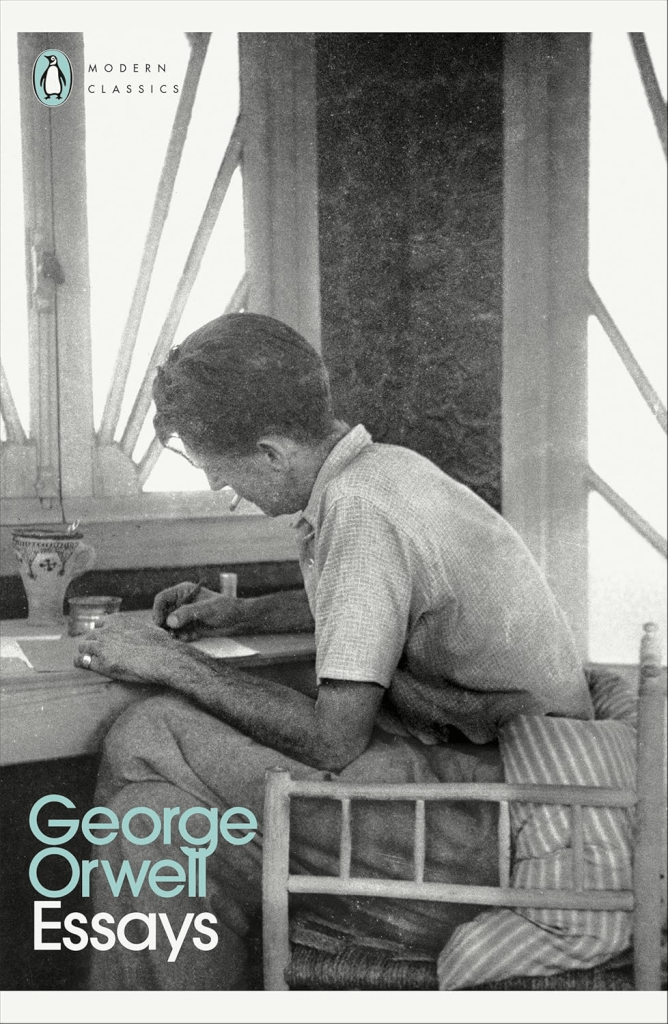
My deep dive into Orwell continues with the Penguin Modern Classics collection of his essays, edited by Bernard Crick, one of Orwell’s earlier biographers.
In the extremely unlikely event that someone asked me to edit a collection of the great man’s essays, the first task I would set myself would be to understand what is an essay? Which of the many articles Orwell wrote would qualify for inclusion, and which would be excluded? There is a simple textbook definition of the term ‘essay’, ‘a short piece of writing on a particular subject’ but that isn’t particularly helpful – a letter of complaint to the council would fit that bill. He published different collections during his lifetime, and since then they have been republished in multiple different formats. Some collections of Orwell’s essays have over 240 items (for example the Everyman’s Library Contemporary Classics edition – to get to this high a number they must have included the weekly columns that Orwell wrote for Tribune from 1943 to 1947). This Penguin Modern Classics edition has 41 essays, which tallies with the count in Orwell’s bibliography on Wikipedia.
The next thing I would do is try to decide how to group the essays? Would I present them chronologically? That would have the benefit of showing Orwell’s progression as a writer, although some of the essays were published long after they were written, such as his account of his days at his prep school, St Cyprians, Such, Such Were the Joys, which was considered so libellous that publication had to wait until the 1950’s when everyone mentioned was safely dead. I think I would instead group the essays thematically. Memoirs such as A Hanging, Shooting an Elephant, Marrakesh, Bookshop Memories and so on would form one category. Another would be literary analysis – Dickens, Kipling, Cervantes, etc. A third would be popular culture including Boy’s Weeklies and The Art of Donald McGill – and finally a politics section.
When Orwell initially wrote these essays they were published in a wide variety of magazines including: Tribune (which is still in print) where he was literary editor after he left the BBC, Horizon, a magazine edited by his old schoolfriend Cyril Connolly, the Evening Standard, for years the principal London evening paper, as well as a number of more obscure and short-lived publications, such as Polemic, which only managed eight issues and Gangrel which only ran to four, but published his seminal essay “Why I Write”. It is fairly obvious from this wide spread of magazines and papers that Orwell wasn’t enormously fussy (or couldn’t afford to be fussy) about where his work was published – although of course he would have had red lines in terms of pro-Communist and pro-fascist publications.
The reason why I have made this point at such length is that I have no idea why this collection was printed in this particular order. It’s not chronological, thematic, alphabetical, or any other structure or design that I can discern. Perhaps I am missing something but the random nature of the collection, if intentional, did not work at all. The changes in tone from whimsical to academically serious were often jarring. The editing of the text did not help either because the date of publication of each essay was only included as an endnote. The date of publication matters – something written in 1942 about what the world might look like after the end of the war lands completely differently from the same topic written in 1946. But you have to check the end of the essay to find this out, even though it is information needed up front. Crick’s introduction to the selection is also really rather strange. At times it seems that he doesn’t particularly like Orwell’s work. At one point he comes close to calling Orwell dishonest, claiming “One can tell lies or spin stories in monosyllables and simple sentences.” and later “Orwell himself seemed to believe that it is more difficult to lie in monosyllables than in polysyllables, but like many people he confused meaning with truth”. This is leading up to his suggestion that A Hanging and Shooting an Elephant are stories rather than essays, and therefore do not belong in this collection. Which begs the simple question, if Crick did not think these are essays, why include them?
Which is all a pity, because the essays themselves are (of course) outstanding. I have some personal favourites. The Burma essays, A Hanging (1931) and Shooting an Elephant (1936), are comparatively early but exceptional, very concise masterpieces that speak to the human condition and the impact of imperialism. In many ways they would be more impressive if they were entirely fictional. The Art of Donald McGill introduced me to the idea that popular culture (in this case, comedic holiday postcards) can be looked at seriously and tell us something about society. His essay Boys’ Weeklies had the same impact (criminally, this edition does not include the response to Orwell’s theory that the author of the Greyfriars stories must be a collective identity, which explained why the stories themselves were so heavily stylised; Frank Richards’ reply to Orwell can be found here, and it is a serious oversight that it was not included in this collection.) Orwell the man always shines through in his work but never more so when he is writing about the simple but very English pleasures of life such as what makes a great pub, how to make a cup of tea (neither of which are included in this collection) or his thoughts on the common toad. And of course Orwell’s political insight and perspective are a guide to both the politics of the period but more importantly provide us with tools to navigate our own troubled times.
This isn’t a book to be read from beginning to end straight through (although you could) but rather it is to be dipped into and referred back to as occasion demands.
 The Reading Bug