
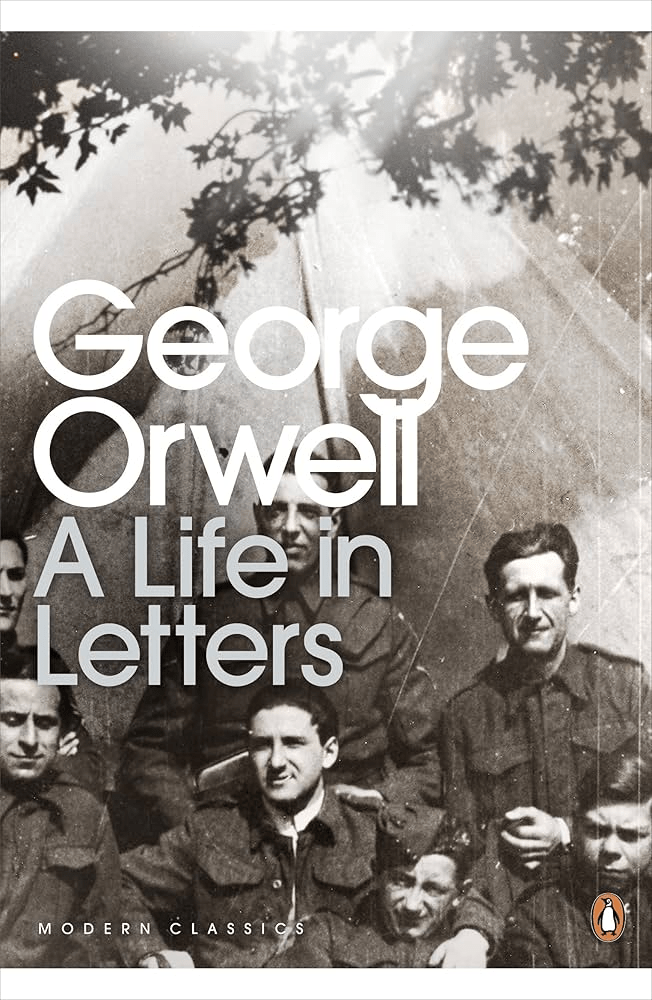
George Orwell, A Life in Letters, edited by Peter Davison, 2010
A Life in Letters is a fascinating collection that took me an inordinately long time to read, simply because of the multiple ‘side quests’ it sent me on. A great example of this is Orwell’s exchange with Anne Popham (pages 293, 307 & 321). Anne was Orwell’s downstairs neighbour in Canonbury Square, and one of the many young women that Orwell propositioned after his wife’s death. (“I wonder if you were angry or surprised when I sort of made advances to you that night before you went away“) According to Anne there was nothing ‘sort of’ about it. In an interview in the Guardian on her 100th birthday she recalled the incident as follows:
“In his flat there was a table, the baby, and its nurse. We had strong Indian tea, with brown bread and treacle. After tea, he told the nurse to take the baby away, and then he said, ‘Come and sit on the bed’. So I went and sat on the bed in the corner, and he came and sat beside me.” She laughs in disbelief at the memory. “In no time at all, his arms were round me, and he was kissing me. I was shocked. I said, ‘What are you up to ?’ and I pushed him away. Later on, I decided this must be how Old Etonians got on with girls, as if no one could resist them. He said, ‘I’m sorry’ and asked about my work, and I said, ‘I’m governing Germany’.”
Anne had an extraordinary life (the interview in the Guardian linked above is a good start) of which the encounter with Orwell played a minor part, but it does tell us a lot about his state of mind following the death of his wife the previous year. It is in this exchange (Orwell’s letter 18th April 1946) in which he makes the claim that “What I am really asking you is whether you would like to be the widow of a literary man?” One can never be completely certain of the extent to which this is being said seriously or is simply a ‘line’, but I am reasonably sure that Orwell himself would not have been able to answer that honestly either – he knew his health was poor and he was looking for a mother for Richard, his adopted son, but at the same time he was making plans for the future and did not have a terminal diagnosis. As a sexually frustrated bachelor in his early forties he would hardly be the first man to chance his arm with a young women with a tragic sob story, on the basis that sooner or later he might be lucky. It is in this same letter that Orwell claims that he did not suffer from jealousy: “I don’t much care who sleeps with whom. It seems to me what matters is being faithful in an emotional and intellectual sense. I was sometimes unfaithful to Eileen and I also treated her very badly, and I think she treated me badly too at times.”
This collection would make a superb companion text to any biography of Orwell. It can be read on its own of course, but combining it with a biography would work really well, with Orwell’s own words accompanying narrative about the events of his life. It would reveal his tendency to downplay things in a very British stiff-upper-lip way, such as his health problems, his distress at the death of his wife (“I don’t know whether you will have heard from anyone else the very bad news. Eileen is dead” opens a letter to Lydia Jackson, one of Eileen’s close friends, dated 1 April 1945, Eileen having died two days earlier. This isn’t Orwell being uncaring or brutal, it is him trying to cope with his grief and carry on doing the right thing.) and his pride in the success of his later books.
Another thing that shines out of the pages of this collection is Orwell’s entirely unsentimental love of the countryside. Very few personal letters go by without lines on the progress of his garden, how many pounds of potatoes have been harvested, how many eggs the hens have laid, and so on. This was more than a hobby, it was a part of his life and he clearly found the loss of gardening when he was laid up in various hospitals and sanitoriums (or away in Spain or Morocco) highly frustrating. It does make me think that the short period he was on Jura, enjoying living off the land, was one of the happiest of his life, even though it was tinged with sadness as he was having to make this home without Eileen, who seemed to have shared his dream of escape to the Hebrides.
Over half of the letters in this collection date from 1945 or later, that is to say the last five full years of his life (he died in January 1950). In part this must be a reflection of the fact that by 1945 Orwell was increasingly well known, so recipients of his letters were much more likely to have kept them. He may have also kept copies himself, certainly of business letters. I don’t have access to the 20-volume Complete Orwell that Davison edited, so I can’t be sure, but this edition doesn’t contain any letters from Orwell’s five years in Burma, which suggests either that he didn’t send any, which is profoundly unlikely, that none of the letters from that time have been found, (quite possible) or that none of them have anything particularly interesting to say. Whatever the reason it does mean that this aspect of his life is unrecorded in this collection, which is a gap. If I am being pedantic I would also say that this collection contained just a few too many letters from Orwell to his literary agent arranging details of publication, distribution, translation and so on – this aspect of his life as an author could have been illustrated just as clearly with fewer examples. But the scholarship of this collection is formidable, with detailed and clear footnotes to every letter, an extensive set of biographical notes of the main recipients of Orwell’s letters, every typo that was Orwell’s not the editor’s marked clearly and of course a detailed index. Even though I have read all the biographies of Orwell I still learnt a lot about his life and work from this collection. Just to offer one example, I previously thought of Jura as a remote and wild place, which it was, but assumed it was madness to decamp there with Orwell’s health so precarious and it being so hard to reach. But he only summered there, spending winters in the Canonbury Square flat in London that he retained the tenancy of (often letting others stay there) and the island had a mild climate. It also seems they ate better there than on the still rationed mainland, with access to fish, lobsters and crabs from the sea, rabbits and venison from the land, eggs and meat from the chickens they kept, and vegetables from the garden. It was also easier to keep warm on Jura compared to London, because there was plenty of natural fuel – peat and wood – available, compared to the capital where everything was scarce and rationed. It does seem rather idyllic and it is not surprising they had so many visitors, at one stage having to set up a tent in the garden to accommodate the overflow.
Davison enriches this collection enormously by interspersing letters from Orwell with those from others such as his childhood sweetheart Jacintha Buddicom. Most revealing are those from Eileen to her friend Norah. These letters are full of impish humour and provocation and were the basis of the 2023 book Wifedom. The author of Wifedom took everything Eileen says in these letters as gospel, when it is plain as anything that she is invariably joking, usually by way of comic exaggeration. Letters between Eileen and Orwell are few and far between. Obviously that is because husband and wife tend not need to write to another. Eileen’s last unsent letter to her husband (29/3/45) is heartbreakingly sad. She was a much more interesting and lively correspondent than Orwell, and the fact that her letters are often interrupted and written over several days, if not longer (instead of throwing away a mislaid draft she would resume writing with an apology for the delay) adds to their charm. The exercise of compiling a complete edition of Orwell’s letters is one that may never end – very recently more letters were discovered by relatives of his correspondents. Last year Darcy Moore, a great Orwell scholar, discovered another lost letter from 1942. I doubt it will be the last.
Sadly the editor of this collection, Peter Davison, who was also the editor of the twenty volume complete Orwell, died in 2022 – I do hope that the Orwell Society or his literary agents appoint someone to continue Davison’s work. The Society has introduced a Peter Davison award for Orwell scholarship, which I suppose goes some way towards this aim. While mentioning the Orwell Society I should also recommend this excellent review of the Collected Letters on their site.
The final year of Orwell’s life was spent a sanatorium and then a hospital where he seemed to have received little by way of actual medical treatment, spending the time just resting, surrounded by growing piles of books. Resting for Orwell still meant undertaking a lot of correspondence, as well as a little journalism and book reviewing. He obviously knew he was very seriously ill but at the same time held out hope for a recovery that might give him a few more years. He had lots of visitors, many of them members literary aristocracy and was clearly much loved – many people expressed concern for his health and the need to ‘do something’ to save him. Forty-six is a ridiculously early age to die, especially for a writer who in Animal Farm and 1984 had fully discovered their own voice. These two novels alone have sold over forty-one million copies. This achievement is not the end of the story. Earlier this month I was watching the television show Countdown. Someone used the word “unperson” without reference to Orwell even though he coined the word in 1984. This to me just emphasises (albeit in a very minor, incidental way), the extent to which Orwell’s thoughts and ideas have permeated Western culture and language; they are just now part of the way we think rather than something that needs to be referenced or explained. Sales of 1984 spike every time world events seem particularly Orwellian such as when Trump’s press spokesperson coined the phrase ‘alternative facts‘. That more than anything else was his contribution.
 The Reading Bug