How Far Can You Go? by David Lodge, 1980
“It is just after eight o’clock in the morning of a dark February day, in this year of grace nineteen hundred and fifty-two. An atmospheric depression has combined with the coal smoke from a million chimneys to cast a pall over London. A cold drizzle is falling on he narrow nondescript streets north of Soho, south of the Euston Road. Inside the church of Our Lady and St Judge, a greystone, neo-gothic edifice squeezed between a bank and a furniture warehouse, it might still be night.“
How Far Can You Go? charts the lives of a group of English Catholic students from the early 1950’s to the late 1970’s, a period of dramatic change in the UK and within the church. The novel is organised chronologically into themed chapters that track the group’s lives within the context of the social and theological changes of the period with a particular focus on the evolution of Catholic teaching. The novel opens by introducing the group of students as they gather at a cold and dark Catholic church for an early-morning mass prior to lectures at University College London. All the students have been taught and believe the church’s teachings on sin, guilt, and sexual abstinence. Compliance with the teachings of the church is compared to a twisted board game (hence the illustration on the novel’s front cover):
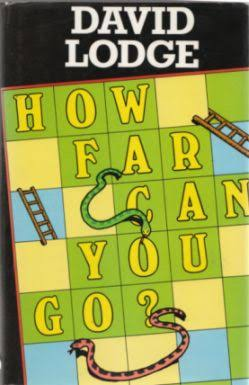
The name of the game was Salvation, the object to get to heaven and avoid Hell. It was like Snakes and Ladders: sin sent you plummeting down towards the Pit; the sacraments, good deeds, acts of self-mortification, enabled you to climb back towards the light.” The author is the unnamed eleventh character in the novel, regularly intruding into the narrative by breaking the fourth wall.
‘How They Lost Their Virginities’ is the (self-explanatory) next section of the novel which details how the awkward, guilt-ridden students transition from youthful chastity into their early sexual experiences and marriages. Or most of them do – one character becomes a nun, with the inevitable vow of chastity that involves, and another is a closeted gay man who is scared of sex, worrying that it will damn his soul. Most of the other students wait until marriage before having sex, largely due to the same fear of damnation. In some cases they wait for several years, with the stress and anxieties this inevitably brings.
‘How Things Began To Change’ takes the novel into the 1960s. The characters marry, have children, and begin a long struggle with the strict Church ban on ‘artificial’ contraception. Hopes for a relaxation of the church’s teachings on this issue are dashed in ‘How They Lost The Fear Of Hell’ with the publication of the papal encyclical Humanae vitae (HV) in 1968, which reaffirmed the ban. The young people, now not so young, have increasingly large families, and the burden of near constant pregnancy or abstinence puts pressure on their compliance with the church’s teachings. Around them society grows more permissive and some of them abandon ‘natural’ contraception for methods that actually work, feeling liberated when doing so.
From here, the fairly linear story begins to fragment as the characters’ lives go their different ways, each of them finding their place in the world and ways to reconcile their faith with their day-to-day lives. Some get divorced, have affairs, suffer mental breakdowns, or experiment with charismatic, personalised versions of faith. One couple, Dennis and Angela, have a child with Down’s Syndrome. The references to the child being a ‘Mongol’ are a shocking remind of how, until quite recently, people with Down’s were commonly referred to. The birth of a child with Down’s Syndrome is presented as a curse from God and this is followed shortly by the death of their daughter, Anne, when she is run down in the road by a car. Here the author once again breaks the fourth wall:
“I have avoided a direct presentation of this incident because frankly I find it too painful to contemplate. Of course, Dennis and Angela and Anne are fictional characters, they cannot bleed or weep, but they stand here for all the real people to whom such disasters happen with no apparent reason or justice. One does not kill off characters lightly, I assure you, even ones like Anne, evoked solely for that purpose”.
This intrusion of the author into the narrative might have seemed very modern or even post-Modern in 1980, but it has not aged well. It is largely redundant (we know Dennis and Angela and Anne are fictional characters, but have chosen to temporarily engage with them as ‘real’ characters as part of the experience of reading the novel) and intrusive, reminding the reader that this is just a novel and that we have no real reason to care about the characters – other than as avatars for anyone we know who has ever suffered. Lodge anticipates this response: “People who find religious belief absurd are often upset if a novelist breaks the illusion of reality he has created”. No, I was not upset, just mildly irritated at the unnecessary intrusion of another, no less illusory character, the author.
The novel ends with a transcript of the documentary filmed at a progressive Catholic retreat organised by some of the characters. The film causes a minor scandal, showing as it does people pushing at the boundaries of the church’s teaching on how religious observance is to be conducted (that is, seriously, without celebration, music or fun).
Underpinning the narrative is a liberal assumption that the course of the church’s teaching is fixed and inevitable, and in particular that sooner or later the rules about contraception will be relaxed. This is presented as something that is simply unavoidable, a matter of time, and I am sure that is how it must have felt in the 1960’s and ’70’s. Lodge’s characters would I think have been shocked to find out that in 2026 the Catholic Church still maintains that artificial contraception is an ‘intrinsic evil’ – it is “always morally wrong and can never be justified by any good intention or difficult situation”. There was nothing inevitable about the liberalisation of Catholic teaching, however it must have seemed half a century ago. Which, unless you are a dogmatic, committed Catholic, makes How Far Can You Go? rather sad. “Thus far and no further” is the answer none of Lodge’s characters, nor I suspect Lodge himself, would have expected.
Why am I (still) reading David Lodge? He was an important figure in the British literary scene in the 1980’s and was nominated and shortlisted twice for the Booker Prize in that decade. I think his standing has diminished significantly since then and his work is commonly perceived as outdated. Which I think is right, but I find it hard to resist a first edition hardback in a second-hand bookshop for just a couple of pounds, so here we are.