Book review

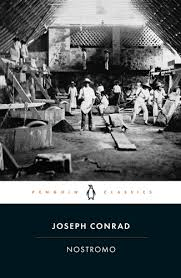
Nostromo, A Tale of the Seaboard, by Joseph Conrad, 1904

I came perilously close to abandoning Nostromo and it was only sheer bloody-mindedness that kept me going. This was a result of a combination of Conrad’s prose style and his poorly defined characters. I found the prose wooden and the characters spent far too much time pontificating about abstract concepts:

“Action is consolatory. It is the enemy of thought and the friend of flattering illusions. Only in the conduct of our action can we find the sense of mastery over the Fates”

or

“There is no peace and no rest in the development of material interests. They have their law, and their justice. But it is founded on expediency, and is inhuman; it is without rectitude, without the continuity and the force that can be found only in a moral principle.”

The novel’s cast of characters is wide, but many of them were often hard to differentiate from one another, especially given the frustrating practice of giving them multiple, interchangeable names (so for instance, the central character, Nostromo, is also known as Giovanni Battista Fidanza or Capataz de Cargadores). Conrad also adopts a narrative structure which eschews traditional chronology and tells some of the story in retrospect, some in the present. None of these techniques are objectively wrong or even particularly challenging, but Conrad’s execution of them is leaden. Although the novel is only 450 or so pages long it took me several weeks to read. You know you are struggling when you start to count the number of pages to go, and 20 pages read was a good day. To what extent this is my failure as a reader and Conrad’s as an author I cannot be sure.

The first two hundred pages (almost half the novel) are a meandering build-up to the point in the story at which the action properly begins, revolving around the struggle over ownership and control of a silver mine in the fictional South American country of Costaguana. Costaguana is an archetypal South America banana republic, with a long history of political instability. Charles Gould owns Costaguana’s primary natural asset, a silver mine, near the port of Sulaco. Revolutionary force invade Sulaco with the aim of capturing the mine. Nostromo, the head longshoreman of the port, escapes with the mine’s recently retrieved cargo of silver. Nostromo, an Italian expatriate, is a leading figure in Sulaco, with influence among the wealthy Europeans who control much of the city, but also widespread support from the working people of the town. Accompanied by a journalist, Martin Decoud, Nostromo smuggles the silver out of Sulaco, but is only able to make it as far as a small island at the head of the harbour, where he and Decoud hide the silver. The revolutionaries and the resident townspeople all believe the silver has been lost at sea and after Nostromo swims back to shore he does nothing to make them think otherwise. He avoids capture by the revolutionaries and rides out to seek help from the Government forces.

A jump forward in time shows the reader that Nostromo’s intervention has led to the creation of the independent state of Sulaco, which is now prospering. He has kept the location of the silver a secret. His partner, Decoud, left stranded on the island with only the silver for company, eventually lost his mind and drowned himself weighed down with some of the silver ingots. Over time Nostromo slowly grows rich, ostensibly because of his successful trading, but mainly because he collects the silver a little at a time so as to not arouse suspicion. But wealth does not bring happiness. Several years pass, and the independent Government decides to construct a lighthouse on Great Isabel. Nostromo fears this will lead to the remaining silver being discovered, but there is little he can do other than keep a close eye on the construction. He recommends an old friend, the widower Giorgio Viola, as the lighthouse keeper. The novel concludes dramatically with the resolution of these plot lines, but I won’t give away the ending.

I have read that Nostromo was originally conceived as a short-story, but over time the novel expanded in scale and scope. This could have had something to do with the publication in instalments of course, but also explains its rambling unfocussed structure. Conrad apparently found writing it almost as difficult as I found reading it, saying “it is like a kind of tomb which is also hell where one must write, write, write.” Nostromo was not very popular or successful when it was first published, with many finding the plotting byzantine and over-elaborate. Online you can find many people praising the novel as the best ever written, but this is surely hyperbole. When I did eventually finish it was with more of a sense of relief than anything else.

Nostromo, A Tale of the Seaboard, by Joseph Conrad, 1904

Aside
Book review

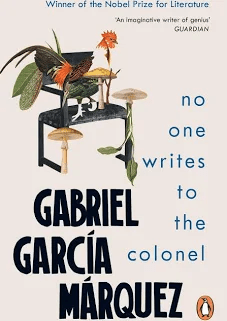
No-one writes to the Colonel, by Gabriel Garcia Marquez, 1958

No One Writes to the Colonel is a long short story or short novella, coming in at under 70 pages. Famously Marquez said that he had to write One Hundred Years of Solitude so that people would read No One Writes to the Colonel. Which is really a throwing down of the gauntlet, challenging any reader who admires his longer form work to love this short story.

An unnamed retired Colonel, a veteran of earlier Colombian wars, lives in poverty with his wife and his rooster. The rooster has been bred to fight on cock-fights, and could potentially be worth a lot of money, either in prize money or sold on to other trainers. The rooster previously belonged to the colonel and his wife’s son, who has been killed in the political violence gripping the country.

For fifteen years the Colonel been waiting for the Government pension he was promised (or perhaps more accurately he believes he was promised, because his lawyer seems to be very unsure of his eligibility). Every week he meets the mailboat and each week he is sent home empty handed, because no-one writes to the Colonel. His wife has asthma, making their daily lives all the more difficult and miserable. The story opens with the colonel preparing to go to the funeral of a town musician. The reader is told that this death is significant because he was the first to die from natural causes in many years. Initially it is unclear why natural causes deaths should be so unusual, but it soon becomes apparent that most other deaths have been as a result of political violence. Their small village is under martial law – there is a nightly curfew at 11, and the funeral procession is forbidden from passing in front of the police station.

The centre of the story is dominated by the decision as to whether or not to sell their prize rooster. Potentially it could be very lucrative once the cock-fighting season starts in the new year, but they have to find a way to get through the winter first and without jobs or the long-awaited pension, they fear they may starve before that happens. So they are forced to consider selling the rooster for well below its actual value just to survive. There is also the complication that the rooster itself eats a lot of corn, taking food out of their mouths. The Colonel’s wife sometimes has to boil stones to try to convince their neighbours that they have something to eat. So this is not a community where the old and hungry feel able to ask for help from others – whether or not that help would be offered.

Despite the eternal non-appearance of his pension, the Colonel still lives in hope, hope that one day a letter will arrive, one day his rooster will win. The story ends on a defiant upbeat note. Having decided to keep the rooster until the cock-fighting season starts, he is berated by his wife who asks

“And meanwhile what do we eat?”.

“It had taken the Colonel seventy-five years – the seventy-five years of his life, minute by minute – to reach this moment. He felt pure, explicit, invincible at the moment when he replied:

‘Shit.'”

No-one writes to the Colonel, by Gabriel Garcia Marquez, 1958

Aside
Book review

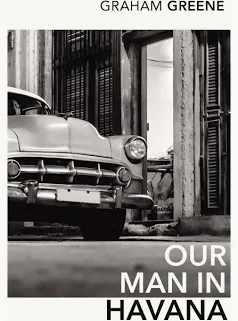
Our Man in Havana by Graham Greene, 1958

The central plot point of Graham Greene’s 1958 novel Our Man in Havana involves an unlikely spy, James Wormold, a middle-aged English vacuum salesman, making up details of secret military installations he claims are being built in the mountains outside Havana. Absurdly he sends his handlers in London detailed drawings of the rocket base using the schematics of the vacuum cleaners he sell, presciently named the Atomic Pile Suction Cleaner. What is strange is that I knew this detail before I opened the book, and it was one of the very few things I know about Greene’s work. But I found it frustrating that I can’t for the life of me remember how I knew that fact! There is a wider point here about how novels work their way into the cultural subconscious (so that, for example, Kate Bush could write a song about Wuthering Heights without ever having read the novel). I suspect the main reason this detail stuck in my head for so long (however it got there) is because of the way the novel strangely anticipated the 1962 Cuban Missile Crisis which brought the world to the brink of nuclear war.

The novel draws its humour from the gullibility of MI6. The central character, Wormold, is a vacuum cleaner salesman, selling only one company’s product (he seems to have only two different models of vacuum available). It shouldn’t matter, I know, but the idea of an Englishman selling vacuums in 1950’s Cuba just struck me as profoundly improbable. Who is buying these things? Greene himself had worked for British Intelligence during the war, and came to realise how easy it was for spies to file fictitious reports – who could check them for accuracy? This idea seems to have originated with the notorious case of Garbo, a Spanish double agent who pretended to have up to 27 agents working for him all over England, and who came to play an important role in misleading the Germans about the location of the 1944 landings. Greene wrote a first draft of the story in 1946 but it was the outbreak of the Cold War that gave the novel a new, more absurd, dimension.

The novel opens with our rather pathetic anti-hero struggling to keep his head above water, financially, mainly due to the demands of his spoilt teenage daughter. His wife has long since left him, leaving him to bring up his strictly Catholic daughter on his own. When he is clumsily approached by Hawthorne, an English spymaster, he becomes a spy himself almost accidentally. His initial doubts about the job are quickly overcome when he realises that this could be a lucrative profession if he recruits enough fictitious agents and claims enough expenses. His masterstroke comes when he concocts the idea of a secret mountain missile base using drawing of vacuum cleaner parts. Although British Intelligence is presented in this novel as incompetent and overly-trusting, it is very hard to see how else they could have dealt with the situation Wormold presents them with. They take his reports seriously – to do otherwise would have been reckless – and insist on him providing proof, suggesting different ways he can do so. They also send other agents out to Cuba to help him. That all seems fairly reasonable to me. Of course their main mistake is there inability to notice drawings of a vacuum clear when presented with them.

Up to the point at which Wormold starts his campaign of deception, the novel has been lightly comic, with Wormold being an accident-prone loser who is making things up as he goes along. He seems destined to be exposed as a fantasist at any point. But he reveals an inner strength when his improvised plans start to fall apart. Back in London, nobody knows he sells vacuum cleaners and has no reason to suspect his worrying reports. A secretary, Beatrice, and a radio assistant are sent out to join him and scale up his operation. As his lies become more outrageous Beatrice comes to suspect his elaborate fictions. She asks to speak to one of his agents, a pilot named Raúl. When a real-life pilot named Raul is killed in a ‘car accident’, but which is almost certainly an assassination, Wormold begins to panic. It is almost as if his lies are becoming reality and he sets out to save his fictional contacts, exposing himself to real danger while doing so. The reader is able to infer that his reports to London have been intercepted and decoded and his ‘operation’ is now under attack. Things get real very quickly and in the novel’s climax Wormold only narrowly escapes an attack on his own life.

An accidental spy who finds himself in the thick of an adventure, surviving encounters with assassins through dumb luck, sounds like a summary of a James Bond parody such as Johnny English or Austin Powers. Our Man in Havana was published only a few months after Dr No, the sixth in the James Bond series which started with Casino Royale in 1953 and seems to have been influenced by many of the tropes Fleming uses. I think it is best seen in this light – as a response to the portrayal of English spies as suave, sophisticated and almost unstoppable. But both Bond and Wormold get the girl in the end, and both beat the bad guys when it matters. Wormold discovers a surprising inner core when he and his family are threatened.

As I have mentioned several times before, I am not a massive fan of trigger/content warnings, but it comes as a shock when Greene uses the n-word in the novel’s opening sentence. The word is used casually by a character rather than the narrator and emphasises his background (he is a refugee from Germany). Other than the general contempt that British people casually treat all ‘foreigners’ in books from this period, the racism shown here does not reappear regularly, so if you can get past this instance you should be able to stick with the rest of the book. This is not Greene’s most sophisticated or complex novel and it is hard to warm to the principal characters, especially Wormold, but it has moments of light comedic touch, and is an interesting portrait of pre-revolutionary Cuba. Never has vacuum sales been more interesting.

Our Man in Havana by Graham Greene, 1958

Aside
Book review

I’ve read some obscure books over the last few years, but N F Simpson’s A Resounding Tinkle, is up there! The play is a striking example of English Absurdism. This was always a bit of a niche genre and reading ART you can see why.

The Theatre of the Absurd was a relatively short-lived genre widely thought to have been inspired by Albert Camus’s description of the human condition as absurd and devoid of purpose. Firmly rooted in the post-war period as humanity recovered from the horrors of the Holocaust, absurdism was expressed on stage by plays devoid of the structures of traditional theatre. There is little dramatic conventional action – the characters find things to do, but they are invariably pointless. These plays have little that could be described as a plot. Language breaks down, is disjointed, and revolves around repetition, misunderstandings and a focus on trivialities. Through this fractured dialogue, broken by occasional bursts of eloquence, the characters express their psychological distress. The plays also often use comedic routines and traditions from vaudeville, and music hall.

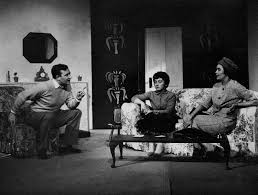
I think it would be fair to argue that there is no grand absurdist tradition in English drama – the genre quickly evolved more complex forms and moved away from its origins. Which is why A Resounding Tinkle is an important text, albeit a very obscure one – it perfectly encapsulates these absurdist conventions. There is not even the semblance of a plot. Characters repeatedly break the fourth wall addressing the audience directly. At the end of the play a group of critics sit around discussing the performance they have just seen, anticipating the audience’s bemused reaction, followed by closing comments by ‘the author’. Two characters, Mr and Mrs Paradock, discuss the elephant they have been given as part of an annual celebration of some kind, and in the end exchange it with their neighbours for a very small snake in a pencil box. This scene would not have been out of place in a Monty Python sketch – and it could be argued that the absurdist genre in English theatre was quickly redirected into comedy having itself been influenced by the loosely structured surrealism of shows such as The Goons.

Perhaps not surprisingly, A Resounding Tinkle is rarely performed today. It is very much of its time, and I can imagine on stage it would appear dated. But the absurdist tradition has never really gone away, and lines such as “You remind me of a cormorant with a beak a yard long tapping out a manifesto to the cosmos on a second-hand typewriter” are reminiscent of the work of Vic Reeves and Bob Mortimer. Perhaps a revival is overdue?

A Resounding Tinkle (play) by N F Simpson, 1957

Aside
Book review

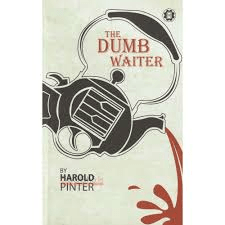
The Dumb Waiter, by Harold Pinter, 1957/1960

I think I am going to try and read, and review, more plays this year, even though I remain steadfast in my view that plays are for watching not reading. Sure you can read them, but in doing so you could easily miss much of the nuance and subtlety of a play that would be brought out in performance.

Just to explain the dates above, the internet tells me that The Dumb Waiter was written in 1957 but not performed until 1960. Either way that makes it one of Pinter’s earliest works. It is a short one-act play in which two men, Ben and Gus, wait in a basement. Ben, apparently the senior member of the two, reads a newspaper, while Gus fusses around nervously. Tea is mentioned but never quite made. As their conversation progresses it emerges that they are hit-men, waiting for an assignment and instructions on who to kill. Their conversation is dominated by mundane, everyday nonsense such as the difference between the phrase ‘light the kettle’ and ‘put on the kettle’. There is almost a vaudeville, back and forth element to their conversation, but at the same time there is a sinister undertone.

Pinter’s stage directions are very detailed and one of the reasons for this emerges when the men realise that at the back of the room is a dumbwaiter, a small lift for carrying food between floors. The waiter starts to deliver a series of food orders, as if to a restaurant kitchen – at first for plain café food – soup of the day, liver and onions, jam tart – and then for more complex orders – macaroni pastistsio, ormitha macaroundada, and scampi. Ben and Gus are dumbfounded by this turn of events, but are so used to doing what they are told that they send up what food they have – milk, biscuits, crisps and chocolate – in a pathetic attempt to comply. . In production I can imagine that this part of the play would be essentially comic, but on the page the tragic element also comes across – they are unable to understand what is happening to them, but still try to do their best. Next to the dumb waiter is a speaking tube which they try to use to communicate with whoever is sending down the orders, but to no avail.

In a break from the dumb waiter’s interruptions, the men start to rehearse the impending assassination, which complies with a strict sequences of events. In doing so they casually but shockingly reveal that their last ‘job’ was to kill a girl.

The impact of Beckett’s Waiting for Godot on this early work by Pinter is immediately obvious – two anonymous characters waiting in a remote location for something to happen, passing time with inane chat that reveals their concerns about their purpose in life. There is no conventional narrative or storyline (although in Pinter’s play there is a dramatic denouement) and absurd and unexplained events challenge the characters’ ideas. Long periods of silence allow space for the claustrophobic tension of the setting to develop. The Dumb Waiter is often produced alongside another of his one-act plays, but I can’t help wonder whether a contrasting text – something by Joe Orton for example – might work as effectively? If you want to read more British post-war plays then The Dumb Waiter is an excellent starting point. Pinter was a key figure in post-war British drama and went on to be awarded the Nobel Prize for literature in 2005, being cited for work that “”uncovers the precipice under everyday prattle and forces entry into oppression’s closed rooms”.

The Dumb Waiter, by Harold Pinter, 1957/1960

Aside
Book review

While doing some background reading for my review of Graham Swift’s short story collection, Learning to Swim, it occurred to me (and I accept this might be a banal statement of the obvious) that the short story form of writing is by far the most neglected when compared to others such as the novel, poetry, and drama.

It will come as no surprise that the Wikipedia entry for ‘short story’ defines the form primarily by its length, saying that it “can typically be read in a single sitting”. Can you imagine defining any other form of writing in this way? (of course I know sonnets have 14 lines and haiku have 17 syllables, but these are very specific forms within the much wider genre of ‘poetry’.) In terms of content, the entry goes on to say that a short story usually “focuses on a self-contained incident or series of linked incidents, with the intent of evoking a single effect or mood. The short story is one of the oldest types of literature and has existed in the form of legends, mythic tales, folk tales, fairy tales, tall tales, fables, and anecdotes in various ancient communities around the world.” This definition is flawed in several respects – Norse sagas were very long compared to other forms of prose, for example – but is probably as good a definition as we are going to get.

Are short stories neglected? Staying with statements of the obvious, the form doesn’t have a special word or term to describe it. Novels, poetry and plays are not ‘long stories’, ‘short stories that often rhyme’, and ‘stories told on stage by actors’. Well, they are, but the point is we have special words for them, whereas with short stories, that’s it. With the possible exception of Katherine Mansfield and Alice Munro there are very few writers who are best known for their short stories. By comparison I guess most people could name half a dozen novelists, poets and playwrights. Few writers specialise in the short story format. Many will have at one point or another written a short story, but there are few for whom it is their preferred format. And yet perversely the short story is probably the most common form of creative writing. The cliché that we all have a novel in us may or may not be true, but if creative writing groups are anything to go by we all have a couple of dozen short stories in us as well!

So why is this? When short stories are the form we are most familiar with from childhood, when many of the greatest stories ever told are short, why is this form of writing considered ‘less’ in so many ways? Is the issue one of length, that longer is better? Certainly with plays and poems that is not the case – Ode to a Nightingale is a better poem that Endymion (a 4000 line epic poem also by Keats and if you have not heard of it that makes my point); Daffodils is better than The Prelude. While plays have a ‘Cinderella’ length – too short and the audience can feel cheated, too long and we get bored and restless, novels can be too long – I would certainly put the nine volumes of Samuel Richardson’s Clarissa into that category. So no, longer is not better, and we therefore need to look elsewhere for an explanation for the neglect of this form of story-telling.

It’s possible that short stories are read more often than we think, simply that they are not read in book or collected form. Many short stories are published in magazines and will not feature in any charts or tables of book sales. The role of agents, editors and critics in pressuring writers to move away from the short story format and into novels may play a part in the marginalisation of this format. Lots of authors start out with short stories, finding it easier to have them published in magazines than getting a novel published, subsequently moving on to writing novels and abandoning the short story format.

All literary forms have periods of supremacy. In Shakespeare’s day poetry was consumed by the upper classes and plays were watched by the unwashed. The novel started its long march to ascendancy in the Eighteenth century, and became dominant when Dickens was publishing his works a chapter at a time (there might be a case for arguing that these were all short stories linked by a common set of characters and themes, and certainly the Pickwick Papers would fit that characterisation, but that can’t really be sustained as Dickens’s preferred form of publication was the exception rather than the rule). There was some speculation that the decreasing attention span brought about by social media and the advent of doom-scrolling might see a revival in popularity (and status) of the short story, but this hasn’t materialised. Perhaps short stories of a few thousand words are just too long for the tik-tok generation?

Short Stories – a neglected form of writing?

Aside
Book review

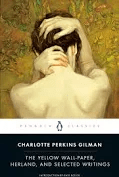
The Yellow Wallpaper and other selected writings by Charlotte Perkins Gilman

Even though you could read The Yellow Wallpaper in not much more time than it takes to drink a cup of coffee, it is widely perceived as both the author’s most significant work and a classic of its genre. The Penguin Classics edition of this story, published with Herland and other selected writings, has The Yellow Wallpaper as the lead text in its title.

The story is written as a collection of journal entries narrated by an unnamed woman whose physician husband has rented a mansion for the summer, to provide her with somewhere to recuperate. He forbids the narrator from working or writing and encourages her to rest. She is suffering from what he calls a “temporary nervous depression – a slight hysterical tendency”, a vague but common diagnosis in women at the time. As the journal entries continue the narrator slowly becomes obsessed with the yellow wallpaper in her room, convinced that it moves and that something is hiding behind it.

An important part of the context of the women’s physical and mental decline is that she has just given birth. We know little about her pregnancy other than it appears to have been the cause of her decline. Although she believes she is treated with care and consideration, the reader can infer that there is more to her confinement. She describes her room with its torn wallpaper, barred windows, metal rings in the walls, a floor “scratched and gouged and splintered”, a bed bolted to the floor – this is a cell in all but name. It will occur to most readers to wonder whether her husband has used his status and authority as a doctor to have her legally sectioned? I haven’t researched this issue thoroughly but it does appear as if women could be declared mentally ill and a danger to themselves and others simply on the word of their husband. If he happened to be a doctor as well then the chances of anyone questioning his decision were slim to non-existent. This is an interesting article on this topic from Time magazine https://time.com/6074783/psychiatry-history-women-mental-health/

The narrator’s morbid obsession with the wallpaper in the room comes to dominate the text and her thoughts. The wallpaper has a “sickly” color, a “yellow” smell, and a pattern like “an interminable string of toadstools, budding and sprouting in endless convolutions”. It leaves yellow smears on the skin and clothing of anyone who touches it. Her mental health rapidly declining, the narrator comes to believe that a woman is trapped behind the pattern in the wallpaper. To free the trapped woman she begins to strip the remaining paper off the wall. When her husband comes home, he finds the narrator rubbing herself against the wallpaper, saying “I’ve got out at last… in spite of you.”

The story is undoubtedly inspired in part by Gilman’s personal experience. When her daughter was born she suffered from postnatal depression. A doctor, considered the leading expert on women’s mental health, prescribed bed rest and forbade her from any form of work including reading, writing, or painting. She found this treatment made her condition worsen. The Yellow Wallpaper is a straightforward autobiographical account of this treatment with the addition of a supernatural component to the story, to provide a dramatic critique of these methods of male control of women’s bodies and lives.

The Yellow Wallpaper has become an important feminist text. The narrator’s attempts to control her environment, her health, and eventually her life by her interpretation of the wallpaper that surrounds her, act as a metaphor for the domestic environment, her body, her mind, and the many other lenses through which the story can be read. At the same time a simple interpretation of the text is elusive – the author scatters hints through the text, but a straightforward key – X = Y – is never provided.

Because of the significance of The Yellow Wallpaper in the canon of feminist literature, the rest of Gilman’s writing is often overlooked, or simply seen as ‘things that might be like, or provide additional information about,’ the primary text. Which is if course both wrong and a pity. Many of the short stories published in the Penguin Classics edition, together with a number available online, are intelligent thought-provoking pieces written from a progressive, feminist perspective. When I was a Witch is a fascinating account of someone being given the power to make wishes that come true, but being unable to use this power for the general improvement of the lives of women. If I were a Man must be the earliest ‘body swap’ story, in which a young woman wishes she were a man and finds herself in her husband’s body. She is fascinated by the different physical experience, and the different, secret attitudes men have towards women – some protective and loving, others base and sexual:

“In the minds of each (man) and all there seemed to be a two-story department, quite apart from the rest of their ideas, a separate place where they kept their thoughts and feelings about women. In the upper half were the tenderest emotions, the most exquisite ideals, the sweetest memories, all lovely sentiments as to ‘home’ and ‘mother,’ all delicate admiring adjectives, a sort of sanctuary, where a veiled statue, blindly adored, shared place with beloved yet commonplace experiences. In the lower half–here that buried consciousness woke to keen distress–they kept quite another assortment of ideas. Here, even in this clean-minded husband of hers, was the memory of stories told at men’s dinners, of worse ones overheard in street or car, of base traditions, coarse epithets, gross experiences–known, though not shared.”

The Giant Wistaria and The Rocking Chair are both conventional, sub-Jamesian ghost stories. While containing traditional gothic elements they are fairly predictable, although The Giant Wistaria still manages to include a feminist portrait of an early American settler woman choosing to commit suicide instead of submitting to an enforced marriage with a cousin. Bee Wise is an early working out of some of the ideas to find expression in Herland, describing a utopian and largely female community established on strongly egalitarian grounds. His Mother and The Vintage are fascinating treatments of social evils affecting the lives of women – the white slave trade and syphilis respectively. His Mother tells the story of a woman tracking down and handing over to the police her son, who has been a key figure in a gang procuring vulnerable young women for prostitution. The Vintage describes in distressing terms the impact untreated syphilis can have down the generations. These were topics that were not widely discussed in ‘polite society’ nor written about outside the pages of medical journals. I find it hard to imagine how brave it would have been for Gilman to have published these stories with their clear and unambiguous treatment of these issues.

Gilman’s personal story is in many ways as fascinating as her writings, and this https://www.neh.gov/article/charlotte-perkins-gilman-did-more-write-one-classic-short-story is a good starting point if you are interested. I agree with the article’s conclusion – Gilman is definitely worth reading beyond The Yellow Wallpaper, although that in itself is a great starting point.

The Yellow Wallpaper and other selected writings by Charlotte Perkins Gilman,

Aside
Book review

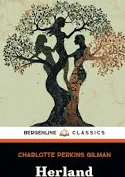
Herland by Charlotte Perkins Gilman, 1915

Herland is one of those novels that has been on the edges of my consciousness for a long time. I’ve known about it, known broadly what is is about, and always intended at some point to get round to it. Unlike a lot of people who take reading seriously I don’t have a literal ‘to be read’ list, but I do have a vague collection of tests that one day I intend to get round to. And for as long as I have been aware of it, Herland has been on that list. Published in 1915, when the Great War was well underway but America had yet to get involved, Herland begins as a traditional exploration/lost world novel: while on a journey of exploration in an unnamed continent, three American adventurers – Vandyck “Van” Jennings, Terry Nicholson and Jeff Margrave – hear of an isolated community that is peopled by women only, Eventually Van gets round to naming this community the rather reductive name of ‘Herland’ (we later hear that this community has been completely isolated for two thousand years, so how the tribes in the area would have heard of it is left unexplained). The explorers’ curiosity is piqued and they eventually return on a subsequent trip determined to track down this lost world. Authors such as Ryder Haggard or Conan Doyle would have lingered over the details of the

preparation for the trip, the extensive list of equipment needed, the hiring of guides, the journey inland and so on. Perkins Gilman has no interest in this element of the story, and within a few short paragraphs they are approaching Herland. Using a plane (that they have someone managed to bring with them), they surmount the impenetrable mountainous barriers around the country. We are not told where Herland is – the implication is that it is somewhere largely unexplored, and the surrounding countryside is populated by ‘savages’ but the ambiguity as to the country’s location is obviously intended to emphasise its universality. In any event, Van’s narration makes it clear that he has subsequently left Herland and returned to America, having committed to not reveal the location of the lost world.

Of course the arrival of a plane in a society isolated from the rest of the world for centuries is hardly likely to be unnoticed, and the explorers are quickly found by, initially by three young women who watch them from the treetops. Treating the women almost as prey, the men try to catch them, but they are easily outrun and then captured by a large group of women. They try to escape but are overpowered, drugged to stop them struggling, and taken to a nearby community.

From this point the body of the novel is comprised of the men’s captivity and education in the ways of Herland, which the author uses to outline the detail of the all-women society. Each man is assigned a tutor who teaches them their language while at the same time learning English. Van is a careful observer of all aspects of this new society, from the well-designed clothing they use to their agriculture and technology. But his real interest (and clearly, the main interest of the author) is in understanding how a women-only society has evolved and in what ways it is different from his own. In short, Herland is a feminist utopia. Everything is better. Conflict, inequality and criminality are things of the past, to the extent that the very concepts are no longer understood. Society has been finely tuned to allow all women to study and be creative. There are no masters and servants, bosses or slaves. No-one is overburdened with childcare or work. The traditional subservient roles of women in modern society have been forgotten – there is no-one to be subservient to. All of society’s practical problems have been mastered. By contrast the men’s accounts of their own world makes many of the practices of the outside world seem barbaric. Particular horror is shown at the very idea of abortion – a view which some modern critics have used to undermine Herland’s claim to be a feminist text, although surely the point is here about women’s loss of control of their fertility?

What is it about a women-only society that makes it so perfect? Or to put it another way, what is it about men that makes the outside world so damaged? The author suggests some answers to these questions but is surprisingly undidactic – the reader is left to join the dots themselves, even if the exercise isn’t that challenging. Free from the oppression of men and traditional female roles, women have evolved a near-perfect society. Women are respected and valued in this society, free from domestic servitude and male oppression. A key factor is their control over their fertility – the women can reproduce by parthenogenesis but choose to control their community’s population by having only one child each. Motherhood is a form of religion in this society, and children are cared for communally. No-one is worn out by having too many children or burdened by the cost of providing for large families. (This is surprisingly accurate – once women have control of their fertility, combined with lower infant mortality rates, birth rates drop dramatically.) But can this utopia survive the reintroduction of men? The author implies that this might be possible and that only some rather than all men are the problem. Of the three explorers, only one, Terry, finds the changes he faces in this society unbearable.

Over the course of the novel Van gradually finds out more information about the women’s society. He is told that a volcanic eruption 2000 years ago sealed off the only pass out of Herland, the only way of travelling to the outside world. The remaining men, mostly slaves, tried to take over but were killed by the women. Facing the end of their race a miracle occurs – one woman became pregnant without the intervention of a male partner, and went on to have five daughters, who in turn grew up to bear five daughters each. This women only society rapidly evolved strategies to survive their isolation and grew to prosper and flourish. Freed from the myriad the problems of society caused by women’s oppression the society find that many of the most deep-rooted problems such as criminality simply wither away and are forgotten.

Having had no contact with men for 2,000 years, the women have no experience or cultural memory of romantic love or sexual intercourse other than for the purposes of animal reproduction. They understand the mechanical process of mating, but the idea of sex for pleasure is unknown to them. This does not appear to be a society in which lesbian couples have formed – there is no mention or suggestion of this – and while it is never said so explicitly is is strongly suggested that all sexual urges have withered away. Therefore the men’s enthusiasm for marriage and sex (the author is not radical enough to suggest that one could happen without the other) is baffling to them. Although the men eventually form affectionate partnerships with three of the Herland ‘girls’, society appears to see this as an experiment in identifying any benefits from fatherhood rather than romances or expressions of love.

To be fair to the author, she doesn’t turn away from the question of sex, even though her freedom for discussing them directly was obviously limited. It would have been tempting I am sure to just have ignored the whole issue. She uses a wide range of creative euphemisms to discuss sex. Marriage is described by the women as “permanent mated love“. In an attempt to persuade the women to have sex with them, the men describe marital sex thus: “Why, to touch you, to be near you, to come closer and closer, to lose myself in you” and talk about “the sweet intense joy of married lovers“.

The women are puzzled by the concept of sex for pleasure rather than for procreation:

“Do you mean, she asked quite calmly, as if I was not holding her cool form hands in my hot and rather quivering ones “that with you, when people marry, they go on doing this in season and out of season, with no thought of children at all?”

Married love as an experiment in Herland is unsuccessful. After a short honeymoon period, Van’s wife Ellador withdraws from ‘married life’ and declines to have sex with him, explaining “If I thought it was really right and necessary I could perhaps bring myself to it, for your sake dear, but I do not want to, not at all. You would not have a mere submission, would you?”

Van and Jeff try to work these issues out with their wives, with Jeff seemingly accepting long-term celibacy as an option, but the more aggressive, impatient of the three, Terry, is uncompromising in his view of the submissive role of women in the bedroom and the rest of the relationship. When his partner Alima rejects his ‘advances’ he hides in her bedroom and “put into practice his pet conviction that a women loves to be mastered, and by sheer brute force, in all the pride and passion of is intense masculinity, he tried to master this woman“. In other words he tries to rape her. Van’s reaction is chilling: “In our country he would have been with quite within his rights of course….”[Crime]’s a pretty hard word for it. After all, Alima was his wife, you know.” Terry stands trial for his crime and is ordered to leave Herland. Van decides to accompany Terry but they are only allowed to leave Herland once they promise not to reveal its location. The novel ends abruptly at that point, with the subsequent adventures of Van, Terry and Ellador in the outside world told in the novel’s sequel With Her in Outland.

Following its publication Herland was almost completely forgotten and it was not until the re-printing of the author’s short-story, The Yellow Wallpaper in 1973, that readers began to rediscover Herland. For its time, Herland was extremely radical, daring to suggest that many of society’s problems originate with the subjugation of women, and even possibly that the problems originate with men alone. That may have been a step too far in a time when women still did not have the vote in the USA or the UK, but these were to happen very soon and formed part of significant changes to the role of women in society. There’s no reason to believe Herland contributed to these changes, but it is nonetheless one of the clearest descriptions of what a society without men might look like (even if it is told from the perspective of a male narrator rather than one of the society’s citizens). It is a treatise dressed up in novel form, where the story element of the text is minimal – very little happens once the men are captured, apart from a desultory escape attempt. But it has important things to say about the role of women in society and many of these messages remain starkly relevant today.

Herland by Charlotte Perkins Gilman, 1915

Aside
Book review

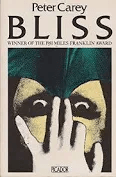
Bliss by Peter Carey, 1981

Initially I thought Bliss, Carey’s first novel, might be interesting in the way authors’ early work often is, giving an insight into the author they are going to become. Northanger Abbey for example is in some ways quite an unremarkable novel, but it does show glimpses of the writer who was going to go on and give us Pride and Prejudice. Would it still be in print if it was the only novel written by Austen? Possibly not (although comments in defence of NA are more than welcome!)

But Bliss is much more than just an early novel of an author showing promise. It is a mature, complex work – had I not know it was Carey’s first I would never have been able to tell. There are characteristics of his work in terms of complexity and also thematically, but few signs of immaturity or anything else to show this is a first novel.

All the reviews of Bliss I have been able to find on the internet agree on one thing – this is a darkly comic novel. While that’s a fair observation it is a lot more than that. The novel’s central character is Harry Joy, an Australian advertising executive. At the start of the novel, Harry suffers a near-fatal heart attack and for a few minutes he is technically dead. When revived he becomes convinced that he is still dead and is now in Hell. The world he once knew— his wife Bettina, his children, and his job in the advertising industry— now feels hellish and grotesque. He is convinced that his family and friends are devils acting as part of his torture. This delusion is aggravated when he simultaneously discovers his wife is having an affair with his business partner and his teenage children are having incestuous, exploitative sex. How can that world not be hell? Seen through this new lens Harry re-evaluates his life. He decides to walk away, seeking the ‘bliss’ of the novel’s title with Honey Barbara, a free-spirited hippie and environmentalist who lives in an off the grid community.

Bliss is a not particularly subtle satire of consumer society; at one point Harry agonises over whether to work with petroleum companies knowing their products are harmful – they eventually are revealed to have given his wife cancer. Harry only comes to life when he walks away and moves to the hippie commune. Bliss is both tragic and redemptive. Harry’s quest for spiritual rebirth brings him a form of peace but he loses his family in the process. Can genuine happiness – “bliss”— only be achieved by rejecting the trappings of modern life?

When Bliss was first published, it was hailed as a major breakthrough in Australian fiction. It won the Miles Franklin Award and was adapted into a film and even an opera. It is one of the strongest first novel’s I have read in quite some time and a clear indication of the author’s abilities, a promise fulfilled in novel’s such as the Booker Prize winning The True History of the Kelly Gang.

Bliss by Peter Carey, 1981

Aside
Book review

Coming from Behind by Howard Jacobson, 1983

One of the most tired propositions about novel writing is ‘write about what you know’. In this his first novel, Howard Jacobson, stretched that saying to its limit. Jacobson is a Jewish man from Manchester who studied English at Cambridge, followed by a teaching post in Australia, then came back to teach at Wolverhampton Polytechnic. In this 1983 novel his protagonist is Sefton Goldberg, a Jewish man from Manchester who studied English at Cambridge, taught in Australia, before coming back to teach in England at ‘Wrottesley’ Polytechnic. It is hard not to see this novel therefore as at least in part autobiographical, albeit with lots of dramatic exaggeration. The novel’s title is a fairly crude pun – it opens with a scene of Sefton having sex with a student in his office, something he seems to think is one of the perks of his job. But he is not enjoying himself – he can’t stop wondering whether he has properly locked his office door, recalling a similar incident when he taught in Australia – obviously a common occurence.

Jacobson came late to the ‘campus novel’ genre – arguably Kingsley Amis kicked this off in the 1950’s with Lucky Jim, followed by Malcolm Bradbury’s The History Man in 1975, and the same year David Lodge’s Changing Places. Academia in all these novels is not portrayed as a privileged place of learning but instead as a wholly depressing experience. These fictional universities are staffed by grumpy, largely male, amoral lecturers overwhelmed by the non-academic requirements of academia.

The novel has very little of what could be called a plot. Sefton is divorcing his wife, but she never appears. His colleagues and students are all lightly sketched, one-dimensional characters with amusing idiosyncrasies such as the professor who specialises in “all the twentieth century poets whose first or last names were Tom or Thomas”. The exception to this beige brigade is the misogynistic portrait of the teacher of creative studies, Cora Peck, defined by her unconventional outfits – blue cowboy boots, white jump suits and black leather jackets. Inevitably Sefton attempts to seduce Cora but surprisingly she rejects him. I say surprisingly because the general rule of thumb in novels written by male novelists of this era is that no matter how clumsy, awkward and unappealing the male protagonists are, they are nevertheless unaccountably irresistible to almost all female characters (see for example pretty much anything ever written by Kingsley Amis.) That rule is broadly followed by Jacobson in this novel, with Cora forming the sole exception. Cora has had a number of her works accepted by a publisher, which gives Sefton another reason to despise her.

An implausible ‘twinning’ deal with the local football club in which some of the departments are going to be moved into the football stadium is introduced as a plot development – but unfortunately it makes no sense, football clubs being notoriously short on classrooms, offices and lecture halls, and is never taken seriously even within the confines of the novel. When he is not having sex with his students Sefton spends his time applying for any and all jobs broadly connected to academia, with the sole objective of getting out of Wrottesley. A Cambridge college invites him for an interview, which provides the opportunity for a set piece college dinner scene in which Sefton feels totally out of place, and where he is inevitably propositioned by the female Director of Studies.

Coming from Behind is the broadest of comedies, more Carry on Teaching than Lucky Jim. There are a series of comic set piece scenes such as when Sefton is confronted by a group of Geography lecturers, outraged that he has parked in their section of the Polytechnic’s awful car park. Throughout Jacobson relentlessly focuses on Sefton’s Jewish identity. Everything he does is seen through this lens. It is mentioned on almost every page, with long meditations on what it means for Sefton to be a Jewish man in education, at Cambridge, making love, discussing sport, walking in the countryside, being ignorant of fishing (“Being Jewish, Sefton didn’t know much about the names or breeds or needs of fish. (p.24)) and so on ad nauseum. At times Sefton specifically resents the fact that he is not being discriminated against because of his Jewish identity! That’s obviously not to say that one’s heritage and religion is not important, but when it is the only defining characteristic of an individual, the only way of looking at and experiencing the world, it gets a bit wearing.

There are moments of bad taste in the novel and language used that was common in the 80’s but today considered offensive. This is just one more barrier to squeezing any pleasure or enjoyment out of this book. I took a quick look at Amazon to see if it is still in print – it is – and while there two reviews jumped out at me. The first was the bizarre “the wife liked it” (!!) but the other was I think on the nose in describing the novel as “spiteful and intellectually snobbish”.

Coming from Behind by Howard Jacobson, 1983

Aside