
The Yellow Wallpaper and other selected writings by Charlotte Perkins Gilman
Even though you could read The Yellow Wallpaper in not much more time than it takes to drink a cup of coffee, it is widely perceived as both the author’s most significant work and a classic of its genre. The Penguin Classics edition of this story, published with Herland and other selected writings, has The Yellow Wallpaper as the lead text in its title.
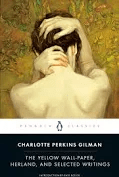
The story is written as a collection of journal entries narrated by an unnamed woman whose physician husband has rented a mansion for the summer, to provide her with somewhere to recuperate. He forbids the narrator from working or writing and encourages her to rest. She is suffering from what he calls a “temporary nervous depression – a slight hysterical tendency”, a vague but common diagnosis in women at the time. As the journal entries continue the narrator slowly becomes obsessed with the yellow wallpaper in her room, convinced that it moves and that something is hiding behind it.
An important part of the context of the women’s physical and mental decline is that she has just given birth. We know little about her pregnancy other than it appears to have been the cause of her decline. Although she believes she is treated with care and consideration, the reader can infer that there is more to her confinement. She describes her room with its torn wallpaper, barred windows, metal rings in the walls, a floor “scratched and gouged and splintered”, a bed bolted to the floor – this is a cell in all but name. It will occur to most readers to wonder whether her husband has used his status and authority as a doctor to have her legally sectioned? I haven’t researched this issue thoroughly but it does appear as if women could be declared mentally ill and a danger to themselves and others simply on the word of their husband. If he happened to be a doctor as well then the chances of anyone questioning his decision were slim to non-existent. This is an interesting article on this topic from Time magazine https://time.com/6074783/psychiatry-history-women-mental-health/
The narrator’s morbid obsession with the wallpaper in the room comes to dominate the text and her thoughts. The wallpaper has a “sickly” color, a “yellow” smell, and a pattern like “an interminable string of toadstools, budding and sprouting in endless convolutions”. It leaves yellow smears on the skin and clothing of anyone who touches it. Her mental health rapidly declining, the narrator comes to believe that a woman is trapped behind the pattern in the wallpaper. To free the trapped woman she begins to strip the remaining paper off the wall. When her husband comes home, he finds the narrator rubbing herself against the wallpaper, saying “I’ve got out at last… in spite of you.”
The story is undoubtedly inspired in part by Gilman’s personal experience. When her daughter was born she suffered from postnatal depression. A doctor, considered the leading expert on women’s mental health, prescribed bed rest and forbade her from any form of work including reading, writing, or painting. She found this treatment made her condition worsen. The Yellow Wallpaper is a straightforward autobiographical account of this treatment with the addition of a supernatural component to the story, to provide a dramatic critique of these methods of male control of women’s bodies and lives.
The Yellow Wallpaper has become an important feminist text. The narrator’s attempts to control her environment, her health, and eventually her life by her interpretation of the wallpaper that surrounds her, act as a metaphor for the domestic environment, her body, her mind, and the many other lenses through which the story can be read. At the same time a simple interpretation of the text is elusive – the author scatters hints through the text, but a straightforward key – X = Y – is never provided.
Because of the significance of The Yellow Wallpaper in the canon of feminist literature, the rest of Gilman’s writing is often overlooked, or simply seen as ‘things that might be like, or provide additional information about,’ the primary text. Which is if course both wrong and a pity. Many of the short stories published in the Penguin Classics edition, together with a number available online, are intelligent thought-provoking pieces written from a progressive, feminist perspective. When I was a Witch is a fascinating account of someone being given the power to make wishes that come true, but being unable to use this power for the general improvement of the lives of women. If I were a Man must be the earliest ‘body swap’ story, in which a young woman wishes she were a man and finds herself in her husband’s body. She is fascinated by the different physical experience, and the different, secret attitudes men have towards women – some protective and loving, others base and sexual:
“In the minds of each (man) and all there seemed to be a two-story department, quite apart from the rest of their ideas, a separate place where they kept their thoughts and feelings about women. In the upper half were the tenderest emotions, the most exquisite ideals, the sweetest memories, all lovely sentiments as to ‘home’ and ‘mother,’ all delicate admiring adjectives, a sort of sanctuary, where a veiled statue, blindly adored, shared place with beloved yet commonplace experiences. In the lower half–here that buried consciousness woke to keen distress–they kept quite another assortment of ideas. Here, even in this clean-minded husband of hers, was the memory of stories told at men’s dinners, of worse ones overheard in street or car, of base traditions, coarse epithets, gross experiences–known, though not shared.”
The Giant Wistaria and The Rocking Chair are both conventional, sub-Jamesian ghost stories. While containing traditional gothic elements they are fairly predictable, although The Giant Wistaria still manages to include a feminist portrait of an early American settler woman choosing to commit suicide instead of submitting to an enforced marriage with a cousin. Bee Wise is an early working out of some of the ideas to find expression in Herland, describing a utopian and largely female community established on strongly egalitarian grounds. His Mother and The Vintage are fascinating treatments of social evils affecting the lives of women – the white slave trade and syphilis respectively. His Mother tells the story of a woman tracking down and handing over to the police her son, who has been a key figure in a gang procuring vulnerable young women for prostitution. The Vintage describes in distressing terms the impact untreated syphilis can have down the generations. These were topics that were not widely discussed in ‘polite society’ nor written about outside the pages of medical journals. I find it hard to imagine how brave it would have been for Gilman to have published these stories with their clear and unambiguous treatment of these issues.
Gilman’s personal story is in many ways as fascinating as her writings, and this https://www.neh.gov/article/charlotte-perkins-gilman-did-more-write-one-classic-short-story is a good starting point if you are interested. I agree with the article’s conclusion – Gilman is definitely worth reading beyond The Yellow Wallpaper, although that in itself is a great starting point.

