
Rosencrantz and Guildenstern are Dead was the answer to a question on University Challenge last month – and that was enough of a reminder that I absolutely loved this play and that I ought to revisit it, especially as I had promised myself that I would read more plays this year. I warmed up by first watching the 1990 Stoppard written and directed version of the play on YouTube. This production took some liberties with the script, but no harm done and I returned to the text looking forward to Stoppard’s wordplay, wit, and intelligence. And I am pleased to say I was not disappointed.
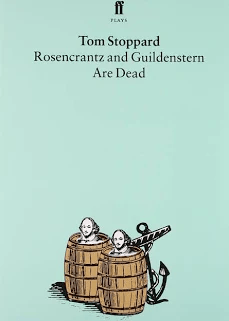
What is that I love about this play so much? First and foremost it’s the simple brilliance of the whole conceit. Telling the story of two minor characters who feature in Hamlet with not much more than walk-on parts, trying to understand their motivation, to explain how they come to betray their childhood friend, as well as providing a drama in its own right throws new light on Hamlet itself. We see key sections of the play in a totally fresh way. Take for example the scene where R&G are trying to work out why Hamlet is so out of sorts. In asking for their help Claudius says
“Something have you heard
Of Hamlet’s transformation, so call it,
Sith nor th’exterior nor inward man
Resembles that it was. What it should be,
More than his father’s death, that thus hath put him,
So much from th’understanding of himself,
I cannot dream of.”
R&G chew this over and come to the following conclusion:
ROS: “To sum up: your father, whom you love, dies, you are his heir, you come back to find that hardly was the corpse cold before his young brother popped on to his throne and into his sheets, thereby offending both legal and natural practice. Now, why exactly you behaving in this extraordinary manner?”
Hamlet is such an extraordinarily strong play that it can survive being carved apart like this and still emerge the stronger. You don’t need an intimate knowledge of Hamlet to appreciate R&G though. Some of the humour and in particular the clowning in the play is brilliantly, effortlessly, done.
“What’s the first thing you remember?”
“No, it’s no good, it’s gone.”
I haven’t indicated in the quote above who says what line because the confusion between the characters’ identities – which is Rosencrantz and which Guildenstern – is one of the many running gaps through the play, picking up on hints in the original text that this was Shakespeare’s intention. Of course the characters are differentiated – Rosencrantz is consistently the more stupid and innocent of the two – but their often muddled identities underlines the point that their lives are of such little value to Hamlet, to Claudius, and to Shakespeare.
The play obviously owes a debt to Waiting for Godot – two characters on an almost bare stage passing time waiting for something to happen. Beckett breaks the tension with the arrival of Pozzo and Lucky; Stoppard achieves the same effect with the larger scale arrival of the players. These are another set of characters with small (but critical) parts in Hamlet given expanded roles here. Stoppard speculates on the lives of itinerant players struggling through hard times and hints at their having to resort to prostitution. It’s never said explicitly but these scenes always make me think that Stoppard was commenting on Shakespeare’s life as a player prior to his writing taking off, especially during the plague years when the company would need to go on the road to stay in business. Stoppard sees this as a hard life, which no doubt it was. Despite these hardships the players retain a dignity and pride in their performances.
Between their brief appearances in the main play, off-stage as it were, Rosencrantz and Guildenstern find ways to pass the time. When the play opens they are playing heads or tail. Guildenstern tosses a coin; Rosencrantz wins if it is heads, which it is every time:
GUIL spins. ROS studies coin.
ROS: Heads.
(He picks it up and puts it in his money bag. The process is repeated.)
Heads.
(Again.)
ROS: Heads.
(Again.)
Heads.
(Again.)
Heads.
GUIL (flipping a coin): There is an art to the building up of suspense.
(This is one of many artful breaches of the fourth wall that greatly add to the humour of the play).
As the run of heads continues improbably into three figures, Rosencrantz is simply delighted with his run of good luck, but Guildenstern becomes increasingly troubled by the implications of what is happening. It becomes an existential threat to his existence and sense of self:
GUIL: It must be indicative of something, besides the redistribution of wealth. (He muses.) List of possible explanations. One: I’m willing it. Inside where nothing shows, I’m the essence of a man spinning double-headed coins, and betting against himself in private atonement for an unremembered past. (He spins a coin at ROS.)
ROS: Heads.
GUIL: Two: time has stopped dead, and a single experience of one coin being spun once has been repeated ninety times… (He flips a coin, looks at it, tosses it to ROS.) On the whole, doubtful. Three: divine intervention, that is to say, a good turn from above concerning him, cf. children of Israel, or retribution from above concerning me, cf. Lot’s wife. Four: a spectacular vindication of the principle that each individual coin spun individually (he spins one) is as likely to come down heads as tails and therefore should cause no surprise that each individual time it does. (It does. He tosses it to ROS.)
This scene is a tour de force of writing, a spectacular piece of craftsmanship which it must be a delight to perform. Stoppard is playing lightly with ideas of determinism and fate. This combination of light comedic touches with the discussion of philosophical ideas – why are we here, is there some force determining our fate or is the world just random? – is an incredibly difficult tightrope to walk, but Stoppard pulls it off with apparent ease.
“A weaker man might be moved to re-examine his faith, if in nothing else at least in the law of probability”
I recognise this has become more of an appreciation than a review, but this is a great play that remains fresh and vibrant. It doesn’t really need a ‘what happens’ review because the clue is in the title! Stoppard went on to write plays that were more successful and more critically lauded, but I don’t think he wrote anything better.

