Book review

A View from the Bridge, by Arthur Miller, 1955

A View from the Bridge is set in 1950s New York in an Italian-American neighbourhood. It is narrated by Alfieri, a lawyer, who opens the play by describing the violent history of the Italian/American community. He tells us that second-generation Italians are now more civilized and they use the law to resolve their disagreements. But there are exceptions, one of which is the story of the play.

Eddie Carbone, an Italian American dock worker, lives with his wife Beatrice and her orphaned niece Catherine in a small apartment in Brooklyn. Eddie is protective and fatherly towards Catherine, but it slowly becomes apparent that as she approaches her 18th birthday his feelings for her are becoming dangerously unfatherly, especially as his relationship with his wife is no longer sexual. Catherine is ready to start stretching her wings and step out from the protective shadow of Eddie. He objects to her taking a job and to the way she dresses, anything that would expose her to the attention of other men. Beatrice seems to be aware that Eddie’s feelings towards Catherine are no longer purely paternal and encourages her to take the job, as a step towards eventual freedom and independence.

One afternoon Eddie breaks the news that he has agreed to accommodate two of Beatrice’s cousins, Marco and Rodolpho, who have arrived in New York as illegal immigrants. Illegal immigration was strictly enforced at this period in American history, which tells us some things don’t change, and if discovered the cousins are almost certain to be deported. However, within the protective Italian American community they are still able to work. Life back home in Italy is poverty stricken and immigrating to America using a network of people smugglers is a common means of escape.

Rodolpho is the more flamboyant of the two brothers – Marco is more brooding. While Marco plans to eventually return to Italy, Rodolpho wants to forge a career as a singer. His tendency to break into song while working on the docks attracts the wrong type of comment. Difference is suspect, and Eddie thinks (and perhaps hopes) he might be gay. This suspicion only becomes an issue when Rodolpho and Catherine start dating. Put simply, Eddie is jealous. When his attempts to ‘lay down the law’ and break them up fail, Eddie seeks advice from Alfieri, hoping that the law will prevent Catherine and Rodolpho from marrying. Of course he has no proof that Rodolpho is gay and is just marrying Catherine for a passport. Alfieri tells him the only thing he can do is report Rodolpho and Marco as illegal aliens, but this advice is framed as something that is unthinkable in the context of the ethics of the community. Time passes and things deteriorate, with Eddie becoming frantic about the trajectory of Catherine and Rodolpho’s relationship. Desperate (and drunk) he tries to prove Rodolpho is gay by kissing him. He then goes back to Alfieri, claiming that the kiss and specifically Rodolpho’s reaction, proves he is gay. Alfieri repeats his advice – the law cannot help. Eddie then does something that is taboo – even more so than being gay or wanting to sleep with your step-daughter – he reports the brothers to immigration services. The officials arrest Marco and Rodolpho and while Eddie claims the arrest is a surprise he convinces no-one. He is treated as persona non grata by the community. Alfieri bails the brothers out of custody but as soon as he is released Marco confronts Eddie, a fight breaks out and tragedy ensues.

A View from the Bridge has an interesting production history. It was first staged in 1955 as a one-act play. After it was poorly received Miller revised and extended the play to two acts. This longer play was much more successful and is the version most often performed today and is the one I read. The play’s origins go back to 1947. Miller was researching a screenplay in an area of New York near the docks. That screenplay eventually became ‘The Hook,’ which was based on a true story about corruption in the longshoremen’s union. Miller asked his friend Elia Kazan to direct the film, but when they tried to get funding for the shoot Columbia Pictures insisted in changes to the screenplay, in particular that the focus be changed from corrupt union leaders to Communists. Miller refused and the film was never made. Fast forward a few years and Kazan was making ‘On the Waterfront’, which is very closely based on ‘The Hook’. Kazan had testified before the House Committee on UnAmerican Activities naming several of his former friends and fellow Communists, leading to them being blacklisted and struggling for years to find work in America – some had to go to the extreme of moving to the UK to work in cinema and theatre. Miller had been called before HUAC but had pleaded ‘the fifth’ i.e. refused to testify. ‘On the Waterfront’ was an attempt to excuse Kazan’s betrayal of his friends. In this Hollywood version of McCarthyism, those who betray their friends are the heroes. A View from the Bridge is Miller’s dramatic response to that argument. Betraying your friends is not heroic – but neither is it a simple case of villainy. Miller seems to be arguing that those who betray their families and friends are obviously in the wrong, but that their motivations can be complex and in some ways understandable. The play is obviously much more than a simple response to McCarthyism, but this context does inform any reading of the play. And of course the drama has much more significant contemporary resonance, with the issues of deportation and what it means to be American once more front and centre of the political stage. Any modern production that does not have the immigration officers dressed as ICE thugs would be missing a dramatic open goal.

A View from the Bridge, by Arthur Miller, 1955

Aside
Book review

I’ve read some obscure books over the last few years, but N F Simpson’s A Resounding Tinkle, is up there! The play is a striking example of English Absurdism. This was always a bit of a niche genre and reading ART you can see why.

The Theatre of the Absurd was a relatively short-lived genre widely thought to have been inspired by Albert Camus’s description of the human condition as absurd and devoid of purpose. Firmly rooted in the post-war period as humanity recovered from the horrors of the Holocaust, absurdism was expressed on stage by plays devoid of the structures of traditional theatre. There is little dramatic conventional action – the characters find things to do, but they are invariably pointless. These plays have little that could be described as a plot. Language breaks down, is disjointed, and revolves around repetition, misunderstandings and a focus on trivialities. Through this fractured dialogue, broken by occasional bursts of eloquence, the characters express their psychological distress. The plays also often use comedic routines and traditions from vaudeville, and music hall.

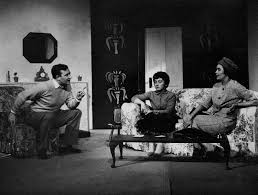
I think it would be fair to argue that there is no grand absurdist tradition in English drama – the genre quickly evolved more complex forms and moved away from its origins. Which is why A Resounding Tinkle is an important text, albeit a very obscure one – it perfectly encapsulates these absurdist conventions. There is not even the semblance of a plot. Characters repeatedly break the fourth wall addressing the audience directly. At the end of the play a group of critics sit around discussing the performance they have just seen, anticipating the audience’s bemused reaction, followed by closing comments by ‘the author’. Two characters, Mr and Mrs Paradock, discuss the elephant they have been given as part of an annual celebration of some kind, and in the end exchange it with their neighbours for a very small snake in a pencil box. This scene would not have been out of place in a Monty Python sketch – and it could be argued that the absurdist genre in English theatre was quickly redirected into comedy having itself been influenced by the loosely structured surrealism of shows such as The Goons.

Perhaps not surprisingly, A Resounding Tinkle is rarely performed today. It is very much of its time, and I can imagine on stage it would appear dated. But the absurdist tradition has never really gone away, and lines such as “You remind me of a cormorant with a beak a yard long tapping out a manifesto to the cosmos on a second-hand typewriter” are reminiscent of the work of Vic Reeves and Bob Mortimer. Perhaps a revival is overdue?

A Resounding Tinkle (play) by N F Simpson, 1957

Aside
Book review

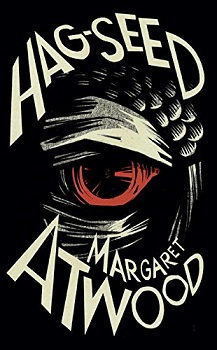
Hag-Seed, by Margaret Atwood, 2013

Hag-Seed was part of the Hogarth Press’s ambitious project to commission authors to rewrite and reimagine Shakespeare’s plays as novels. It was an interesting project that Hogarth planned to coincide with the four-hundredth anniversary of Shakespeare’s death. But it does mean that Atwood was commissioned to write the book. It’s not a labour of love or a story she felt compelled to tell. When artists are commissioned to paint a portrait nobody thinks this sullies the purity of their creativity, but when authors take on a similar project there is a slight whiff of commercialism that leaves a bad taste and a lingering thought that the author might not be fully committed to the project. Would Atwood have written this novel if there wasn’t the promise of a cheque at the end of it? Was she at her best, or just getting the project done?

Briefly, Hag-Seed is a retelling of The Tempest. Felix Phillips, a theatre producer, is working on a production of The Tempest as part of the Makeshiweg Theatre festival, when he is unexpectedly sacked and replaced by Tony Price, his assistant. He disappears from public view in a form of exile, living in a secluded shack miles from anywhere. Felix lost his daughter when she was three, and to keep her memory alive he imagines she is with him in his shack, keeping him company.

After several years he secures a teaching position at the Fletcher County Correctional Institute as part of a literacy programme. His work proves an unexpected success. Four years into the programme, having successfully produced Macbeth, Richard the Third and Julius Caesar, Felix ambitiously decides to stage The Tempest. Fortune casts an opportunity for revenge in his way – Tony is now a politician and plans to visit the prison to see the literacy programme in action, totally unaware of Felix’s involvement. The novel climaxes in a chaotic performance of the play with Felix being restored to his former position

There are multiple versions of The Tempest in this novel. Attwood provides a synopsis of the original play at the end of the text – to be honest, if it were needed it would have been better placed at the beginning. There is then the production Felix is working on when he is deposed from his role as artistic director of the Makeshiweg theatre festival by his assistant, Tony. Attwood mocks modernist staging of the play in which “Ariel, he’d decided, would be played by a transvestite on stilts who’d transform into a giant firefly at significant moments. His Caliban would be a scabby street person – black or maybe Native – and a paraplegic as well, pushing himself around the stage on an oversized skateboard.”

The third version of the play is the one Felix inhabits – his story closely follows the plot of the play. In this version Felix is Prospero, deposed Duke of Milan, (Felix applies for this teaching position using the name Mr Duke) his daughter is both Miranda and Ariel, and other roles are filled by his friends, associates and acquaintances. Attwood doesn’t follow the plot of the play mechanically – there isn’t an exact correspondence between Felix’s life and the events of the play – but there is a broadly similar story arc. Caliban is one of the most interesting characters in the Tempest, but he is the one character who does not have a clear equivalent in the novel. Aspects of his role are taken by the prisoners, but they are perfect inmates who engage in the dramatic process, learn their lines, obey Felix’s rule about only swearing using curses found in the play (not something you would get professional actors to comply with I suspect!) and never once threatening any form of rebellion or misbehaviour.

A fourth version of the play is performed by the inmates of the Fletcher County Correctional Institute who participate in the literacy programme. In fact the inmates put on two versions of the play – one which is recorded and broadcast throughout the prison and another ‘immersive experience’ version (the fifth) acted out while everyone is watching the video of the first (or is it the fourth?) version.

The initial ending of the novel falls a little flat. Felix’s cunning plan to get his old job back succeeds flawlessly. End of story. No possible recriminations or attempts at revenge from the powerful people that he has crossed and bested. Attwood then uses an interesting theatrical device to give the reader an improved, secondary ending. The inmate players are invited to present their ideas about what happens to the play’s characters (and by inference the lives of their equivalents in Felix’s world) after the play ends. They come up with some really imaginative ideas that I thought showed Attwood finally breaking free from the constraints of the structure she has imposed on herself.

Hag-Seed, by Margaret Atwood, 2013

Aside